If you’re eyeing a Mercedes EQS or EQS SUV, especially on the used market, you’ll quickly run into headlines about recalls. A “Mercedes EQS recalls list” can look intimidating, but with EVs (and software-heavy luxury cars in general) recalls are closer to software patches than doom bells. The key is knowing which recalls matter, how they were fixed, and whether a specific car you’re considering has had the work done.
Good news before we get into the bad
Overview: How worried should you be about Mercedes EQS recalls?
What’s on the EQS record so far
The EQS launched for the 2022 model year, and like most new-from-scratch EV platforms, it has seen a cluster of early recalls. These skew toward software and electrical issues rather than fundamental chassis or crash-structure problems.
- 2022: Launch-year glitches like the eCall emergency call system not working correctly.
- 2023–2025: Broader electrical/fuse issues that also affect other Mercedes models.
- Ongoing: Small batches of vehicles periodically recalled as Mercedes tightens up quality.
Should recalls scare off a used buyer?
Not automatically. A luxury EV like the EQS is more akin to a smartphone on wheels than a 1990s E-Class. That means Mercedes will keep chasing bugs, issuing recalls and service campaigns as they go. The real question for you is:
- Has this specific car had all its recall work completed?
- Were the repairs documented and done at an authorized dealer?
- Are there patterns of repeated problems (for example, multiple electrical failures) in the car’s history report?
That’s where a structured recall check and a thorough battery/health inspection become non‑negotiable if you’re buying used.
Mercedes EQS recalls in context
Recall ≠ warranty
Quick Mercedes EQS recalls list by year
Here’s a high-level Mercedes EQS recalls list focused on U.S. market vehicles. Exact recall IDs and populations live on NHTSA’s site and Mercedes’ own recall lookup, but this snapshot will help you understand the themes and what to ask about when you’re looking at a specific car.
Mercedes EQS recalls overview (U.S. focus)
Approximate recall themes for EQS sedans and SUVs by model year. Always confirm individual recall IDs with a VIN check.
| Model year | EQS variants typically affected | Main recall themes | Typical remedy |
|---|---|---|---|
| 2022 | EQS 450, EQS 450+, EQS 580 (sedan) | eCall emergency call system software glitch; potential communication module failure; scattered early electrical fixes | Software update (over-the-air or at dealer); control module reflash. |
| 2023 | EQS 450, EQS 450+, EQS 580, AMG EQS; early EQS SUV trims | Broader electrical issues tied to improperly manufactured high‑amp fuses and fuse boxes shared with EQE and other models; risk of sudden power loss or non‑functioning safety systems. | Inspection and replacement of fuses or entire fuse box; software updates where needed. |
| 2024 | Carryover EQS sedan and EQS SUV | Follow‑up campaigns to verify correct fuse boxes were installed under earlier recalls; clean‑up of electrical and software edge cases. | Re‑inspection of prior repair work; replacement of incorrect parts; updated software if applicable. |
| 2025+ | Later EQS SUV examples, AMG variants | Small‑volume, VIN‑specific campaigns typical of a maturing model: module software updates, component checks, and supplier clean‑up actions. | Targeted inspections and updates at dealer; sometimes handled during regular service. |
This table is for orientation only; individual vehicles may be affected by more (or fewer) recalls depending on build date and options.
Where the fuse recalls fit in
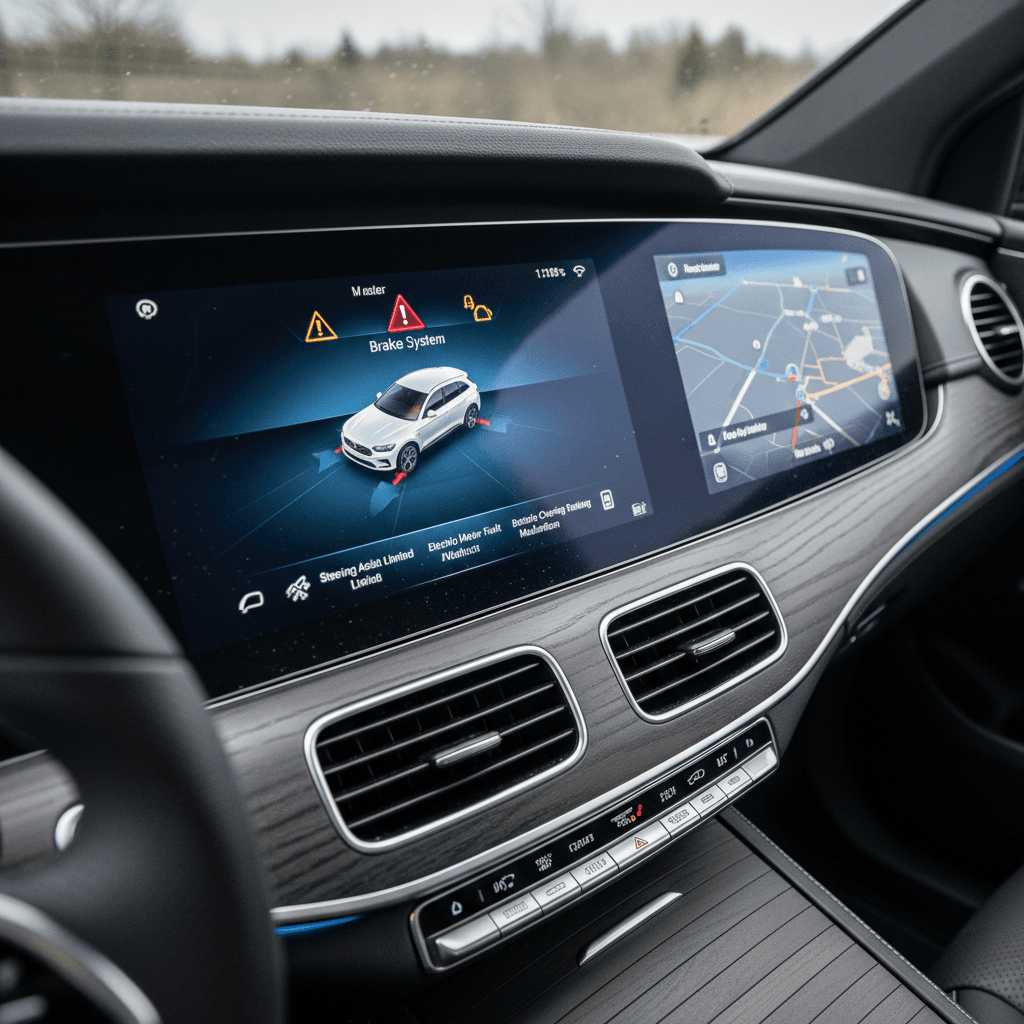
Spotlight on the major EQS recalls
Key Mercedes EQS recall campaigns explained
What they fix, what the risks are, and what to confirm on a used car.
eCall / emergency call failure (2022)
What it is: On some early 2022 EQS sedans, the built‑in eCall system, the automatic SOS function that dials emergency services after a serious crash, might not initiate correctly because of a software problem in the communication module.
Why it matters: In a worst‑case crash, emergency responders might not be contacted automatically, which can delay help if occupants are unable to call.
What to ask: Has the eCall recall been completed? The remedy is a communication module software update, sometimes delivered over the air. A dealer can confirm completion by VIN.
High‑amp fuse / fuse box issues (2023–2024)
What it is: Certain 2023–2024 EQS and AMG EQS models were swept into a wider Mercedes campaign where an 80‑amp or similar high‑current fuse and associated fuse box could be out‑of‑spec or incorrectly replaced during an earlier recall.
Why it matters: A defective fuse or wrong fuse box can lead to loss of propulsion, dark instrument clusters, non‑functional restraint systems, and, if a short occurs, an increased risk of fire.
What to ask: Has the vehicle had both the original electrical recall and any follow‑up campaign completed? Make sure the dealer can show paperwork that the correct, updated fuse box is installed.
Software and control module updates
What it is: Throughout 2022–2025, the EQS has been part of smaller software‑related campaigns, think control units that might reboot unexpectedly, or modules that don’t behave correctly in rare scenarios.
Why it matters: These issues are less dramatic than a battery fire, but they’re exactly the kind of thing that can strand you with a luxury EV that decides not to boot.
What to ask: Is the car on the latest software level for infotainment, driver‑assist and battery management? A good dealer will perform all outstanding updates during pre‑sale prep.
What about EQS battery fire recalls?
How to check if a specific Mercedes EQS has open recalls
The single most important step is to run the VIN, not just glance at a Carfax summary. In the U.S., recall checks are free and take seconds if you know where to look.
Step‑by‑step: EQS recall check before you buy
1. Get the full 17‑digit VIN
Ask the seller or dealer for the EQS’s complete VIN. For a remote purchase, you can usually see it in listing photos (lower windshield) or the window sticker. Don’t settle for "last 6 digits" when you’re checking recalls.
2. Use the official NHTSA recall lookup
Go to the NHTSA recall lookup site and enter the VIN. You’ll see all <strong>open safety recalls</strong> that haven’t been completed yet. If the site shows an open campaign, that repair still needs to be done, ideally before money changes hands.
3. Cross‑check on Mercedes’ own site
Mercedes-Benz also hosts a recall/VIN lookup on its U.S. website. Use it as a cross‑check; occasionally, manufacturer systems will show service campaigns or technical updates that don’t appear as federal safety recalls.
4. Ask for dealer repair history
If the car’s been serviced at a Mercedes dealer, they can print a <strong>warranty and recall history</strong> that shows when each campaign was completed. On a used EQS, this is as important as the standard maintenance records.
5. Confirm timing and mileage of recall work
Look at the dates and odometer readings when recalls were performed. A car that had a major electrical repair 2,000 miles ago and has been trouble‑free since is more reassuring than one that’s bounced back for repeat fixes.
6. Make recall completion a condition of sale
If the EQS you love still has an open campaign, you can reasonably insist the seller <strong>gets the recall done before you sign</strong>. There’s no cost to them, just scheduling time at a dealer.
Pro move for online shoppers
Recalls vs common EQS issues: what’s covered, what isn’t
A recall only exists when a defect affects safety or legal compliance. But the EQS is a very complex car, and owners have reported other frustrations that don’t show up in a formal Mercedes EQS recalls list, everything from sensor gremlins to infotainment freezes. Understanding that gap can save you from expensive surprises.
What safety recalls typically cover
- Loss of propulsion or power steering due to defective electrical components.
- Airbag, seatbelt, or crash‑notification failures (eCall, front sensors, control modules).
- Battery or charging defects that create a fire risk or shock hazard.
- Serious visibility problems, for example, a design flaw that can cause total instrument‑cluster blackout.
These are the issues that force Mercedes to notify NHTSA, mail letters to owners, and repair every affected car for free.
What recalls usually don’t cover
- Annoying but non‑dangerous software bugs (sluggish screens, random reboots).
- Wear‑and‑tear items: tires, brake pads, suspension bushings.
- General "deficiency in service" complaints, like repeated visits for the same non‑safety fault.
- Range loss or capacity fade from normal battery aging.
Those may still be grounds for warranty claims or negotiations with a dealer, but they won’t appear under the federal recall umbrella.
That high‑profile EQS court case
Shopping for a used Mercedes EQS after these recalls
Buying a used EQS is like adopting a retired private jet: the acquisition is easy; the homework is where you earn your sleep at night. Recalls are one piece of that homework, sitting alongside battery health, service history, and how the car was driven and charged.
Used EQS due‑diligence checklist
Layer these checks on top of a clean recall history.
Battery health & fast‑charge history
Your biggest single risk in any used EV is the high‑voltage battery. Ask for a battery health report that shows remaining capacity, balance between cells, and any history of thermal or charging faults.
If the EQS spent its life as an airport‑fast‑charger warrior, you want to know that before you pay S‑Class money.
Warranty and service coverage
Confirm how much factory warranty remains on the battery, electric drive and general vehicle. Mercedes’ EV battery warranty runs long in years and miles, but that doesn’t mean every nuisance is covered.
Extended service contracts for complex EVs can be worth considering, especially on early‑build EQS models.
Service records & owner behavior
Look for regular dealer visits, not just oil‑change‑style quick lube shops. EVs don’t need oil, but software updates, TSBs and inspections usually only happen at the dealer.
Multiple visits for similar electrical complaints may hint at a problem child, even if recalls are all marked "completed."
Be wary of "discontinued" or heavily discounted EQS models
How Recharged helps you de-risk a used Mercedes EQS
Luxury EVs reward the meticulous and punish the romantic. At Recharged, the entire business is built around removing as much of that risk as possible when you consider a used EQS, EQS SUV, or any other high‑end EV.
What you get with a Recharged EQS
Beyond a simple Carfax and a handshake.
Recharged Score battery & health diagnostics
Every vehicle we sell comes with a Recharged Score Report that includes verified battery health, charging behavior analysis, and system diagnostics. On an EQS, that means looking for cell imbalances, error codes from battery management modules, and signs of abuse.
You don’t have to guess whether the pack is healthy, we show you the data.
Recall & service-history verification
We check each car against manufacturer and NHTSA recall databases and verify completion of any safety campaigns as part of our intake process. If an open recall exists, it’s addressed before the car is listed, not left as your problem to solve.
Our EV‑specialist team is also available to walk you through exactly what was done and why it matters.
Financing, trade‑in, and fair pricing
Because we live in the used‑EV world, our pricing for EQS models reflects real‑world demand, battery condition, and recall history, not just auction averages.
You can finance, trade‑in, or get an instant offer fully online, with transparent numbers that factor in the long‑term costs of luxury EV ownership.
Nationwide delivery & Richmond, VA Experience Center
Found the right EQS but live three states away? We offer nationwide delivery, plus an in‑person Experience Center in Richmond, VA where you can see, touch, and test‑drive select vehicles.
Either way, the goal is the same: make used EV ownership simple and transparent.
Ready to find your next EV?
Browse VehiclesMercedes EQS recalls FAQ
Frequently asked questions about Mercedes EQS recalls
Bottom line: Should EQS recalls stop you from buying?
Recalls on the Mercedes EQS are less a scandal than a symptom of the times: a large, very complicated electric flagship feeling its way through early production years. The issues have been real, especially around electrical hardware and the eCall system, but they’ve also been identifiable, fixable, and free to repair when handled through Mercedes’ recall network.
If you’re shopping used, what matters is not that an EQS has ever been recalled, but whether the specific car in front of you shows a clean, well‑documented repair and battery‑health story. Combine a proper VIN recall check, service‑history review, and deep battery diagnostics, and the EQS can still be a compelling way to experience top‑shelf Mercedes comfort without paying new‑car money.
And if you’d rather not juggle NHTSA printouts, dealer invoices and SOC charts on your own, that’s exactly what Recharged is built for: transparent used EVs with recall status, fair market pricing, and verified battery health baked in from the start.