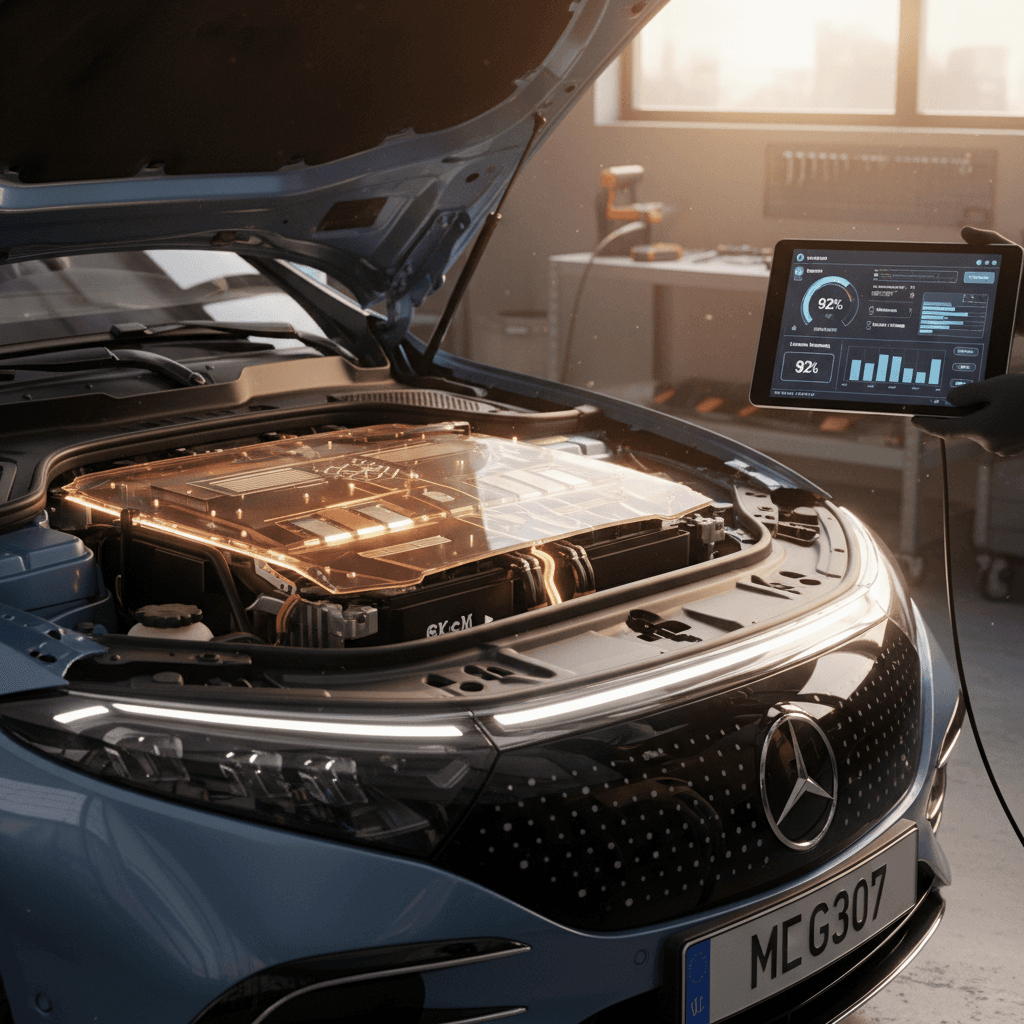
When you’re spending six figures on a luxury EV, you’re not just buying leather and ambient lighting. You’re buying a battery. So it’s natural to ask: how long does a Mercedes EQS battery really last, and what does that mean for you today, or five owners from now?
Quick answer
Mercedes EQS battery lifespan at a glance
EQS battery life by the numbers (estimates)
Those numbers aren’t marketing fluff, they’re based on how large, liquid‑cooled EV battery packs behave in the real world. While we don’t yet have 15‑year‑old EQS models to point to, we do have a decade of data from earlier Mercedes and competitor EVs, and the EQS uses newer, more robust chemistry and thermal management.
Lifespan vs. usability
What kind of battery does the Mercedes EQS use?
To understand EQS battery lifespan, you need to know what’s under the floor. The Mercedes EQS uses a large, lithium‑ion high‑voltage pack mounted in the vehicle’s floor, with energy capacity typically in the 90–120 kWh range depending on model and year. That big capacity is a secret weapon for longevity: the more kWh you start with, the less you’ll feel each percentage of capacity loss in daily use.
- Lithium‑ion chemistry designed for long cycle life rather than maximum power output alone.
- Sophisticated liquid cooling and heating to keep cells in their ideal temperature window.
- A structural battery enclosure mounted in the floor for crash protection and stiffness.
- High‑voltage contactors and power electronics tuned for efficiency and thermal control.
Mercedes also leans heavily on software to protect the pack. The EQS doesn’t usually allow you to access 100% of the physical capacity. Instead, there’s a buffer at the top and bottom of the pack that you never use. That means “100%” on your gauge is a little less than 100% of the cells’ real capacity, an intentional choice to slow degradation over the life of the car.
How fast does a Mercedes EQS battery degrade?
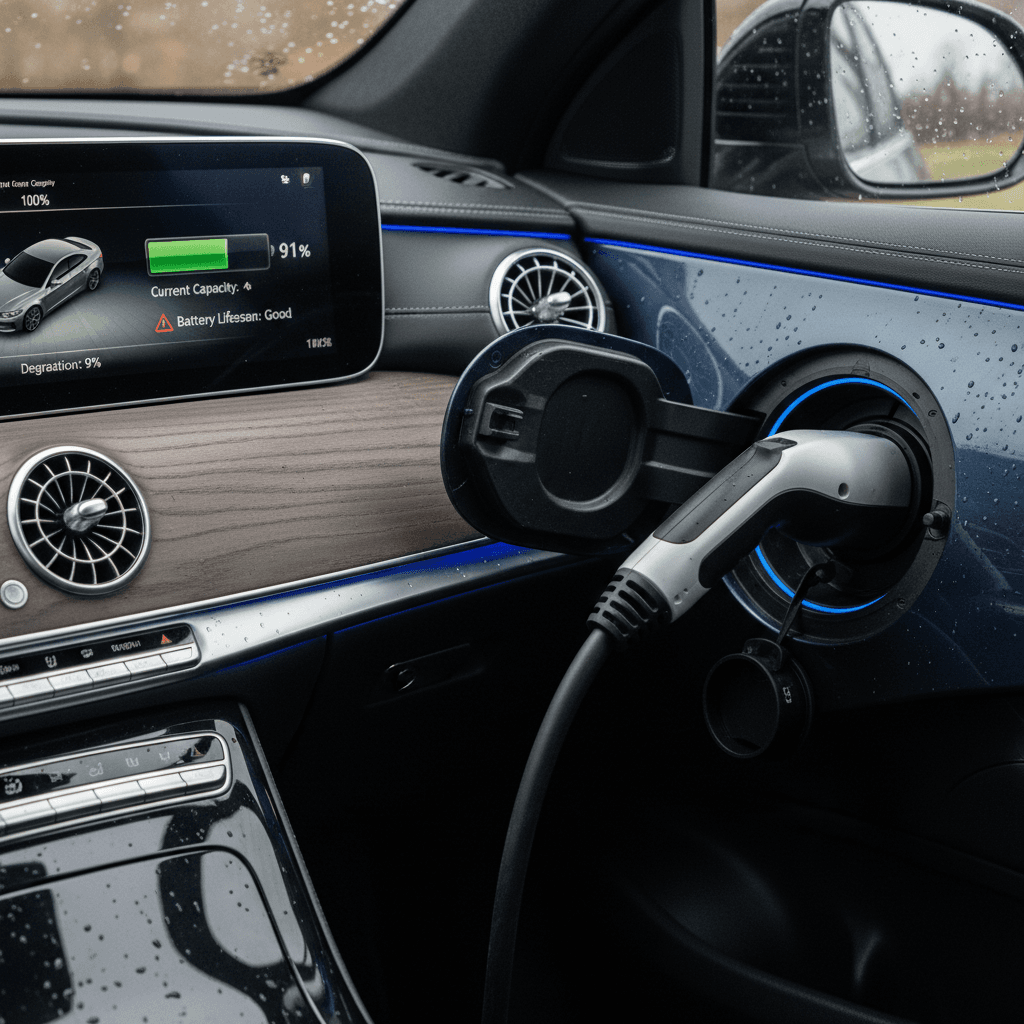
All lithium‑ion batteries degrade. The real question for an EQS owner is: how quickly does range drop, and when will it matter? Based on broader EV data and early EQS experience, here’s a reasonable expectation curve, assuming normal use and maintenance:
Typical Mercedes EQS battery degradation curve (estimate)
Approximate capacity retention over time for a well‑maintained EQS driven 10,000–15,000 miles per year.
| Vehicle Age | Estimated Remaining Capacity | Real‑world Impact |
|---|---|---|
| Year 1–3 | 92–98% | Range drop is small, often hard to notice day to day. |
| Year 4–6 | 88–94% | You might see 10–20 fewer miles of real‑world range vs. new. |
| Year 7–10 | 80–90% | Range loss becomes more noticeable, but still workable for most commutes. |
| Year 10+ | 70–85% | Perfectly usable for many drivers; road‑trippers may feel the pinch. |
These are generalized estimates based on EV battery behavior, not a Mercedes guarantee. Your results can vary with climate, driving style, and charging habits.
Why EQS batteries age more gracefully
7 factors that shorten or extend EQS battery life
What really determines how long your EQS battery lasts
The badge on the hood matters less than what you do with the car.
1. Extreme temperatures
2. Fast‑charging habits
3. State‑of‑charge extremes
4. Annual mileage
5. Vehicle load & towing
6. Driving style
7. Storage habits
Daily target range
Mercedes EQS battery warranty: what’s actually covered
Mercedes knows the battery is the heart of the EQS, so the warranty is built accordingly. While details can vary by model year and region, the high‑voltage battery coverage for EQS in the U.S. generally looks like this:
- High‑voltage battery warranty of up to 10 years or around 155,000 miles (whichever comes first) on many EQS variants, from original in‑service date.
- Coverage against defects in materials or workmanship in the battery and related high‑voltage components.
- Capacity retention guarantee: if the battery falls below a specified percentage of original usable capacity within the warranty period, Mercedes may repair or replace it under warranty. The exact threshold is model‑ and market‑specific, so always check your paperwork.
Read the fine print
Buying new
If you’re buying or leasing a new EQS, you’re covered from day one. The clock starts at the first in‑service date, not the model year, and the odometer and calendar both matter.
Plan to keep the car long‑term? That 8–10 year battery warranty essentially backs the pack for the first half (or more) of its likely life.
Buying used
For a used EQS, find out exactly when the car was first sold. A 2022 EQS first registered in late 2021 has had the battery‑warranty clock ticking longer than a 2022 model delivered in mid‑2023.
At Recharged, every EQS listing includes a Recharged Score battery health report, so you’re not guessing about how much life is left.
EQS battery replacement costs and alternatives
Batteries do fail early sometimes, but it’s rare. More often, owners start asking about replacement when degradation finally collides with their lifestyle. Maybe the car no longer makes a favorite road trip on one charge. So what happens then, and what can it cost?
Options when your EQS battery no longer fits your life
Possible paths if your EQS battery loses significant capacity beyond warranty coverage.
| Option | What it involves | Typical Cost Range* |
|---|---|---|
| Full battery replacement | Replacing the entire high‑voltage pack with a new or factory‑remanufactured unit. | $20,000+ (parts and labor) |
| Module‑level repair | Replacing only the faulty sections of the pack, if supported by Mercedes. | Lower than full pack; still a five‑figure job in many cases. |
| Sell or trade the vehicle | Move into a newer EV with a fresh battery and better charging tech. | Cost is effectively the difference to your next vehicle. |
| Keep driving with reduced range | Adjust routes/charging habits to work around reduced range. | $0, but may change how you use the car. |
Costs vary widely by dealer, region, and whether Mercedes offers remanufactured packs or module‑level repairs at that time.
Don’t plan on paying cash for a pack
If you’re buying a used EQS and worried about getting stuck with a tired battery, focus less on theoretical replacement cost and more on verified health today. That’s where third‑party diagnostics and tools like the Recharged Score become critical when shopping used.
How to maximize your EQS battery lifespan
Practical habits that add years to your EQS battery
1. Use Level 2 as your default
Rely on home or workplace Level 2 charging for most top‑ups. Save high‑power DC fast charging for road trips or true emergencies.
2. Avoid living at 100%
Charge to 100% right before a long drive, but day to day, targeting 70–80% is kinder to the battery, especially if the car will sit for hours.
3. Don’t fear low state‑of‑charge, but don’t camp there
It’s fine to run down to 10–20% occasionally. Just avoid leaving the EQS parked at very low charge for days at a time.
4. Let the car manage temperature
Enable the EQS’s scheduled departure or pre‑conditioning features so the pack is at a healthy temperature when you start driving or fast‑charging.
5. Park in the shade or garage
Whenever possible, keep the car out of baking sun and extreme cold. The less often the pack has to fight temperature extremes, the better.
6. Keep software up to date
Mercedes can refine charging curves and thermal management via updates, which can subtly improve long‑term battery health and efficiency.
7. Drive smoothly
Hard launches are fun, but constant drag‑strip starts and 90‑mph cruising heat up the battery and drive train. Smooth driving is easier on everything.
The 80/20 rule of battery care
Buying a used EQS? How to check battery health
If you’re shopping used, “How long does an EQS battery last?” turns into a more pointed question: “How much life is left in this specific EQS?” Two cars built in the same year can have very different stories depending on how they were charged, driven, and stored.
What you can check yourself
- Displayed range at 100%: A healthy EQS should show numbers reasonably close to its original EPA rating in mild weather. Big gaps may signal capacity loss, or just cold temps and recent driving history.
- Charging history: Ask how the previous owner charged. Home Level 2 most of the time? Or DC fast chargers nearly every day?
- Climate and mileage: High‑miles sun‑belt commuter? Or low‑miles garage queen? Both can be fine, but they age batteries differently.
What requires real diagnostics
Modern EVs log detailed battery data, cell voltages, internal resistance, and capacity estimates, behind the scenes. Accessing and interpreting that data correctly is the hard part.
Every EV sold through Recharged comes with a Recharged Score Report that includes a verified battery‑health snapshot, fair market pricing, and expert support. That lets you compare a used EQS to other EVs with hard numbers, not guesswork.
Use battery health like a Carfax for the pack
EQS battery life vs. other luxury EVs
So is the Mercedes EQS better or worse than its peers when it comes to battery longevity? On paper, and increasingly in the real world, it’s right where you’d expect a flagship Mercedes to land: conservative, well‑engineered, and built for the long haul.
How EQS stacks up on battery life
Comparing high‑level battery characteristics among flagship luxury EVs.
Mercedes EQS
Tesla Model S
Lucid Air & others
The takeaway: the EQS doesn’t need to be an outlier to be a great long‑term bet. Modern luxury EVs share many of the same suppliers, chemistries, and engineering philosophies. Your individual usage patterns will almost always matter more than the logo on the grille.
Mercedes EQS battery lifespan FAQ
Frequently asked questions about EQS battery life
Bottom line: how long will a Mercedes EQS battery last?
If you’re wondering how long a Mercedes EQS battery lasts, the honest answer is: long enough that most owners will move on from the car for other reasons, tech, styling, lifestyle changes, before the pack becomes a brick. With sane charging habits and normal driving, you’re looking at a decade or more of useful life, backed by a long battery warranty and thoughtful engineering.
Where the story gets interesting is in the used market. As early EQS models change hands, battery health becomes the new mileage. That’s exactly where Recharged comes in: every EV we sell comes with a Recharged Score Report that makes battery health, fair pricing, and long‑term costs transparent. So whether you’re eyeing a garage‑fresh EQS or a well‑loved one with stories to tell, you can buy with confidence about the power source that matters most.