If you’re looking at a Mercedes EQE today, either to buy new, buy used, or sell your current car, the big question is simple: what will a Mercedes EQE be worth after 5 years? With EV depreciation running hotter than most gas cars, understanding 5‑year value is the difference between a smart deal and an expensive lesson.
Context: where we are in 2026
Mercedes EQE value after 5 years: the short version
Mercedes EQE resale snapshot (based on current data & forecasts)
You should expect a typical Mercedes EQE to lose roughly half of its value in the first 5 years, with most of the pain front‑loaded in the first 3. That’s broadly in line with recent nationwide studies showing that many EVs lose well over 50% of their value in 5 years, largely because their MSRP starts out higher than comparable gas models and incentives distort the new‑car side of the market.
Don’t over‑interpret a single number
How the Mercedes EQE has depreciated so far (real numbers)
Because the EQE is still a relatively new nameplate, we lean heavily on 1–3‑year market data to extrapolate 5‑year value. The picture is clear: like most luxury EVs, the EQE takes a big initial hit, then depreciation starts to calm down.
Early Mercedes EQE depreciation: what we’re seeing now
Approximate U.S. market figures as of early 2026, assuming typical mileage and mainstream trims (not AMG).
| Model year & age | Original MSRP (typical spec) | Current used price range | Approx. value kept |
|---|---|---|---|
| 2023 EQE sedan – ~3 years old in 2026 | $75,000 | $40,000–$50,000 | ≈55–65% of MSRP |
| 2023 EQE SUV – ~3 years old in 2026 | $80,000 | $42,000–$52,000 | ≈53–65% of MSRP |
| High‑option / AMG EQE (sedan or SUV) | $95,000+ | $50,000–$60,000 | ≈50–60% of MSRP |
These ranges are based on current listing and appraisal data, not guaranteed future values.
Third‑party pricing tools and real‑world listings show that a 2023 EQE has already shed $20,000–$30,000 in value within about three years, depending on equipment and mileage. Some owners have seen even steeper drops, especially on heavily discounted lease cars that are now coming off lease and re‑entering the market at aggressive prices.
How this compares to gas Mercedes models
Projecting Mercedes EQE value at 5 years old
No one can tell you exactly what any individual EQE will be worth in, say, 2030. But we can build reasonable 5‑year scenarios using what we know now about EQE pricing and 5‑year EV depreciation patterns across the market.
Three 5‑year value scenarios for a Mercedes EQE
Assuming 12,000 miles per year, no major accidents, and normal wear.
Scenario 1: Strong market, well‑kept EQE
Who this fits: Clean history, documented maintenance, healthy battery, desirable color/options.
- Original MSRP: ~$80,000
- 5‑year value: ~$40,000–$44,000
- Retained value: ≈50–55%
Think well‑specced EQE 350+ sedan or SUV with strong battery health reports.
Scenario 2: Typical real‑world EQE
Who this fits: Average miles, some cosmetic wear, standard options.
- Original MSRP: ~$80,000
- 5‑year value: ~$35,000–$40,000
- Retained value: ≈44–50%
This is where most 5‑year‑old EQEs will likely land if current trends hold.
Scenario 3: Hard‑used or less desirable spec
Who this fits: High mileage, weak service history, poor battery health, or oddball spec.
- Original MSRP: ~$80,000
- 5‑year value: ~$28,000–$34,000
- Retained value: ≈35–43%
Accidents, rough cosmetic condition, or visibly tired batteries drag values down fast.
These ranges put the EQE roughly in line with other luxury EVs that tend to lose 50% or more of their value by year five. The big swing factor is how much EV tech and incentives change in the meantime. A flood of heavily discounted new EVs, or aggressive lease support that dumps cheap used cars into the market, will always pressure 5‑year values.
What if you bought used instead of new?
What drives Mercedes EQE depreciation
The EQE isn’t depreciating in a vacuum. It’s riding the same waves that are tossing the EV market around: price cuts on new models, fast‑moving technology, and shifting incentives. For a 5‑year outlook, these are the big levers you need to understand.
- High initial MSRP and discounts. Mercedes priced the EQE ambitiously at launch, and real‑world discounts and lease support have been significant. When lots of new cars leave the showroom already $10k–$15k below MSRP, used values adjust accordingly.
- Rapid EV tech improvements. Range, charging speed, and software are improving quickly. Even if your EQE still drives beautifully, a buyer shopping a 5‑year‑old car next to a brand‑new, more advanced EV will expect a meaningful discount.
- Incentives and lease programs. Federal and state EV incentives, plus lease cash, effectively lower the real cost of new EQEs. Those programs can make new cars feel “too good a deal to pass up,” which caps what a 5‑year‑old car can reasonably command.
- Brand and segment. Luxury brands like Mercedes traditionally depreciate faster in dollars than mainstream brands because they start higher. The EQE is no exception, luxury EVs are among the most heavily discounted vehicles on the used market right now.
- Used‑EV buyer caution. Many shoppers are still learning EV ownership. Concerns about battery life, charging, and future tech put extra downward pressure on 5‑year values compared with familiar gas models.
“Luxury EVs combine the normal big‑car depreciation curve with a tech curve that still feels like smartphones. That’s why the first owner takes such a beating, and why the second owner often gets a bargain.”
Sedan vs. SUV EQE: which holds value better?
The EQE comes in two main flavors: the EQE sedan and the EQE SUV. In the U.S., shoppers have shifted heavily toward SUVs, so it’s reasonable to ask whether the EQE SUV will outperform the sedan in 5‑year value.
EQE sedan
- Lower, more traditional luxury‑sedan profile.
- Often slightly better range than the SUV version on the same battery.
- Smaller buyer pool in a crossover‑obsessed market.
- Current used prices already reflect solid discounts vs. MSRP.
5‑year value outlook: Expect the sedan to be the value leader on the buying side. You may pay less up front for the same tech, even if percentages are similar.
EQE SUV
- Body style most U.S. luxury shoppers prefer.
- Higher seating position and cargo flexibility.
- Typically higher MSRP and stronger lease incentive activity.
- Early data shows slightly stronger demand in the used market.
5‑year value outlook: In pure dollars, SUVs may cost a bit more to buy used. As a seller, you may see slightly stronger demand for a clean 5‑year‑old EQE SUV than for a sedan.
Bottom line: sedan vs. SUV value
How battery health affects 5‑year EQE value
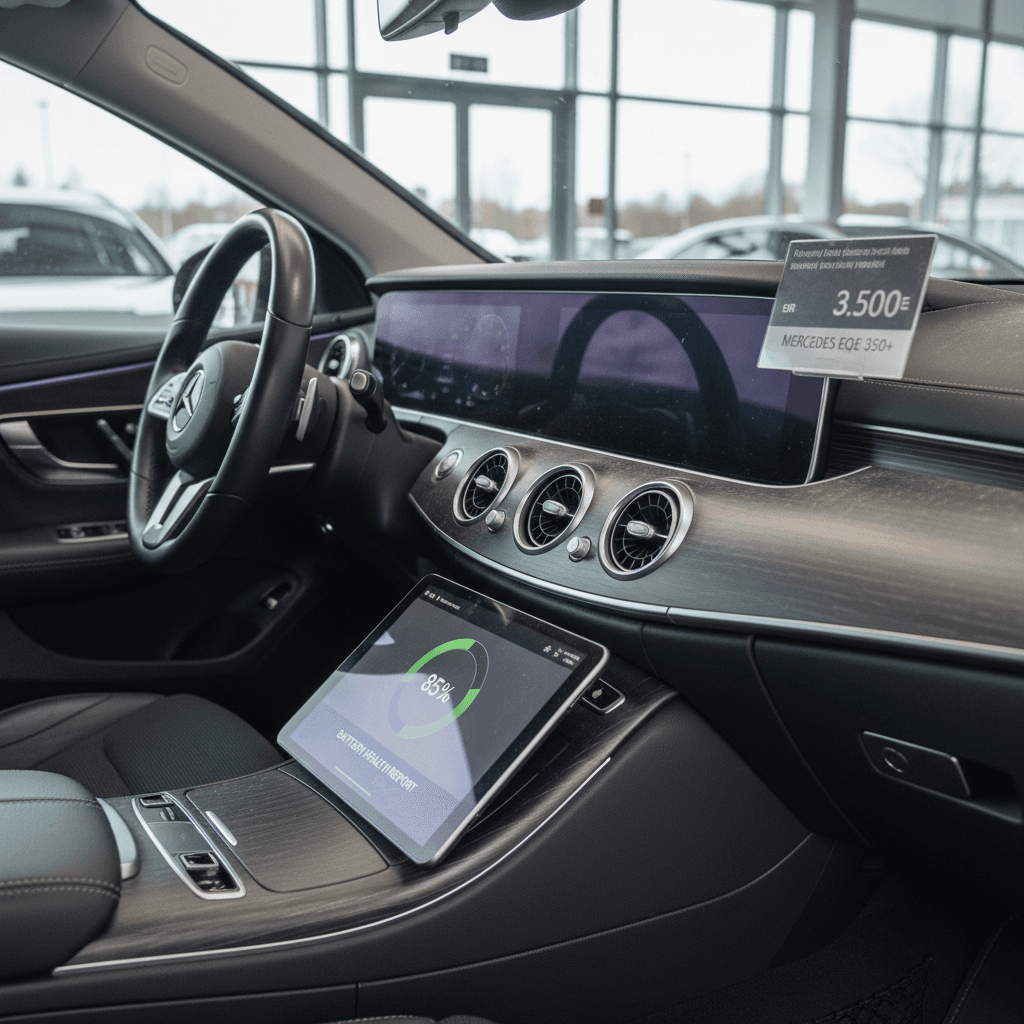
For any 5‑year‑old EV, battery health is value. Shoppers might not care what your EQE’s original window sticker looked like, but they absolutely care whether the pack still delivers the range and performance they expect.
- Range loss is visible. A 5‑year‑old EQE that has lost a noticeable chunk of range will immediately draw tougher questions from used buyers and from lenders setting residual assumptions.
- Fast‑charging history matters. Heavy DC fast‑charging, especially in hot climates, can accelerate battery wear. Cars that lived on Level 2 home charging typically show healthier packs at year five.
- Documentation is gold. Service records, on‑board data, and third‑party battery diagnostics can all help prove that an EQE’s pack is still in good shape, and justify the upper end of the price range.
- Warranties set the floor. Mercedes’ battery warranty gives buyers confidence there’s a safety net on severe degradation, but a car hovering close to warranty thresholds will still trade at a discount.
How Recharged’s battery data changes the story
7 ways to protect your Mercedes EQE resale value
You can’t control the entire EV market, but you can absolutely influence where your individual EQE lands inside those broad value ranges. Here are practical steps you can take over the first 5 years.
Action steps to keep your EQE’s 5‑year value strong
1. Keep miles reasonable
Staying close to 10,000–12,000 miles per year helps your EQE look “normal” in the used market. Pushing far beyond that quickly moves you into value‑car territory, especially on a luxury EV.
2. Favor Level 2 over fast charging
Use DC fast charging when you need it on trips, but rely on Level 2 at home or work the rest of the time. It’s easier on the pack and easier to document a gentle charging history later.
3. Stay on top of software and service
Apply software updates, follow Mercedes’ maintenance guidance, and keep invoices. A well‑maintained EV, especially with software up to date, feels newer to a used buyer than the odometer suggests.
4. Protect the interior and wheels
Luxury EV shoppers are picky. Curbed wheels, stained leather, or cracked glass can knock thousands off the top of your price. Fix the obvious cosmetic flaws before listing the car.
5. Avoid unusual modifications
Wraps, oversized wheels, or non‑factory lighting can turn off a large share of the EQE buyer pool. Stock or tasteful OEM‑plus mods make it easier to find a willing buyer at a good price.
6. Document your charging setup
If you have a quality Level 2 charger at home, keep the installation paperwork. Buyers like to see that the car was charged in a controlled environment, not just wherever a plug was handy.
7. Time your sale around incentives
If new‑car incentives on EQE or competing models suddenly spike, used prices often soften. When possible, list your EQE when new‑car deals are relatively modest, not during a clearance event.
Is a 5‑year‑old Mercedes EQE a good buy?
From a used‑car shopper’s perspective, a 5‑year‑old EQE can be a sweet spot. You’re letting someone else pay the expensive early‑years depreciation while you pick up a still‑modern EV at a price that looks more like a well‑equipped gas E‑Class.
Why a 5‑year‑old EQE makes sense
- Huge depreciation already baked in. If the car has already dropped 45–50% from MSRP, your next 3–5 years of ownership will generally be much cheaper in depreciation terms.
- Tech still competitive. The EQE’s range, charging capability, and cabin tech are likely to remain very usable at year five, especially if software has stayed up to date.
- Luxury feel at used‑car money. You’re getting a full‑size Mercedes EV experience for the price of many new mainstream crossovers.
What to watch out for
- Battery health variance. Two similar‑looking EQEs can have very different pack health depending on how they were used and charged.
- Out‑of‑warranty repairs. As the car ages, make sure you understand what’s still covered by Mercedes and what isn’t.
- Future‑proofing. Check charging standards and software support so your EQE will still fit your charging plans in 5–7 years.
Don’t skip a specialized EV inspection
How Recharged helps you buy or sell a used EQE
Whether you’re looking at your EQE and wondering what it’ll be worth at year five, or shopping for one that’s already there, having trustworthy data is everything. That’s where Recharged comes in.
What Recharged brings to the 5‑year EQE equation
Data, transparency, and an easier way to move into, or out of, a used Mercedes EQE.
Recharged Score battery health diagnostics
Every EQE listed on Recharged includes a Recharged Score Report with verified battery health, charging behavior insights, and key EV‑system checks. That helps buyers distinguish a strong 5‑year‑old EQE from one that just looks good in photos.
Fair market pricing & financing
Our pricing engine compares similar used EVs nationwide so your EQE is priced right from day one. You can also finance your purchase through Recharged, often with terms tailored to EVs and their unique depreciation curves.
Trade‑in, instant offer & delivery
Already own an EV or gas car? Use it as a trade‑in, request an instant offer, or consign it through Recharged. Then have your next EQE delivered nationwide, or visit our Experience Center in Richmond, VA if you prefer to see cars in person.
Ready to find your next EV?
Browse VehiclesPut simply, Recharged is built to make used‑EV ownership simpler and more transparent. With a model like the Mercedes EQE, where 5‑year value hinges on details like battery health and prior incentives, that transparency can save you real money.
Mercedes EQE 5‑year value: FAQ
Common questions about Mercedes EQE value after 5 years
The Mercedes EQE is a sophisticated, comfortable, and impressively capable EV, but like most luxury electric vehicles, it’s not shy about shedding value in its early years. If you understand that reality and plan around it, you can use depreciation to your advantage instead of becoming its victim. Buy strategically (often 2–3 years into the curve), keep your battery and records in good shape, and lean on EV‑specific data like the Recharged Score when it’s time to buy or sell. Do that, and a 5‑year‑old EQE can be one of the smarter luxury‑car buys on the road.