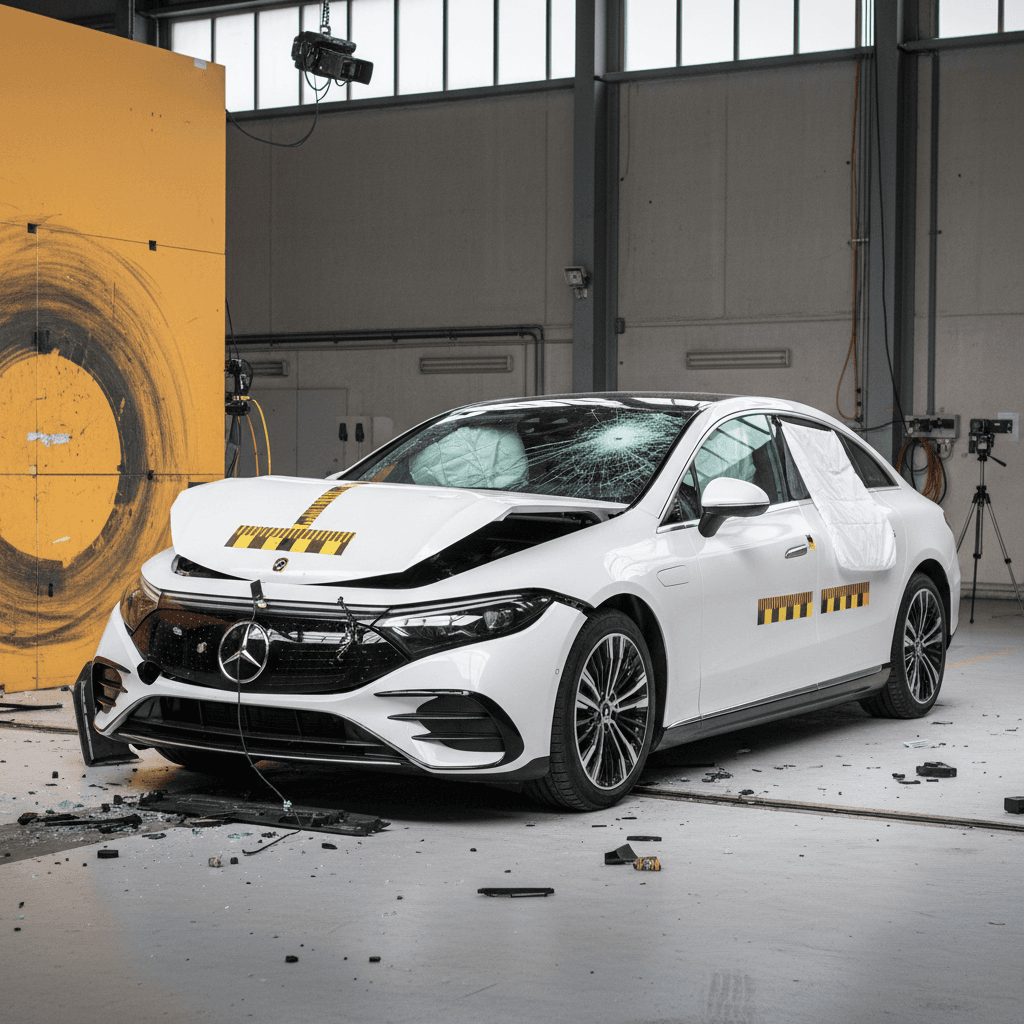
If you’re considering a Mercedes EQE sedan or EQE SUV, you’re probably wondering how it actually performs in independent crash tests. The good news: the Mercedes EQE safety rating and crash test results from Europe and Australia put it firmly in the top tier of premium electric vehicles. But as always with safety, the details matter, especially if you’re looking at a used EQE.
Key takeaway
Overview: Mercedes EQE safety ratings at a glance
Mercedes EQE crash-test scores (headline numbers)
From a crash-test standpoint, the EQE is very much a modern Mercedes: conservative in styling, but quietly obsessive about safety engineering. The EQE sedan earned five stars in Euro NCAP’s overall rating, and its driver-assistance suite was rated “very good” in Euro NCAP’s dedicated assistance-system assessment. The EQE SUV followed with its own five‑star Euro NCAP rating in 2023, with particularly strong child-occupant and safety-assist scores, and a matching 5‑star ANCAP score for the Australian and New Zealand markets.
Tip for North American shoppers
Crash test results: EQE sedan vs. EQE SUV
EQE sedan: Euro NCAP and ADAS testing
- Overall rating: 5 stars from Euro NCAP.
- Assistance systems: Rated “very good” in Euro NCAP’s dedicated highway-assistance evaluation, with particularly high scores for safety backup functions.
- Crash structure: Rigid passenger cell with extensive deformation zones tuned for EV packaging and a floor-mounted battery.
- Airbags: Multiple front, side, curtain and driver’s knee airbags; a center airbag helps prevent head contact between front occupants in side impacts.
EQE SUV: Euro NCAP & ANCAP crash tests
- Euro NCAP rating: 5 stars (tested 2023) with strong sub-scores: around the high‑80s for adult occupant protection, ~90% for child occupants, ~80% for vulnerable road users, and mid‑80s for safety assist.
- ANCAP rating: Separate 5‑star ANCAP rating for EQE SUV variants (excluding the AMG 53), valid through 2031.
- Standard safety spec: Dual frontal, side chest, side head (curtain), and driver knee airbags, plus a standard center airbag for side impacts.
Mercedes EQE sedan vs. EQE SUV: crash test highlights
How the two body styles compare on independent safety metrics.
| Metric | EQE Sedan (Euro NCAP) | EQE SUV (Euro NCAP) | EQE SUV (ANCAP) |
|---|---|---|---|
| Overall rating | 5 stars | 5 stars | 5 stars |
| Adult occupant protection | High 80s–90s (Mercedes internal data points to very strong performance) | ~87% | Similar to Euro NCAP |
| Child occupant protection | Strong (comparable to SUV) | ~90% | Strong, with good child-seat installation scores |
| Safety assist / ADAS | “Very good” highway assist, 100% safety backup in assistance test | ~85% | Advanced AEB, lane support and speed assistance standard |
| Vulnerable road user (pedestrian/cyclist) | Competitive for the segment | ~80% | Comparable to Euro NCAP SUV score |
Exact percentages can vary by protocol year; focus on the relative performance and feature coverage.
The sedan and SUV share the same underlying EVA2 platform and safety philosophy, so their crash-test results track closely. The SUV’s elevated seating position and family focus show up most clearly in its strong child-protection scores and ANCAP’s emphasis on its comprehensive airbag coverage and active-safety tech.
How the EQE performs in real-world crash scenarios
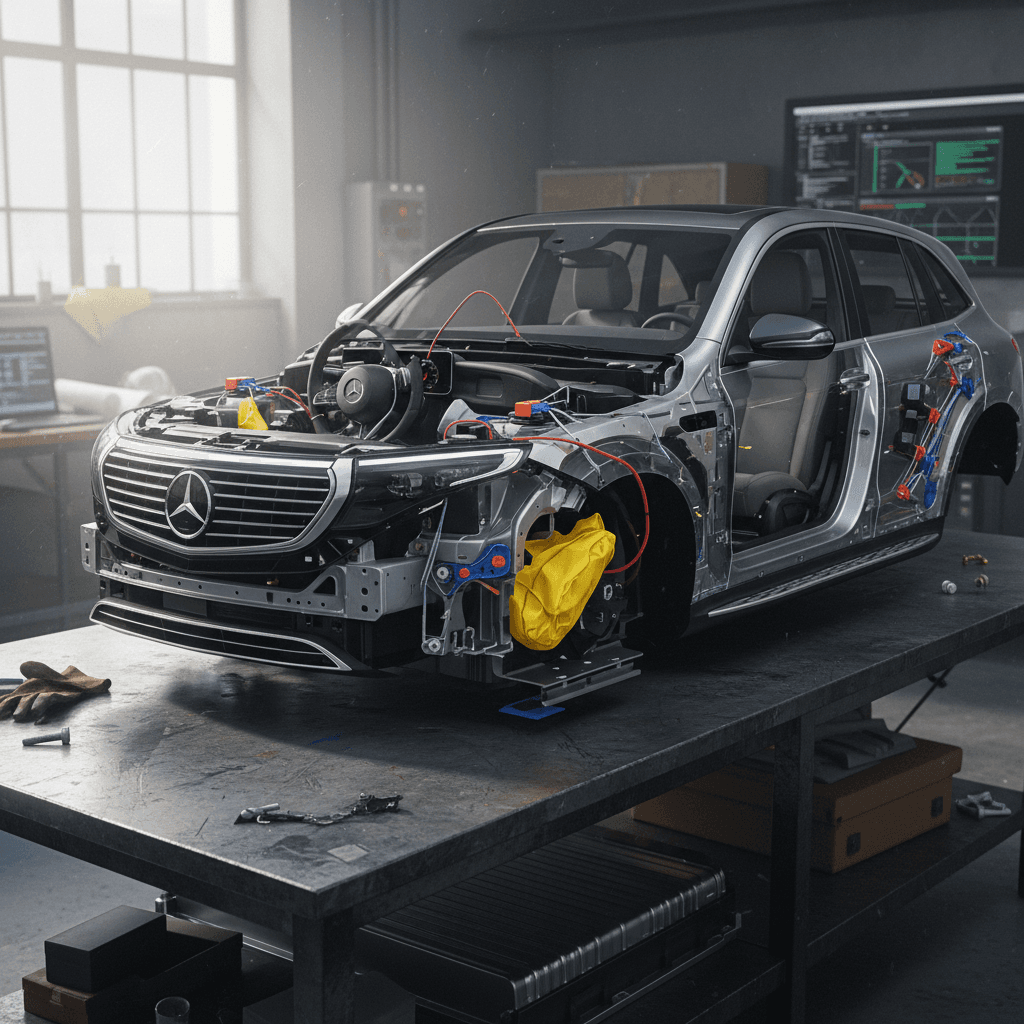
Crash tests are abstractions of messy real-world crashes, but they’re still our best comparable metric. Fold in Mercedes’ own accident data and what we know from similar EV architectures, and a clear pattern emerges: the EQE is engineered first and foremost to keep occupants inside a very stiff safety cell while letting the rest of the structure and hardware absorb impact energy.
Key crash scenarios the EQE is built around
How design decisions show up when things go wrong.
Frontal offset crashes
Most serious real-world crashes are offset frontal impacts. The EQE’s long front crash structure is designed to absorb these hits while keeping intrusion into the footwell low and pedal movement controlled, reducing lower-leg injuries.
Side impacts & poles
With a floor-mounted battery and reinforced sills, the EQE has strong side impact resistance. Curtain, side torso, and center airbags, plus the stiff battery enclosure, help protect occupants in both broadside and pole impacts.
Pedestrians & cyclists
Euro NCAP and ANCAP scores around 80% for vulnerable road users place the EQE near the top of its class. Active bonnet geometry and well-tuned automatic emergency braking (AEB) mitigate many lower-speed urban impacts.
Heavier EVs change the risk mix
Safety tech and ADAS in the Mercedes EQE
Crash structure gets you only part of the way; the rest is about avoiding crashes altogether. Here the EQE leans hard into Mercedes’ driver-assistance playbook. Even base trims include a suite of active safety features aimed at helping you avoid or at least mitigate collisions, especially at urban and highway speeds.
Core safety and driver-assistance systems in the EQE
Standard features will vary slightly by market and trim, but this is the typical toolkit.
Automatic emergency braking (AEB)
Forward collision warning with autonomous braking for vehicles, pedestrians and often cyclists. Many EQE configurations also support intersection and cross-traffic scenarios, which Euro NCAP and ANCAP explicitly test.
Lane keeping & lane centering
Lane keeping assist gently corrects you if you drift over a lane line, while optional lane centering on highways can actively keep the car in the middle of the lane when adaptive cruise control is active.
Adaptive cruise & stop-and-go
Radar-based adaptive cruise can handle dense traffic with stop‑and‑go capability. In Euro NCAP’s assistance test, the EQE scored particularly well for how it hands control back to the driver when conditions fall outside the system’s remit.
Blind-spot & rear cross-traffic
Blind-spot monitoring with steering intervention in some configurations, plus rear cross-traffic braking to help avoid collisions when reversing out of parking spaces.
360° cameras & parking assist
Surround-view cameras and active parking systems are common on higher trims, improving low-speed situational awareness in tight urban environments.
Highway assistance rated “very good”
Euro NCAP’s dedicated ADAS evaluation gave the EQE top-tier scores for driver engagement and safety backup. In plain English: it’s competent assistance designed to support an attentive driver, not replace one.
Spec check when shopping used
Recalls and known safety concerns
Even very safe vehicles can have recalls or software issues. The EQE family is no exception. None of the publicly known issues fundamentally change the strong crash-test performance, but they do matter when you’re evaluating overall risk and ownership experience, especially if you’re looking at 2023–2025 build years.
- AVAS (Acoustic Vehicle Alerting System) software: Certain 2022–2025 EQE and EQE SUV models in the U.S. were recalled because the external pedestrian warning sound while reversing could be incorrect or non-compliant with regulations. The fix is a dealer software update.
- High-voltage battery management software: Some 2024 EQE sedan and 2023–2025 EQE SUV variants were recalled for battery management software that could trigger an unnecessary high-voltage shutdown and sudden loss of drive power. Again, the remedy is a dealer software update.
- Steering coupling bolt torque: A smaller group of EQE vehicles built across several model years were recalled over a potentially loose steering coupling bolt that could, in the worst case, affect steering control if not corrected.
- Ongoing software updates: Beyond formal recalls, Mercedes has been iterating software for its MBUX infotainment and EV control systems. Some early owners have reported glitches or reduced-power warnings that were resolved with software revisions.
Don’t ignore recall notices
If you’re shopping used through a traditional dealer or private seller, build time into your process for a recall and software-status check. If you’re buying through a modern marketplace like Recharged, those checks are typically rolled into the Recharged Score and condition reporting so you’re not guessing about safety-critical updates.
Mercedes EQE vs. other premium EVs on safety
In the premium EV segment, it’s not enough to know whether a car earned five stars, you want to know how it stacks up against rivals that also cleared that bar. The EQE competes with vehicles like the Tesla Model S and Model Y, BMW i4 and iX, Audi Q8 e‑tron, and Polestar 3. Many of these also achieve strong ratings, but their strengths are distributed differently across passive crash protection and active safety technology.
How the Mercedes EQE compares to rival EVs on safety
High-level directional comparison for shoppers cross-shopping multiple premium EVs. Exact scores vary by model year and body style.
| Model | Overall rating (Euro NCAP / equivalent) | Active safety / ADAS emphasis | Notable strengths |
|---|---|---|---|
| Mercedes EQE (sedan/SUV) | 5 stars (Euro NCAP & ANCAP) | Strong focus on robust assistance with excellent safety backup | Balanced crash performance, dense airbag coverage, top-tier assistance scores |
| Tesla Model 3 / Model Y | 5 stars (Euro NCAP, NHTSA) | Heavy emphasis on camera-based automation; mixed independent ADAS scores historically | Very strong crash structure and occupant protection; software-first philosophy |
| BMW iX / i4 | 5 stars (Euro NCAP) | Comprehensive ADAS with conservative tuning | Strong passive protection and high active-safety coverage, particularly for pedestrians |
| Audi Q8 e‑tron | 5 stars (Euro NCAP) | Balanced ADAS with driver‑in‑the‑loop focus | High adult and child occupant scores; predictable handling and braking |
| Polestar 3 | 5 stars (anticipated based on platform peers) | Lidar and advanced sensors on some trims | Forward‑looking sensor suite, especially on higher-spec models |
Where multiple ratings exist, this table reflects typical results rather than a specific configuration.
How to read 5‑star vs. 5‑star
Buying a used Mercedes EQE: safety checklist
If you’re looking at a 2022–2025 EQE on the used market, you’re in a sweet spot: depreciation has done its work, but you’re still close enough to launch that factory support, software updates and parts availability are strong. That said, not every used EQE is created equal from a safety standpoint. Here’s a pragmatic checklist to work through before you sign anything.
Pre-purchase safety review for a used EQE sedan or EQE SUV
1. Verify crash-test coverage for your exact body style
Confirm whether you’re looking at the sedan or SUV and which test programs apply (Euro NCAP, ANCAP, and any domestic ratings in your market). For U.S. shoppers, remember that NHTSA and IIHS may not have tested every European-market variant yet.
2. Run a full recall & software update check
Use the VIN to check for open recalls, then ask for documentation that all campaigns have been completed. Also confirm that the vehicle has received the latest powertrain and ADAS software updates, these can address both safety and drivability issues.
3. Inspect airbags and seatbelts
Have a qualified technician confirm that all airbags and pre-tensioners are original or properly replaced, with no airbag warning lights. Check seatbelts for fraying or signs of crash damage, especially on ex-lease vehicles.
4. Evaluate ADAS functionality on a test drive
On a calm road, test adaptive cruise, lane keeping, blind-spot alerts and AEB behavior where it’s safe to do so. You’re not trying to trick the systems, just making sure they behave consistently and don’t show random error messages.
5. Look for structural or battery repairs
Any EV that has taken a serious hit to the front structure, side sills or battery enclosure deserves extra scrutiny. Ask specifically about prior collision repairs and obtain photos and invoices. Poorly repaired crash damage can compromise future crash performance.
6. Get independent battery and high-voltage health data
Battery degradation and high-voltage faults aren’t traditional crash issues, but they are safety issues if they lead to sudden loss of power. Platforms like <strong>Recharged</strong> include a <strong>Recharged Score</strong> with verified battery diagnostics and vehicle health, so you’re not guessing.
How Recharged approaches EQE safety
Ready to find your next EV?
Browse VehiclesFAQ: Mercedes EQE safety rating & crash test questions
Frequently asked questions about Mercedes EQE safety ratings
Bottom line: Is the Mercedes EQE a safe EV to buy?
Viewed strictly through the lens of safety rating and crash test performance, the Mercedes EQE sedan and EQE SUV are exactly what you’d expect from a modern Mercedes EV: five‑star scores, carefully tuned driver-assistance tech and a lot of very serious engineering hidden under relatively understated sheetmetal. The known recalls are manageable, and largely software-based, as long as they’re addressed promptly.
If you’re shopping new, treat the EQE as a benchmark for how a premium EV should behave when things go wrong. If you’re shopping used, focus on verifying recall completion, software status and structural integrity, then compare ADAS content the way you’d compare range or options. And if you’d rather not do that legwork yourself, a vetted EQE with a Recharged Score Report, expert guidance and available financing from Recharged can collapse that research into a single, transparent snapshot, so you can spend more mental energy deciding whether the EQE’s blend of comfort and safety fits the way you actually drive.