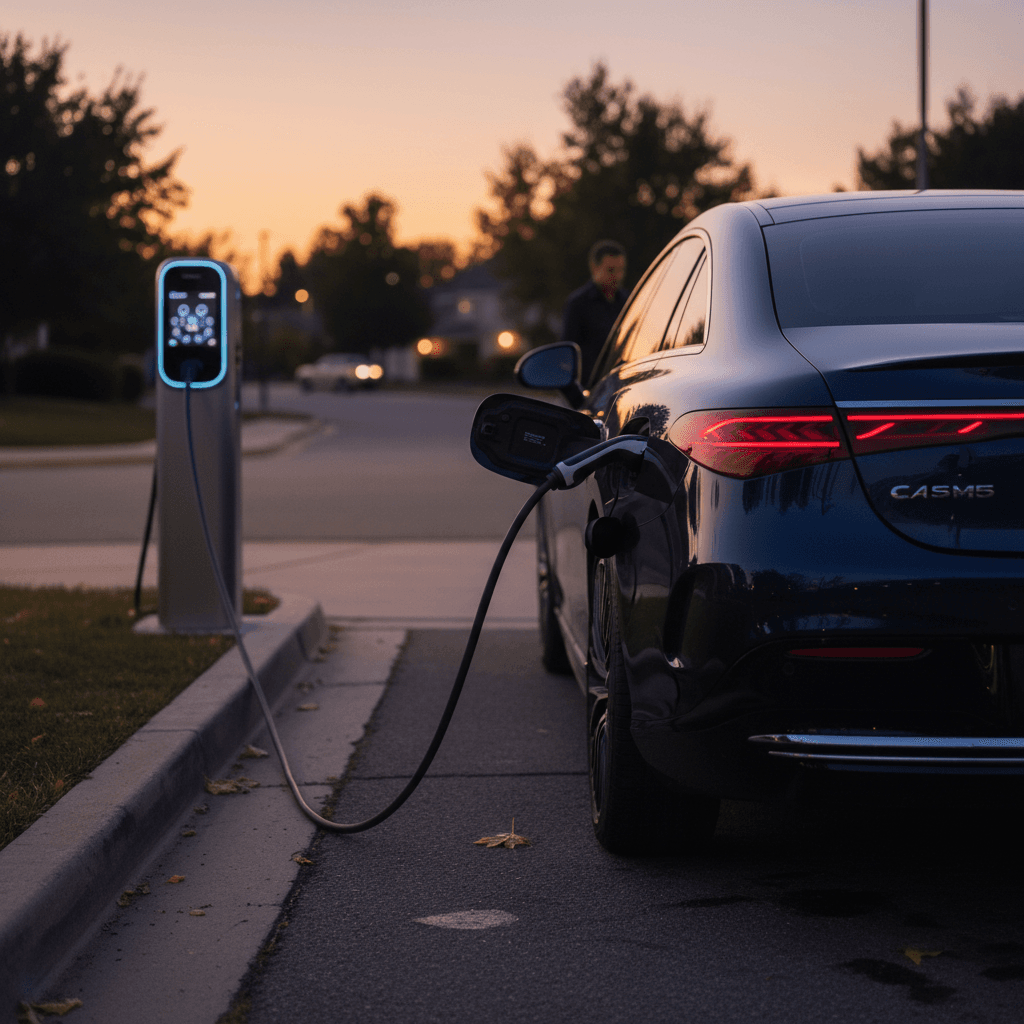
If you’re eyeing a Mercedes EQE, or already have one, the big question is what it really costs **per mile to drive**. The sticker price tells you what it costs to buy, but the *electricity cost per mile* is what you feel every day in your budget. This guide breaks down realistic cents‑per‑mile numbers for the EQE sedan and SUV in 2026 U.S. conditions, plus how buying used through Recharged can lower your overall cost of ownership.
Why cost per mile matters
Mercedes EQE cost per mile: quick answer
Typical Mercedes EQE electricity cost per mile (U.S. 2026)
For most U.S. drivers in 2026, driving a **Mercedes EQE** costs roughly **6–9 cents per mile** in electricity if you mainly charge at home, and **12–20 cents per mile** if you lean heavily on DC fast charging. That’s broadly equivalent to driving a gas luxury sedan getting 35–70 mpg, depending on your local electricity price and how you drive.
Your numbers may differ
How efficient is the Mercedes EQE in kWh per mile?
To calculate the **cost per mile to drive a Mercedes EQE**, you first need its energy use in **kWh per 100 miles** or **kWh per mile**. Official EPA‑style ratings for recent EQE 350 models cluster in the **high‑20s to high‑30s kWh/100 mi**, depending on body style and drivetrain:
Mercedes EQE efficiency benchmarks
Rounded figures based on EPA-style and real-world data for popular EQE variants.
| Model | Body style / drive | Typical kWh/100 mi (EPA or similar) | Approx. kWh per mile |
|---|---|---|---|
| EQE 350+ sedan (RWD) | Sedan, rear‑wheel drive | 27–30 | 0.27–0.30 |
| EQE 350 4MATIC sedan | Sedan, all‑wheel drive | 30–32 | 0.30–0.32 |
| EQE 350 SUV (RWD/AWD) | SUV, mixed drivetrains | 32–36 | 0.32–0.36 |
| EQE AMG variants | Sedan/SUV, performance | 36–40+ | 0.36–0.40+ |
Use these kWh/100 mi numbers as inputs for cost‑per‑mile calculations.
In mixed U.S. driving, many EQE owners report **around 2.8–3.5 miles per kWh**, translating to roughly **28–36 kWh/100 mi**. For this article, we’ll use **30 kWh/100 miles (0.30 kWh/mi)** as a **reasonable baseline** for an EQE 350 doing normal commuting. You can easily plug in your own numbers if your car is more or less efficient.
Find your personal kWh per mile
Electricity price assumptions for 2026
The other half of the equation is **what you pay per kWh**. Federal and state data point to an average **U.S. residential electricity price in late 2025 and early 2026 of roughly 17–18¢/kWh**, with big variation by state. Think single‑digits in the cheapest states and mid‑20s (or more) in the most expensive coastal markets.
Three simple price scenarios to model your EQE cost per mile
Pick the column that looks most like your home rate or public charging price.
Budget power (12¢/kWh)
Who this fits:
- Low‑cost states (parts of the Midwest, South, Pacific Northwest)
- Owners with time‑of‑use off‑peak rates
- Occasional workplace charging at favorable rates
Typical U.S. home (18¢/kWh)
Who this fits:
- Close to current national average residential price
- Many suburban and urban households
- No special EV rate, mostly flat pricing
High‑cost or DC fast (30–40¢/kWh)
Who this fits:
- High‑price states (e.g., CA, HI, parts of New England)
- Frequent DC fast charging on road trips
- Urban fast‑charge hubs with demand fees built into pricing
The core formula
Sedan vs SUV: cost per mile breakdown
The EQE sedan is a bit more efficient than the EQE SUV. Let’s run the numbers for both using realistic efficiency assumptions and the three electricity price scenarios above.
Mercedes EQE cost per mile by body style
Approximate cents per mile for popular Mercedes EQE variants at different electricity prices.
| Model & scenario | Assumed kWh/mi | 12¢/kWh | 18¢/kWh | 35¢/kWh (typical DC fast) |
|---|---|---|---|---|
| EQE 350+ sedan, efficient driver | 0.27 | 3.2¢/mi | 4.9¢/mi | 9.5¢/mi |
| EQE 350+ sedan, normal driver | 0.30 | 3.6¢/mi | 5.4¢/mi | 10.5¢/mi |
| EQE 350 SUV, normal driver | 0.33 | 4.0¢/mi | 5.9¢/mi | 11.6¢/mi |
| EQE SUV / AMG, spirited driving | 0.36 | 4.3¢/mi | 6.5¢/mi | 12.6¢/mi |
Your actual numbers will depend on driving style, weather, wheel size, and exact tariff, but these ranges are representative.
If you’re mostly home‑charging at something close to the national average (~18¢/kWh), plan on **about 5–6¢ per mile** in electricity for a non‑AMG EQE. In a high‑price state or if you live on DC fast chargers, 10–13¢ per mile is a reasonable planning number.
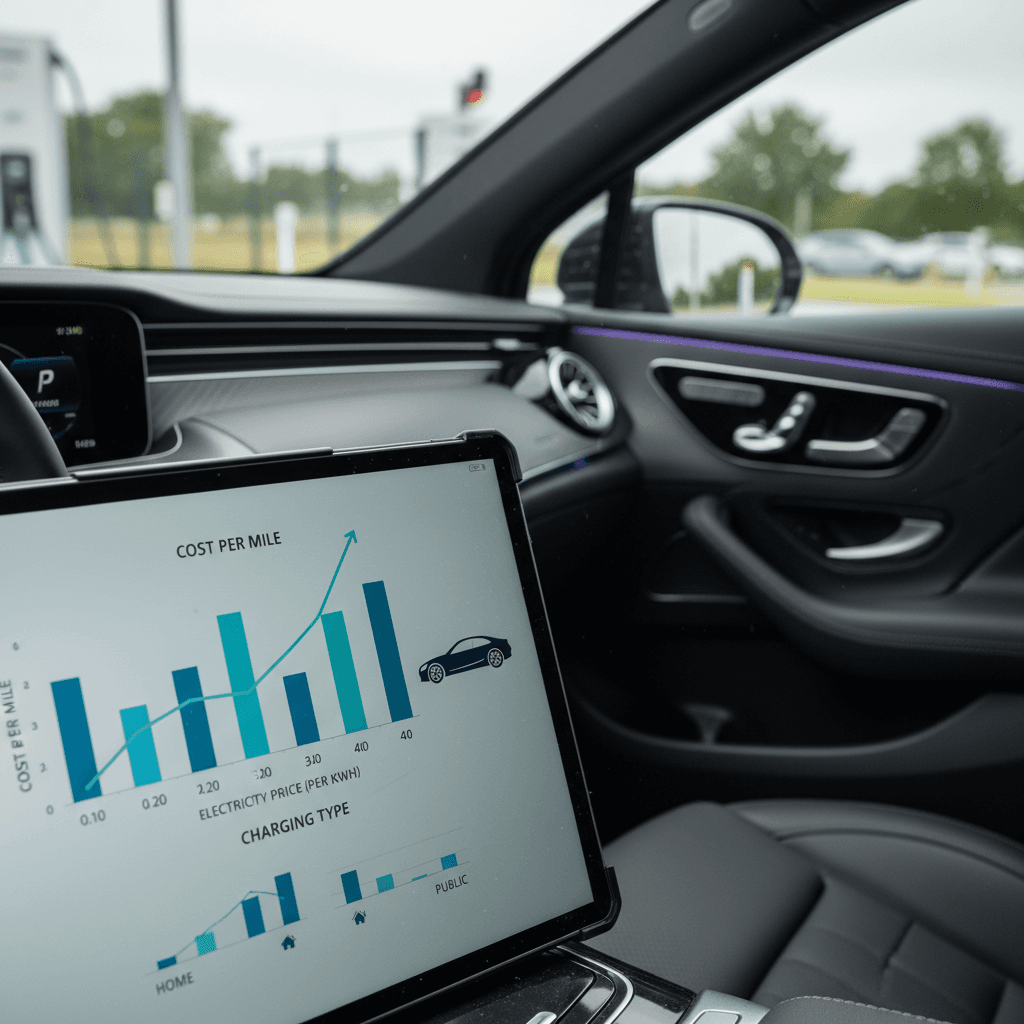
Home charging vs public fast charging costs
Home charging: where the EQE shines
Charging your EQE at home is almost always the cheapest way to run it, especially if you:
- Live in a state with sub‑20¢/kWh residential rates
- Can charge overnight on an EV‑specific or off‑peak plan
- Drive a predictable commute and rarely need DC fast charging
At 18¢/kWh and 0.30 kWh/mi, 12,000 miles per year costs about $648 in electricity, less than many people spend on oil changes and gas station snacks with a comparable ICE luxury sedan.
Public fast charging: convenience at a premium
DC fast charging is priced more like highway gas stations: you’re paying for infrastructure, demand charges, and convenience. Many networks now charge 30–50¢/kWh effective rates.
At 35¢/kWh and 0.33 kWh/mi in an EQE SUV, you’re at roughly 11–12¢ per mile. Still competitive with a 25–30 mpg gas SUV at today’s fuel prices, but nowhere near as cheap as home charging.
Blend charging to balance cost and convenience
Other running costs: tires, maintenance, and depreciation
Electricity is just one piece of the EQE’s total cost per mile. To compare your EQE to an internal‑combustion luxury car, or to decide between a new and used EQE, you need to factor in **maintenance, repairs, tires, insurance, and depreciation**.
Non‑electricity costs that affect your EQE cost per mile
Electricity is cheap; depreciation often isn’t.
Maintenance & repairs
EVs like the EQE skip oil changes, spark plugs, and complex exhaust systems, but:
- You’ll still service brakes, suspension, and HVAC
- Complex luxury features can be expensive to diagnose
- Out‑of‑warranty repairs can move your cost per mile up fast
Tires & wear items
The EQE’s weight and torque are hard on tires. Expect:
- More frequent tire replacements than a light compact car
- Higher prices for the large, premium‑brand sizes
- Tire costs adding a few cents per mile over long ownership
Depreciation
For luxury EVs, depreciation is usually the largest cost per mile.
- New EQEs lose value fastest in the first 3–4 years
- Buying used shifts that early depreciation to the first owner
- This is where the biggest cost‑per‑mile savings live
How Recharged helps on non‑fuel costs
Ready to find your next EV?
Browse VehiclesHow a used Mercedes EQE changes your cost per mile
From a pure economics standpoint, a **well‑bought used EQE** can slash your total cost per mile even though its electricity cost per mile is similar to a new one. Here’s how that works.
New vs used Mercedes EQE: what changes in cost per mile?
High‑level comparison of how a new EQE and a 3–4‑year‑old used EQE break down on major cost components over a typical year.
| Cost component | New EQE (first 3–4 years) | Used EQE (3–6 years old) | |
|---|---|---|---|
| Electricity per mile | Same car, same kWh/mi, difference comes mostly from your electricity price and driving style | ||
| Depreciation per mile | High: steep value drop from MSRP in early years | Lower: much of the depreciation already taken by first owner | |
| Maintenance & repairs | Lower during warranty, but dealer rates can be high | Slightly higher out of warranty, but offset by lower finance cost | |
| Financing cost | Higher: larger principal balance | Lower: smaller loan amount and monthly payment | |
| Insurance | Often higher for new, high‑MSRP vehicles | Can be meaningfully lower for a 3–4‑year‑old used EQE |
Illustrative only, but directionally accurate for many U.S. buyers.
If you line up all of those categories, it’s common to see a **used EQE’s total cost per mile** (loan, depreciation, electricity, maintenance) come in well below a new one, even though the electricity cost per mile is nearly identical.
Use battery health to protect your cost per mile
Practical ways to cut your EQE cost per mile
7 ways to lower your Mercedes EQE cost per mile
1. Optimize when you charge
Ask your utility about EV or off‑peak plans. Shifting most of your EQE charging to cheap overnight hours (for example, from 26¢/kWh peak to 14¢/kWh off‑peak) can knock a couple of cents off every mile you drive.
2. Favor Level 2 over DC fast
Use home or workplace Level 2 charging as your default. Reserve DC fast charging for road trips and genuine time crunches. This not only lowers your kWh price but is generally better for long‑term battery health.
3. Drive in Comfort or Eco instead of Sport
The EQE is tuned for comfort, not track days. Staying out of the harshest acceleration modes, coasting more, and using intelligent recuperation can easily move you from 0.36 kWh/mi down toward 0.30 kWh/mi or better.
4. Watch your highway speed
Above about 65–70 mph, aerodynamic drag punishes efficiency. Dropping 5–10 mph on long highway stretches can add several miles of range per kWh, cutting your electricity cost per mile by double‑digit percentages.
5. Keep tires properly inflated
Under‑inflated tires increase rolling resistance and energy use. Checking pressures monthly (especially through season changes) pays back continually in lower Wh per mile and longer tire life.
6. Right‑size the car and wheels
If you don’t need the EQE SUV’s extra space or the biggest wheel package, the sedan on smaller wheels will generally be more efficient and cheaper to tire, trimming both electricity and tire cost per mile.
7. Let someone else pay for the steepest depreciation
Choosing a used EQE with verified battery health through a marketplace like <strong>Recharged</strong> often drops your monthly payment and your depreciation per mile, without changing your day‑to‑day electricity cost.
Mercedes EQE cost per mile: FAQ
Frequently asked questions about Mercedes EQE cost per mile
Bottom line: what you should budget per mile
If you plan to drive a **Mercedes EQE** in the U.S. in 2026 and you mostly charge at home, it’s reasonable to budget **about 6–9¢ of electricity per mile** for everyday use. Lean heavily on DC fast charging and that can climb into the low‑teens or higher, but you’re still broadly in line with, or better than, many gas luxury sedans on energy cost.
The bigger swing factor in your true cost per mile isn’t kWh, it’s **how you buy the car**. A thoughtfully chosen **used EQE with strong battery health** can dramatically lower your depreciation and financing cost per mile while keeping the same posh, quiet driving experience. That’s exactly the gap a marketplace like Recharged is designed to fill: transparent battery diagnostics, fair pricing, EV‑savvy guidance, and nationwide delivery so you can enjoy Mercedes‑level comfort at a cost‑per‑mile that actually pencils out.