On paper, the Mercedes EQE looks like a charging overachiever: up to 170 kW DC fast charging, a big 90.6 kWh usable battery, and a 10–80% time quoted at roughly half an hour. But spec sheets are aspirational literature. If you’re hunting for a Mercedes EQE charging speed test because you actually road-trip or are shopping one used, you care about what the car does when it’s cold, busy, and plugged into a random 350 kW box off the interstate.
Key takeaway up front
Mercedes EQE charging basics: specs vs reality
EQE charging numbers at a glance
Under the skin, the EQE sedan and SUV both use a pack that’s roughly 96 kWh gross, about 90.6 kWh usable. DC fast charging maxes out at 170 kW on a CCS plug. Mercedes, in typical German understatement, quotes around 30–32 minutes for a 10–80% DC fast‑charge session when you’re on a suitably beefy station and the battery is already warm from driving.
On AC, the onboard charger is rated at 9.6 kW, so a 10–100% top‑up on a 240 V Level 2 station takes roughly 10.5–11.5 hours depending on model year and trim. That’s your overnight reset button. What we’re focusing on here, though, is the tempo of DC fast charging: how hard the EQE pulls early in the session, how quickly it tapers, and what that means for your time stuck at a charger.
Charging specs are best‑case
How a real-world EQE charging speed test works
The basic test procedure
Most serious EQE charging speed tests follow a similar script:
- Drive on the highway to warm the battery (ideally 30–60 minutes).
- Arrive at a DC fast charger rated at 150–350 kW with the EQE at ~10% state of charge.
- Log power, state of charge, and time every 1–5 minutes up to at least 80%, sometimes 90%.
- Note outside temperature, charger brand, and whether battery pre‑conditioning was active.
Why 10–80% matters
Below ~10%, many EVs throttle power to protect the pack. Above ~80%, nearly all of them taper dramatically. The Mercedes EQE is no exception. Looking at 10–80% gives you the most honest window into road‑trip reality, the part of the curve you’ll actually use if you’re trying to make time, not socialize with the food court.
Pro testing tip you can copy
DC fast charging results: 10–80% in the real world
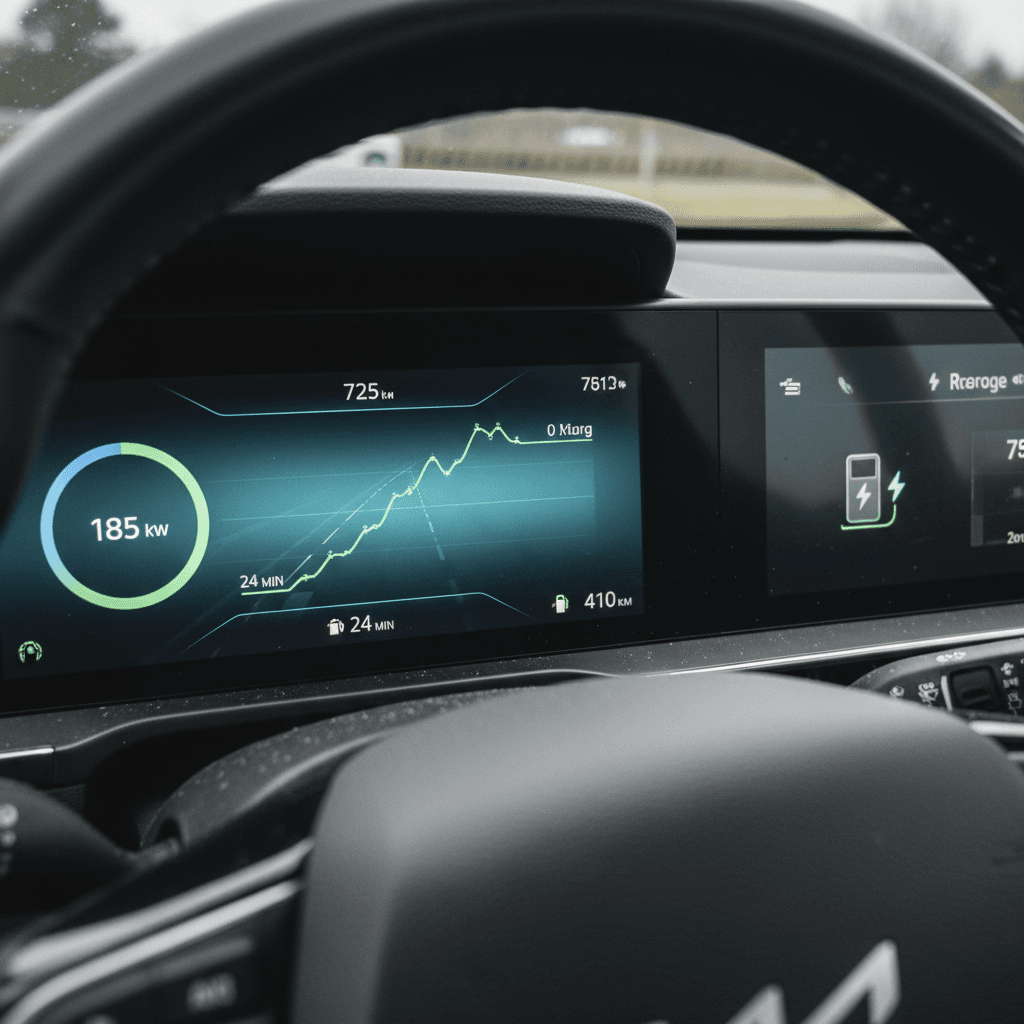
Across independent tests and dealer data, a pattern emerges. In good conditions, say, 60–80°F, a warmed battery, and a 150–350 kW charger, the EQE will ramp quickly into the 150–170 kW range around 10–20% state of charge, then step down through the 120s and 90s as you creep past 50% and 70%. Average power over a 10–80% session usually lands in the 110–130 kW band.
Typical DC fast charging results for Mercedes EQE
Approximate numbers from mixed real‑world tests of EQE sedans and SUVs on high‑power DC fast chargers.
| State of Charge | Approx. Power | Time Window | Notes |
|---|---|---|---|
| 10–20% | 150–170 kW | 0–5 min | Short burst near peak advertised speed |
| 20–50% | 120–140 kW | 5–18 min | Strong, stable pull; best part of the curve |
| 50–70% | 80–110 kW | 18–28 min | Noticeable taper but still worthwhile on road trips |
| 70–80% | 55–80 kW | 28–32 min | Efficiency drops; past here, you’re mostly feeding your anxiety |
| 80–100% | 25–45 kW | 32–60+ min | Best left for home or destination charging unless absolutely necessary |
Actual numbers vary with temperature, charger quality, state of charge and software updates, but these ballparks are representative for 2023–2025 EQE models.
If you start at 10% and unplug around 70–75%, you’re typically looking at 20–25 minutes on the cable. Run it to 80% and it’s closer to 30–32 minutes, which lines up with what many Mercedes dealers and official communication quote for the EQE sedan and SUV.
Good news for road‑trippers
EQE sedan vs EQE SUV: does one charge faster?
EQE sedan vs EQE SUV: charging at a glance
Same family, slightly different personalities at the plug.
EQE Sedan
- Shares ~90.6 kWh usable battery with SUV.
- Rated up to 170 kW DC, ~32 minutes 10–80% in ideal conditions.
- Lower, more aero profile means each kWh buys slightly more range.
- On a 170 kW charger, expect around 200–220 miles gained from 10–80%.
EQE SUV
- Same basic pack and 170 kW DC rating.
- Similar ~30–32 min 10–80% time when warm and plugged into a strong station.
- Boxier shape and higher ride chip away at efficiency.
- The same 10–80% stop nets more like 180–200 real highway miles, depending on trim.
In terms of charging speed alone, the EQE sedan and SUV are effectively twins. They share the same DC hardware and very similar software behavior. Where they diverge is in how much real‑world range you get per minute of charging. The sleeker sedan squeezes more miles out of each kilowatt‑hour, so a 25‑minute splash‑and‑dash simply takes you farther than it does in the taller, heavier SUV.
Charging speed vs trip speed
How many miles per minute does the EQE really add?
This is what you actually feel on a road trip: not voltage or amps, but how many highway miles appear every time you sneak off for a coffee. Using typical EPA ranges and real‑world charging tests, we can sketch some practical numbers.
Approximate miles of range gained per minute of DC fast charging
These are ballpark numbers for warmed‑up EQE models on a strong DC fast charger, charging from roughly 10% upward.
| Model | Highway Range Assumption | Charge Window | Time | Miles Added | Miles/Minute |
|---|---|---|---|---|---|
| EQE 350+ Sedan | ~280–300 mi | 10–70% | ~22 min | ~180–190 mi | 8–9 mi/min (peak), ~7–8 avg |
| EQE 350 4MATIC Sedan | ~250–260 mi | 10–70% | ~22 min | ~155–165 mi | ~7 mi/min avg |
| EQE 350+ SUV | ~270–280 mi | 10–70% | ~22 min | ~165–175 mi | ~7–8 mi/min (peak), ~6–7 avg |
| AMG EQE SUV | ~230–240 mi | 10–70% | ~22 min | ~140–150 mi | ~6–7 mi/min avg |
For conservative planning, always assume 10–20% less than the table shows, wind, temperature and speed are unkind to optimism.
Those are idealized, but they illustrate the character of the car. The EQE isn’t a Lucid‑grade charging monster, but a 20–25 minute stop will reliably buy you two to three solid hours of driving at American interstate speeds. For most families, the constraint won’t be the car; it’ll be the attention span of the back seat.
Plan around people, not electrons
Level 2 and home charging: living with an EQE day to day
Fast‑charging tests get the headlines, but day to day you’ll live on AC. With its 9.6 kW onboard charger, the EQE makes home charging refreshingly boring: plug into a 40‑amp Level 2 circuit in the evening, and you’ll wake up to a full pack even if you arrived nearly empty. Expect roughly 9–11 hours from 10–100% on a properly installed 240 V wall box.
EQE home charging checklist
1. Confirm your panel can handle 40–50 amps
The EQE is happiest on a 40‑amp circuit (or higher) dedicated to a 9.6 kW Level 2 charger. Have a licensed electrician verify capacity before adding a new circuit.
2. Choose a quality Level 2 charger
Look for a 48‑amp, Wi‑Fi‑enabled unit from a reputable brand, ideally with scheduled charging and load‑sharing. You don’t need anything exotic; reliability beats gadgetry.
3. Use scheduled or off‑peak charging
Set the EQE or your wall box to start charging when rates are lowest. Big pack plus slow, cheap electrons is the whole point of owning a luxury EV.
4. Keep daily charge limits moderate
For longevity, Mercedes and battery nerds alike prefer you live between about 20–80% for routine commuting, saving 100% charges for trips.
Don’t rely on Level 1
Road-trip strategy: getting the best out of the EQE charge curve
1. Aim for 10–70%, not 0–100%
The EQE pours energy in quickly when the battery is low and warm, then eases off above 60–70%. On a road trip, the trick is to arrive a bit low and leave a bit early. Bouncing between 10–70% keeps you squarely in the fat, juicy part of the charging curve.
That’s why a single 45‑minute stay at 30–95% often feels slower than two shorter 20‑minute hits from 10–70%.
2. Let the car pre‑condition the battery
Use the EQE’s navigation to route to a DC fast charger and enable pre‑conditioning. The car will warm (or cool) the pack en route so it can comfortably pull closer to its 170 kW peak the moment you plug in.
Skip this and you’ll see lower peak power, especially in winter, your charging speed test turns into a charging patience test.
Three simple rules for faster EQE road trips
You don’t control the charger network, but you do control how you use it.
Choose the right stations
Charge when you stop anyway
Stay flexible with route planning
NACS adapters and future‑proofing
Charging speed, battery health, and buying a used EQE
Here’s the uncomfortable truth: the cleanest EQE charging speed tests are done on new, pampered press cars. Out in the wild, a three‑year‑old EQE with 60,000 miles of hard DC fast charging may not behave quite the same way. Peak power could be a bit lower, and taper could start earlier if the pack has lost capacity or the battery management system is being protective.
What to watch for on a test drive
- Do a short DC fast‑charging session from ~20–50% and watch the numbers on the screen.
- Healthy EQEs should briefly crest well into three digits on a strong charger.
- If it stubbornly sits below ~70–80 kW in mild weather on a 150–350 kW unit, something may be off: degraded pack, cold battery, or a weak charger.
How Recharged helps with the unknowns
If you buy a used EQE through Recharged, every car comes with a Recharged Score battery health report. We measure usable capacity and charging behavior so you’re not guessing about how the previous owner treated the pack.
That means fewer surprises at the plug, and a clearer sense of how this particular EQE will charge three winters from now, not just how it behaved the day it left the showroom.
Don’t ignore weird charging behavior
Mercedes EQE charging speed FAQ
Frequently asked questions about EQE charging speed
Is the Mercedes EQE fast enough at the plug?
If you went looking for a Mercedes EQE charging speed test expecting Lucid‑style fireworks, you’ll come away only moderately impressed. This isn’t the wild child of the fast‑charging world. But judged the way you actually use a car, stringing together meals, bathrooms and sanity breaks on unfamiliar highways, the EQE is quietly competent. A warmed‑up car on a decent DC fast charger will hand you two to three hours of highway range for a 20–30 minute stop, and it will do that predictably, which matters more than any isolated peak kW number.
Where things get interesting is in the used market. As prices come down and some U.S. EQE production pauses, the car’s combination of range, comfort and solid charging performance makes it a compelling second‑hand buy, as long as you know what’s happening inside the battery. That’s where a transparent Recharged Score battery health report earns its keep, turning fast‑charging guesswork into actual data so you can shop the EQE with your head, not just your heart.