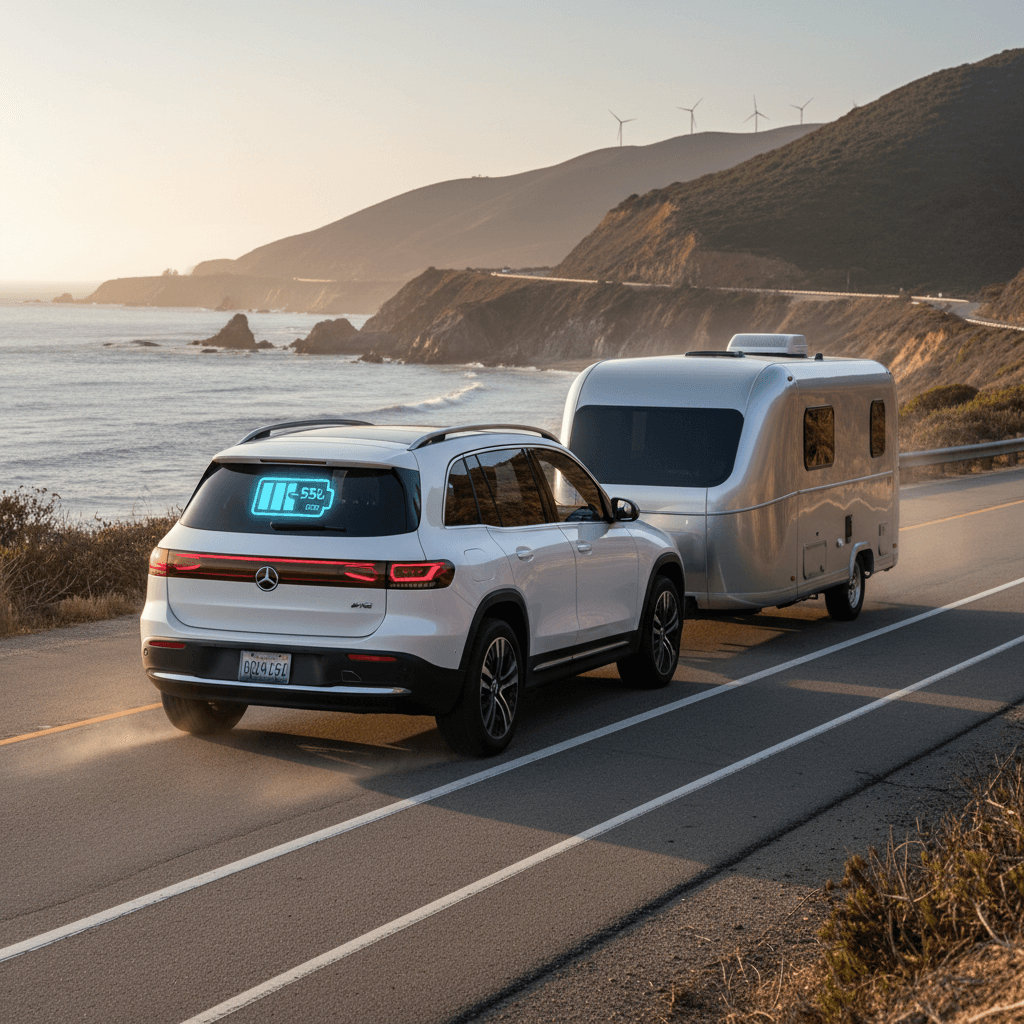
If you’re looking at a Mercedes EQB as a family hauler or adventure rig, sooner or later you’ll ask the big question: what’s the real Mercedes EQB towing capacity and range loss when you hook up a trailer? On paper the numbers look tidy, but the story changes once you’re pulling a camper into a headwind with kids and cargo on board.
Quick takeaway
Can a Mercedes EQB really tow?
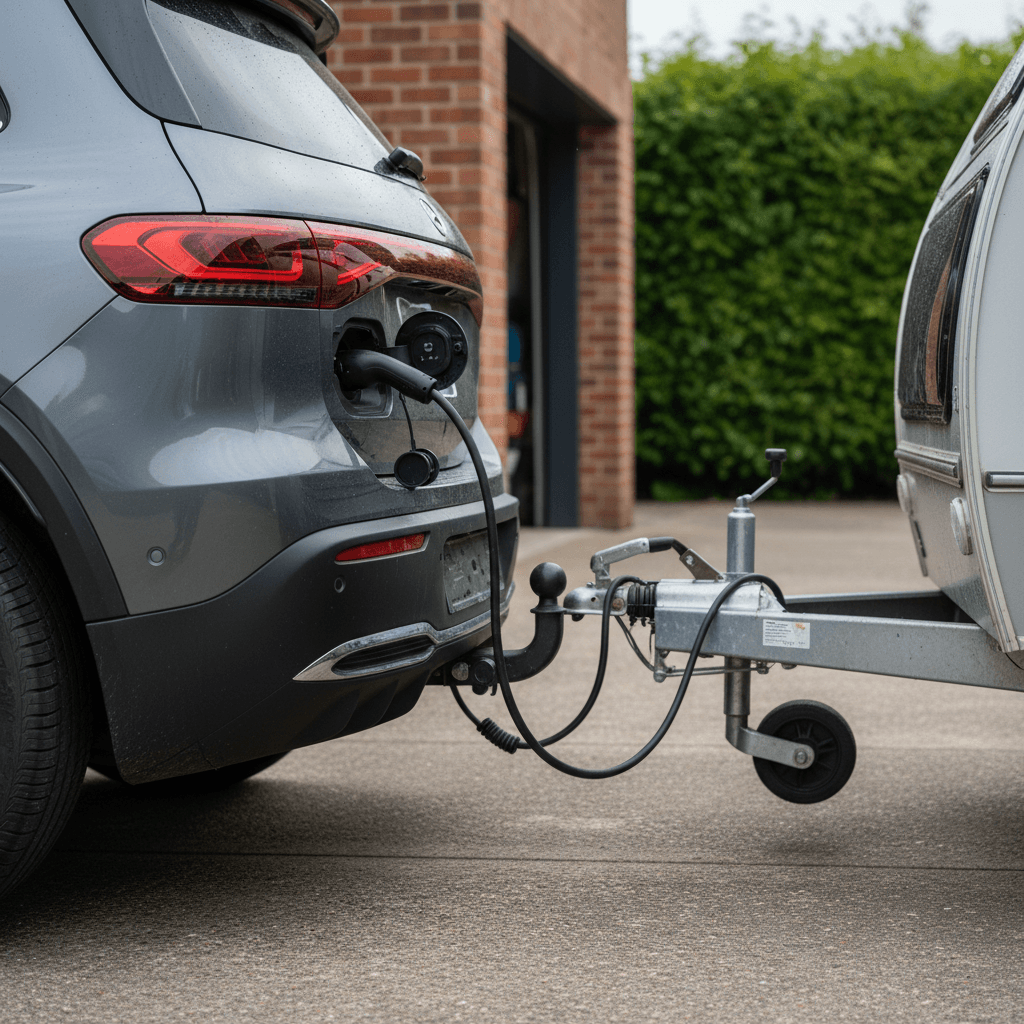
Yes, with the right equipment. The Mercedes EQB is a compact, three-row electric SUV built on the same platform as the gas-powered GLB. That’s good news for towing, because the underlying chassis and suspension were designed to deal with the extra weight and tongue load of a trailer. However, not every EQB that rolls off the lot is ready to tow.
- You need a factory or properly engineered aftermarket tow hitch rated for the EQB’s tow limit.
- Your specific EQB trim must be certified for towing in your market (tow ratings can vary by region).
- You must stay within the vehicle’s Gross Vehicle Weight Rating (GVWR) and Gross Combined Weight Rating (GCWR).
Check your exact car
Mercedes EQB towing capacity by model
While final numbers for each market can differ slightly, the big picture is straightforward: single‑motor EQB 250 models are generally rated lower, while dual‑motor EQB 300 and EQB 350 models carry the highest tow ratings when properly equipped with a factory tow package.
Approximate Mercedes EQB tow ratings (properly equipped)
Always confirm the exact rating for your VIN and market, this table is a practical guide, not a substitute for the owner’s manual.
| Model | Drive | Typical braked tow rating* | Unbraked tow rating* | Best use case |
|---|---|---|---|---|
| EQB 250+ | FWD | 2,000–2,650 lbs | ~1,650 lbs | Small utility or cargo trailer |
| EQB 300 4MATIC | AWD | 3,300–3,500 lbs | ~1,650 lbs | Light camper, small boat |
| EQB 350 4MATIC | AWD | 3,300–3,500 lbs | ~1,650 lbs | Heavier single‑axle trailers within limit |
U.S.‑market numbers are broadly similar to these figures; European models often list both braked and unbraked limits.
Braked vs. unbraked
Even when the badge says your EQB can tow up to around 3,500 lbs, that doesn’t mean you should live at that limit. For comfort, performance, and range, most EV owners find a sweet spot at 50–70% of the maximum rating for regular use.
EQB towing and range at a glance
How towing affects Mercedes EQB range
Every EV pays a range penalty when towing. The EQB is no exception, and its relatively compact battery means you feel that penalty faster than in a big electric pickup. The key is understanding why range drops so much so you can plan around it.
Why towing eats into EQB range
Four forces that start working against your battery once you hitch up.
Aerodynamic drag
Extra weight
Terrain and elevation
Temperature & HVAC
Think in consumption, not just miles
Real-world examples of EQB range loss when towing
Exact numbers will depend on how and where you drive, but you can use these scenarios as a sanity check when you’re planning trips. We’ll use simple, rounded figures so you can adapt them to your own EQB.
Sample EQB towing scenarios and range impact
These are illustrative examples based on typical EV towing behavior, always leave a safety buffer on top of these estimates.
| Scenario | Trailer | Speed | Estimated range (one charge) | Range loss vs. solo driving |
|---|---|---|---|---|
| Light utility trailer, local | Empty 4×8 utility (~800 lbs total) | 45–55 mph | 180–200 mi | ≈20–25% |
| Small teardrop camper | Low, aerodynamic (1,800–2,200 lbs) | 60–65 mph | 140–170 mi | ≈30–40% |
| Boxy single‑axle camper | 3,000+ lbs, tall front wall | 65–70 mph | 110–140 mi | ≈40–50% |
| Winter highway, mid‑size camper | 2,500 lbs, temps in 20s °F | 60–65 mph | 90–120 mi | ≈50–60% |
Assumes a healthy battery and mild weather; cold, wind, and hills will shorten range further.
Winter + trailer = plan aggressively
What kind of trailer can an EQB handle?
On paper, a dual‑motor EQB can pull a reasonably stout single‑axle trailer. In practice, you’ll enjoy towing much more if you stay on the lighter and more aerodynamic end of what the spec sheet allows.
Trailer types that pair best with an EQB
From easiest on range to hardest.
1. Small utility or bike trailer
2. Teardrop or compact camper
3. Tall boxy camper
Mind your payload, not just tow rating
Trip-planning strategy for towing with an EQB
The difference between a stressful towing day and a relaxed one usually comes down to planning. With an EQB, you’ll stop more often than a gas SUV, but those breaks can be shorter and more predictable if you work with the EV’s strengths instead of fighting them.
EQB towing trip-planning checklist
1. Start with conservative range assumptions
For highway trips with a mid‑size trailer, plan around <strong>50–60% of your solo highway range</strong>. If your EQB typically does 220 mi on the highway, assume 110–130 mi per leg when towing.
2. Map fast chargers along your actual route
Use multiple apps, Mercedes’ own navigation, PlugShare, A Better Routeplanner, or similar, to confirm fast charger locations that accommodate trailers. Favor sites with easy pull‑through access or enough space to park and unhitch if needed.
3. Shorten your charging legs in bad weather
If the forecast calls for heavy headwinds or freezing temperatures, tighten your charging intervals. Instead of trying to stretch 140 miles, split it into two relaxed 70‑mile hops.
4. Budget extra charging time
Towing means you’ll arrive with a lower state of charge and often want to charge higher than the usual 60–70% sweet spot. Build an extra 10–20 minutes per stop into your expectations.
5. Practice a dry run close to home
Before a big road trip, do a shorter towing run near home and note your energy use at various speeds. That real‑world data is more useful than any spec sheet.
6. Have a plan B for each stop
Sometimes a charger is busy, offline, or awkward with a trailer. Identify an alternate station or a slower Level 2 backup near every planned fast charge just in case.
Use 55–60 mph as your secret weapon
Protecting your EQB’s battery when you tow
EV batteries don’t love heat, high sustained power, or spending lots of time at 100% charge, all things towing can encourage if you’re not careful. The EQB’s thermal management system works hard behind the scenes, but your choices still matter for long‑term battery health.
Charging and state of charge (SoC)
- Avoid full charges just to feel safe. When possible, charge to 80–90% before a leg instead of 100%. That’s kinder to the battery, especially in hot weather.
- Don’t arrive at chargers completely empty. Try to roll in with at least 10–15% remaining when towing. Repeated deep discharges put extra stress on the pack.
- Use DC fast charging strategically. It’s your friend on tow trips, but if you frequently tow, mix in slower AC charging at home or overnight stops.
Driving style and cooling
- Be smooth with power. Hard launches look fun on YouTube, but your inverter and battery prefer gentle, progressive throttle, especially with a trailer.
- Watch temperature warnings. If the EQB starts limiting power or flashes thermal warnings, back off the speed and give it a rest at the next stop.
- Use preconditioning when available. If your EQB and route planner support it, let the car pre‑condition the battery before DC fast charges to keep sessions short and efficient.
The good news for used buyers
When EQB towing makes sense, and when it doesn’t
In the gas world, you buy a tow‑rated SUV and pretty much forget about it. With an EV like the EQB, towing works best when you treat it as an occasional superpower rather than a daily expectation.
Is the Mercedes EQB a good tow vehicle for you?
Match your use case to the EQB’s strengths.
Great fit if…
- You tow a small trailer, teardrop camper, or bikes a few times a year.
- Your typical legs between stops are under 120 miles, or you don’t mind stopping more often.
- You mostly stay in regions with solid fast‑charging coverage.
- You value the EQB’s compact size and three‑row flexibility more than brute towing strength.
Look elsewhere if…
- You regularly need to tow 3,000+ lbs over long interstate stretches.
- Your routes cross remote areas with sparse fast charging.
- You want to set the cruise at 75 mph with a tall camper and forget about it.
- Most of your towing happens in very cold or very hot climates.
Buying a used Mercedes EQB for towing
If you’re shopping the used market, the Mercedes EQB can be a smart way to get three‑row practicality and occasional towing ability without paying new‑SUV money. You just need to make sure the specific vehicle is up to the job you have in mind.
Used EQB towing buyer checklist
1. Confirm factory towing prep or quality hitch
A factory tow package is ideal, but a professionally installed aftermarket hitch can work if it’s properly rated and installed. Inspect for rust, damage, or sketchy wiring splices.
2. Verify tow rating for that exact VIN
Don’t assume all EQBs are rated the same. Check the owner’s manual, door‑jamb label, and (if available) the original window sticker for official tow figures.
3. Check for signs of hard towing use
Look for worn rear suspension components, uneven tire wear, or wiring modifications. Ask the previous owner how often, and what, they towed.
4. Get an objective battery health report
Range is everything when you tow. A <strong>Recharged Score battery health report</strong> can show you how much usable capacity remains so you’re not guessing about road‑trip ability.
5. Test‑drive with weight, if possible
Even a load of sandbags or a rental utility trailer can give you a feel for how the EQB accelerates, brakes, and rides with extra weight before you commit.
How Recharged can help
FAQ: Mercedes EQB towing capacity and range loss
Common questions about towing with a Mercedes EQB
Towing with a Mercedes EQB is absolutely possible, and for the right kind of trailer and trip, it can be a quiet, relaxed way to travel. The trick is knowing your real‑world towing capacity and range loss, then planning around those numbers instead of hoping the EPA sticker will bail you out. If you’re weighing whether an EQB belongs in your driveway, or you’re hunting for a used one that can handle weekends with a camper, tools like a verified battery health report and expert EV guidance can take the guesswork out of the decision.