If you’re eyeing a Mercedes EQB, or already own one, you’re probably wondering how its value will hold up. EVs have a reputation for steeper early depreciation than gas cars, and the EQB is a niche player: a compact, three-row luxury EV SUV. Understanding the Mercedes EQB depreciation rate helps you time your purchase or sale, manage total ownership cost, and avoid surprises at trade‑in time.
Quick take
Mercedes EQB depreciation overview
Mercedes introduced the EQB for the 2022 model year in the U.S. as an electric counterpart to the gas-powered GLB. It’s a premium, compact SUV with available three-row seating, dual‑motor all‑wheel drive options, and the usual Mercedes tech and comfort features. That combination puts it squarely in the small luxury EV SUV segment, which typically depreciates faster than mainstream models but often recovers with stronger used demand once prices fall to a wider buyer pool.
Mercedes EQB value snapshot (estimated ranges)
About the numbers
How fast does the Mercedes EQB depreciate?
You won’t find a perfect, universally accepted curve for Mercedes EQB depreciation yet, but we can triangulate from similar vehicles (GLB, other Mercedes EVs, and rival compact electric SUVs). Here’s a reasonable, directional view for a typical, well‑kept EQB bought new at MSRP and driven 10,000–12,000 miles per year:
Illustrative Mercedes EQB depreciation curve
Directional view of how a new Mercedes EQB’s value might decline over time under normal use. Actual results vary by trim, incentives, and market swings.
| Age | Odometer (approx.) | Typical value vs. original MSRP | What this stage looks like |
|---|---|---|---|
| 1 year | 10,000–12,000 mi | 80–85% | Many first owners keep the EQB; off‑lease units are rare. Incentives and discounts matter a lot here. |
| 3 years | 30,000–36,000 mi | 55–65% | First wave of lease returns hits the market; strongest depreciation is typically behind you. |
| 5 years | 50,000–60,000 mi | 45–55% | Battery warranty coverage remains, but shoppers pay closer attention to real‑world range and software support. |
| 7+ years | 80,000+ mi | 35–45% | Depreciation slows; battery health and maintenance history dominate value discussions. |
Example only – use this to understand patterns, not as a guaranteed forecast.
Used‑buyer opportunity window
Why EVs like the EQB depreciate differently from gas SUVs
EV depreciation isn’t just about miles and model‑year. Electric SUVs like the EQB live in a fast‑moving tech market, where range, charging speed, and software can change quickly. That adds extra moving parts to any discussion of resale value.
Key differences in EV vs. gas‑SUV depreciation
Why the EQB’s curve won’t look exactly like a GLB’s
Battery health matters
For EVs, usable range is as important as mileage. A higher‑mileage EQB with a strong battery can be more valuable than a lower‑mileage one with noticeable degradation.
Tech pace is faster
Infotainment, driver‑assist systems, and charging tech move quickly. Newer EQBs with updated software or hardware can push down prices of earlier builds faster than in typical gas segments.
Charging ecosystem
As public charging networks expand and NACS adoption spreads, older EVs that charge more slowly or lack native NACS ports may feel dated sooner, impacting depreciation.
Battery warranty and perception
The biggest factors that shape EQB resale value
Looking at early EQB resale patterns and comparable EVs, five levers show up again and again: incentives, trims, mileage, battery health, and market conditions. If you want to predict where your EQB’s value is heading, or spot a used bargain, start here.
- Original pricing & incentives: If a new EQB was heavily discounted or stacked with federal, state, or dealer incentives, used prices will adjust to that lower real‑world transaction value, not just MSRP.
- Trim and options: Higher‑spec AMG Line or dual‑motor EQB 350 models carry higher MSRPs, but not every option holds value equally. Practical features (all‑wheel drive, upgraded driver‑assist, larger battery) tend to support resale better than purely cosmetic packages.
- Mileage and usage profile: High‑mileage urban commuting is less scary on an EV than high‑miles towing on a gas SUV, but buyers will still discount heavy use. Lower‑mileage, regularly driven EQBs typically sell fastest.
- Battery health and real‑world range: Two EQBs with the same odometer can command very different money based on how much real‑world range they have left. That’s where independent battery diagnostics become a major differentiator.
- Macroeconomics and incentives: Interest rates, gas prices, and evolving EV incentives can move used values up or down quickly. A surge of off‑lease inventory or aggressive discounts on new EQBs can soften used pricing in a hurry.
How Recharged helps here
Mercedes EQB vs competitors on depreciation
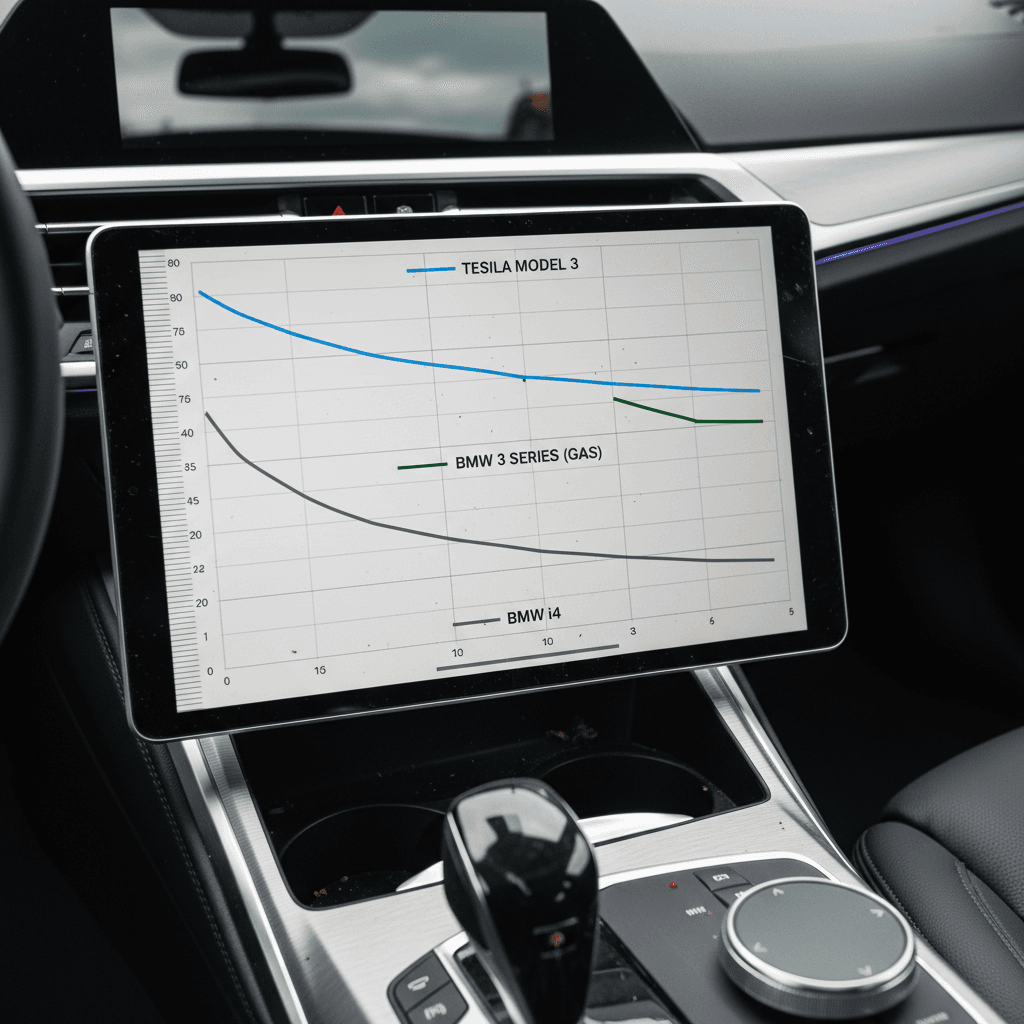
Even with limited long‑term data, it’s clear the EQB lives in a crowded corner of the EV world. To understand its depreciation, you have to see where it sits relative to rivals like the Tesla Model Y, Volvo XC40 Recharge / C40, and Hyundai Ioniq 5 / Kia EV6.
Tesla Model Y
Tesla’s compact SUV often shows stronger resale value than many luxury EVs because of brand pull, software support, and the Supercharger network. That said, heavy Tesla price cuts in 2023–2024 shook used values and show how quickly things can change.
If the Model Y holds a modest edge in long‑term resale, the EQB can become more attractive on the used market when you factor in interior quality and traditional luxury‑SUV feel.
Other small luxury EV SUVs
Compared with vehicles like the Volvo XC40 Recharge, Mercedes EQB depreciation so far looks broadly similar: a big early drop, followed by more stable pricing once the market finds a fair used level.
Where the EQB may stand out is its three‑row configuration. That niche capability can support used demand among families who want luxury, compact size, and occasional seven‑seat flexibility without going up to something like an EQE SUV.
Where the EQB shines on the used market
Buying a used Mercedes EQB: turning depreciation into a deal
If you’re shopping for a used EQB, depreciation is working in your favor. Your job is to separate genuinely good deals from cars that are cheap for a reason. That comes down to battery health, equipment, and how the previous owner treated the vehicle.
Smart strategies for buying a used Mercedes EQB
Leverage depreciation without taking on hidden risk
Target the right age window
Focus on EQBs around 3–5 years old. You capture the bulk of depreciation savings while preserving meaningful remaining factory warranty coverage and up‑to‑date tech.
Insist on battery diagnostics
Ask for independent battery health data, not just a dashboard estimate. On Recharged, every EQB listing includes a Recharged Score battery report so you can compare vehicles apples‑to‑apples.
Compare to new transaction prices
Don’t benchmark used prices only against MSRP. Research real‑world new EQB transaction prices and incentives in the model year you’re cross‑shopping so you truly understand the delta.
How Recharged fits in your search
Selling or trading in your Mercedes EQB
If you’re on the other side of the transaction, considering a sale or trade‑in, understanding depreciation helps you set realistic expectations and choose the right exit path. The EQB is neither a runaway resale star nor a disaster; it’s a premium EV in a maturing market, and presentation matters.
Timing your sale
- Before lease end: If you leased an EQB and its buyout price is below current market value, you may be able to purchase it and sell or consign it for a profit.
- Before warranty milestones: Values can soften as major warranty milestones (like 4 years / 50,000 miles for bumper‑to‑bumper) expire. Selling a bit early can protect your position.
- After technology shifts: Big announcements, like widespread NACS adoption or new EQ models, can push prices around. If the market is suddenly flooded with incentives on new EQBs, waiting may hurt your resale value.
Choosing how to sell
- Dealer trade‑in: Fast and convenient, but typically leaves money on the table, especially on EVs where appraisal competence varies.
- Private sale: Potentially maximizes value, but requires more time, marketing, and buyer education about EVs and battery health.
- Consignment/marketplace: Platforms like Recharged can list, market, and help sell your EQB with expert EV guidance and battery diagnostics, often netting more than a standard trade‑in while saving you the hassle of a private sale.
Don’t ignore software and recalls
Checklist: What to check on a used Mercedes EQB
Used Mercedes EQB inspection checklist
1. Verify battery health and range
Request a <strong>battery health report</strong> and compare stated range to EPA ratings for that model year. On a test drive, watch how quickly the state‑of‑charge percentage drops under typical driving.
2. Confirm charging behavior
Test AC and, if possible, DC fast‑charging. Make sure the EQB charges at expected speeds and that there are no intermittent errors when plugging in.
3. Review service and recall history
Ask for documentation of scheduled maintenance, software updates, and any recall work. Consistent service at a Mercedes dealer or qualified EV shop supports value.
4. Inspect tires and brakes
EVs are heavier than comparable gas SUVs. Check for uneven tire wear and verify brake condition, especially if the EQB has seen a lot of city driving with frequent regen use.
5. Evaluate interior wear
Luxury buyers expect a clean cabin. Check seat bolsters, MBUX screens, switchgear, and third‑row seating (if equipped) for wear that doesn’t match the mileage.
6. Confirm option content
Cross‑check the VIN’s build sheet (or window sticker, if available) so you’re sure you’re paying for the equipment you think you’re getting, driver‑assist packages, premium audio, panoramic roof, and so on.
FAQ: Mercedes EQB depreciation & used value
Frequently asked questions about Mercedes EQB depreciation
Bottom line: Is Mercedes EQB depreciation a problem or an opportunity?
The Mercedes EQB isn’t magically immune to the forces shaping EV values. Like most small luxury electric SUVs, it tends to lose value quickly in the first few years, then settles into a slower, more predictable decline. That’s tough medicine if you bought new at full MSRP, but it’s a real opportunity if you’re shopping used and bring the right tools to the search.
If you’re buying, focus on 3–5‑year‑old EQBs with solid battery health, clean histories, and realistic pricing versus new‑car transaction values. If you’re selling, treat battery documentation and cosmetic condition as marketing tools, not afterthoughts. Either way, a data‑driven approach beats guesswork. Recharged’s battery‑health diagnostics, expert EV guidance, and nationwide used‑EV marketplace are built to help you navigate depreciation, not be surprised by it.