If you’re considering a Mercedes EQB in 2026, or already own one, you’ve probably heard about battery recalls, charging quirks and software glitches. The good news is that many EQBs are pleasant, practical EVs. The bad news is that a handful of well‑documented problem areas can turn ownership into a headache if you go in blind. This guide walks you through the most common Mercedes EQB problems in 2026, how serious they really are, and what to look for if you’re shopping used.
Quick snapshot
Mercedes EQB problems in 2026: what’s changed
The EQB launched for 2022 as an electric version of the GLB. Early coverage called it a familiar Mercedes with an electric heart, and for the most part that’s still true in 2026. Where owners have struggled is in high‑voltage hardware and software tuning, especially as Mercedes has rolled out multiple recall campaigns and battery‑management updates.
EQB problem areas at a glance (2022–2025 models)
Newer 2024–2025 EQBs benefit from revised battery packs and updated software, but the recall story is still unfolding. If you’re looking at a used EQB, the single most important step is to check recall completion status by VIN and understand how any fixes may affect range and charging behavior.
High-voltage battery recalls and fire-risk alerts
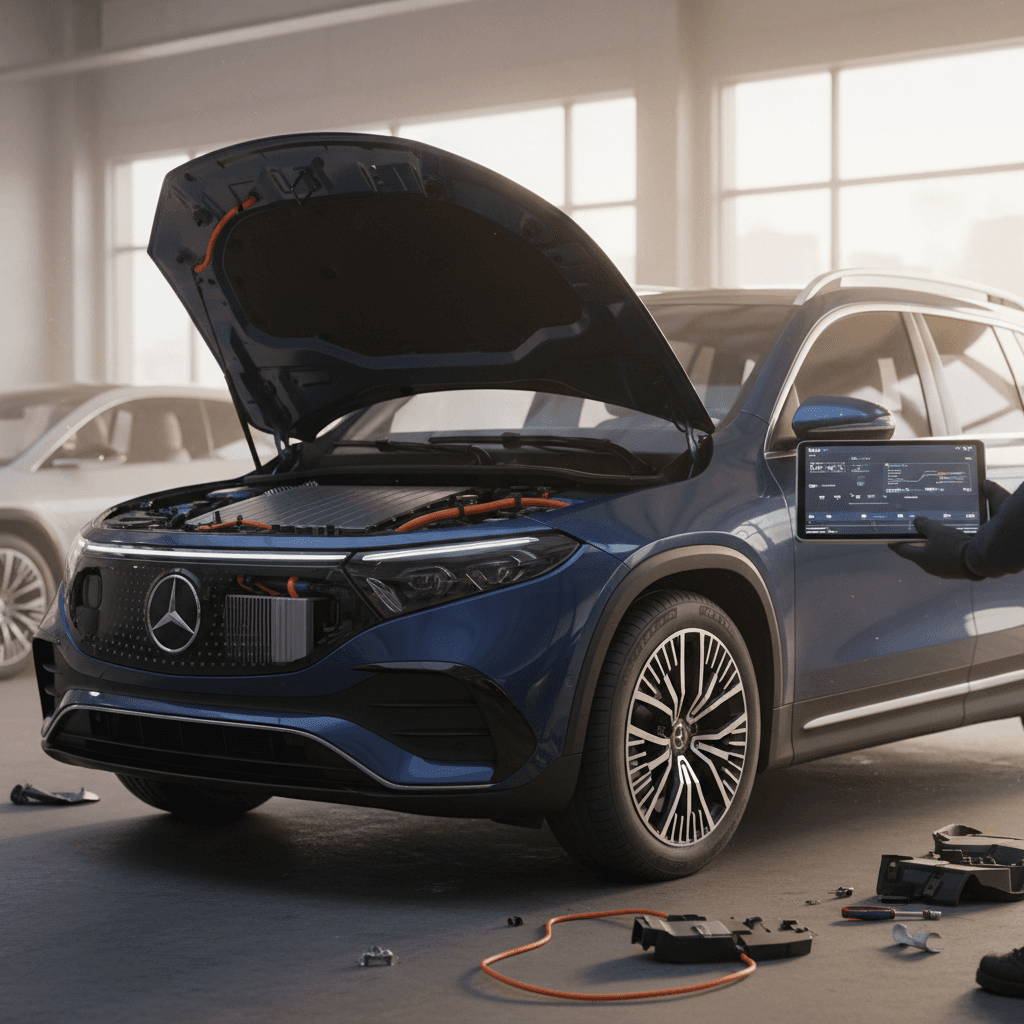
The headline Mercedes EQB problem in 2026 is the high‑voltage battery fire‑risk recall. Multiple campaigns now cover 2022–2024 EQB 300 4MATIC and EQB 350 4MATIC, plus many 2023–2024 EQB 250+ models. In certain packs, internal defects can cause short circuits that may lead to smoke or fire while parked or driving.
- Most affected: 2022–2024 EQB 300 4MATIC and EQB 350 4MATIC; 2023–2024 EQB 250+ for some campaigns
- Typical interim instructions: park outside, away from structures, and limit maximum charge to about 80% until repairs are complete
- Final remedy: in many cases, full high‑voltage battery replacement at no cost to the owner
- Separate but related campaigns: incorrect fasteners or internal bus‑bar issues that can trigger sudden loss of drive power
If your EQB is under a fire-risk recall
From a used‑car shopper’s perspective, a replaced high‑voltage battery is actually a mixed blessing. On one hand, you get a fresh pack with new warranty coverage. On the other, the car’s Carfax will show a major recall, which can spook some buyers. This is where having clear documentation from the dealer, and a third‑party health check like the Recharged Score battery report, can turn a potential red flag into a negotiating point.
Range loss and slower DC fast charging after updates
To reduce fire risk before physical repairs, Mercedes released several battery‑management software updates for the EQB. Many owners report that after these updates their cars: (1) charge more slowly on DC fast chargers and (2) show a smaller usable battery capacity or range.
1. Slower DC fast charging
Owners who were used to seeing peak DC speeds in the 100 kW range now report that their EQBs often sit closer to 60–80 kW, and they may taper earlier. That can easily add 10–20 minutes to a 20–80% highway fast‑charge session compared with pre‑update behavior.
- More time spent above 30–40 minutes at fast chargers
- Charging curves can be inconsistent between stations
- Some chargers misestimate time to 80% because of the new taper profile
2. Apparent range reduction
Because the software update often reduces the usable portion of the pack, you may see 10–20% less indicated range, especially on early 250+ and 300 4MATIC models. This doesn’t necessarily mean your battery suddenly degraded, it’s the software preventing it from using the full capacity window.
- Displayed state of charge may drop more quickly
- Highway range in winter can feel especially constrained
- Some owners receive later updates that relax limits after inspection
How to tell if an EQB has been de-rated
When you shop used, ask the seller for service records showing recall and software campaign codes. At Recharged, we pair that with a diagnostic battery‑health test so you can see both the physical state of the pack and how software is currently managing it. That’s the only way to separate genuine degradation from recall‑related limits.
Everyday charging problems: home and public
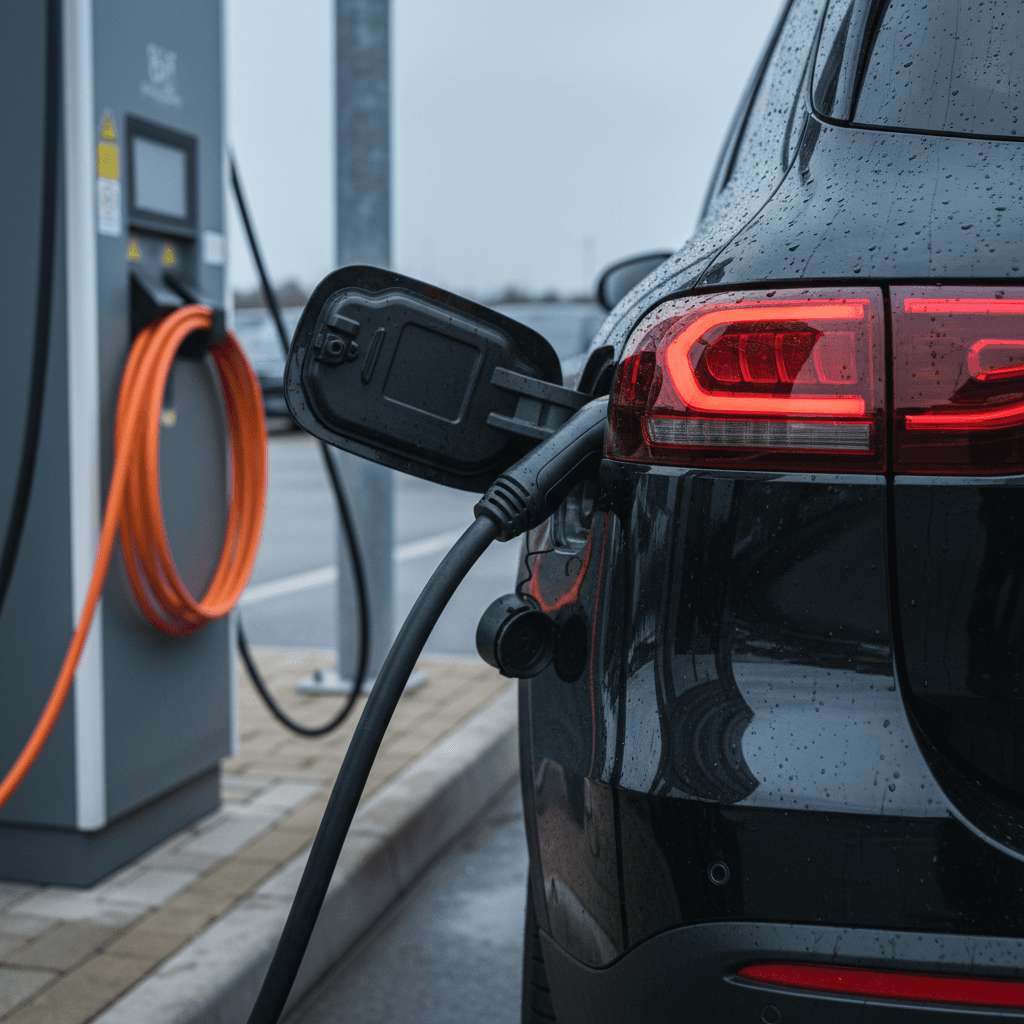
Beyond the big recalls, many owners mention day‑to‑day charging frustrations, some caused by the car, others by finicky public infrastructure. These issues can be annoying, but in most cases they’re manageable once you understand the pattern.
Common Mercedes EQB charging complaints
What they look like in real life, and what usually fixes them
Charge session won’t start
On some public DC fast chargers, you plug in, hear a few clicks, then get an error and no power.
- Try another stall or another network first
- Lock/unlock the car and restart the session
- Use the charger’s app or card instead of Mercedes Me, or vice versa
Interrupted or stuck charging
Charging stops at 30–40% or stalls at a low kW rate on DC.
- Check for active battery‑management recalls and updates
- Verify battery is warm enough, precondition via nav to charger
- If it repeats across stations, a dealer needs to scan for fault codes
Home charging quirks
Trickle charging from 120V can feel painfully slow, and some 240V setups trip breakers.
- Use a dedicated 240V circuit with appropriate amperage
- Set the EQB’s max charging current to match the circuit
- If a properly installed 240V circuit still trips, have the onboard charger checked
Don’t assume it’s always the car
For U.S. buyers, the EQB uses the CCS connector today but will gradually transition as Mercedes adopts the NACS standard. If you plan to keep the car long‑term, factor in the cost and convenience of a future NACS adapter alongside your existing CCS options.
MBUX software glitches and driver-assistance quirks
Like most modern Mercedes models, the EQB runs the MBUX infotainment system and a suite of driver‑assistance features. These are powerful but complex, and owner complaints tend to center on small but persistent software annoyances rather than catastrophic failures.
- Apple CarPlay and Android Auto calls dropping or audio cutting out mid‑journey
- Random pop‑up warnings about driver‑assistance systems being unavailable, then disappearing at the next restart
- Navigation‑to‑charger routing that doesn’t fully sync with how the car preconditions the battery for DC fast charging
- Adaptive cruise or route‑based speed adjustment feeling too aggressive, including occasional phantom braking on some roads
First-line fixes for EQB software oddities
If you test‑drive a used EQB and see multiple warning lights or repeated messages about the high‑voltage system, don’t ignore them. Ask the seller for scan reports or have a Mercedes dealer pull stored fault codes before you sign anything. A clean dash during a 20–30 minute drive is a good baseline expectation for a healthy car.
Build quality complaints, noises and trim issues
Under the skin, the EQB is a relatively conventional Mercedes compact SUV, and most owners are satisfied with basic build quality. That said, a noticeable minority mention interior squeaks, vibration noises and trim misalignment, especially on early 2022–2023 builds.
Common complaints
- Buzzing or vibration near the head‑up display or dash at certain speeds
- Rattles from the rear cargo area or third‑row seat hardware (where equipped)
- Wind noise around door seals at highway speeds
- Misaligned interior trim pieces or inconsistent gaps around the center console
What we look for at Recharged
- Road test on a mix of smooth and rough pavement with audio off
- Check all seat latches, load floor panels and cargo‑area trim for looseness
- Inspect door seals for wear or prior adjustments
- Note any panel gaps or cosmetic flaws that might matter to resale value
Some noises are easy dealer fixes; others are just part of the car’s character. The key is knowing which is which before you buy.
Which model years and trims see the most issues?
Mercedes has already adjusted hardware and software several times, so not all EQBs are created equal. When you’re scanning listings in 2026, it helps to understand how the issues cluster by year and trim.
Mercedes EQB problem patterns by model year (U.S.)
High‑level view, always verify recalls and software status by VIN.
| Model year | Typical trims | Problem hot spots | Shopping notes |
|---|---|---|---|
| 2022 | EQB 300 4MATIC, EQB 350 4MATIC | Earliest high‑voltage battery fire‑risk recalls; separate loss‑of‑power campaigns; some software immaturity | Attractive pricing but do your homework, prioritize cars with completed battery replacement and documented software updates. |
| 2023 | EQB 250+, EQB 300 4MATIC, EQB 350 4MATIC | Core of the battery recall population; more reports of software glitches and charging quirks; some build‑quality complaints | Likely to be the most common used EQB in 2026. Great candidates if recalls are complete and the car drives cleanly. |
| 2024 | Facelifted EQB 250+ and 300/350 4MATIC | Still affected by some battery campaigns depending on build date; generally improved infotainment and driver‑assist behavior | Balance of updated styling and maturing software. Verify whether its pack falls into later recall waves. |
| 2025 (early) | Carryover with incremental tweaks | Too little data for solid reliability verdict; recall exposure depends on exact pack and production window | Treat on a case‑by‑case basis. A thorough inspection and battery‑health check are more useful than broad-year assumptions. |
Use this as a starting point, not a substitute for a VIN‑specific recall and service history check.
Warranty context
Buying a used EQB in 2026: inspection checklist
If you like how the EQB drives and you need a compact three‑row‑optional EV, you don’t have to walk away just because of the online horror stories. You do, however, need a disciplined inspection process. Here’s a practical checklist our EV specialists lean on when evaluating EQBs for the Recharged marketplace.
Used Mercedes EQB buyer’s checklist (2026)
1. Run a full VIN recall check
Use the NHTSA site or a brand‑authorized tool to confirm whether any high‑voltage battery, loss‑of‑power or software‑related recalls are open. An EQB that still needs a fire‑risk remedy should be priced accordingly, and you’ll want written confirmation that the work will be performed.
2. Ask for battery paperwork
Request service invoices that show any battery replacements or high‑voltage repairs. Pair that with a <strong>third‑party battery‑health test</strong>, for example, the Recharged Score, to see true usable capacity, DC fast‑charge behavior and error history.
3. Test DC fast charging
If possible, do a real DC fast‑charge stop during your test drive. Note peak kW, time from ~20–80%, and whether the session drops unexpectedly. A single bad public charger proves little; consistent issues across multiple stations are a red flag.
4. Drive at highway speeds
Take the car to 65–75 mph and listen closely. You’re checking for wind noise around the doors, rattles in the dash or cargo area, and any steering vibration. On a straight, lightly trafficked stretch, run adaptive cruise to confirm smooth operation without harsh braking.
5. Stress-test MBUX and the apps
Pair your phone, run CarPlay or Android Auto, and cycle through navigation, audio and EQ menus. Start and stop charging in the Mercedes Me app if you can. Minor quirks are acceptable; repeated crashes, lag or persistent warning messages are not.
6. Evaluate charging fit for your life
Confirm that your home can support a 240V circuit where you park, or that you have reliable public charging nearby. Given the EQB’s modest DC speeds, an easy Level 2 home setup is almost essential for low‑stress ownership.
Costs, warranty coverage and dealing with Mercedes
Major Mercedes EQB problems tied to recalls, like battery fire risk or sudden loss of power, are repaired free of charge at authorized dealers. Where owners get frustrated is the time it can take to secure a replacement battery pack, plus inconsistent communication about range and charging changes after software updates.
What EQB problems typically cost you
Separating scary headlines from real‑world wallet impact
Recall-related battery work
Cost to owner: $0, but you may be inconvenienced.
Battery replacements and high‑voltage safety fixes are covered under recall or battery warranty. The downside is wait time and temporary 80% charge limits.
Out-of-warranty charging hardware
Cost to owner: Varies.
Onboard charger or charge‑port repairs can run into four figures at retail. This is one area where buying a vetted used EQB with documented charging behavior can protect you.
Software and minor trim fixes
Cost to owner: Usually low or none.
MBUX updates and many dash rattles or seal adjustments are handled during normal service visits, especially while the car is under basic warranty.
Getting Mercedes to take issues seriously
When you buy through a marketplace like Recharged, a lot of this legwork is done for you. Vehicles come with a Recharged Score battery report, verified recall status, and support from EV‑specialist advisors who can walk you through what’s normal for the EQB and what isn’t, before you commit.
Mercedes EQB common problems: FAQ
Frequently asked questions about Mercedes EQB problems in 2026
Bottom line: is a used Mercedes EQB worth it?
If you only skim the headlines, it’s easy to write off the Mercedes EQB as a problem child. The reality in 2026 is more nuanced. The big story is the high‑voltage battery campaigns; once those are addressed, most EQBs settle into a life defined by modest charging speeds, occasional software quirks and the same day‑to‑day practicality that drew buyers to the GLB in the first place.
If you value a compact footprint, available three‑row seating and a familiar Mercedes cabin, a properly sorted EQB can still be a smart used‑EV buy. The key is to demand transparency: full recall history, documented battery work, real‑world charging behavior and a trustworthy battery‑health report. That’s exactly what platforms like Recharged are built to provide, so you can enjoy the benefits of an electric Mercedes SUV without getting surprised by the common EQB problems that others discovered the hard way.