If you’re trying to make sense of the Mazda MX-30 resale value forecast, you’re not alone. Mazda’s first U.S. EV sold in tiny numbers, was only offered in California, and was discontinued after the 2023 model year. That unusual history is now shaping how this quirky crossover behaves in the used market, and it’s a very different story from mainstream EVs like the Tesla Model 3 or Chevy Bolt.
Fast facts on the MX-30
Why the Mazda MX-30 Is a Special Case on Resale
Most EV resale forecasts start with production volume, battery size, range and brand strength. The Mazda MX-30 checks some of those boxes in a very unusual way. It has low production, very limited geographic distribution, a tiny battery, and some real usability compromises, like rear-hinged back doors and tight cargo room. On paper, those factors point to heavy depreciation, but ultra-low supply can also create a niche following that supports values for the right buyer.
Mazda MX-30 Value Snapshot (2022 Model, Approximate)
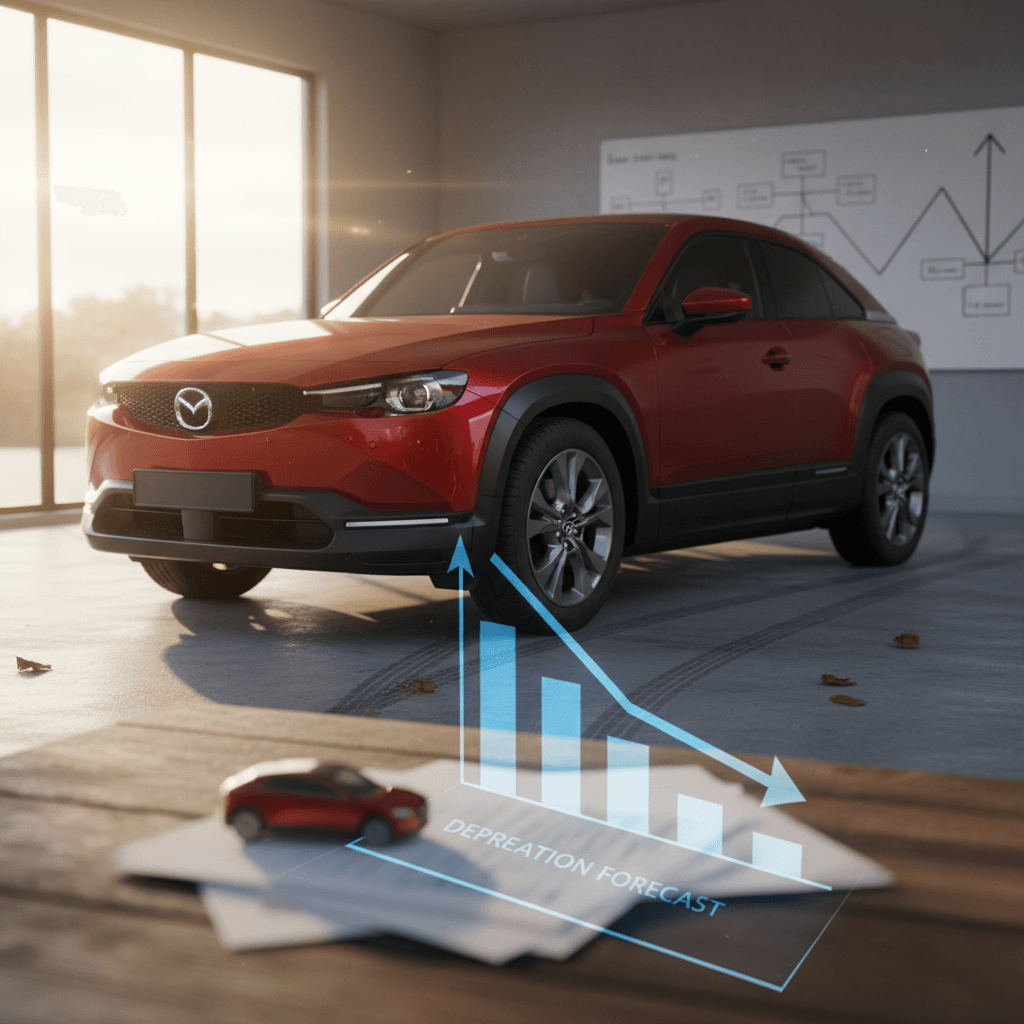
Data from major pricing guides shows a 2022 MX-30 losing well over half its original value after three years, a steeper slide than most 2022 compact SUVs and even many early EVs. In other words, the market has already marked the MX-30 down hard, and that shapes the next five years of its resale story.
Current Mazda MX-30 Value Trends
Because Mazda only sold the MX-30 in small numbers, you won’t see pages of auction data every week. But the pricing signals that are available all point in the same direction: sharp early depreciation that is now beginning to level off.
Approximate 2022 Mazda MX-30 Value Curve (U.S.)
Illustrative view of how a typical 2022 MX-30’s resale value might trend versus its original MSRP, based on pricing-guide data and current used-market patterns.
| Model year usage | Age | Indicative resale price* | % of original MSRP |
|---|---|---|---|
| First year used (2023) | ~1 year | $31,500 | 100% |
| Second year used (2024) | ~2 years | $20,500 | 65% |
| Third year used (2025) | ~3 years | $15,900 | 50% |
| Early 2026 market | ~3.5–4 years | $13,000 | 40–45% |
Values will vary by mileage, condition, and whether the vehicle still qualifies for state or utility incentives when sold.
About these numbers
The big story so far is the cliff between year one and year three. Once the MX-30’s short range and discontinuation status became common knowledge, resale values dropped fast. Now that the market has largely “priced in” those weaknesses, the forecast from here is for a slower, more predictable decline, closer to a niche economy car than a mainstream EV.
5 Key Drivers of Mazda MX-30 Depreciation
- Very short range for the segment (~100 miles EPA) and modest 35–36 kWh battery pack
- Slow DC fast charging (around 50 kW peak) that limits road-trip practicality
- Discontinued in the U.S. after 2023, signaling limited future support and no upgrades
- Sold only in California in tiny volumes, shrinking the pool of both buyers and service familiarity
- Rapid improvements in rival EVs (longer range, faster charging) at similar used prices
Where the MX-30 actually shines
Mazda MX-30 Resale Value Forecast: 2026–2031
Looking ahead, the Mazda MX-30 resale value forecast is shaped by two opposing forces. On one side you have the car’s structural weaknesses, range, charging speed, discontinued status. On the other, you’ve got very low supply, Mazda’s strong reliability reputation outside the battery spec sheet, and a core of urban or second-car buyers who don’t need long range.
Three MX-30 Value Scenarios Through 2031
These scenarios assume a 2022 MX-30 starting at roughly $13,000 resale value in early 2026, average mileage, and good condition.
Base case (most likely)
Value path: Gradual decline as the MX-30 ages, but depreciation slows noticeably after year 4–5.
- 2028: values in the high-$8,000s to low-$10,000s
- 2030–2031: values drift toward $5,000–$7,000
- Behaves like an older compact hatchback with EV quirks
Upside case (niche appeal)
Value path: Supply stays extremely tight; a small group of Mazda and EV enthusiasts keeps demand surprisingly firm.
- Prices hold a bit stronger than comparable short-range EVs
- Well-kept, low-mile examples with clean battery reports get a premium
- Think cult car, not investment car
Downside case (faster obsolescence)
Value path: If urban charging becomes even easier and rival EVs keep getting cheaper, the MX-30’s 100-mile range could start to look unworkable to most buyers.
- Values slide faster after 8–10 years
- Cars with weak battery health become very hard to sell
- Some units effectively retire into local-only use
Battery health is the swing factor
How the MX-30 Compares With Rival Used EVs
If you’re shopping used EVs, you’re probably cross-shopping the MX-30 with cars such as the Nissan Leaf, Chevrolet Bolt EV, Hyundai Kona Electric, or Kia Niro EV. On paper, almost all of these deliver more range and faster charging than the Mazda. That shows up directly in their resale curves.
Used EV Comparison: Where the MX-30 Fits
High-level comparison for a 2021–2022 model-year compact EV in early 2026, assuming similar mileage and condition.
| Model | Typical EPA range | Charging speed (DC) | Resale strength vs MX-30 | Used-market positioning |
|---|---|---|---|---|
| Mazda MX-30 | ~100 miles | Up to ~50 kW | Baseline | Cheapest to buy, toughest to resell |
| Nissan Leaf (40–62 kWh) | 149–226 miles | Up to ~100 kW (later cars) | Slightly better | Older tech, but more usable range |
| Chevy Bolt EV | 259 miles | Up to ~55 kW | Stronger | Recall history, but excellent range/value mix |
| Hyundai Kona Electric | 258 miles | Up to ~75 kW | Stronger | Long range, long warranty, popular in cities |
| Kia Niro EV | 239 miles | Up to ~75 kW | Stronger | More practical body style and usability |
Figures are broad ranges and meant for directional comparison, not quotes for any specific vehicle.
The takeaway: resale values on the MX-30 sit at the bottom of this pack. That’s bad news if you bought new at full sticker, but good news now if you’re a used buyer who can live with its limits. You’re paying far less per mile than the original owner did.
Who Should (and Shouldn’t) Consider a Used Mazda MX-30
Who the MX-30 fits
- Urban commuters with predictable round-trips under ~60–70 miles.
- Households with multiple vehicles where the MX-30 is a city runabout or second car.
- Homeowners with Level 2 charging who can fully recharge overnight.
- Mazda loyalists who value steering feel, design, and cabin quality over raw range.
Who should probably skip it
- Drivers who regularly road-trip or exceed 100 miles in a day.
- Apartment dwellers without reliable home charging.
- Shoppers who want an EV as their only family vehicle.
- Buyers who are anxious about discontinued models and long-term parts support.
Where Recharged can help
Ready to find your next EV?
Browse VehiclesBuying a Used Mazda MX-30: Essential Checklist
If you decide the MX-30’s trade-offs make sense for your life, your next move is due diligence. Because these cars are rare and heavily discounted versus new, it’s easy to get excited and skip steps. Don’t. Follow this checklist instead.
MX-30 Pre-Purchase Checklist
1. Confirm your daily range needs
Log or estimate your typical and worst-case daily mileage. If you regularly exceed 80–90 miles in mixed conditions, the MX-30 will feel tight on range, especially in cold weather.
2. Get a battery health report
Request a recent, third-party battery diagnostic or a detailed <strong>Recharged Score Report</strong> that shows remaining capacity, fast-charge history, and any fault codes.
3. Check DC fast-charging behavior
On a test drive, if possible, plug into a DC fast charger and observe charging rates. A healthy MX-30 should climb quickly toward its modest peak; if it tapers too soon, you may have thermal or pack issues.
4. Inspect software and charging hardware
Confirm that the latest software updates are applied and that the onboard charger, charge ports, and cables are in good condition. Look for corrosion or physical damage around the charging inlet.
5. Verify warranty and service access
Ask which portions of the battery and EV components remain under warranty and which Mazda dealer is actually experienced with MX-30 service. Not every store has deep EV expertise yet.
6. Compare total cost to alternatives
Cross-shop similarly priced used EVs and even efficient hybrids. A slightly higher purchase price on a longer-range EV may pay off in flexibility and resale down the road.
Leverage digital tools
Selling or Trading In Your Mazda MX-30
If you’re on the other side of the table and looking to sell, the MX-30’s depreciation history can be painful to look at. But you still have levers to pull to get a respectable number and move the car quickly.
Smart Ways to Sell an MX-30 in a Weak-Value Segment
Focus on the strengths that matter to the right buyer, not the weaknesses that will scare them off.
Lead with condition and history
Because MX-30s are so new and sold in small volumes, buyers will be picky.
- Highlight one-owner history, clean Carfax, and low miles.
- Document all maintenance and software updates.
- Include service records from a Mazda dealer, if available.
Provide objective battery data
Battery health is the single biggest resale question.
- Invest in a professional battery test or leverage a Recharged Score report.
- Share screenshots of range estimates in typical driving.
- Be up front about any degradation or charging quirks.
Price to the real market
Look at recent sales and listings in your region, not just guidebook numbers.
- Expect to undercut higher-range competitors of the same age.
- Consider instant-offer or consignment options to reach more buyers.
- Be realistic, overpricing will just lengthen time to sale.
Trade-in vs. consignment vs. private sale
FAQ: Mazda MX-30 Resale Value
Mazda MX-30 Resale Value Forecast: Common Questions
Bottom Line: Is the Mazda MX-30 a Smart Used Buy?
As a new car, the Mazda MX-30 was a tough sell: short range, limited availability, and price tags that overlapped much more capable EVs. As a used car, the equation looks different. Heavy early depreciation, low sales volumes, and Mazda’s inherent driving polish now combine to create a narrow but real opportunity for the right buyer.
If you need a do-everything family EV or you regularly stretch your daily mileage, the Mazda MX-30 resale value forecast is a warning sign, skip it and shop longer-range models instead. But if your life fits well inside its 100-mile bubble and you can verify strong battery health, a used MX-30 can deliver a lot of style and refinement for the money.
Whichever side you’re on, buyer or seller, ground your decisions in data, not guesswork. Tools like the Recharged Score battery report, transparent pricing comparisons, trade-in and consignment options, and nationwide delivery can take much of the friction out of dealing with a niche EV like this. In a market where most depreciation has already happened, smart information is your best asset.