If your Kia Niro EV 12V battery is acting up, you’re not alone. From random warning messages in the Kia Connect app to a Niro that won’t “wake up” in the morning, 12‑volt issues are one of the most talked‑about hassles in owner forums. The good news: replacing the 12V battery on a Niro EV is straightforward if you’re comfortable with basic tools, and knowing how it works can save you money and headaches whether you already own one or you’re eyeing a used Niro EV.
Quick takeaway
Why the Kia Niro EV’s 12V battery matters more than you think
Every modern EV, including the Kia Niro EV, still relies on a conventional 12‑volt electrical system. That small battery powers the control modules, contactors, alarm, telematics, lights, and HVAC relays that let the main high‑voltage pack do its job. If the 12V battery can’t supply stable voltage, the Niro EV’s computers may refuse to boot. That’s why owners sometimes find a fully charged car that simply won’t turn on, or one that throws persistent 12V warnings in the app.
On earlier Niro EVs (roughly 2019–2022), the 12V battery is a conventional lead‑acid unit under the hood. On some newer Niro family hybrids and plug‑ins, Kia moved to a lithium 12V module integrated with the traction battery, but the all‑electric Niro EV still uses a separate 12V supply. The underlying lesson is the same: if the 12V system isn’t healthy, the car isn’t either.
Kia Niro EV 12V battery at a glance
Common Kia Niro EV 12V battery symptoms
You don’t need specialized EV tools to tell when a Niro EV’s 12V battery is on its way out. Most failures advertise themselves with a cluster of annoying but recognizable symptoms:
- Red or yellow 12V battery warnings in the Kia Access / Kia Connect app that keep coming back even after a charge.
- Niro EV won’t “Ready” or power on, especially after sitting for a few days.
- Remote functions (pre‑conditioning, lock/unlock, charging control) stop working or become unreliable.
- Interior lights, screens, or chimes flicker when you open the door.
- You’ve needed multiple jump‑starts in recent weeks, or a trickle charger only temporarily revives the battery.
Don’t ignore intermittent issues
Which Kia Niro EV models use what 12V battery?
Before you buy a new 12V battery for your Kia Niro EV, you need to confirm which generation you own and which group size fits. Kia has changed layouts and battery specs over time, and parts catalogs aren’t always caught up, something many owners discover the hard way at big‑box parts stores.
Typical 12V battery types for Kia Niro EV
Always confirm group size and polarity against your existing battery label or owner’s manual before ordering parts.
| Model years | Body code / notes | Typical 12V group size | Location | Notes |
|---|---|---|---|---|
| 2019–2022 Niro EV (Gen 1) | e‑Niro / first‑gen EV | H4 / DIN (sometimes cross‑listed as Group 26R or similar) | Under hood, driver side | Common complaints about weak OEM batteries; many owners upgrade to AGM or lithium drop‑in. |
| 2023–2024 Niro EV (Gen 2) | New‑body Niro EV | Group 47 (H5/L2) reported by owners | Under hood | Catalog coverage is improving but still spotty; double‑check dimensions and terminal layout. |
| Niro HEV / PHEV (various) | Hybrid & plug‑in hybrids | Often integrated 12V lithium module | Trunk or near traction pack | Different design than full EV; consult hybrid‑specific guides, as procedures and parts differ. |
These fitment notes are typical, but there can be regional and supplier differences. When in doubt, match what’s in your car today.
Double‑check your exact battery
Tools and parts you’ll need for 12V battery replacement
If you’ve ever replaced a 12V battery in a gas car, the Kia Niro EV will feel familiar. You’re still dealing with a conventional low‑voltage battery, just in an electric‑only context. Here’s what you’ll want on hand before you crack the hood:
Essential gear for a Niro EV 12V battery swap
Most of this is basic DIY stuff, no high‑voltage gloves required, but respect the electronics.
Basic hand tools
- 10mm and 12mm sockets with ratchet and short extension
- Combination wrench for tight spots
- Flathead screwdriver or trim tool for covers
Correct replacement battery
- Match group size (H4, Group 47, etc.)
- Equal or higher cold‑cranking amps (CCA)
- Consider an AGM or lithium upgrade if compatible
Support gear
- Memory saver (optional) to keep radio presets
- Small wire brush or battery‑terminal cleaner
- Gloves and safety glasses
AGM or lithium upgrade?
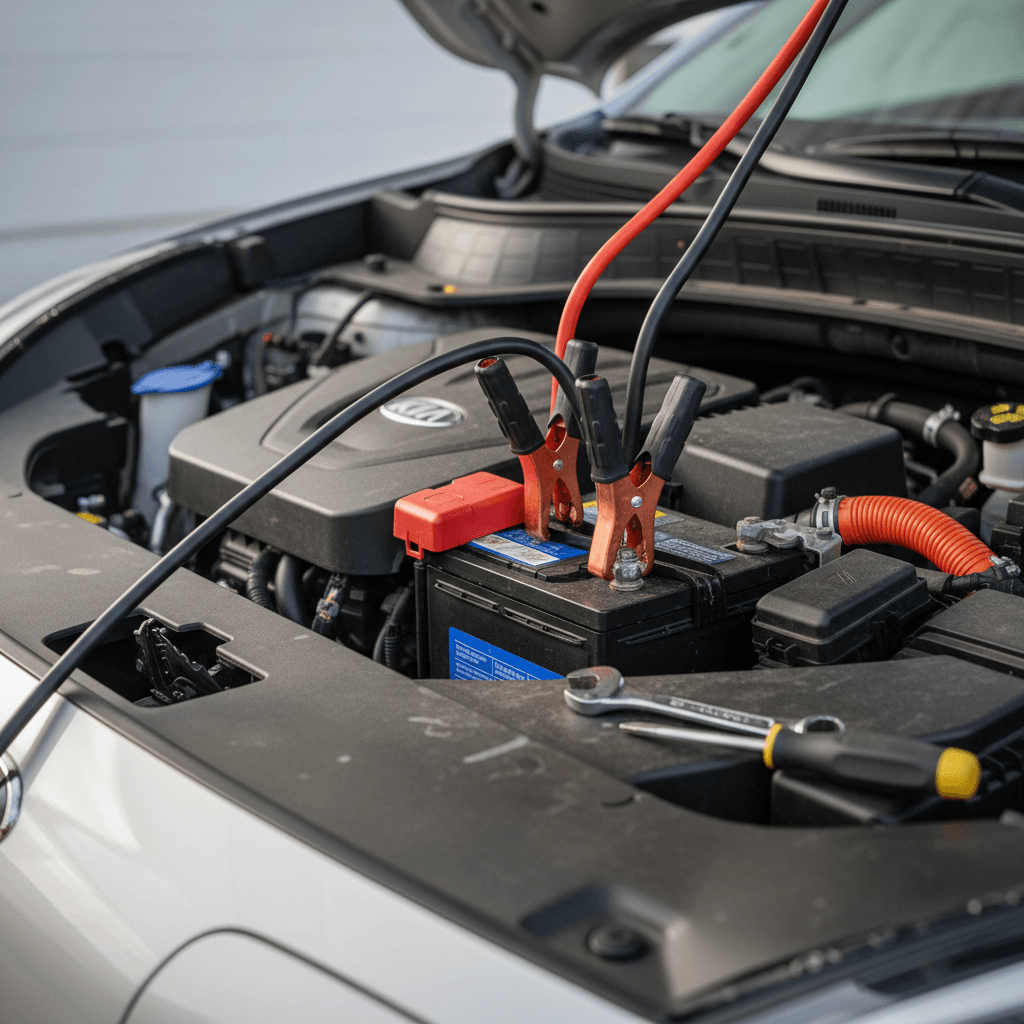
Step‑by‑step: Kia Niro EV 12V battery replacement
The exact layout varies a bit between generations, but the core process is the same. These steps assume a conventional under‑hood 12V battery like you’ll find on most Niro EVs in North America. Always cross‑check with your owner’s manual and any labels under the hood.
Kia Niro EV 12V battery replacement checklist
1. Park safely and power everything down
Park on a level surface, set the parking brake, and make sure the Niro EV is fully off, not in Ready mode. Remove the key fob from the cabin so the car doesn’t try to wake up while you’re working.
2. Open the hood and locate the 12V battery
Release the hood latch and prop it open. On most Niro EVs, the 12V battery is on the driver side near the fender, covered by a small plastic shield or trim piece. Remove any covers to expose the terminals and hold‑down bracket.
3. Disconnect the negative (–) terminal first
Using a 10mm wrench or socket, loosen the nut on the <strong>negative (–)</strong> battery clamp and carefully lift it off the post. Tuck the cable out of the way so it can’t spring back and touch the terminal.
4. Disconnect the positive (+) terminal and sensor
Loosen the 10mm nut on the <strong>positive (+)</strong> clamp. Some Niro EVs have a current sensor or small harness attached; handle that carefully and avoid prying on plastic components. Once loose, move the clamp away from the post.
5. Remove the hold‑down and lift the battery out
Locate the metal or plastic hold‑down bracket at the base of the battery. Remove its bolts (often 10mm or 12mm) and set the bracket aside. Lift the battery straight up and out, these are heavier than they look, so lift with your legs and keep it level.
6. Clean the tray and terminals
Before dropping in the new battery, clear any debris from the tray and inspect for corrosion. Use a small wire brush or battery cleaner on the inside of the cable clamps if they’re dirty or rusty.
7. Install the new battery
Set the new battery into the tray in the <strong>same orientation</strong> as the old one. Reinstall and tighten the hold‑down bracket so the battery can’t move or tip. Make sure terminals are easily reachable and not contacting bodywork.
8. Reconnect positive (+), then negative (–)
Attach the <strong>positive (+) cable first</strong> and snug the clamp so it doesn’t rotate. Then attach the <strong>negative (–) cable</strong>. Don’t overtighten, just enough to prevent movement. Reinstall any covers or sensor clips you removed.
9. Verify operation and clear warnings
Close the hood, sit in the driver seat, and press the start button with your foot on the brake. The Niro EV should go into Ready mode without error messages. If warning lights persist, cycle the car off and on once or twice; some ECUs need a full power‑down to recognize the new battery.
Respect high voltage, even if you’re not touching it
After replacement: resets, checks, and avoiding glitches
Unlike some older vehicles, the Niro EV doesn’t require complex programming after a 12V battery swap. Still, there are a few things worth double‑checking so you don’t chase phantom problems later.
- Confirm the car goes into Ready mode consistently and that major warning lights clear after a few key cycles.
- Check clock, radio presets, and trip meters, some may reset after power loss.
- Make sure the Kia Access / Kia Connect app reconnects and no longer shows a 12V battery caution after a short drive and refresh.
- Verify your home charger or public station starts a session reliably; marginal 12V voltage can cause failed handshakes.
- If you replaced a severely weak battery, watch it over the next week, if the new battery goes flat quickly, you may have a parasitic draw or charging‑system issue, not just a bad battery.
Do you need a “12V reset” button?
Costs, warranty, and when to let the dealer handle it
A big reason drivers tackle their own Kia Niro EV 12V battery replacement is cost. A conventional 12V battery plus a half‑hour of shop labor can add up quickly, especially at a dealership. Understanding the price ranges helps you decide whether DIY or a service visit makes more sense.
Typical 12V battery costs for Kia Niro EV
Approximate U.S. pricing as of 2026, actual prices vary by brand, region, and promotions.
| Option | What it includes | Estimated parts cost | Installed cost (dealer/shop) |
|---|---|---|---|
| OEM lead‑acid replacement | Stock‑type battery from Kia dealer | $180–$260 | $300–$450 |
| Quality aftermarket flooded | Name‑brand 12V from parts retailer | $130–$200 | $250–$350 |
| AGM upgrade (if available) | Absorbed glass mat battery, same group size | $200–$320 | $350–$550 |
| Lithium 12V upgrade | Drop‑in lithium 12V designed for Niro EV | $350–$600+ | Often DIY only; specialty shops vary |
Use these ranges as a planning guide; always confirm local quotes and warranty terms.
When to use the dealer
- Your Niro EV is still under basic warranty and the 12V battery failed early.
- You’re seeing multiple system errors beyond just a low‑voltage warning.
- You suspect a software or DC‑DC converter problem, not just a tired battery.
- You’re not comfortable lifting or wrestling a heavy battery.
When DIY makes sense
- Your Niro EV is out of warranty and only shows classic weak‑battery symptoms.
- You can physically access and lift the battery safely.
- You want to choose a specific AGM or lithium upgrade.
- You’re comfortable saving a couple hundred dollars on labor.
How Recharged fits in
Ready to find your next EV?
Browse VehiclesPreventing future 12V battery problems in your Niro EV
Once you’ve replaced the 12V battery, you’ll want it to last. EVs treat 12V systems differently than gas cars, there’s no alternator, just a DC‑DC converter that tops up the 12V from the main pack as needed. A few simple habits can go a long way toward avoiding repeat failures.
Simple habits to extend your Niro EV’s 12V battery life
Drive (or Ready) the car regularly
Short, infrequent drives with long parked periods are hard on 12V systems. Put the car into Ready and drive it for at least 20–30 minutes once or twice a week so the DC‑DC converter can top up the 12V battery.
Avoid leaving the car “half awake”
Leaving doors open, the hatch unlatched, or accessories on while the car is off can drain the 12V system. If the car will be open for a while, for detailing or loading, use the manual’s guidance on utility or accessory mode so the DC‑DC can support the load.
Be mindful of plug‑in behavior
Some owners report 12V drain when the Niro EV sits plugged in for days without driving. If you’re storing the car or leaving it at the airport, consider unplugging once the main pack is charged and using a quality <strong>12V battery maintainer</strong> instead.
Limit aftermarket accessories
Poorly wired dash cams, lights, or trackers can create parasitic draws that slowly kill the 12V battery. If you add accessories, use switched power sources and proper fusing, and verify standby current draw is low.
Check 12V health annually
Once a year, or before long trips, have the 12V battery load‑tested or check resting voltage with a multimeter. Catching a weak battery early is much better than discovering it at 5 a.m. in a cold parking lot.
What 12V battery issues mean when you’re shopping a used Niro EV
If you’re in the market for a used Kia Niro EV, 12V battery history is a useful clue about how the car was used, and how the previous owner treated it. A brand‑new 12V in a five‑year‑old Niro isn’t necessarily bad news, but it should trigger a few questions.
Reading between the lines on a used Niro EV’s 12V history
A weak 12V battery is usually a wear item, but patterns matter.
Service records
Seller’s explanation
Independent inspection
Kia Niro EV 12V battery replacement FAQ
Frequently asked questions about Kia Niro EV 12V batteries
The 12‑volt battery in a Kia Niro EV is small in size but big in impact. When it’s healthy, you never think about it. When it isn’t, the car can feel unreliable, even though the main traction battery is perfectly fine. By understanding the symptoms, choosing the right replacement, and following a clear step‑by‑step process, you can handle a Kia Niro EV 12V battery replacement with confidence. And if you’re considering a used Niro EV, paying attention to 12V history, and leaning on tools like the Recharged Score, can give you a more accurate picture of what ownership will really look like over the next few years.