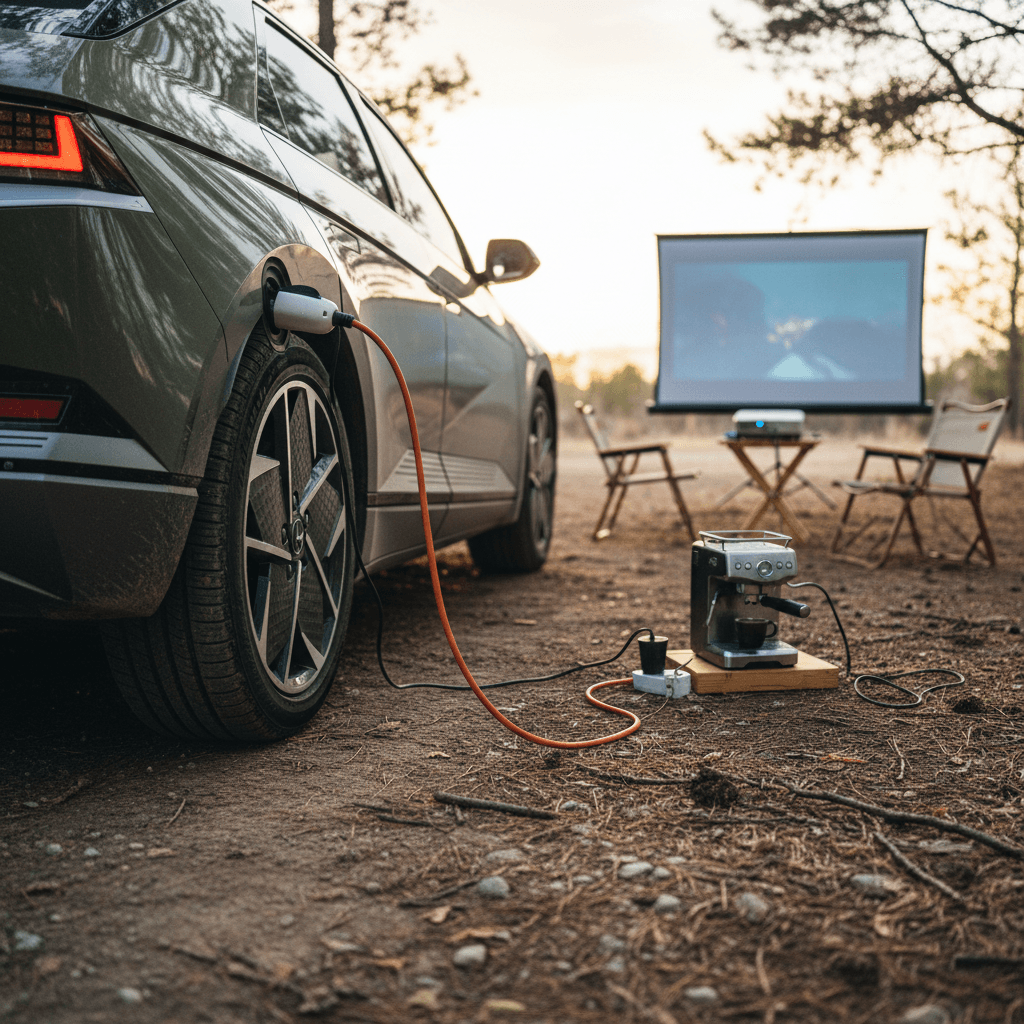
If you drive a Hyundai IONIQ 5, the built‑in Vehicle‑to‑Load (V2L) system is one of the car’s most useful, and most underused, features. With V2L, your IONIQ 5 can act like a rolling 120‑volt generator for camping, tailgating, home outages, or even helping a neighbor. This guide walks you through exactly how to use Hyundai IONIQ 5 V2L, step by step, with safety tips and real‑world examples.
Quick definition
What is V2L on the Hyundai IONIQ 5?
On the Hyundai IONIQ 5, V2L is a built‑in inverter system that converts the car’s DC battery power into AC power, similar to what you get from a 120‑volt household outlet in North America. Officially, the system is rated up to about 3.6 kW of output, enough for laptops and phones, but also heavier loads like power tools, a small space heater, or a compact fridge.
You can access V2L in two ways:
- Exterior V2L: Using a special adapter that plugs into the charge port and gives you a standard outlet at the rear of the car.
- Interior V2L (select trims): A 120‑volt outlet under the rear seats that looks like a regular household socket.
When V2L is most useful
IONIQ 5 V2L basics: power limits and trims
Hyundai IONIQ 5 V2L at a glance
A few key points before you start using V2L on your IONIQ 5:
- All IONIQ 5 trims support V2L through the exterior adapter. That includes SE, SEL, Limited, XRT and N. The inverter hardware lives in the car, not the adapter.
- Only higher trims (like Limited in the U.S.) have the built‑in interior outlet under the rear seats from the factory.
- In North America, V2L power is delivered as 120 V AC. Outside North America, it may be 230 V, always check your manual for your region.
- The interior and exterior V2L share the same circuit. If one is active, the other is live too, and they share the same 15‑amp limit.
Don’t overload the system
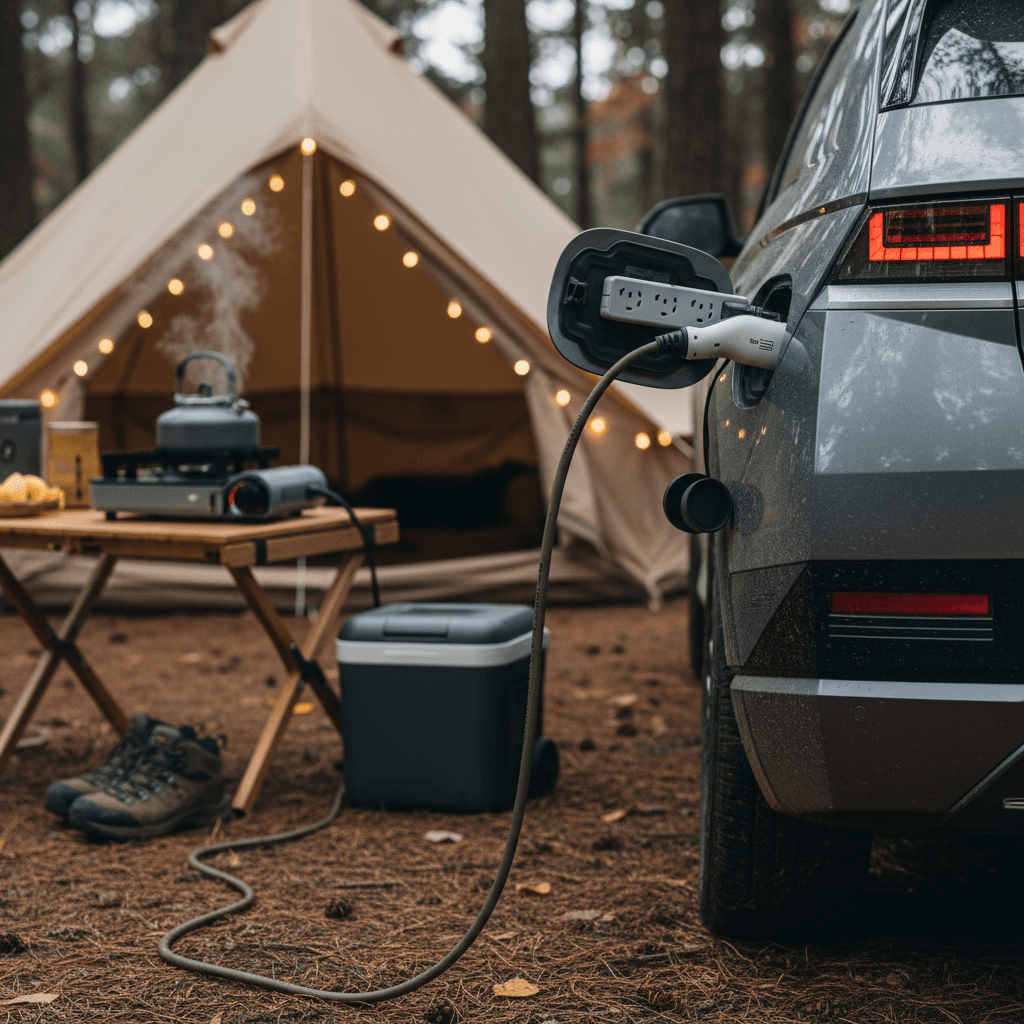
How to use exterior V2L with the adapter
The exterior V2L adapter is what turns your charge port into a wall outlet. Some IONIQ 5s were sold with the adapter included; others require you to buy it separately from Hyundai or a third party. Once you have it, here’s how to use it safely.
- Park safely and set the parking brake. Choose a flat, ventilated area. Avoid standing water or heavy rain if you’ll be using exposed cords.
- Make sure the car is not charging. You cannot use V2L while the car is actively charging from AC or DC. Unplug any charger first.
- Open the charge port door. This is usually on the rear quarter panel. Ensure there’s enough space behind the car to work safely.
- Insert the V2L adapter into the charge port. Push until it clicks and locks. On NACS‑port vehicles, use the correct NACS‑style adapter; on CCS vehicles, use the J1772‑style adapter designed for Hyundai’s V2L.
- Set your battery discharge limit in the infotainment screen. On most IONIQ 5s: EV → EV Charge Transfer (or V2L) → Discharge limit. Many owners set this to 20–30% so the car stops powering devices before the battery gets too low.
- Open the adapter’s outlet cover. You’ll see a standard three‑prong receptacle. Some adapters also have a power button and status light.
- Plug in your device or power strip. Use a grounded, outdoor‑rated extension cord or power strip when running multiple devices.
- Turn on the adapter (if applicable). Press the on/off button on the V2L adapter. Look for a green light to indicate power is flowing.
- Verify on the dashboard. The cluster or EV screen will usually show a V2L/Transfer icon and kW usage once a load is detected.
- To stop V2L, turn off the adapter and unplug. Press the adapter’s power button, unplug your devices, then release and remove the adapter before closing the charge door.
Use a short, heavy‑duty extension cord
How to use the interior V2L outlet
If your IONIQ 5 trim includes the interior outlet under the rear seats, you can power devices from inside the cabin without opening the charge door or using the external adapter. It’s especially handy for laptops, tablets, and small appliances while passengers relax.
- Check that the charge port door is closed. The interior outlet will not activate if the charge door is open, unless the exterior V2L adapter itself is plugged in.
- Turn the vehicle ON. Press the brake and start button so the cluster shows READY, or use Utility Mode if equipped. The car must be on; Accessory mode alone is often not enough.
- Open the outlet cover under the rear seat. You’ll see a standard three‑prong outlet and an indicator light.
- Plug in your device. Start with lower‑draw devices (laptops, chargers, small fans) to confirm it’s working, then move up to heavier loads if needed.
- Watch the indicator light. Many owners report the following behavior:
- Blue: Standby, outlet armed but no load.
- Green: Power flowing normally.
- Red: Fault or no power (overload, incompatible device, or system protection).
- Adjust the V2L discharge limit if needed. In the EV/V2L menu, make sure your minimum battery level isn’t set so high that it immediately cuts off power.
- Turn the car off when finished. Unplug your devices and shut the outlet cover before powering down.
Interior vs. exterior V2L behavior
Step-by-step checklist before you plug in
Quick safety and setup checklist
1. Confirm battery level
Aim for at least <strong>40–50% state of charge</strong> before running larger loads or using V2L for more than an hour. Set a minimum SOC limit in the EV → V2L menu so the car shuts off power before the pack gets too low.
2. Make sure the car isn’t charging
V2L and charging are mutually exclusive. Unplug any home EVSE, public Level 2, or DC fast charger before you try to activate V2L.
3. Park in a safe, ventilated spot
Avoid high‑traffic areas, tight garages with exhaust‑style fumes from other vehicles, or standing water. If you run cables outdoors, keep them clear of where people walk or drive.
4. Use proper cords and strips
Stick to <strong>grounded, outdoor‑rated extension cords</strong> and quality power strips with overload protection. Avoid dollar‑store strips and ungrounded adapters.
5. Add up your loads
Check the wattage labels on your devices (or Google them) and keep the total under ~1,800 W to stay within a safe 15‑amp limit at 120 V.
6. Know how to shut it down fast
If something smells hot, trips a breaker, or behaves oddly, you should know exactly where the adapter’s power button is and how to disable V2L in the EV/V2L menu.
What you can, and can’t, power with V2L
Because the IONIQ 5’s V2L system can deliver up to roughly 3.6 kW, you have a lot of flexibility. The trick is to think like an electrician: every device has a wattage rating, and all of those watts add up against your V2L budget.
Common devices to run from IONIQ 5 V2L
Approximate power draws will vary by model. Always check each device’s label before use.
| Device | Typical watts | OK for V2L? | Notes |
|---|---|---|---|
| Phone / tablet charger | 10–20 W | Yes | Barely dents the battery; run many at once. |
| Laptop | 60–100 W | Yes | Easy load; ideal for remote work or studying. |
| LED work light / string lights | 20–80 W | Yes | Great for camping or job sites. |
| Small fan | 40–75 W | Yes | Good for tents or tailgates. |
| Mini fridge / cooler | 80–150 W | Yes | Watch startup surge; keep door closed as much as possible. |
| Gaming console + TV | 150–300 W | Yes | Comfortable for several hours if battery SOC is healthy. |
| Cordless tool charger | 50–200 W | Yes | Perfect for remote DIY work. |
| Microwave (compact) | 700–1,200 W | Maybe | Use for short bursts only; don’t stack with other big loads. |
| Space heater | 1,000–1,500 W | Use with caution | Very heavy draw; monitor battery closely and never leave unattended. |
| Another EV via Level 1 EVSE | 1,200–1,500 W | Technically possible | Slow emergency top‑up only; not a primary charging solution. |
Use this as a planning guide, not a hard promise, actual consumption can fluctuate.
Sweet spot loads
Things to avoid
Important safety rules and common mistakes
Top safety rules
- Keep cords dry and off the ground when possible, especially around kids or pets.
- Uncoil extension cords fully. Coiled cords can overheat under heavy load.
- Don’t defeat safety features. Don’t bypass grounding pins or modify the V2L adapter.
- Use only one high‑draw appliance at a time. For example, run the microwave or the heater, not both.
- Never run heaters or stoves unattended. Treat V2L like a generator: useful, but requiring respect.
Common mistakes to avoid
- Forgetting the charge port is open. The interior outlet usually won’t activate with the charge door open.
- Assuming Accessory mode is enough. In most cases, the car must be fully ON (READY) or in Utility Mode.
- Overlooking the SOC limit. If you set V2L to stop at 60% and your battery is at 62%, it may shut off quickly.
- Using cheap splitters. They increase fire risk and can confuse the outlet’s safety sensors.
- Ignoring warning lights. If the outlet LED turns red or the cluster shows a fault, unplug devices and reset before continuing.
Using V2L for camping, tailgating, and outages
Where V2L really changes the game is when you treat your IONIQ 5 as both transportation and infrastructure. You don’t just drive to the campground or stadium, you bring the power with you.
Practical ways to use IONIQ 5 V2L
Real‑world scenarios where V2L makes EV ownership easier
Camping & overlanding
- Run LED string lights around your site.
- Power a portable induction cooktop or electric kettle.
- Keep a 12V/120V cooler humming overnight.
- Charge camera batteries, drones, and phones.
Tailgating & events
- Power a TV and streaming stick to watch the pre‑game.
- Run a small speaker system and lights.
- Use an electric grill or hot plate in short bursts.
Home backup (short outages)
- Keep your modem/router, phones, and a laptop running.
- Run a mini fridge or chest freezer to protect food.
- Power medical devices only if they’re within the outlet’s rating.
For longer outages or whole‑home backup, you’ll still want a dedicated home energy backup system.
Plan your battery budget
V2L and battery health: what owners should know
A fair question for any EV owner is whether regular V2L use will hurt battery life. So far, there’s no strong evidence that occasional, sensible V2L use (especially at moderate loads) is any worse than normal driving. The inverter and pack are designed to handle power flowing in both directions.
- Avoid running the pack very low just to squeeze out a few more minutes of V2L, deep discharges are harder on any lithium‑ion battery.
- Try not to combine high‑power V2L and aggressive driving back‑to‑back on very hot days; give the battery time to manage its temperature.
- If you frequently rely on V2L for work or backup, consider keeping your daily charge limit around 70–80% rather than 100% to reduce long‑term stress.
- Monitor how much energy V2L sessions consume in your trip computer; it helps you understand what’s “normal” for your use.
How Recharged looks at V2L on used IONIQ 5s
FAQ: Hyundai IONIQ 5 V2L how to use
Frequently asked questions about IONIQ 5 V2L
The Hyundai IONIQ 5’s V2L system is more than a party trick, it’s a genuinely useful tool that can replace a portable generator for many everyday situations. Once you know how to set discharge limits, choose the right outlet (interior vs. exterior), and respect the 15‑amp power ceiling, using V2L becomes second nature. Whether you already own an IONIQ 5 or you’re considering a used one, learning how to use Hyundai IONIQ 5 V2L turns your EV into backup power, a mobile office, and a camp kitchen on wheels, all in one.