Recharged
EV Stories Feed
How to Check EV Battery Health (Without Guessing or Getting Burned)
Photo by Marija Zaric on Unsplash
EV Ownership

How to Check EV Battery Health (Without Guessing or Getting Burned)

By Recharged Editorial11 min read
battery-healthused-ev-buyingev-inspectionev-warrantystate-of-healthrange-degradationleaf-spytesla-batteryrecharged-score

If you’re shopping for a used EV, the **battery is the whole ballgame**. Get the battery health wrong and that sweet deal can turn into a very expensive science project. The good news: you *can* learn how to check EV battery health without a PhD in electrochemistry or blind trust in a seller.

What this guide will give you

You’ll get a step‑by‑step process to check EV battery health: what to look for on the dash, a simple range test you can do in an afternoon, how to use apps and OBD tools, what dealer reports actually mean, and how Recharged verifies battery health on every car we sell.

Why EV battery health matters so much

In an electric car, **the battery pack is both fuel tank and engine**. It’s also the single most expensive component. A modern pack can easily represent 30–40% of the car’s value. That’s why checking EV battery health before you buy is not optional, it’s the core of your due diligence.

EV battery health basics: SOH, range and reality

Before you start poking at menus and apps, it helps to decode the jargon. Underneath every battery health report is the same basic question: **How much energy can this pack still hold compared with when it was new?**

Key EV battery health terms (in plain English)

These are the phrases you’ll see in apps, dashboards, and dealer reports.

State of Health (SOH)

SOH is the big one. It’s a percentage of original usable capacity.

  • 100% = like new.
  • 90% = gentle, normal aging.
  • 70% = typical warranty threshold for “end of life.”

State of Charge (SOC)

SOC is your fuel gauge: how full the battery is right now.

Health tests are most meaningful when run between 20–80% SOC, not at 2% or 100%.

Estimated Range

The number on the dash: how far the car thinks it can go.

Useful, but easily skewed by your last few trips, climate, and driving style. Treat it as a clue, not gospel.

Normal vs. worrying degradation

Across many modern EVs, a 1–2% loss of capacity per year is common under typical use. A five‑year‑old EV at 88–92% SOH is usually doing fine. The time to worry is when a relatively young or low‑mileage car is already flirting with 70–75% SOH.

Quick checklist: how to check EV battery health

Five steps to evaluate an EV battery

1. Check the cars own battery screens

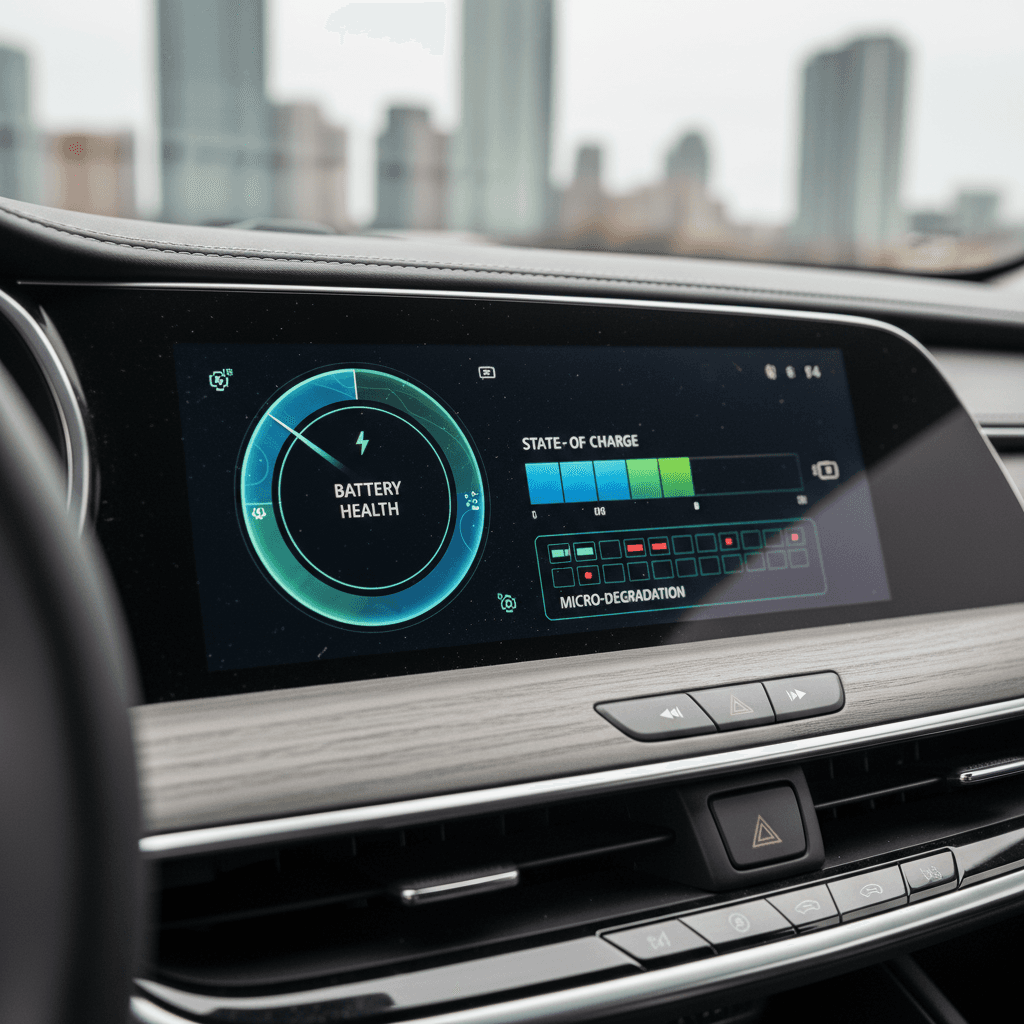
Dig into the dash or infotainment menus for any battery health readouts: capacity bars (Nissan Leaf), battery percentage health (some Korean and European brands), or explicit SOH where available.

2. Compare estimated vs. original range

Fully charge the car, note the range on the dash, and compare it to the original EPA rating for that model and trim. A modest gap is normal; a huge one is a red flag.

3. Do a simple real‑world range test

Drive a known route, log miles driven vs. percentage of battery used, and back‑calculate real‑world usable range under your conditions.

4. Pull deeper data with apps or OBD2

Use a Bluetooth OBD2 dongle and a model‑specific app (LeafSpy Pro, Car Scanner, EVNotify, Tesla‑focused apps) to read SOH, usable kWh, and cell balance where supported.

5. Get a professional battery health report

For high‑value purchases, pay for a dealer or specialist EV battery inspection, or buy from a seller like <strong>Recharged</strong> that includes an independent battery health report by default.

Step 1: Start with the cars own battery and range displays

Your first stop is always the car itself. Modern EVs are surprisingly talkative if you know where to look. You don’t need tools yet, just patience with menus.

Electric vehicle dashboard screen showing battery charge and estimated driving range
The battery and range screens in the dash are your first, easiest window into EV battery health.Photo by Annie Spratt on Unsplash

Dont over‑trust the dash

Some EVs are optimistic, some are pessimistic. A conservative range estimate on a cold day doesn’t mean the battery is bad. Always back this up with a real‑world drive and, where possible, a proper SOH reading.

Step 2: Do a simple real‑world range test

If you have a few hours with the car, a **controlled test drive is the most intuitive way** to check EV battery health. You’re essentially asking, “How many real miles do I get per 10% of battery?” and scaling that up.

  1. Start at a stable charge level. Aim for around 80–90% SOC at the beginning of the test.
  2. Pick a simple loop or there‑and‑back route. Ideally mostly flat, speeds between 30–65 mph, minimal stop‑and‑go.
  3. Reset the trip meter. Note starting mileage and starting SOC (for example, 85%).
  4. Drive at your normal, sane pace. Use climate control as you actually would; don’t game the test.
  5. After 20–40 miles, note ending mileage and SOC. For example: 38 miles driven, SOC dropped from 85% to 55% (a 30% drop).
  6. Calculate implied range. In that example, 38 miles / 0.30 ≈ 127 miles of full‑pack range under those conditions. Compare that to the EPA number for the car.

Factor in conditions

Cold weather, high speeds, heavy loads, and lots of highway driving all reduce range for perfectly healthy batteries. A winter test that shows 20–25% less range than the EPA number might be totally normal. What you’re watching for is drastic shortfall without a good explanation.

Step 3: Use apps and OBD tools for deeper EV battery data

If you want to get serious, or if you’re evaluating a pricey EV, apps and OBD tools let you peek behind the curtain. You’re still not doing lab science, but you can get much closer to the pack’s true State of Health.

Common tools for checking EV battery SOH

Exact support varies by model, but these names come up again and again in the EV world.

LeafSpy Pro (Nissan Leaf)

The go‑to app for Leafs. Paired with a Bluetooth OBD2 dongle, it can show:

  • Exact SOH percentage
  • Usable kWh remaining
  • Individual cell voltages and temps
  • Charge cycles and quick‑charge history

Car Scanner, EVNotify & others

Many non‑Tesla EVs (VW ID.4, Hyundai/Kia, some European brands) can expose:

  • SOH or capacity estimates
  • Pack voltage and current
  • Cell temperature spread

Support varies by car; always confirm your model is supported before buying hardware.

Tesla apps & Service Mode

Tesla doesn’t publish SOH directly in big friendly letters, but third‑party apps and Service Mode views can show:

  • Nominal full pack and usable kWh
  • Degradation estimates vs. new
  • Charging history and balance

Choosing an OBD2 dongle

Pick a reputable Bluetooth OBD2 adapter, popular choices among EV owners include VEEPEAK and OBDLink. Cheap, unbranded dongles can be flaky or even interfere with vehicle networks. Always follow the app developer’s hardware recommendations.

When you connect a compatible app, the key numbers to look for are:

Visitors also read...

Know when to stop DIYing

If the data looks strange, very low SOH, wild cell imbalances, or values that don’t line up with the car’s age and mileage, this is not a puzzle to solve on the driveway. Step away and get a professional EV technician or dealer to run a formal battery diagnostic, or move on to a different car.

Step 4: Ask for a professional EV battery health report

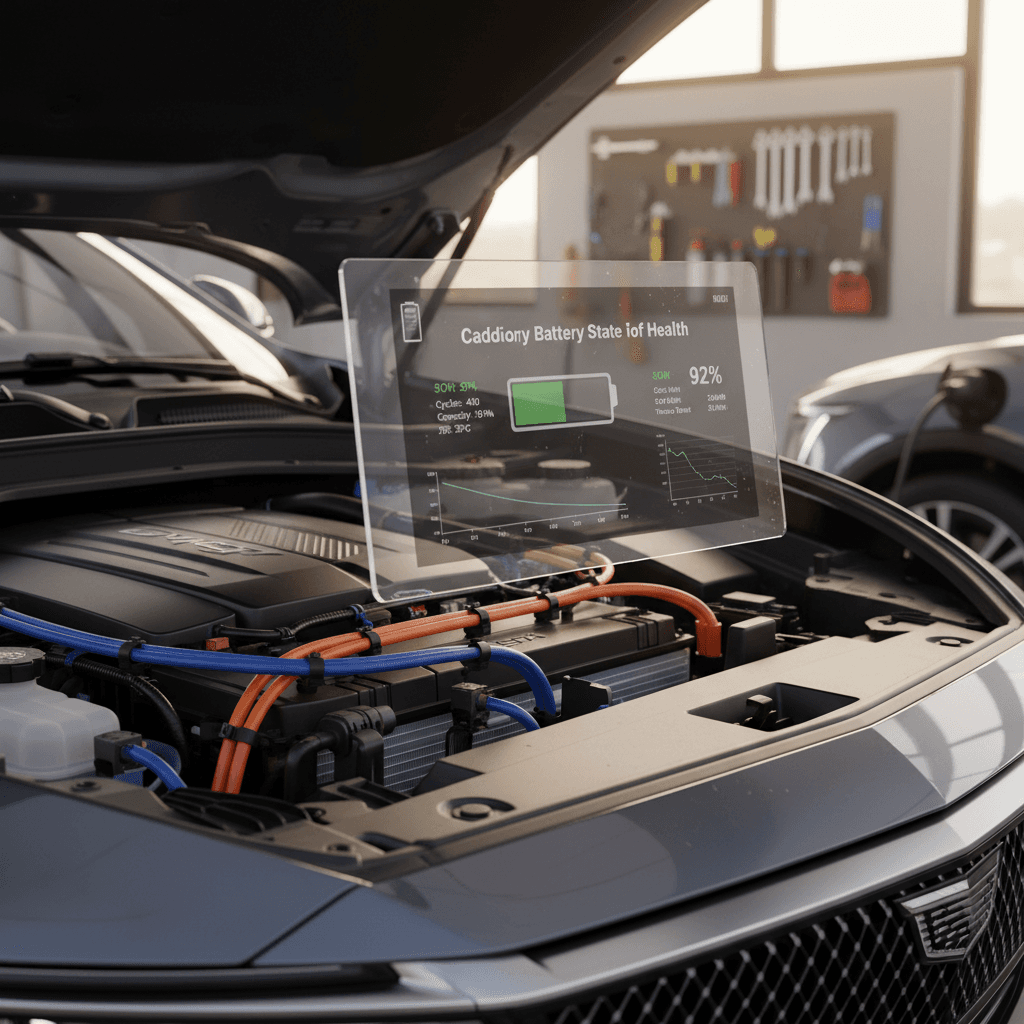
For higher‑value cars, or when you’re simply not comfortable interpreting numbers, paying for a **formal battery health report** is smart money. Think of it as a home inspection for the most expensive part of the car.

Technician inspecting the battery pack of an electric vehicle on a lift
A professional EV battery health diagnostic goes beyond generic “multi‑point” inspections that many dealers perform.Photo by Donovan Silva on Unsplash

Where to get a professional EV battery health check

Options range from OEM dealer tools to independent EV specialists.

SourceTypical Cost (USD)What You GetGood For
Franchise dealer for that brand$150–$300OEM‑level battery diagnostic, SOH / capacity report, fault codes, thermal management checkLate‑model EVs still under factory warranty
Independent EV specialist shop$150–$400Brand‑agnostic diagnostics, test drives, charging tests, written assessmentOut‑of‑warranty EVs, unusual brands, or modified cars
Mobile/third‑party inspection service with EV expertise$100–$250On‑site inspection, photos, basic scan and test drive; EV‑specific items if advertisedRemote purchases and private‑party sales
Buying from RechargedIncluded in priceA Recharged Score battery health report with verified SOH, range estimates, and pack diagnostics on every carIf you want independent battery verification baked into the deal

Prices and capabilities vary by region; always confirm EV experience before you book.

Why the Recharged Score matters

Every vehicle sold by Recharged includes a Recharged Score Report with verified battery health, fair‑market pricing, and expert‑guided support. You don’t have to argue with a strangers phone screenshot, the battery’s story is independently documented before you ever sign anything.

How EV battery warranties and capacity guarantees work

Battery warranties are your safety net against **abnormal** degradation. They’re not promising zero loss, they’re promising “not worse than this.” To use that safety net intelligently, you need to understand the fine print.

Typical EV battery warranty patterns (U.S., 2025–2026)

8–10 yrs
Warranty length
Most full EVs carry 8 years / 100,000 miles of high‑voltage battery coverage; some Korean and luxury brands stretch to 10 years.
~70%
Capacity floor
Many brands consider the battery “failed” for warranty when usable capacity falls below about 70% of original.
100k–150k
Miles covered
Mileage limits vary; adventure‑oriented brands sometimes go as high as 175,000 miles on pack and drive units.
Fed. minimum
8 yrs / 100k
U.S. regulations require at least 8 years or 100,000 miles of EV battery coverage; CARB states can drive stricter terms.

Dont buy “just inside warranty” without evidence

A used EV thats one year away from the end of its battery warranty with no documentation is a gamble. If its already near 70% SOH, you might inherit the fight with the dealer. If youre that close to the cliff, insist on a formal SOH report before buying.

Battery health red flags, green flags, and when to walk away

Green flags: signs of a well‑lived pack

  • Consistent story: SOH, mileage, and age line up (e.g., five‑year‑old, 60,000‑mile car at 88–92% SOH).
  • Clean history: No battery or thermal warnings in the dash, no history of pack repairs.
  • Calm temperature behavior: Fans and pumps behave normally; no repeated overheating messages under normal driving.
  • Transparent seller: Theyre happy to show service records, SOH screenshots, or a recent dealer report.

Red flags: time to think hard or walk away

  • Low SOH for age: Anything near or below 75% on a relatively young or low‑mileage car.
  • Big mismatch between tests: Dash range, OBD SOH, and real‑world range all tell different stories.
  • Warning lights: Battery‑system fault icons, persistent reduced‑power mode, or DC fast charging disabled.
  • Vague answers: Seller refuses a range test, wont let you plug in an OBD dongle, or bad‑mouths the idea of a dealer diagnostic.

The one hard line: unresolved HV battery faults

If the car is showing an active high‑voltage battery or isolation fault and the seller can’t produce a clear repair invoice from a qualified EV shop, do not rationalize your way into that deal. Modern packs are safe, but not forgiving of hacky fixes.

How Recharged checks EV battery health for you

If all of this sounds like homework, that’s because it is. The used EV market is still young, and a lot of sellers treat “battery health” like a vibe, not a number. At Recharged, we built our entire model around making that number clear.

Make the batterys health part of the price

Because every Recharged listing includes verified battery data and fair‑market pricing, youre not haggling in the dark. A car with stronger‑than‑average battery health is priced accordingly; a car with more miles on the pack is discounted with full disclosure.

EV battery health FAQ

Frequently asked questions about checking EV battery health

Bottom line: Make the battery earn your trust

In the gas‑car world, people still buy on paint color and seat heaters, then act surprised when the transmission explodes. Dont bring that energy into EVs. The right way to buy a used electric car is to start with the battery, end with the battery, and let everything else, trim, wheels, sunroof, fight for second place.

If youre shopping private‑party, follow the steps in this guide: mine the dash for clues, run a simple range test, leverage apps and OBD tools when you can, and dont be shy about asking a dealer or specialist for a written battery health report. If that sounds like more wrench‑time than you want in your life, let Recharged do the homework, every car we sell comes with verified battery health and expert support built in.

Either way, demand evidence. Make the pack prove itself. When you know how to check EV battery health, and insist on seeing the numbers, you turn a mysterious black box under the floor into something you can actually value, compare, and buy with confidence.


Discover EV Stories & Insights

Dive into our magazine-style feed with expert reviews, industry news, charging guides, and the latest electric vehicle trends, all in one place.

Explore Articles Feed

Related Articles

EV Battery Replacement Cost in 2025: Real Prices, Myths & How to Plan
EV Ownership9 min

EV Battery Replacement Cost in 2025: Real Prices, Myths & How to Plan

Worried about EV battery replacement cost? See 2025 prices by model, what warranties cover, and how to avoid big bills, plus options if you buy a used EV.

ev-battery-replacement-costbattery-healthused-ev-buying
How Much Do Batteries for Electric Cars Cost in 2025?
EV Ownership10 min

How Much Do Batteries for Electric Cars Cost in 2025?

Wondering how much batteries for electric cars cost? See 2025 EV battery prices, replacement costs by model, and how warranties protect you, plus tips if you buy used.

ev-battery-costsbattery-replacementused-ev-buying
BMW i4 Battery Replacement Cost: Real Numbers, Risks, and Alternatives
EV Ownership9 min

BMW i4 Battery Replacement Cost: Real Numbers, Risks, and Alternatives

Wondering what a BMW i4 battery replacement costs? See real-world price ranges, warranty rules, lifespan, and smarter options than replacing the pack outright.

bmw-i4battery-replacementbattery-health
Chevrolet Equinox EV Battery Health Check: 2026 Owner’s Guide
EV Ownership9 min

Chevrolet Equinox EV Battery Health Check: 2026 Owner’s Guide

Learn how to check Chevrolet Equinox EV battery health, understand range loss, warranty, and what to inspect when buying a used Equinox EV.

chevrolet-equinox-evbattery-healthbattery-degradation
Nissan Ariya Battery Degradation: Real‑World Data, Warranty, and Used‑Buyer Tips
EV Ownership9 min

Nissan Ariya Battery Degradation: Real‑World Data, Warranty, and Used‑Buyer Tips

Worried about Nissan Ariya battery degradation? Learn how the Ariya’s pack holds up, what Nissan’s warranty covers, and what to check when buying used.

nissan-ariyabattery-degradationbattery-health
Nissan Ariya Battery Replacement Cost: 2025–2026 Owner’s Guide
EV Ownership9 min

Nissan Ariya Battery Replacement Cost: 2025–2026 Owner’s Guide

See real-world Nissan Ariya battery replacement costs, warranty coverage, and when it’s smarter to trade into a different EV instead of replacing the pack.

nissan-ariyabattery-replacementev-ownership-costs

Big Story


Pre-qualify with no impact to your credit

Fast and easy

Answer a few simple questions, get prequalified.

No hit to your credit

All credit types are welcome. You'll see your approval status shortly after finishing.

Time to browse

Shop with comfort, then get financing through Recharged.

Recharged

Discover EV articles