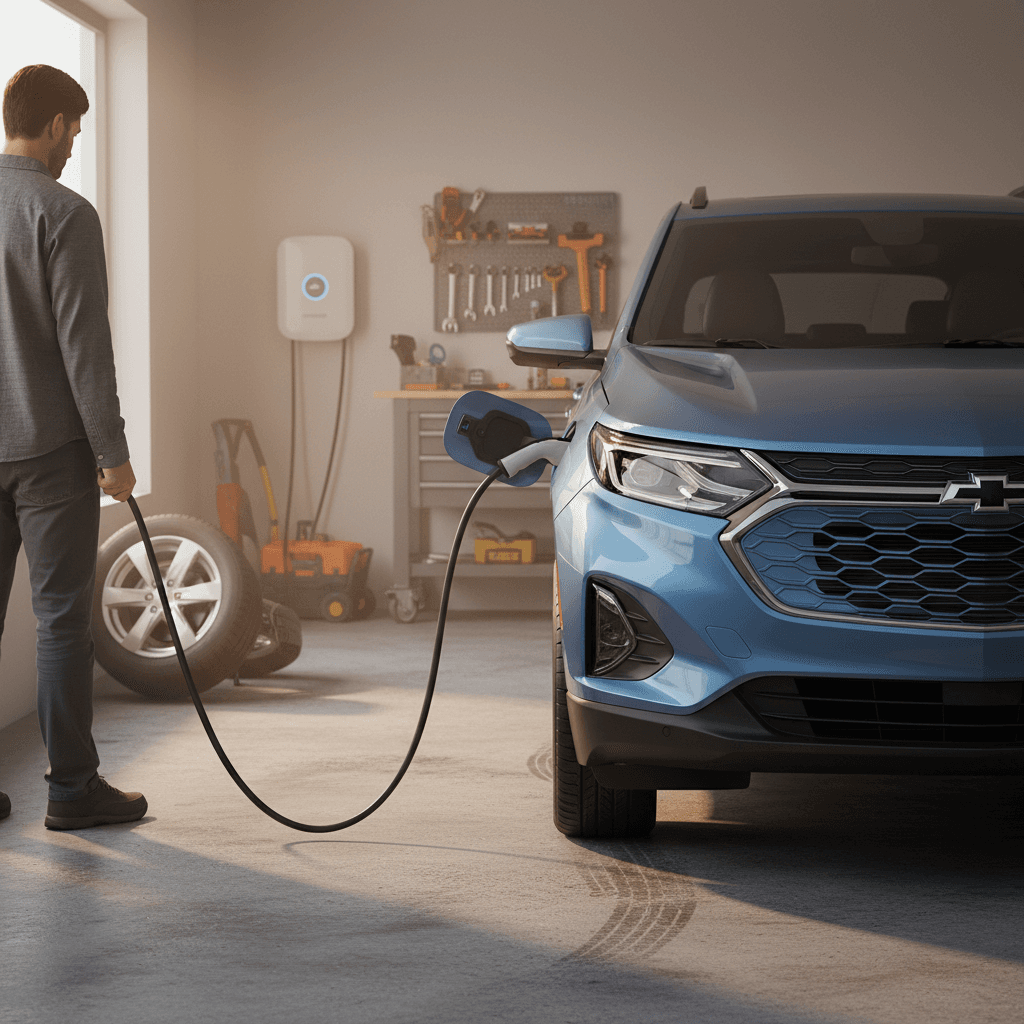
If you’ve just picked up a Chevrolet Equinox EV (or you’re thinking about buying a new or used one), the most important part of living with it is figuring out how to charge your Equinox EV at home. The good news: the Ultium hardware is flexible, and you can start with a basic wall outlet, then upgrade to faster Level 2 charging when it makes sense for your driving and budget.
Key takeaway
Chevrolet Equinox EV home charging basics
Before you buy any hardware, it helps to understand how the Equinox EV actually takes power. Under the floor is an ~85 kWh Ultium battery pack, and in most trims an 11.5 kW onboard AC charger that converts household AC to DC for the pack. At home you’ll normally use AC charging in one of two ways:
- Level 1 (120V), Uses a normal three‑prong household outlet. It’s slow (think 3–5 miles of range per hour), but cheap to get started and fine for low‑mileage drivers.
- Level 2 (240V), Uses a 240‑volt circuit like an electric dryer or dedicated wallbox. With the Equinox EV’s 11.5 kW capability, a properly sized Level 2 setup can add roughly 25–35 miles of range per hour of charging, enough for a full overnight refill from a typical commuting day.
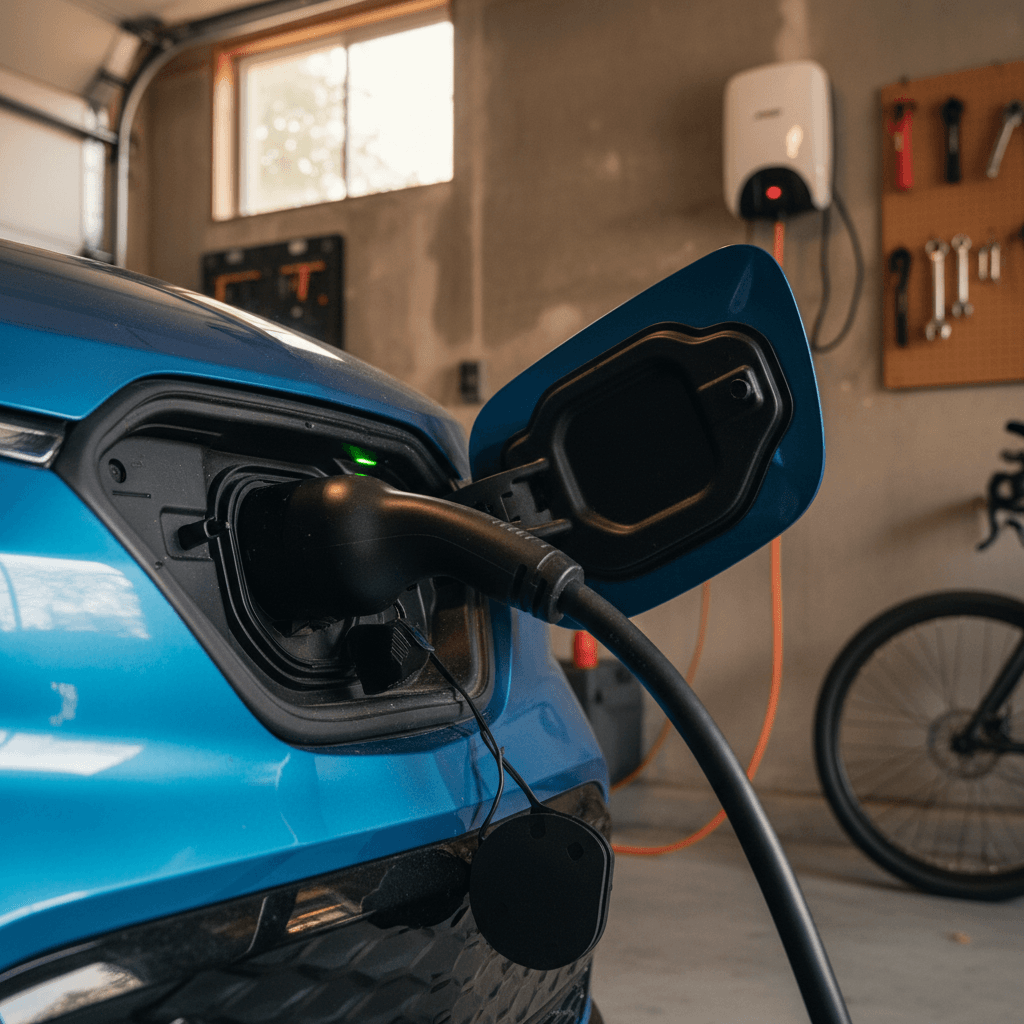
You’ll plug into the J1772 / NACS style port behind the charge door on the driver’s side front fender (GM is transitioning to NACS; functionally, home use is the same: you click the connector in until it latches and the Equinox EV handles the rest).
Home charging vs public fast charging
What comes with the Equinox EV, and what you might still need
Chevrolet has shipped different charging accessories depending on model year, trim, and incentive programs in your region. Many early Equinox EVs included a dual‑level portable charge cord (often called an EVSE) that can do both 120V Level 1 and 240V Level 2 up to around 7.7 kW when used on a 40‑amp 240V circuit. Later vehicles in some markets ship with no portable cord at all and expect you to buy one or install a wallbox.
Typical Equinox EV home charging gear
What you’re likely to have on day one, and what you might add later
Included or dealer‑supplied gear
- Dual‑level portable charge cord (some trims/years)
- 120V plug adapter for standard wall outlets
- Occasionally a 240V adapter for NEMA 14‑50 or 6‑50
Always check your window sticker or ask the seller exactly what charging hardware is included, especially on a used Equinox EV.
Optional upgrades you might buy
- Hard‑wired Level 2 wallbox (9.6–11.5 kW typical)
- Higher‑power GM Ultium or GM Energy PowerShift charger
- Aftermarket dual‑voltage portable EVSE for travel
If you’re buying an Equinox EV used from Recharged, your listing will spell out exactly what charging equipment comes with the car.
Don’t assume the cable is included
Level 1 vs Level 2: How fast will an Equinox EV charge at home?
Your Equinox EV’s onboard charger caps AC charging at about 11.5 kW on most trims. That’s the ceiling; how close you get depends on the circuit and EVSE you plug into. Here’s what that looks like in practice.
Typical Equinox EV home charging speeds
Optional higher‑power onboard charger
How to set up safe Level 1 charging for an Equinox EV
Level 1 is the “no‑installer” way to charge a Chevrolet Equinox EV at home. It’s slow, but for light drivers it works surprisingly well if you set it up safely and let it run whenever you’re parked.
Step‑by‑step: Level 1 charging on a 120V outlet
1. Pick the right outlet
Use a <strong>dedicated, three‑prong 120V outlet</strong> on a 15A or 20A circuit with no big loads (space heaters, fridges, power tools). Avoid daisy‑chained power strips, extension cords, or old outdoor outlets.
2. Inspect and test
Check that the outlet and wall plate are in good condition and don’t feel warm after 30–60 minutes of charging. If they do, stop and have an electrician take a look, heat is a sign of a bad connection.
3. Plug in your dual‑level cord
Connect your Equinox EV’s dual‑level cord (or another UL‑listed portable EVSE) to the outlet first, then to the car. The indicator lights on the EVSE should show it’s ready before you plug into the vehicle.
4. Set the correct amperage in the car
In the Equinox EV’s charging settings, you can typically choose between <strong>8A and 12A</strong> on Level 1. If your home circuit is marginal or shared, stick to 8A; on a healthy dedicated circuit, 12A is usually fine and gives you more miles per hour.
5. Let it run overnight
Level 1 charging can feel slow, but that’s the point, it’s gentle on your battery and works while you sleep. For a 30‑mile daily commute, plugging in every night can easily keep you topped up.
6. Save public fast charging for when you need it
If Level 1 isn’t fully covering your needs, use a public DC fast charger occasionally while you decide whether it’s worth upgrading to Level 2 at home.
Never use cheap extension cords
Installing a Level 2 home charger for your Equinox EV
If you routinely drive more than 40–50 miles a day, or you simply want to “fill from empty” overnight, a Level 2 charger is the right long‑term solution. That can mean either using the Equinox EV’s dual‑level cord on a 240V outlet or having a dedicated wallbox installed.
Option A: Use a 240V outlet + portable EVSE
- Electrician installs a NEMA 14‑50 or 6‑50 outlet near your parking spot.
- You plug in either GM’s dual‑level cord or an aftermarket 32–40A EVSE.
- Flexible: unplug and take the cord with you on trips.
- Good match if you rent or might move soon.
Option B: Hard‑wired wallbox
- Electrician runs a dedicated 240V circuit to a permanently mounted charger.
- Common sizes: 40A (≈9.6 kW) or 48A (≈11.5 kW) to fully match the Equinox EV’s onboard charger.
- Cleaner look, better cable management, built‑in Wi‑Fi and load management features.
- Best if this is your long‑term home base.
Level 2 installation checklist
1. Estimate your daily use
Roughly total your weekly miles and divide by seven. If you’re averaging more than 40–50 miles a day, or you want the flexibility to refill quickly after late‑night returns, Level 2 is probably worth it.
2. Get an electrician quote
Ask for pricing on a 40A and 50A circuit near your parking spot, including any panel upgrades. For most U.S. homes, expect installation in the mid‑hundreds to low‑thousands of dollars depending on distance and panel capacity.
3. Choose your EVSE
Match the charger’s <strong>continuous current rating</strong> to your breaker and the Equinox EV’s ~11.5 kW capability. A 40A wallbox on a 50A breaker or a 48A wallbox on a 60A breaker are common pairings.
4. Plan cable routing and mounting height
Make sure the cable can reach your Equinox EV’s front‑driver‑side charge port without crossing walkways or forcing tight bends. Mount the unit high enough to keep the holster comfortable to reach.
5. Pull any incentives or rebates
Check for local utility rebates on home EVSE installation and equipment. If you’re financing or buying a used Equinox EV through <strong>Recharged</strong>, you can factor the likely charger cost into your ownership budget up front.
Where Level 2 really pays off
Charging times and costs: Realistic Equinox EV examples
Exact numbers depend on your battery size, trim, weather, and local electricity rates, but we can sketch realistic ranges so you know what to expect. Below assumes an ~85 kWh pack, about 3.0 mi/kWh efficiency, and $0.16/kWh electricity, close to the current U.S. average.
Chevrolet Equinox EV home charging time and cost
Approximate time and cost to add common amounts of range at home.
| Use case | Energy added | Approx. miles added | Level 1 (120V, 12A) time | Level 2 (240V, 32A) time | Level 2 (240V, 48A) time | Estimated electricity cost |
|---|---|---|---|---|---|---|
| Daily top‑off | 10 kWh | ~30 mi | 6–8 hours | 1.5–2 hours | ≈1 hour | ≈$1.60 |
| Heavy commute day | 25 kWh | ~75 mi | 15–20 hours | 3.5–4 hours | ≈2.5 hours | ≈$4.00 |
| Weekend trip recovery | 50 kWh | ~150 mi | 30+ hours (not ideal) | 7–8 hours (overnight) | ≈5 hours | ≈$8.00 |
| Near‑empty to ~80% | 60–65 kWh | ~180–195 mi | Multi‑day (impractical) | 8–9 hours | 6–7 hours | ≈$10–11 |
Use this as a planning tool, not a promise; your numbers will vary slightly.
Compare to gasoline
Smart settings, scheduling, and battery health
Knowing how to charge a Chevrolet Equinox EV at home is only half the story. The other half is using the software tools GM gives you, the in‑car menus and the myChevrolet app, to charge cheaply and keep the battery happy over the long haul.
- Set a daily charge limit, For everyday use, many EV drivers choose 70–80% instead of 100%. That keeps a buffer at the top of the pack, which most battery chemistries prefer for long‑term health.
- Schedule charging for off‑peak hours, In the Equinox EV’s charging menu or app, set a schedule that starts after your utility’s peak period (often late evening) so you automatically get cheaper energy.
- Use “Charge to 100%” only for trips, There’s nothing wrong with an occasional 100% charge before a road trip, especially if you depart soon after. Just avoid sitting at 100% for days at a time.
- Save DC fast charging for when you need it, High‑power DC charging is a fantastic convenience tool but slightly harder on the battery. Home Level 1/2 should be your default; use DC fast only when time matters more than cost or long‑term wear.
Set your “home” location once
Troubleshooting slow or failed home charging
Most Equinox EV owners never think about charging once things are configured, but it’s useful to know the usual failure modes. If your home charging feels too slow, or doesn’t start at all, run through this quick diagnostic list.
Common home charging issues and fixes
Charging much slower than expected
Check what <strong>level</strong> you’re on. Level 1 at 8A will only add a few miles per hour; if you’re expecting 20–30 mi/hr, you need a 240V Level 2 circuit. Also confirm your EVSE amperage setting and the limit in the car’s menus.
Charging won’t start at home but works in public
Often this is an outlet or wiring problem, not the vehicle. Try a different outlet for Level 1, or verify that a 240V outlet shows proper voltage on a multimeter. If breakers trip or outlets feel warm, stop and call an electrician.
Stops charging before your target
Look for conflicting limits: scheduled charging windows, utility “demand response” programs, or a charge limit set lower at home than away. Some owners also accidentally set a location‑specific limit that differs from the global one.
Breaker keeps tripping
Your circuit may be undersized or already loaded with other appliances. Drop the charge amperage in the car (for Level 1) or on the EVSE, and ask an electrician whether a dedicated circuit is required.
EVSE error lights
Consult your charger’s manual; many wallboxes and portable cords have specific blink codes for ground faults, overheating, or bad wiring. Don’t override these warnings, it’s a safety feature.
When to involve a professional
Chevrolet Equinox EV home charging FAQ
Frequently asked questions about charging an Equinox EV at home
Wrapping up: Choosing the right home charging setup
Charging a Chevrolet Equinox EV at home doesn’t have to be complicated. Start from your actual driving: if your weeks are light and you have an accessible outlet, Level 1 may be all you need. If your lifestyle is busier or you just want the flexibility to refill quickly, a properly installed Level 2 charger turns your driveway or garage into a personal fast‑lane, with lower fuel costs than gasoline and far less hassle than hunting for public chargers.
If you’re considering a used Equinox EV, platforms like Recharged take some of the guesswork out. Every vehicle comes with a Recharged Score battery‑health report, transparent pricing, and EV‑savvy advisors who can talk through home‑charging options, estimated install costs, and whether Level 1 or Level 2 really fits your life. Dial in the right home charging setup once, and the day‑to‑day ownership experience tends to fade into the background, exactly how it should be.