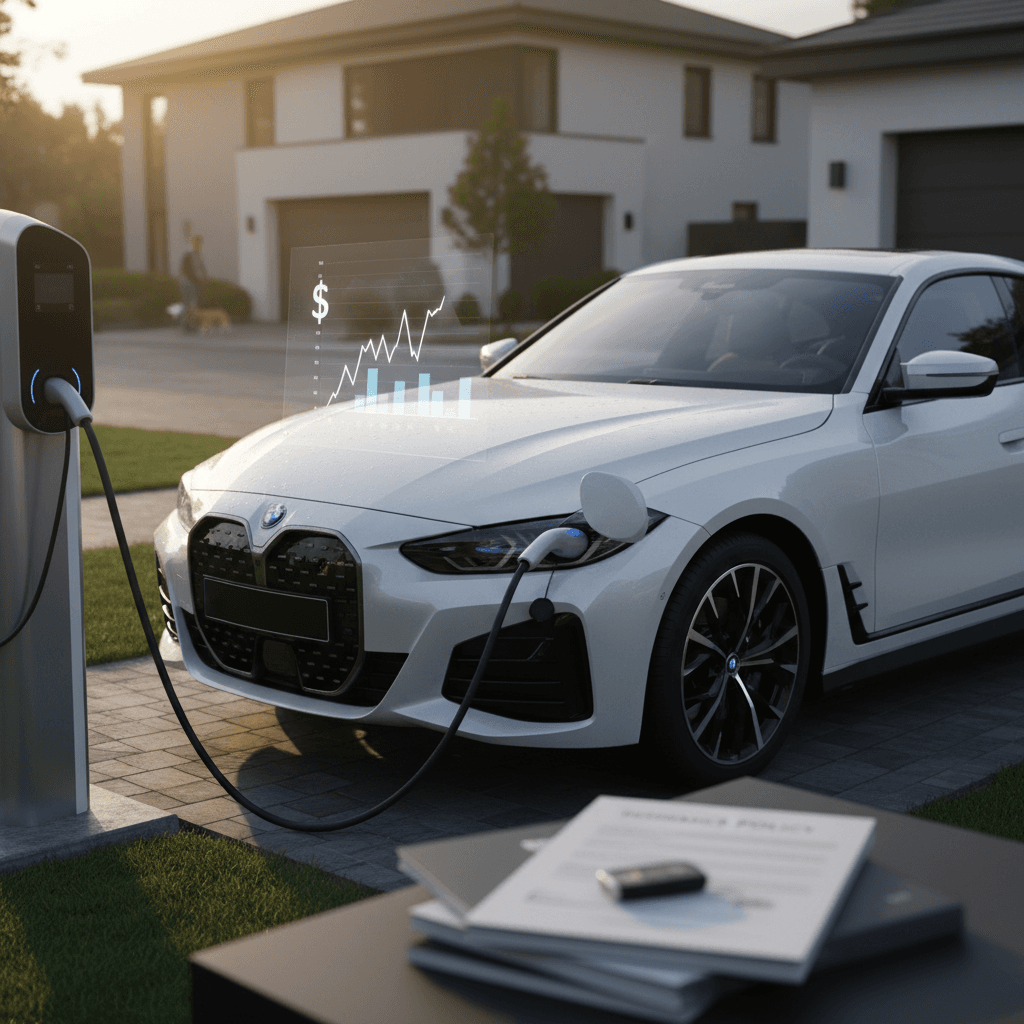
If you’re eyeing a BMW i4 or already have one in your driveway, insurance is a big piece of the total cost puzzle. So how much is insurance on a BMW i4 in the U.S., and what can you realistically expect to pay each year, especially if you’re considering a lower-priced used i4 instead of new?
Quick takeaway
BMW i4 Insurance at a Glance
BMW i4 Insurance Snapshot (Typical U.S. Ranges)
Insurers still treat the BMW i4 as a premium performance EV. That means you’re usually starting from a higher baseline than a typical compact sedan or small crossover, then adjusting up or down for your personal profile. Newer models, higher trims, and big wheels or performance packages all tend to nudge premiums higher, while a strong credit score, clean record, and safe driving features can pull them down.
How Much Is Insurance on a BMW i4 on Average?
There’s no single price that fits every driver, but if you’re trying to budget, it helps to work with a realistic range. For a BMW i4 driver in the U.S. with a clean record, full coverage, and average commuting miles, many shoppers will see quotes land in this zone:
Typical BMW i4 Insurance Ranges in the U.S.
These are directional ranges based on common profiles, not guaranteed prices. Your personal quote may fall outside these bands depending on age, ZIP code, and coverage choices.
| Driver profile & vehicle | Estimated annual | Estimated monthly | Notes |
|---|---|---|---|
| Adult driver, clean record, BMW i4 eDrive35 (used, 3–4 years old) | $1,400–$1,900 | $115–$160 | Lower purchase price helps; still a premium EV. |
| Adult driver, clean record, BMW i4 eDrive40 (new or nearly new) | $1,600–$2,200 | $135–$185 | Higher MSRP and newer parts push costs up. |
| Adult driver, clean record, BMW i4 M50 (new or nearly new) | $1,900–$2,600 | $160–$215 | More power and higher replacement cost = pricier to insure. |
| Young driver (under 25), any BMW i4 | $2,800+ | $230+ | Age and inexperience are the biggest cost drivers. |
| City driver with prior accidents (any trim) | $2,400+ | $200+ | Dense traffic plus at-fault claims can spike premiums. |
Use these ranges only as planning benchmarks; always get personalized quotes.
These are planning numbers, not quotes
7 Factors That Make BMW i4 Insurance Higher or Lower
Why does your friend pay $140 a month for their i4 while your quote is $210? Electric vehicles stack the usual insurance factors on top of EV-specific quirks. Here are the levers that move a BMW i4 premium the most.
Major Factors That Shape BMW i4 Insurance
Some you can control, some you can’t, but it helps to know which is which.
1. Where you live
2. Age & driving history
3. Trim and performance
4. Claim and accident history
5. Coverage level & deductibles
6. Annual mileage & use
Factor 7: Credit and loyalty
eDrive35 vs eDrive40 vs M50: Trim-Level Insurance Differences
BMW sells the i4 in several trims, and insurers don’t ignore those badges. Under the skin, every i4 is an EV with a large battery pack and advanced electronics, but power output, MSRP, and repair costs differ by model.
Lower trims: eDrive35 and eDrive40
- eDrive35 is typically the most affordable i4 to buy used and often cheapest to insure, thanks to a smaller battery and lower sticker price.
- eDrive40 sits in the middle: more power and range than the 35, but usually cheaper to insure than an M50.
- Insurers see these as premium EVs, but not full-blown performance cars.
Performance trim: i4 M50
- Dual motors, more power, and sportier intent push the M50 closer to performance sedans in insurers’ risk models.
- Repair costs are often higher thanks to larger wheels, performance tires, and upgraded brakes and suspension.
- Expect the M50 to sit at the upper end of the i4 insurance range, especially for young or high-risk drivers.
How big is the gap?
Does a Used BMW i4 Cost Less to Insure?
Often, yes, but not always as dramatically as you might expect. Insurance prices are driven by current replacement cost and repair cost, not just model year.
- A 3–4‑year‑old i4 eDrive35 or eDrive40 with a lower market value can be cheaper to insure than a brand‑new M50 with every option.
- If you finance a used i4, your lender will still require full coverage, just like on a new car.
- Insurers sometimes give modest breaks for mature, claims-free vehicles, but the savings may be overshadowed by your personal profile (age, tickets, credit).
Where used really helps
If you’re exploring used, this is where Recharged leans in. Every car on our marketplace comes with a Recharged Score report, so you can line up battery health, vehicle condition, and your insurance quotes before you ever sign paperwork.
What Coverage Do You Really Need on a BMW i4?
Because the BMW i4 is a high-tech, high-value EV, cutting coverage to the legal minimum is almost never a good idea. Here’s how to think about the major pieces of a policy.
Core Coverage for BMW i4 Owners
Think of these as the non‑negotiables for protecting a premium EV.
Liability (bodily injury & property damage)
Collision
Comprehensive
Uninsured/underinsured motorist
Don’t skip EV‑specific extras without thinking
9 Smart Ways to Lower BMW i4 Insurance Costs
You can’t change your age or magically teleport to a cheaper ZIP code, but you do have more control than you think. Here are practical, EV‑friendly tactics BMW i4 owners use to bring premiums back down to earth.
Practical Savings Moves for BMW i4 Drivers
1. Shop several EV‑friendly insurers
Not every carrier prices electric vehicles the same way. Get <strong>at least three or four quotes</strong>, and specifically ask how each company handles EV repair and battery claims.
2. Adjust your deductibles thoughtfully
Raising your collision and comprehensive deductibles from, say, $500 to $1,000 can cut premiums. Just be honest with yourself about what you could comfortably pay out of pocket after a claim.
3. Bundle home and auto
If you own a home or condo, bundling the policy with your BMW i4 can unlock significant multi‑policy discounts. Renters policies can also count toward bundling with some carriers.
4. Use telematics or safe‑driver programs
Many insurers offer usage‑based programs that track acceleration, braking, and mileage through an app or plug‑in device. EVs like the i4 often score well if you drive smoothly and don’t rack up huge miles.
5. Ask about EV or green‑vehicle discounts
Some companies offer <strong>explicit discounts for electric vehicles</strong> or vehicles with advanced safety features. They’re not huge on their own, but they stack with other savings.
6. Right‑size your annual mileage
If you’re working remotely or using the i4 as a second car, don’t let the quote default to a long‑commute assumption. Accurately reporting low annual mileage can shave costs.
7. Improve your credit over time
In states where it’s allowed, better credit often means better insurance rates. You won’t fix this overnight, but it’s one lever that can make future renewals more affordable.
8. Re‑shop at renewal, especially after life changes
New address, fewer miles, old tickets dropping off, each can improve your risk profile. Don’t assume your current insurer is still the best fit after those changes.
9. Consider a safer trim or older model year
If you’re shopping, know that a <strong>used eDrive35 or eDrive40</strong> can be cheaper to insure than a new M50. That matters when you’re comparing total cost of ownership, not just the monthly payment.
Insuring a BMW i4 You’re Leasing or Financing
Most BMW i4s on the road today are either leased or financed, and lenders play a big role in dictating how much insurance you must carry. Skimping on coverage isn’t an option if you still owe money on the car.
- Your lender or leasing company will require full coverage (liability, collision, and comprehensive).
- Leases often specify minimum liability limits that are higher than state minimums, check the fine print.
- If you put little money down, you may want, or be required, to carry gap insurance, which covers the difference between what you owe and the car’s actual cash value if it’s totaled.
- Some lenders bundle gap coverage into the loan or lease; others expect you to buy it from your insurer. Compare both options.
Pair your insurance shopping with your purchase
EV-Specific Insurance Issues BMW i4 Owners Should Know
EVs like the BMW i4 carry a different risk and repair profile than gas cars. That doesn’t automatically make them more expensive to insure, but it does change how claims get handled and why parts of your policy cost what they do.
How Electric-Only Design Affects Insurance
These are some of the reasons EV premiums, and repair bills, look different.
Battery pack damage risk
Limited EV‑trained repair shops
Software & electronics
Charging equipment coverage
Weather & range
Safety tech benefits

BMW i4 Insurance: Frequently Asked Questions
Common Questions About Insuring a BMW i4
Bottom Line: Budgeting for BMW i4 Insurance
For many U.S. drivers, insuring a BMW i4 lands somewhere between $1,600 and $2,400 per year, with lower trims and used examples typically sitting closer to the bottom of that range and the performance‑oriented M50 at the top. Where you fall depends on the usual suspects, age, driving history, credit, and ZIP code, plus EV‑specific factors like repair complexity and battery replacement cost.
If you’re comparing a new versus used BMW i4, don’t just look at the payment. Put insurance in the same spreadsheet. A well‑priced used i4 with slightly lower insurance can deliver a much more comfortable total cost of ownership without giving up the tech and driving feel that make this car compelling.
That’s where a marketplace built specifically for EVs earns its keep. On Recharged, every used BMW i4 comes with a Recharged Score battery‑health and pricing report, EV‑savvy support, and nationwide delivery options. Pair that transparency with a few smart insurance moves, shopping multiple EV‑friendly carriers, dialing in your coverage, and choosing the right trim, and you’ll know exactly what your BMW i4 will cost to own, not just to buy.