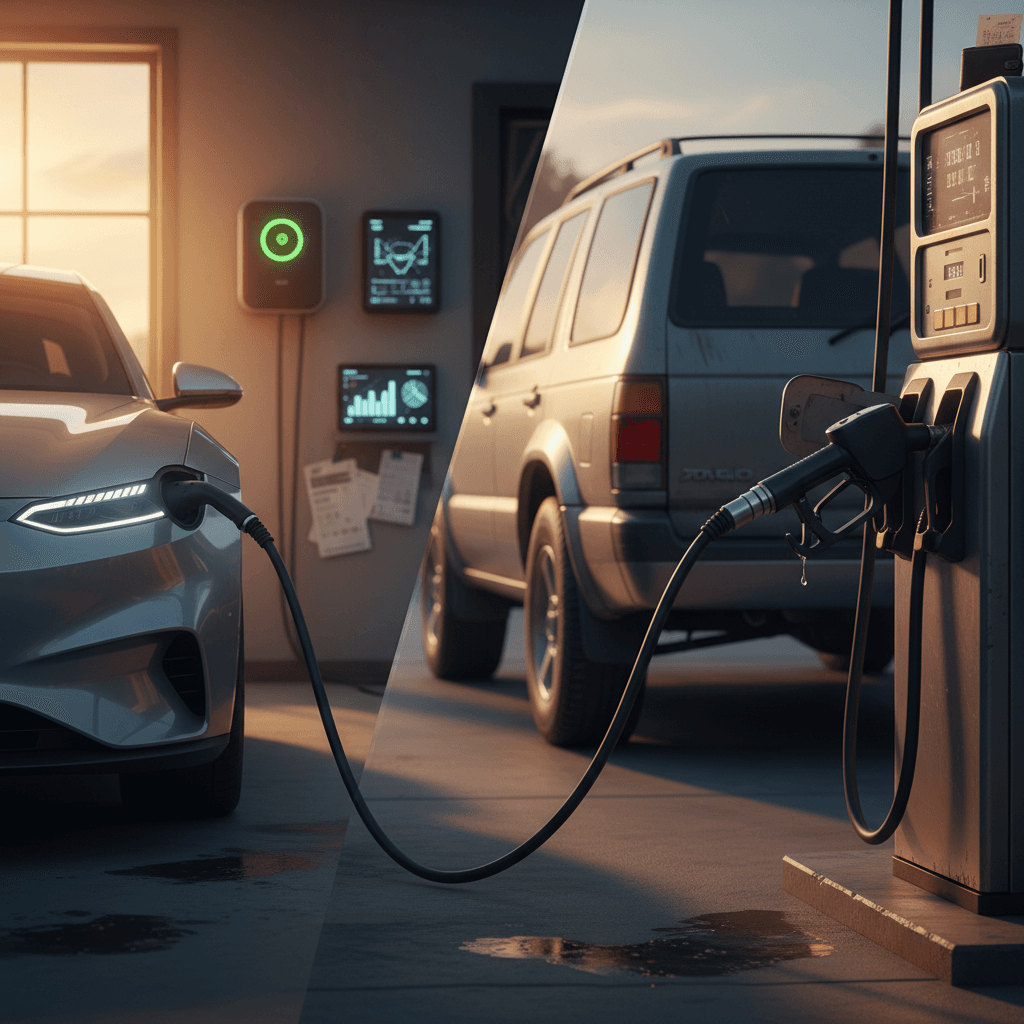
You’re not alone if you’re staring at $4‑a‑gallon gas and wondering, **how much does it cost to charge an EV vs fill up with gas** right now. The answer is: it depends where you live, how you charge, and what you drive, but the underlying math is straightforward once you break it down to cost per mile.
Snapshot for April 2026
EV vs gas: what does it really cost in 2026?
Typical U.S. cost per 100 miles (2026 averages)
Those ranges are broad on purpose. A very efficient EV charged mostly at home in a cheap‑electricity state can cost **less than half as much per mile** as a typical gas car. A big, inefficient EV that lives on pricey DC fast chargers in a cheap‑gas region can come close to gas parity, or even lose the edge on “fuel” cost. The trick is understanding the levers you control: efficiency, energy prices, and where you plug in.
Key numbers at a glance: EV charging vs gas
Core assumptions for this comparison
You can easily swap in your own local prices or vehicle numbers.
EV efficiency
Most modern EVs fall between 28–40 kWh per 100 miles, depending on size and driving style. Compact sedans tend to be at the low end, big SUVs and trucks at the high end.
Gas car efficiency
The real‑world U.S. light‑duty fleet averages roughly 25–30 mpg. A thrifty hybrid can beat 40 mpg, while large SUVs and trucks are often in the teens or low 20s.
Energy prices
In early 2026, typical U.S. prices are around 17–19¢/kWh for residential electricity and roughly $4.00/gal for regular gas. Your local numbers may differ a lot, especially electricity.
Use this to plug in your own numbers
How to compare EV vs gas cost per mile
Step 1: EV cost per mile
The simplest way to compare is to convert everything to cost per mile.
Formula:
EV cost per mile = (kWh per 100 miles × electricity price) ÷ 100
Example: Suppose your EV averages 30 kWh/100 miles and you pay 18¢/kWh at home.
- Energy cost for 100 miles = 30 × $0.18 = $5.40
- Cost per mile = $5.40 ÷ 100 = $0.054 per mile
Step 2: Gas cost per mile
Do the same for a gasoline car.
Formula:
Gas cost per mile = gas price ÷ mpg
Example: A 30 mpg car on $4.00/gal gas:
- Cost per mile = $4.00 ÷ 30 ≈ $0.13 per mile
- Cost per 100 miles ≈ $13.33
In this scenario, the EV costs about 5.4¢/mile vs the gas car’s 13.3¢/mile, roughly a 60% savings on “fuel.”
Beware perfect‑world ratings
Home charging: what you’ll actually pay
For most EV owners, home charging is the backbone of the cost advantage. It’s usually the cheapest, most convenient way to “refuel,” and it’s also where you have the most control, through your electricity plan, charging schedule, and even rooftop solar if you have it.
Example home‑charging scenarios (per 100 miles)
Three common EV types on different residential electricity rates. Swap in your own numbers to fine‑tune the comparison.
| Scenario | EV type & efficiency | Electricity rate | Cost per 100 miles | Comparable gas car cost* |
|---|---|---|---|---|
| Efficient commuter | Compact EV at 28 kWh/100 mi | $0.15/kWh | $4.20 | $11.43 (30 mpg, $3.43/gal) |
| Typical crossover | Mid‑size crossover at 32 kWh/100 mi | $0.18/kWh | $5.76 | $13.33 (30 mpg, $4.00/gal) |
| Large SUV/truck | Big EV SUV at 40 kWh/100 mi | $0.20/kWh | $8.00 | $16.00 (25 mpg, $4.00/gal) |
All figures rounded; real‑world efficiency will vary with speed, temperature, and driving style.
What the table shows
- Most utilities charge higher rates in the afternoon and early evening. If your plan supports it, scheduling charging after 9–10 p.m. can shave several cents per kWh off your cost.
- Some regions offer EV‑specific or time‑of‑use plans where overnight rates are dramatically lower. In those cases, EV “fuel” costs can drop into the $3–4 per 100 miles range for typical crossovers.
- If you own solar and size it appropriately, your marginal cost to charge can be near zero during sunny hours, though the panels and inverter themselves are not free, so that’s a separate investment decision.
Set it and forget it
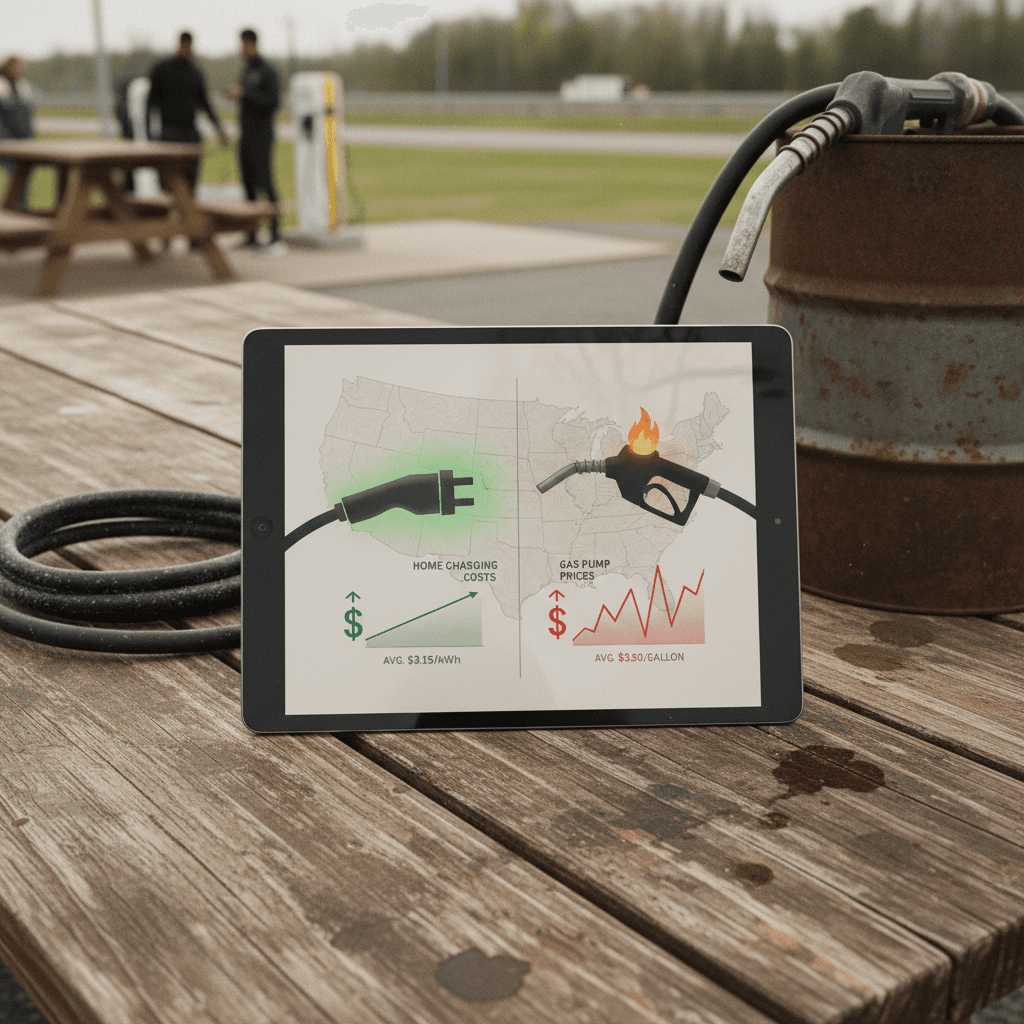
Public charging: when EVs are cheaper (and when they’re not)
Public charging is where the simple “EVs are always cheaper” narrative can break down. You’re paying not just for electricity but for the convenience and the massive infrastructure behind high‑power DC fast chargers. Think of it less like your home power bill and more like buying bottled water at an airport.
Typical public charging cost ranges (per 100 miles)
Approximate U.S. pricing as of early 2026. Actual rates vary by network, location, and membership plan.
| Charging type | Typical price | EV cost per 100 miles | Notes |
|---|---|---|---|
| Level 2 public (workplace, city lots) | 15–30¢/kWh | $4.80–$9.60 | Often similar to or slightly above residential rates; sometimes free at workplaces or hotels. |
| DC fast (non‑Tesla networks) | 30–60¢/kWh | $9.60–$19.20 | Pricing models vary: per kWh, per minute, or hybrid. Membership discounts can help. |
| Tesla Supercharger (non‑Tesla access) | 25–55¢/kWh | $8.00–$17.60 | Heavily location‑ and time‑dependent; off‑peak rates can be much cheaper. |
Assumes a mid‑size crossover using 32 kWh/100 miles. Session fees, idle fees and taxes can raise effective costs, especially for short charging stops.
The costly edge cases
How to keep public charging costs in check
1. Favor Level 2 when you can
For errands, workdays, or overnight stays, Level 2 often costs less per kWh than DC fast and is gentler on your battery.
2. Join membership programs
Most major networks offer discounted rates for members. If you road‑trip regularly, those savings add up quickly.
3. Charge deeper at home, top up in public
Arrive at DC fast chargers with lower state of charge and leave with enough to comfortably reach a cheaper Level 2 or your home charger instead of relying on fast charging for every mile.
4. Watch idle and session fees
Many stations tack on per‑minute idle fees after your charge completes. Moving your car promptly prevents surprises and frees the stall for the next driver.
How your state’s electricity and gas prices change the math
National averages are useful, but nobody pays the national average. California, New England and Hawaii see some of the highest residential electricity prices in the country, while parts of the Midwest and South are well below the national mean. Gasoline prices vary by more than a dollar per gallon between cheapest and most expensive states.
High‑electricity, high‑gas states
In places like California, both electricity and gasoline are relatively expensive. Residential rates above 25¢/kWh aren’t unusual, but regular gas may also run well above $4.00/gal.
Result: EVs still usually win on per‑mile energy cost, especially with off‑peak or EV‑specific electricity plans, but the advantage narrows. The bigger story there often becomes HOV access, emissions rules, and urban driving convenience rather than pure fuel savings.
Low‑electricity, moderate‑gas states
In parts of the Midwest or South where electricity might be closer to 12–15¢/kWh and gas prices sit near national averages, EVs can be extraordinarily cheap to run per mile. A mid‑size crossover at 30 kWh/100 miles and 13¢/kWh is only about $3.90 per 100 miles.
Result: In these markets the fuel‑cost advantage of an EV is stark, which is one reason you see growing interest in used EVs as commuting appliances.
Quick way to localize this article
Beyond “fuel”: maintenance, depreciation and total cost of ownership
Energy is only one line in the total cost of owning a vehicle. Even if an EV and a gas car are neck‑and‑neck on per‑mile fuel costs in your particular situation, the EV can still come out ahead, often by a wide margin, once you factor in maintenance and long‑term reliability.
Key non‑fuel cost differences: EV vs gas
Why looking only at the pump or charger can be misleading.
Maintenance and repairs
EVs have far fewer moving parts: no oil changes, timing belts, spark plugs, or exhaust systems. You still have brakes, tires, cabin filters and coolant, but service schedules are simpler and typically cheaper over 5–10 years.
Battery health
Modern EV packs are engineered to last well over 100,000 miles, and many include 8–10‑year battery warranties. Actual degradation trends vary by model and climate, which is why tools that measure real battery health, like the Recharged Score, matter so much for used buyers.
Depreciation and resale
EV resale values have been volatile as technology and incentives change. Buying used can let you benefit from early‑owner depreciation, while still enjoying low running costs going forward, especially if you know the battery’s true condition.
Putting it together: total cost of ownership
Why this math matters even more for used EVs
If you’re shopping new, you’re comparing a high sticker price EV against a high sticker price gas car, with long‑term savings still abstract. In the used market, that equation changes. Many used EVs have already taken their steepest depreciation hit but still deliver years of low‑cost driving, if the battery is healthy and the price reflects the market correctly.
Used EV fuel savings stack on top of price savings
A reasonably priced used EV that costs half as much to “fuel” per mile as your current gas car quickly becomes more than a climate or tech statement, it’s a practical household cost‑cutting tool. For commuters racking up 10,000–15,000 miles a year, the annual energy savings alone can look like an extra car payment.
Why verified battery health matters
The catch with used EVs is uncertainty around the battery. That’s why every vehicle sold through Recharged comes with a Recharged Score Report that includes verified battery health and fair‑market pricing. You can line up your expected energy costs with a clear picture of how much usable capacity you’re actually buying, no guesswork required.
If you’re trading in a gas car, Recharged can also provide an instant offer or consignment option, so you’re not trying to juggle private sales while learning a new fueling economy.
FAQ: EV charging vs gas fill‑ups
Frequently asked questions about EV vs gas costs
Bottom line: when does an EV really save you money?
When you cut through the noise, the pattern is consistent: if you can charge at home or work at reasonable electricity rates, and you drive a typical modern EV, your **per‑mile energy cost is usually 30–60% lower** than a comparable gas car on today’s prices. Stack that on top of simpler maintenance and the right purchase price, especially in the used market, and the economics of EV ownership become hard to ignore.
If you’re EV‑curious but cost‑cautious, start by modeling your own numbers with the formulas in this article. Then, if a used EV looks appealing, explore options on Recharged. Every vehicle comes with a Recharged Score Report so you can align price, battery health, and realistic charging costs before you make the leap, and know exactly how much you stand to save compared to your next tank of gas.