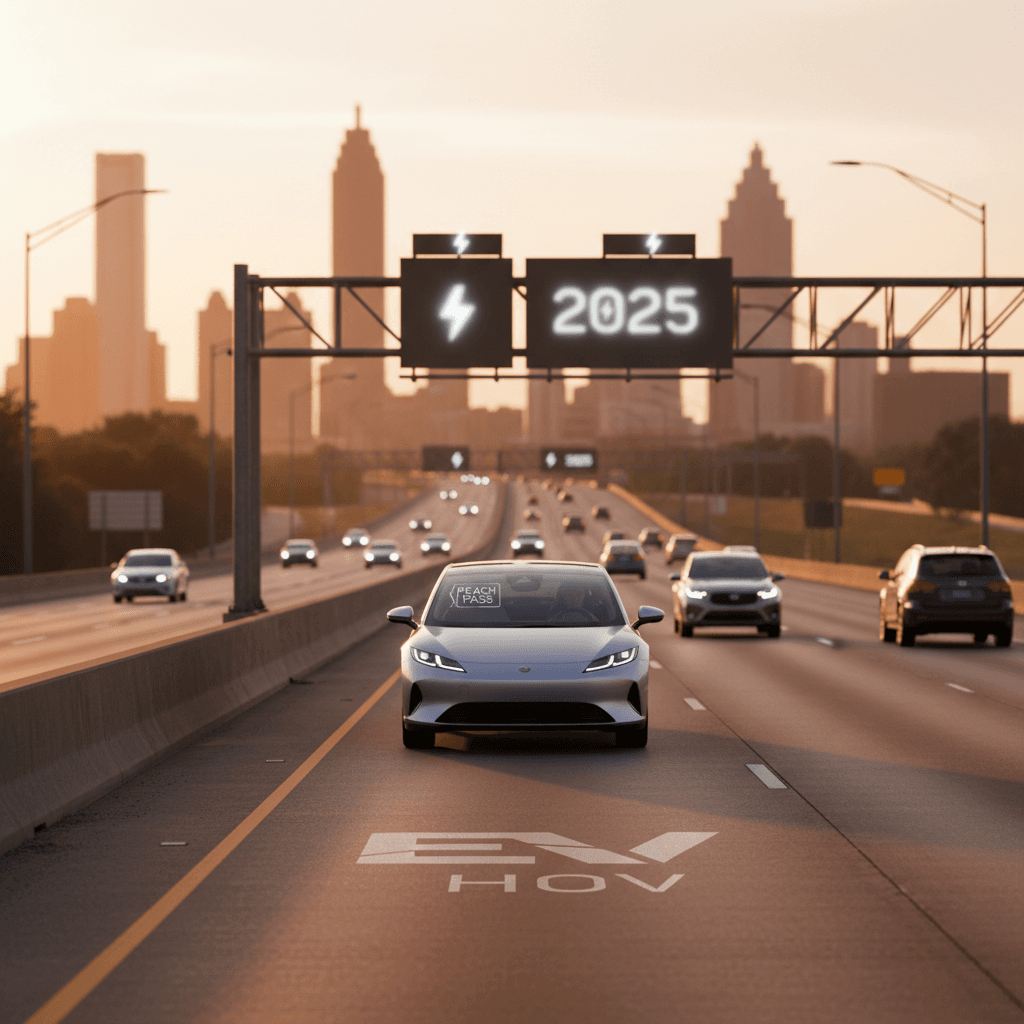
If you drive an electric vehicle in Georgia, the HOV and express lane perks you *used* to hear about have changed. As of late 2025, the federal exemption that let many EVs with Alternative Fuel Vehicle (AFV) plates use HOV and I‑85 express lanes solo has expired, and Georgia’s rules have shifted with it. This guide breaks down today’s Georgia EV HOV lane rules in plain English so you know when you can use these lanes, when you’ll pay tolls, and how to avoid an expensive ticket.
Quick snapshot for EV drivers
Overview: Georgia EV HOV lane rules in 2026
For years, Georgia offered EV owners a valuable traffic perk: with the right license plate and Peach Pass registration, you could legally drive alone in HOV lanes and even use the I‑85 express lanes without paying tolls. That was tied to a federal program under the FAST Act. That program ended on September 30, 2025, and so did Georgia’s special treatment for most AFV-tagged vehicles in HOV and HOT lanes.
- HOV lanes now generally require 2 or more people in the vehicle, including EVs with AFV plates.
- The I‑85 Express Lanes are toll roads for EVs unless you’re carpooling with 3 or more verified occupants through Peach Pass.
- AFV plates still exist and still matter for fees and vehicle classification, but they no longer override HOV occupancy rules.
If you’re used to gliding past traffic in an AFV‑tagged EV, this is a noticeable change. But if you understand the new rules, you can still use Georgia’s managed lanes strategically and stay on the right side of enforcement.
How Georgia HOV and HOT/express lanes work
Before we zoom in on electric vehicles, it helps to understand how Georgia’s lane system works overall. State law lets the Georgia Department of Transportation (GDOT) designate certain lanes for specific uses, like carpools, buses or toll-paying drivers, under O.C.G.A. § 32‑9‑4.
The two special lane types EV drivers care about
Knowing which lane you’re in is step one to following Georgia EV HOV rules.
High Occupancy Vehicle (HOV) lanes
These are the carpool lanes you see on interstates like I‑75, I‑85 and I‑20 in metro Atlanta. They’re usually the leftmost lane and marked with a white diamond.
- Standard rule: 2+ occupants in the vehicle.
- Open to passenger cars, motorcycles, certain buses and vans.
- Enforced mainly during posted hours (often rush periods).
High Occupancy Toll (HOT) / Express lanes
These are the I‑85 Express Lanes and other managed lanes that use Peach Pass.
- Solo drivers: pay a variable toll based on congestion.
- Carpools (typically 3+ verified): can travel toll‑free.
- Separate rules for access and pricing, enforced by cameras and transponders.
For EV owners, the important shift is that driving an electric or plug‑in hybrid vehicle in Georgia no longer changes these basic rules by itself. Instead, occupancy and Peach Pass settings drive what you can and can’t do.
Old vs. new rules for EVs and AFV plates
Before September 30, 2025
- Certain EVs and other alternative fuel vehicles (AFVs) with Georgia AFV license plates could:
- Use HOV lanes solo (one occupant) legally.
- Use the I‑85 Express Lanes toll‑free when properly certified and registered with Peach Pass.
- These perks were authorized under a federal exemption in the FAST Act.
After September 30, 2025
- The federal exemption expired, and Georgia had to phase out the perk.
- As of fall 2025:
- AFV‑tagged EVs must now follow standard HOV rules.
- AFVs must either pay tolls like other vehicles in the I‑85 Express Lanes or meet carpool requirements (3+ verified people) to ride free.
- AFV plates no longer guarantee solo HOV or toll‑free HOT access.
Don’t rely on old EV perk articles
Current rules for EVs in Georgia HOV lanes
The Georgia Department of Public Safety (DPS) enforces HOV rules. Under O.C.G.A. § 40‑6‑54 and GDOT policy, the HOV rules now treat EVs and AFV‑plated vehicles like any other passenger car, with just a few special exceptions like motorcycles and some buses.
Current HOV rules for EVs and other vehicles in Georgia
How many people you need in the car, and when EV status matters, for Georgia HOV lanes.
| Vehicle type | Solo driver: Can use HOV? | With 2 occupants | With 3+ occupants | Notes |
|---|---|---|---|---|
| Gasoline or diesel passenger car | No | Yes | Yes | Standard HOV carpool rules. |
| Battery-electric or plug‑in hybrid without AFV plate | No | Yes | Yes | EV status alone doesn’t change HOV access. |
| EV or AFV with Georgia AFV plate | No | Yes | Yes | AFV plates no longer override occupancy rules. |
| Motorcycle | Yes | N/A | N/A | Motorcycles can generally use HOV with one rider. |
| Authorized transit bus/vanpool | Yes | Yes | Yes | Subject to GDOT designation. |
These rules apply statewide, including metro Atlanta interstates with HOV lanes.
Easy way to remember it
EVs in I‑85 express lanes and Peach Pass rules
Georgia’s I‑85 Express Lanes are HOT (High Occupancy Toll) lanes managed by the State Road and Tollway Authority (SRTA). Every vehicle, including EVs, needs a Peach Pass transponder (or compatible) to use them. What you pay, or whether you pay at all, depends on both your occupancy and your Peach Pass settings, not on whether you drive an EV.
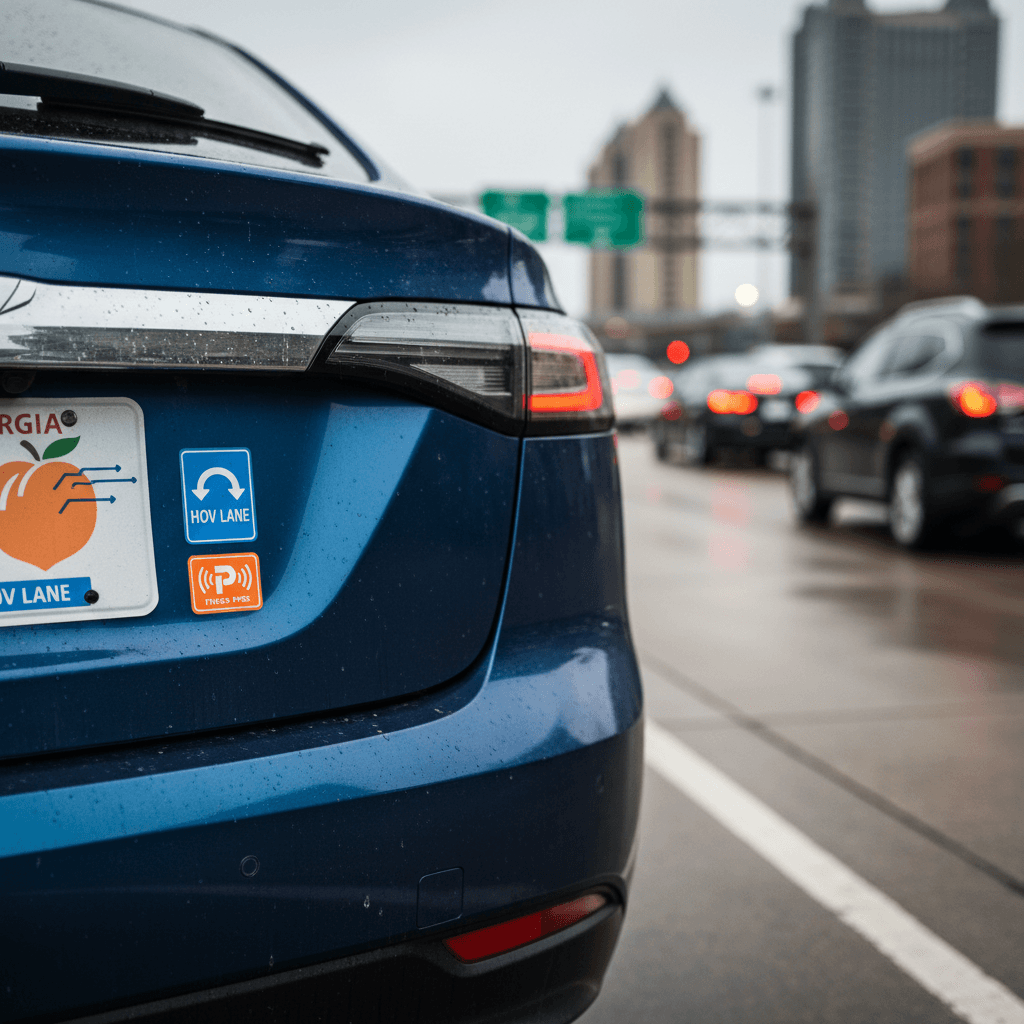
Using I‑85 Express Lanes in an EV: what to do now
1. Get and install a Peach Pass
Create a Peach Pass account, order a transponder, and mount it on your windshield according to instructions. EVs do not get a different device than gas cars.
2. Set the correct occupancy in the app or device
Before entering the express lanes, set your Peach Pass mode (Solo, 2‑person, 3+ carpool) in the app or per SRTA instructions. This controls tolling.
3. Understand toll‑free carpooling rules
To use I‑85 Express Lanes <strong>without paying a toll</strong>, most drivers, including EV owners, must carpool with <strong>3 or more people</strong> and verify that in Peach Pass.
4. Don’t expect AFV toll exemptions
The old policy that let AFV‑tagged EVs ride the I‑85 Express Lanes toll‑free, even solo, has ended. Expect to pay the posted toll unless you qualify as a verified carpool.
5. Watch for signage and dynamic pricing
Digital signs show current toll rates and rules as you approach the lanes. Rates change with congestion, and cameras enforce compliance.
6. Exit only at designated points
Like HOV lanes, HOT lanes have designated entry and exit points. Crossing the double‑solid lines can result in citations regardless of vehicle type.
Good news for true carpools
Who qualifies for Georgia AFV plates, and what they still do
Georgia still issues Alternative Fuel Vehicle (AFV) license plates through county tag offices. These plates identify vehicles powered solely or primarily by alternative fuels, including many battery‑electric vehicles. They come with extra annual fees and paperwork, but they no longer come with solo HOV or nationwide toll perks.
Georgia AFV plates: now mostly about identification and fees
Understanding what you’re paying for when you register an EV in Georgia.
Which vehicles qualify
- Battery‑electric vehicles
- Some plug‑in hybrids that meet state criteria
- Other vehicles fueled solely by approved alternative fuels
You apply through your county tag office with documentation of eligibility.
What AFV plates cost
Georgia charges additional annual licensing fees for AFVs, updated each year based on federal fuel‑efficiency data. These are in addition to normal registration fees and taxes.
What they no longer guarantee
- Solo HOV access statewide
- Toll‑free I‑85 Express Lane travel for single‑occupant AFVs
- Any across‑the‑board carpool exemptions
AFV plates now mainly identify your vehicle type and fee category.
Don’t assume AFV plate = extra privileges
Penalties and common mistakes EV drivers make
Georgia HOV violation penalties you could face
Those dollar amounts don’t include court costs, which can be significant. And while EVs aren’t targeted specifically, DPS and Georgia State Patrol do conduct HOV and HOT enforcement details, often where traffic merges or at major interchanges, so relying on “nobody checks” is a gamble.
- Solo EV in HOV lane with or without AFV plate, outside of any posted exemptions.
- Using HOV entry/exit ramps when you don’t qualify for HOV use at that time.
- Setting Peach Pass to carpool mode without the required number of people in the car.
- Crossing double‑solid lines to enter or exit the express lane outside designated access points.
- Covering or improperly mounting your Peach Pass, leading to toll violations.
Grace periods are over
Practical tips for EV commuters in metro Atlanta
Losing solo HOV and toll‑free express lane perks doesn’t mean your commute has to grind to a halt. It does mean you’ll need to be more strategic, especially if you count on I‑75, I‑85 or I‑20 in rush hour.
Smart ways Georgia EV drivers can adapt
Use your EV’s strengths, and the new rules, to your advantage.
Build a real carpool
The only free fast‑lane perk left is carpooling. Organize a commute group with coworkers or neighbors so your vehicle consistently meets 2+ occupants for HOV and 3+ for toll‑free I‑85 express.
Shift your schedule
Your EV’s low running costs make off‑peak driving more attractive. If your job is flexible, commuting earlier or later can be less stressful than counting on HOV access.
Rethink your route
Navigation apps and many EV in‑car systems can factor in traffic and toll costs. Experiment with alternate routes that take advantage of surface streets or shorter HOT segments.
Leverage fuel savings
Even if you now pay some tolls, your fuel and maintenance savings as an EV driver can offset occasional express‑lane use when you really need it.
Use Peach Pass and EV apps together
Check Peach Pass rates and HOV status alongside your EV’s trip planner so you can decide, trip by trip, when a toll is worth it.
Combine HOV and charging stops
On longer drives, time your DC fast‑charging stops to avoid the absolute worst congestion periods, even if you can’t rely on HOV lanes anymore.
What these HOV rules mean if you own or buy a used EV
Policy changes like this don’t just affect your daily drive, they can also influence resale values and which EV makes the most sense for you. In high‑traffic markets like metro Atlanta, solo HOV or express‑lane perks used to be a big part of the sales pitch for new and used EVs. With those perks gone, the focus shifts back to fundamentals: battery health, range, and total cost of ownership.
EV owners already in Georgia
- If you bought your EV expecting solo HOV perks, your day‑to‑day commute math has changed. You’ll want to compare toll costs vs. time savings using current rules.
- Make sure your registration and Peach Pass settings reflect how you actually use the lanes; inaccurate settings can trigger toll disputes or citations.
- If your AFV plate fee feels like a “giveback” with no lane perks, factor it into your annual ownership budget like insurance or property tax.
Shopping for a used EV in Georgia
- When you evaluate options on Recharged or elsewhere, make decisions based on range, charging speed, and battery health rather than HOV perks that no longer exist.
- Ask sellers or platforms for transparent battery diagnostics, Recharged provides a Recharged Score battery health report with every vehicle so you know how the car will perform in stop‑and‑go traffic.
- Consider how your commute patterns will change. A slightly longer range or faster DC charging could matter more than an old promise about HOV access.
How Recharged can help
FAQ: Georgia EV HOV lane rules
Frequently asked questions about Georgia EV HOV rules
Bottom line for Georgia EV HOV lane rules
Georgia’s EV landscape has matured, and its highway rules have followed suit. The days of solo EV drivers sailing past traffic in HOV and express lanes on the strength of an AFV plate are over. In 2026, your passenger count and Peach Pass settings matter more than your powertrain. If you understand the updated Georgia EV HOV lane rules, you can still use carpools, smart trip planning, and occasional tolls to manage your commute, while your EV continues to save you money at the plug.
If you’re already driving electric or considering a used EV in Georgia, build your plan around today’s realities: traffic patterns, charging access, and total ownership cost. With transparent battery health data and EV‑specialist support, Recharged is built to help you make that call confidently, whether you’re cruising in the general‑purpose lanes or timing your trip for a smooth, toll‑assisted run up I‑85.