If you search for a Georgia electric car rebate in 2026, you’ll quickly run into half-updated blogs, expired programs, and confusing federal rules. The good news is that Georgia drivers can still stack meaningful incentives on the right electric vehicle, especially used EVs, but you need to understand what’s actually available now, what disappeared years ago, and what’s coming through your utility rather than the state.
Quick snapshot for 2026
Overview: What “Georgia electric car rebate 2026” really means
When people talk about a Georgia electric car rebate in 2026, they usually mean one of three things: 1. A state-level rebate or income tax credit for buying an EV. 2. Utility rebates from Georgia Power or local EMCs (electric membership co-ops) for chargers or special rate plans. 3. Federal tax credits that Georgia residents can claim on EVs bought in 2026. These are separate buckets with completely different rules. Georgia used to offer its own state income tax credit for zero-emission vehicles, but that program ended back in 2015 and has not been revived as a general EV purchase credit. Today, the incentives that matter most for Georgia shoppers live at the utility and federal levels, plus a niche state credit for converting gas cars to alternative fuels.
Potential EV Savings for a Typical Georgia Driver in 2026
Does Georgia have a state EV rebate or tax credit in 2026?
Georgia once had one of the most generous state EV incentives in the country: a $5,000 income tax credit for zero-emission vehicles. That program ended for vehicles titled after July 1, 2015, and lawmakers have not brought it back in a broad form. As of April 2026, there is no statewide Georgia income tax credit or cash rebate solely for buying a new or used electric vehicle.
There is, however, a new Converted Vehicle Tax Credit for residents who convert an existing gasoline or diesel vehicle to run solely on alternative fuel and meet specific emissions standards. That’s interesting for enthusiasts and fleets converting trucks or vans, but it doesn’t help you if you’re simply shopping for a factory-built used EV from a dealer.
Don’t confuse old news with current reality
Georgia Power EV charger rebates in 2026
Even without a statewide EV purchase rebate, many Georgia drivers can save money through Georgia Power’s EV charger and rate programs. These don’t lower your purchase price directly, but they cut the cost of fueling and setting up home charging, often a more meaningful lever over time.
Residential Level 2 charger rebates (2026 window)
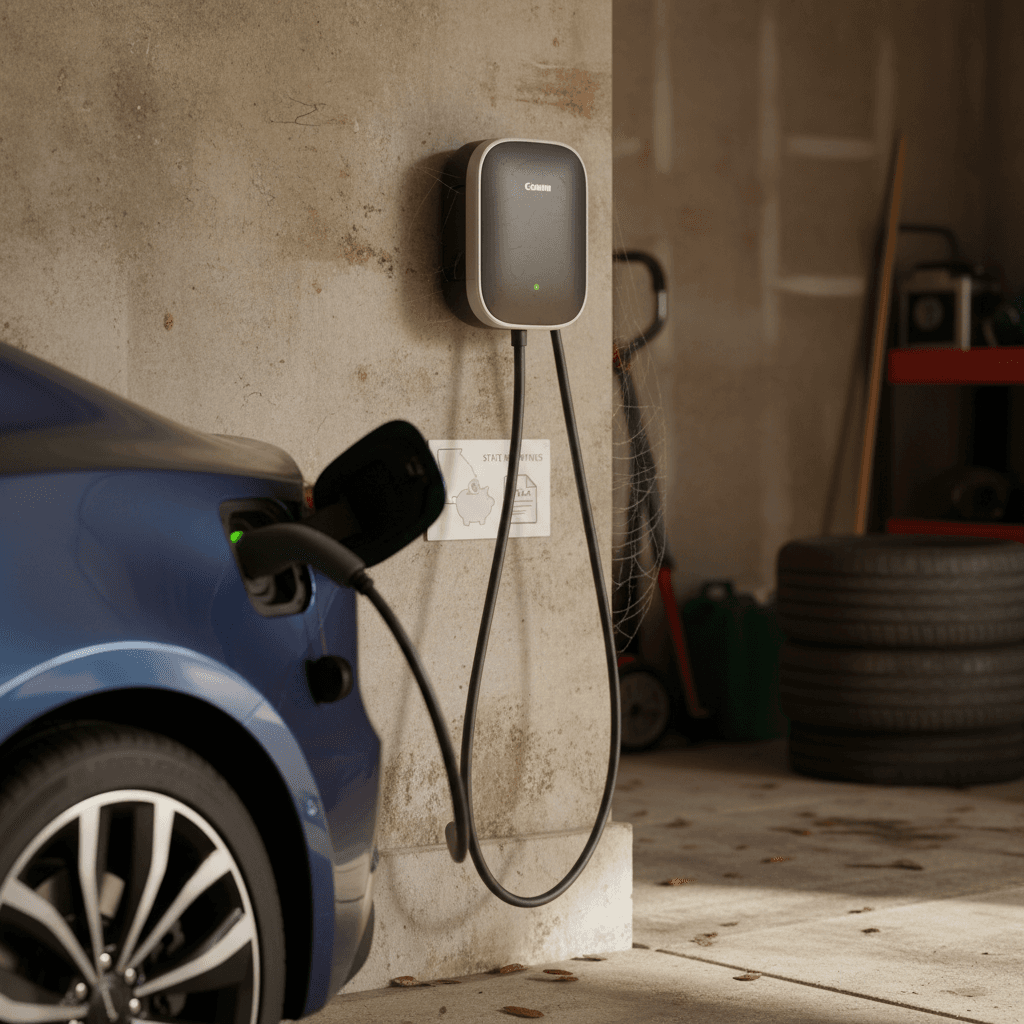
Georgia Power has run multiple waves of home charger rebates. Earlier versions covered installations through December 31, 2024, and more recent materials describe rebates for installations completed between January 1, 2026 and December 31, 2028, subject to funding and specific terms. The current structure typically looks like:
- A rebate for purchasing and installing a qualifying 240‑volt Level 2 charger at your home (often in the $150–$300 range per charger).
- The charger must be hard‑wired or plugged into a dedicated 240‑volt circuit; simple 120‑volt “mobile connectors” generally don’t qualify.
- You must be a Georgia Power residential customer and submit paperwork (and often proof of installation) within a set time window after installation.
How to check the exact 2026 rebate amount
Business and multifamily EV charger rebates
If you’re a business, fleet operator, or multifamily property owner in Georgia, Georgia Power’s Business EV Charger and “EV Charger Plus” programs can offer significantly higher per‑port rebates for Level 2 and DC fast charging equipment. These programs are project‑based, with rebate levels tied to the power rating and number of ports, and they’re designed to offset a portion of hardware and installation costs at workplaces, retail sites, or apartment communities.
These commercial and multifamily programs are especially important if you live in an apartment or condo and rely on shared parking. A landlord who understands the available rebates is much more likely to green‑light charger installation, something worth mentioning when you’re talking to property management about installing EV charging.
Off‑peak and EV‑specific rate plans
Georgia Power also offers EV‑focused time‑of‑use rate plans with very low overnight prices and higher daytime rates. These aren’t rebates in the traditional sense, but if you can regularly charge after, say, 11 p.m., you may pay just a fraction of the standard per‑kWh price for most of your charging. Over a year, that can dwarf a one‑time $150–$300 rebate, especially if you commute long distances.
Low off‑peak rates come with tradeoffs
Federal EV tax credits Georgia drivers can still use
Whether you’re in Atlanta or Albany, the biggest “Georgia electric car rebate” available in 2026 is actually federal. The Inflation Reduction Act created two main credits that Georgia buyers can still use in 2026, plus a separate credit for home charging equipment:
- New Clean Vehicle Credit (Section 30D): Up to $7,500 for eligible new EVs and fuel cell vehicles purchased before the current end date, subject to evolving battery sourcing and assembly rules.
- Used Clean Vehicle Credit (Section 25E): Up to $4,000 (30% of the price, capped at $4,000) for qualifying used EVs bought from a dealer for $25,000 or less.
- Alternative Fuel Refueling Property Credit (home charger credit): 30% of qualifying home charger and installation costs, capped at $1,000 per home for personal use.
Starting in 2024 and continuing in 2026, you can usually choose to transfer these credits to a participating dealer at the point of sale. In that case, the dealer knocks the credit amount off your purchase price immediately and then claims the credit from the IRS. You still have to meet all eligibility rules, but you no longer need big tax liability to benefit.
Important timing note for new EV credits
How much can you save on a used EV in Georgia?
For many Georgia shoppers, the sweet spot in 2026 is a used EV under $25,000 that qualifies for the federal used clean vehicle credit. The rules are more forgiving than the new‑vehicle credit and pair nicely with Georgia Power’s charger rebates and the federal charger credit.
Example Used EV Savings Stack for Georgia Buyers (2026)
Illustrative examples only; actual eligibility depends on income, vehicle, and program status at the time of purchase.
| Scenario | Vehicle price | Federal used EV credit | Georgia Power home charger rebate | Federal home charger credit | Total potential incentives |
|---|---|---|---|---|---|
| Budget commuter | $18,000 | $4,000 | $150 | $200 | $4,350 |
| Family crossover | $24,000 | $4,000 | $300 | $300 | $4,600 |
| Apartment dweller (no home charger) | $22,000 | $4,000 | $0 | $0 | $4,000 |
These scenarios assume you meet all income limits and buy from a licensed dealer willing to handle point‑of‑sale credit transfers.
These numbers are illustrative, but they highlight something important: for a typical Georgia commuter, the used EV credit is often the single largest “rebate” available in 2026, and it remains available through at least the middle of the decade for qualifying vehicles.
Stacking incentives: Real-world Georgia used EV scenarios
Scenario 1: Suburban homeowner near Atlanta
Profile: Owns a house in Gwinnett County, commutes 40 miles/day, currently drives a 25 mpg crossover.
- Buys a $21,000 used EV from a licensed dealer that qualifies for the used clean vehicle credit.
- Has household income below the federal cap and has not claimed a used EV credit in the past three years.
- Installs a $900 Level 2 charger and pays $700 for electrical work (total $1,600).
Potential incentives:
- $4,000 used clean vehicle credit (point-of-sale or on taxes).
- $150–$300 Georgia Power residential charger rebate (depending on active offer).
- 30% federal home charger credit on the $1,600 project (up to $480, capped at $1,000).
If everything lines up, this buyer could be looking at roughly $4,600–$4,800 in combined incentives, plus hundreds of dollars a year in gas savings.
Scenario 2: In-town renter in Atlanta
Profile: Rents an apartment with no assigned parking, parks on‑street or in a shared lot.
- Buys a $19,000 used EV that qualifies for the $4,000 federal credit.
- Can’t install a home charger, so relies on workplace and public charging.
- Can still benefit from Georgia Power commercial and multifamily programs if their landlord or employer participates.
Potential incentives:
- $4,000 used clean vehicle credit.
- $0 in home charger credits personally, unless they later move to a home where they can install one.
- Indirect benefits if their building adds chargers using Georgia Power business rebates.
This buyer’s main “rebate” is the federal used EV credit, but that alone can make a well‑priced used EV competitive with a comparable used gas car.
Who actually qualifies? Income, price and vehicle rules
Key qualification rules for 2026 EV incentives
You need to clear three hurdles: you, the car, and the deal.
1. Your income
Both new and used federal EV credits have modified adjusted gross income (MAGI) limits, based on your filing status and the year you claim the credit. If your income is above those thresholds, you’re not eligible for that credit, regardless of how clean the car is.
2. The vehicle
The car must be on the official list of eligible vehicles, with requirements around final assembly location, battery capacity, and sometimes component sourcing. For used EVs, there are also age and price caps.
3. The transaction
The vehicle must be bought from a licensed dealership (not a private sale), at or below the allowed price cap, and you generally can’t claim the used EV credit more than once every three years.
Used Clean Vehicle Credit: Quick eligibility checklist
Confirm the vehicle is truly “used”
The vehicle must be at least two model years older than the year of purchase and sold to you as a used vehicle. A demonstration car that’s never been titled to a retail customer usually doesn’t count as used.
Verify the purchase price is $25,000 or less
The federal used EV credit only applies if the total sale price, after any dealer discounts but before trade‑ins, is $25,000 or less.
Buy from a licensed dealer
Private‑party purchases between individuals don’t qualify. The selling dealer must also register with the IRS to handle point‑of‑sale transfers if you want the credit applied instantly.
Check your income against IRS limits
Your modified adjusted gross income must be below the thresholds for your filing status in either the year you buy the vehicle or the prior year. If it’s too high for both, you can’t claim the credit.
Make sure you haven’t used the credit in the last 3 years
You can only claim the used clean vehicle credit once every three years. If you already used it recently, you’ll need to wait.
Confirm the dealer doesn’t “bake in” the credit
The advertised price should reflect the car’s actual market value. A dealer who quietly adds $4,000 and then subtracts a “$4,000 credit” isn’t giving you a real discount.
How to actually claim these rebates and credits
The process varies depending on whether you’re dealing with Georgia Power, federal tax credits, or both. Here’s the practical sequence most Georgia shoppers should follow in 2026.
- Decide whether you’re targeting a new or used EV. If your budget is under $30,000, a used EV under $25,000 that qualifies for the used credit is often the most straightforward way to unlock a large incentive.
- Confirm federal eligibility by VIN before you sign. Ask the dealer to provide the VIN and check it against official eligibility lists and tools. For a used EV, ensure it meets the age and price rules as well.
- Ask the dealer if they can apply the credit at the point of sale. If they’re registered for credit transfers, you can get the value as an immediate discount and avoid worrying about your tax liability later.
- Line up your home charging plan. Before closing the deal, talk to an electrician and check Georgia Power’s current residential Level 2 rebate terms so you know what equipment qualifies and what documentation you’ll need.
- Submit Georgia Power rebate paperwork promptly. Most programs give you a fixed number of months after installation to claim rebates. Save invoices for equipment and electrical work, and follow the online submission process carefully.
- Work with a tax professional if your situation is complex. Especially if you own a business, have variable income, or might claim the vehicle for mixed personal and business use, get advice before relying on the credit amount in your budget.
Where Recharged fits into this process
Ready to find your next EV?
Browse VehiclesCommon pitfalls for Georgia EV shoppers
Avoid these Georgia EV incentive mistakes
A little homework saves you thousands, and a lot of frustration.
Assuming “Georgia EV rebate” means cash from the state
As of 2026, Georgia is not writing you a check just for buying an EV. Your major savings come from federal tax credits and Georgia Power programs, not a statewide EV purchase rebate.
Not verifying VIN-level eligibility
EV incentives are now VIN‑specific. Don’t rely on model‑level lists or dealer promises. Make sure the exact car you’re buying appears as eligible under current rules.
Letting dealers “keep” your credit
If a dealer advertises a car as “$4,000 off with federal EV credit” but quietly inflates the price by $4,000, you’re not really getting a deal. Compare against independent market pricing for similar used EVs.
Missing rebate deadlines
Georgia Power rebate programs and federal home charger credits require proper documentation and timing. Don’t throw away $150–$1,000 because you misplaced an invoice or waited too long to submit a form.
How Recharged makes incentives simpler for Georgia buyers
Used EV incentives get messy fast: changing federal rules, VIN‑specific eligibility, and utility rebate paperwork that feels like it was designed in a different decade. Recharged is built to strip out as much of that friction as possible while keeping you firmly in control.
- Transparent, used‑EV focused inventory: Recharged specializes in used electric vehicles, so your options are already filtered toward models that typically make sense even before incentives.
- Recharged Score battery health diagnostics: Every vehicle listing includes a battery health report, so you’re not trading a one‑time tax credit for a long‑term battery headache.
- Expert EV‑specialist support: Our team can walk you through whether a specific car looks like a good candidate for the federal used EV credit based on price, age, and your situation (though you should always confirm final tax details with a professional).
- Financing and trade‑in in one place: You can line up financing, value your trade‑in, and complete most of the deal digitally, with nationwide delivery, including to Georgia.
- Guidance on home charging: If you’re planning to install Level 2 charging, we’ll help you think through charger sizing, installation basics, and how to ask your electrician for a quote that supports both Georgia Power rebates and the federal home charger credit.
If you’re in Georgia and starting your used EV search, exploring inventory on Recharged can save you time, and help you focus on cars that pencil out when you add in realistic incentives rather than marketing promises.
FAQ: Georgia electric car rebate 2026
Frequently asked questions about Georgia EV rebates in 2026
Bottom line: Is an EV still worth it in Georgia in 2026?
Even without a headline‑grabbing state rebate, a carefully chosen EV can still be a very smart move for Georgia drivers in 2026, especially if you’re looking at used models under $25,000 and can charge at home. Between the federal used clean vehicle credit, Georgia Power’s home charger rebates, the federal home charging credit, and ongoing fuel and maintenance savings, it’s not unusual to see thousands of dollars in value over the first few years of ownership.
The key is to treat incentives as a bonus on top of a solid deal, not a reason to overpay. Verify eligibility, watch the fine print, and choose a car with a healthy battery and realistic range for your life. If you’d like help sorting through those trade‑offs, browsing Recharged’s used EV inventory and talking with an EV specialist is an easy way to start grounded in today’s actual rules, not yesterday’s headlines.