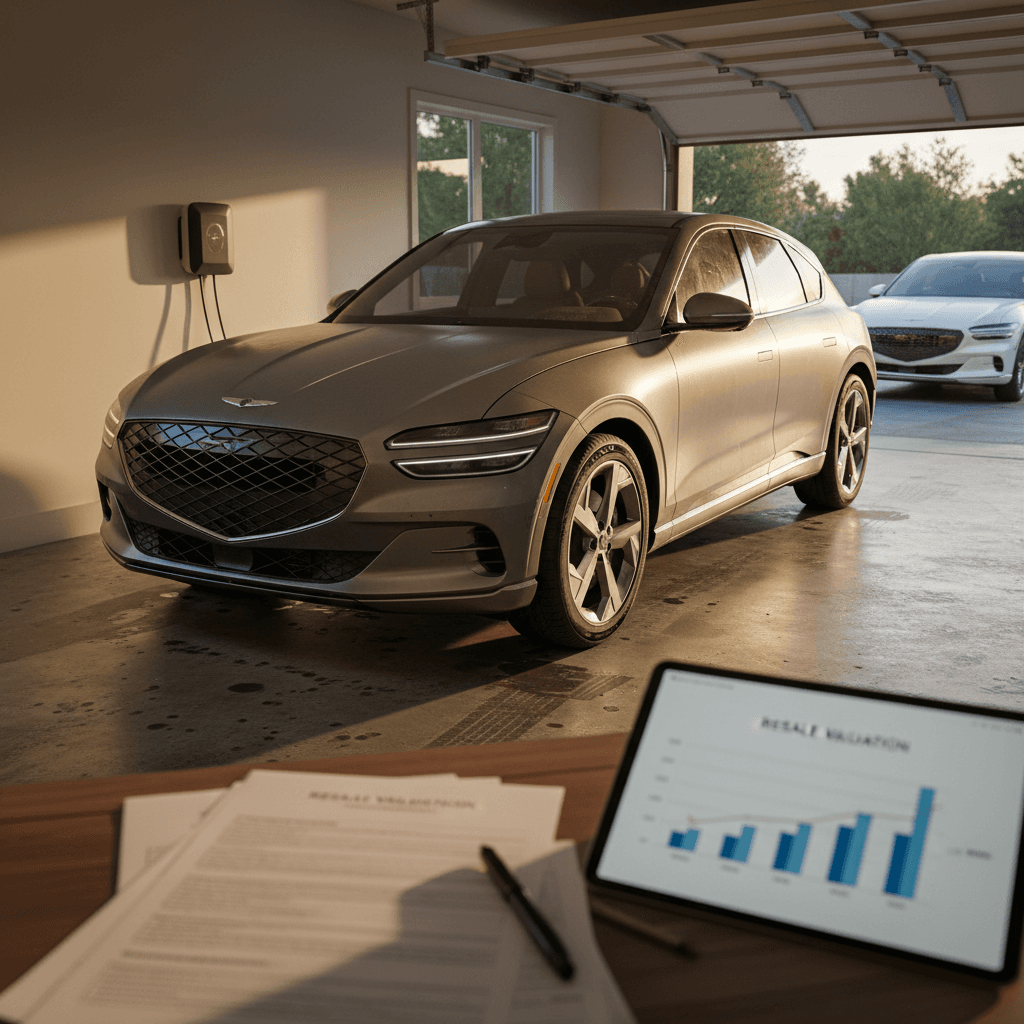
If you own, or are eyeing, a used Genesis GV60, understanding its value after 3 years is critical. The GV60 is a stylish, quick luxury EV, but like many premium electric crossovers, it’s faced steep early depreciation. That can sting for first owners, yet create real opportunity if you’re shopping used in 2026. This guide breaks down what a 3‑year‑old GV60 is actually worth, why the numbers look the way they do, and how to make the math work in your favor.
Quick takeaway
Why Genesis GV60 value after 3 years matters
Three years is a turning point for any luxury vehicle. Lease returns start to hit the market, original warranties are still strong, and real‑world reliability stories have had time to surface. For the Genesis GV60, the 3‑year mark is especially important because early buyers paid premium MSRPs for a brand‑new EV nameplate. Now that those 2023 models are maturing, we can see how the GV60 actually holds its value, not just what was promised on launch day.
If you’re a current owner, 3‑year value affects whether you sell, trade, or keep the car through its battery warranty. If you’re a shopper, it helps you decide whether a GV60 is a bargain next to rivals like the Tesla Model Y, Kia EV6, and Hyundai Ioniq 5. And if you’re looking at financing or trade‑in scenarios, platforms like Recharged can help you see your GV60’s market‑based value alongside verified battery health, so you’re not guessing.
Genesis GV60 3‑Year Value Snapshot (Typical Ranges)
How much is a Genesis GV60 worth after 3 years?
With the GV60, it’s helpful to separate **original sticker price** from **real‑world 3‑year values**. Many 2023 Genesis GV60 Advanced and Performance models stickered between roughly $60,000 and $71,000 with options. Three years later, typical used asking prices and realistic trade‑in numbers tell a very different story.
Approximate 3‑Year Genesis GV60 Value Ranges (2026 Market)
Illustrative ranges for a 2023 GV60 hitting the 3‑year mark in average U.S. use, assuming clean history and typical equipment.
| Model year & trim | Original MSRP (approx.) | Age in 2026 | Typical retail asking range | Likely real‑world trade range |
|---|---|---|---|---|
| 2023 GV60 Advanced | $60,000–$65,000 | ~3 years | $34,000–$40,000 | $29,000–$35,000 |
| 2023 GV60 Performance | $68,000–$71,000+ | ~3 years | $36,000–$45,000 | $31,000–$38,000 |
| 2024 GV60 Advanced/Performance | Mid‑$50ks to low‑$70ks | 2–3 years | Upper‑$30ks to low‑$40ks | Low‑to‑mid‑$30ks |
Actual values vary by region, options, mileage, and condition, but this table shows how hard the GV60’s first three years can hit the wallet.
Don’t anchor on window stickers
Third‑party depreciation models back this up. Several cost‑to‑own tools show the GV60 losing its value fastest in the first two to three years, then settling into a slower decline. Internal Recharged pricing analysis of recent listings finds many 2023–2024 GV60 examples with 20,000–35,000 miles marketed in the mid‑$20,000s to low‑$30,000s at more aggressive non‑franchise dealers, while Genesis Certified Pre‑Owned examples sit somewhat higher.
For owners, that means a big paper loss on a three‑year horizon. For used shoppers, it means you can often buy a GV60 for about half of its original MSRP while still enjoying years of battery and powertrain coverage.
What drives Genesis GV60 depreciation in the first 3 years?
Key forces pushing GV60 values down early
Some are EV‑market trends, others are Genesis‑specific.
Luxury EV price pressure
Brand still building trust
Reliability headlines
EV‑specific headwinds
All EVs face certain structural depreciation challenges. Technology moves quickly, so a 3‑year‑old battery pack and charging hardware can feel dated next to the latest range and charging‑speed headlines. Rapid improvements in rival models, and in some cases, lower new‑vehicle MSRPs than early adopters paid, push used values down.
In that context, the GV60 is competing not just with other used EVs, but with aggressive leases on new mainstream models and deep discounts on new inventory as automakers chase market share.
Genesis‑specific factors
The GV60 launched in small volumes and targeted a narrow, tech‑forward luxury audience. That makes it niche, which is a double‑edged sword. The upside: great equipment and a standout design. The downside: a smaller pool of used‑car shoppers actively searching for a GV60, which weakens pricing power.
Add in patchy dealer coverage and service‑department growing pains, and some buyers will demand a price discount to take on perceived risk.
Why this can work in your favor
Trim, mileage and condition: how they shape 3‑year value
Not all GV60s are treated equally in the used market. At three years, appraisers and online marketplaces are looking closely at trim, mileage, options, and cosmetic condition before they put a number on your EV.
What appraisers look at on a 3‑year‑old GV60
1. Trim level and options
Performance models with dual‑motor power and more features started higher, which can mean slightly better absolute resale dollars, but they also depreciate more in pure dollar terms. Unique color and option combos can help or hurt depending on your region.
2. Odometer reading
A three‑year GV60 with 18,000 miles is worth more than one with 45,000 miles, all else equal. The sweet spot for many buyers is roughly 8,000–12,000 miles per year, enough use to show the car isn’t a garage queen, but not so much that it feels worn.
3. Service history
Consistent maintenance, recall work, and software updates documented with receipts are a big plus. Spotty records or incomplete recall work will drag on offers and can scare off private buyers.
4. Cosmetic condition
Curb rash on the 21‑inch wheels, interior wear, or collision repairs (especially structural) can quickly erase thousands of dollars in resale value, even on a relatively young luxury EV.
5. Battery and charging behavior
Third‑party buyers, and EV‑focused retailers like <strong>Recharged</strong>, are increasingly looking at battery health data, DC‑fast‑charging history, and State of Health (SoH) readings to decide how aggressively to price a 3‑year‑old EV.
Battery health and warranty: the hidden value drivers
On a 3‑year‑old GV60, the high‑voltage battery is both the most expensive component and the least understood by many used‑car buyers. The good news: in the U.S., Genesis backs the EV battery and electric powertrain for up to 10 years or 100,000 miles, which extends well past the three‑year mark. That coverage is a safety net that supports resale value and reassures second owners.
Where things get more nuanced is actual battery health and the supporting hardware. Early GV60s have seen scattered owner reports of 12‑volt battery drain and ICCU (charging control) failures. Many of these issues are addressed under warranty, but they’ve generated online buzz that used buyers will have seen. A clean service history and documentation that any recall‑related work has been completed will help your particular vehicle stand out from the noise.
How Recharged approaches GV60 battery health
Ready to find your next EV?
Browse Vehicles- A GV60 with documented gentle charging habits (more AC than DC fast charging) is generally more attractive than one fast‑charged every day.
- Battery degradation on most early GV60s appears modest by year three, but hard data still matters more than promises.
- Because the long EV battery warranty is transferable, buyers can reasonably expect coverage to extend many years beyond the 3‑year point, depending on mileage.
Genesis GV60 vs rivals: 3‑year value comparison
The GV60 isn’t depreciating in a vacuum. To understand its 3‑year value story, you have to stack it against the broader luxury EV crossover field. Overall, GV60 depreciation has been steeper than mainstream rivals but roughly in line with several other premium EVs that launched at ambitious prices into a rapidly evolving market.
3‑Year Value Snapshot: Genesis GV60 vs Key Rivals
Broad comparison of how several popular EV crossovers typically hold up over three years, based on public depreciation tools and current used‑market asking prices.
| Model (approx. 3‑year‑old) | Original price band | Typical 3‑year depreciation | Notable context |
|---|---|---|---|
| Genesis GV60 | $60k–$70k+ | ~45–55% | Newer luxury brand, niche volumes, mixed reliability headlines but strong warranty support. |
| Tesla Model Y Long Range | High‑$40ks–$60k+ | ~35–45% | Huge brand awareness, deep charging network; heavy new‑car price cuts have also hit used values. |
| Hyundai Ioniq 5 | Low‑to‑mid‑$50ks | ~40–50% | Mainstream sibling on the same platform; higher volume and incentives pressure used prices. |
| Kia EV6 | Low‑to‑mid‑$50ks | ~40–50% | Sporty image and wide availability; subject to the same EV discount cycle as Ioniq 5. |
Exact percentages vary by trim and equipment, but this table highlights the GV60’s relatively aggressive early depreciation compared with some higher‑volume EVs.
What this means for you
Should you buy a 3‑year‑old Genesis GV60?
For the right buyer, a 3‑year‑old GV60 can be a sweet spot: you capture a large discount from new, bypass the sharpest part of the depreciation curve, and still enjoy years of EV battery and powertrain coverage. But it’s not the automatic choice for everyone.
Who a 3‑year‑old GV60 is great for
- Value‑oriented luxury shoppers who want a distinctive, well‑equipped EV for the price of a new mainstream crossover.
- Early EV adopters who understand charging networks and don’t mind navigating a newer dealer ecosystem.
- Buyers planning to keep the car well past the 3‑year mark, smoothing out early depreciation with longer‑term ownership.
Who might want to think twice
- Short‑horizon owners who plan to sell again in 2–3 years and can’t stomach more price swings.
- Shoppers far from a Genesis service center, where logistics for warranty work and recalls can get frustrating.
- Risk‑averse buyers who are uncomfortable with any level of reliability question marks, even with a warranty safety net.
How Recharged can simplify the decision
How to protect your GV60’s value over the first 3 years
If you already own a GV60, the first three years are when your choices matter most for resale. You can’t control market‑wide EV price shifts, but you can control how attractive your particular vehicle looks to the next owner, or to a trade‑in buyer like Recharged.
Six ways to safeguard your GV60’s 3‑year value
1. Keep up with recalls and software updates
Make sure any recall campaigns and service bulletins are addressed promptly. Save paperwork showing that key updates, especially around charging and battery management, have been performed.
2. Document every service visit
Keep a digital folder with invoices for maintenance, tire rotations, and any warranty work. A clean, well‑documented paper trail is worth real money at trade‑in time.
3. Be kind to the battery
Avoid fast‑charging to 100% every day, and don’t leave the car sitting at a very high or very low state of charge for long periods. These good habits help keep the battery healthier, which matters more than ever as buyers get savvier.
4. Protect wheels and interior
Luxury EVs attract picky used‑car shoppers. Fix curb‑rashed wheels, repair windshield chips early, and stay ahead of interior wear with mats and regular cleaning.
5. Mind your mileage
You don’t need to baby the odometer, but if you can keep annual mileage in a typical range, roughly 10,000–12,000 miles per year, you’ll keep your GV60 in the market sweet spot at resale time.
6. Get a pre‑sale battery health report
Before you list or trade, a third‑party battery health check (or a <strong>Recharged Score Report</strong> if you sell through Recharged) can validate your car’s condition and justify stronger offers.
Selling or trading a 3‑year‑old Genesis GV60
Once your GV60 hits the three‑year mark, you’ll face the classic fork in the road: trade it, sell it privately, consign it, or hang on longer. Because early depreciation has already done most of its damage, many owners find that keeping the car beyond year three gives them more value per dollar, especially with a long battery warranty still in play.
Options for moving on from a 3‑year‑old GV60
Choose the path that balances price, effort, and risk.
Trade‑in to a dealer or EV retailer
Sell privately
Consignment with an EV specialist
Watch the timing
At Recharged, you can request an instant offer for your GV60, share photos and details online, and get a value that reflects current market data and the specific battery health of your vehicle. If you decide to buy another EV through Recharged, you can roll that value directly into your next purchase and arrange nationwide delivery from your couch.
Genesis GV60 3‑year value: FAQ
Frequently asked questions about Genesis GV60 value after 3 years
Three years into the Genesis GV60’s life cycle, the verdict on value is clear: it’s a depreciation‑heavy luxury EV up front, but a compelling buy on the used market. If you’re already an owner, smart maintenance, good battery habits, and thoughtful timing can soften the blow and position you for a solid sale or trade. If you’re a shopper, those same dynamics mean you can land a distinctive, high‑tech EV for far less than its original MSRP, especially if you lean on tools like the Recharged Score to separate the gems from the question marks. Either way, understanding the GV60’s 3‑year value story lets you treat depreciation as a lever you can pull, not just a number that happens to you.