If you own or are shopping for a Genesis GV60 in 2026, resale value should be near the top of your checklist. This luxury EV has earned praise for performance and tech, but it’s also become a poster child for aggressive depreciation. In this Genesis GV60 resale value guide for 2026, we’ll walk through what the market actually looks like right now, why prices fell so hard, and how you can still come out ahead whether you’re buying used or planning to sell.
Key takeaway for 2026 GV60 owners
Genesis GV60 resale value in 2026 at a glance
Genesis GV60 depreciation snapshot for 2026
Multiple third‑party valuation models that track real‑world transaction data point to the Genesis GV60 losing roughly 55–65% of its value within five years of original purchase, depending on trim, incentives at the time of sale, and mileage. In dollar terms, that often means a GV60 that stickered around $62,000–$70,000 new is forecast to be worth somewhere in the mid‑$20,000s after five years of typical use.
Genesis GV60 vs "typical" car depreciation
Why the Genesis GV60 depreciates faster than you’d expect
On paper, the Genesis GV60 checks every box: dual‑motor performance options, an 800‑volt architecture for fast charging, a high‑end interior, and distinctive styling. So why is resale value in 2026 lagging behind some rival EVs and German luxury crossovers?
Four big forces pushing GV60 values down
Most of them have more to do with the EV market than with the GV60 itself.
1. Heavy incentives up front
New Genesis EVs have routinely been sold or leased with stacked discounts, lease cash, and tax credits. That effectively lowers the real transaction price, so when the car shows up later in used‑car data at a much lower advertised price, it looks like a dramatic crash from MSRP, even though many buyers never paid full sticker.
2. Rapid EV price wars
Tesla price cuts, aggressive lease deals from mainstream brands, and a flood of new EV nameplates have pushed used EV prices down across the board. The GV60, being a niche luxury model with modest sales volume, takes this hit more visibly than high‑volume models.
3. Brand awareness and trust
Genesis is still building its reputation in the U.S. luxury market. Shoppers who don’t recognize the badge tend to bid more conservatively on used inventory, especially when they’re comparing it to a Tesla, BMW, or Mercedes they already know.
4. Early‑adopter risk and recalls
Like many first‑wave EVs, the GV60 has had software updates, stop‑sales, and quality campaigns. Even when issues are fixed under warranty, the headline risk can soften demand at auction and on dealer lots, nudging resale values down.
Don’t ignore the flip side
Real 2026 used GV60 price bands by year and trim
Every Genesis GV60 is unique, but by 2026, patterns are clear enough that you can think in terms of realistic price bands. Below is an orientation chart for U.S. retail asking prices we’re seeing in early 2026 for clean‑title, average‑mileage examples. These are not offers from Recharged or any specific dealer, just guideposts to sanity‑check what you’re seeing online.
Typical 2026 U.S. used Genesis GV60 price bands
Approximate retail asking‑price ranges for well‑equipped GV60s in decent condition. High‑miles, accident history, buybacks, or rough condition can fall well below these bands.
| Model year | Trim (common) | Typical mileage in 2026 | Observed asking‑price band* |
|---|---|---|---|
| 2022 | Advanced / Performance | 30,000–45,000 mi | Low‑$20Ks to low‑$30Ks |
| 2023 | Advanced / Performance | 20,000–35,000 mi | High‑$20Ks to mid‑$30Ks |
| 2024 | Standard / Advanced / Performance | 10,000–25,000 mi | Low‑$30Ks to low‑$40Ks |
| 2025 | Standard / Advanced | Under 15,000 mi | Mid‑$30Ks to low‑$40Ks |
Use this as a directional guide, not a substitute for a real appraisal.
How to use these ranges
The thread that jumps out across valuation sites and owner anecdotes is just how far some of these numbers are from the original MSRP, which commonly ran from the low‑$50,000s to around $70,000 depending on trim and options. Seeing a 2‑ to 3‑year‑old GV60 advertised in the $28,000–$35,000 range is no longer unusual.
3–5 year Genesis GV60 resale outlook
If you’re buying or selling a Genesis GV60 in 2026, you’re really betting on what happens between now and around 2029–2031. Most depreciation models for the GV60 today cluster around a 5‑year resale value in the mid‑$20,000s for a typically optioned, non‑abused example originally priced in the low‑$60,000s.
Short term: 2026–2027
Over the next 12–24 months, most data suggests the GV60 will continue to lose value, but at a slower rate than its first two years. Much of the "shock" depreciation has already happened. Expect modest downward pressure as more off‑lease and early‑term trade‑ins reach the market.
For sellers, that means now is rarely the "best" time, but it can be a reasonable time if you price aggressively and present the car well. For buyers, it’s an opportunity to find a sweet‑spot 2023–2024 GV60 at a fraction of original MSRP.
Medium term: 2028–2031
Looking out to years 6–9 of a GV60’s life, depreciation typically flattens. Residual value becomes more about condition, battery health, and brand reputation than model‑year hype. If Genesis continues to build out its lineup, improves dealer support, and keeps software updated, that brand story can stabilize used values.
Battery longevity and high‑voltage component reliability will be critical here: a car with a documented healthy pack and charging history can remain attractive well into its second decade.
Who "wins" the GV60 depreciation curve?
What helps (and hurts) GV60 resale value
Even in a soft segment, there’s a wide spread between a top‑tier used GV60 and one that will only sell at a discount. The usual suspects matter, mileage, accidents, maintenance, but EV‑specific details are starting to carry real weight.
Key levers you can pull as an owner
Low, consistent mileage
Staying close to 10,000–12,000 miles per year positions your GV60 in the "average" mileage bucket. Extremely low miles can help, but 4–5 years of almost no use can also raise questions about how the pack was treated.
Clean accident and title history
A GV60 with no accidents, no airbag deployments, and no manufacturer buyback history will usually appraise thousands higher than one with a branded title or major repairs.
Documented service and software updates
Keeping receipts for scheduled maintenance, tire rotations, and any recall or software campaign makes it easier to prove your GV60 has been cared for, and often smooths the appraisal process.
Battery‑friendly charging habits
Frequent DC fast charging and lots of time spent at 100% state of charge can accelerate degradation in any EV. Using Level 2 at home, limiting 100% charges to road trips, and avoiding chronic deep discharges can all help preserve long‑term value.
Strong cosmetics and interior condition
Luxury buyers notice curb rash, worn bolsters, pet damage, and lingering smells. Fixing small cosmetic issues before appraisal can have an outsized impact on perceived value.
Red flags that crush GV60 offers
How battery health factors into GV60 resale
With internal‑combustion cars, shoppers fixate on odometer readings and Carfax reports. With used EVs like the Genesis GV60, they’re increasingly asking a new question: How healthy is the battery? That’s where a structured battery assessment becomes a differentiator rather than just a nice‑to‑have.
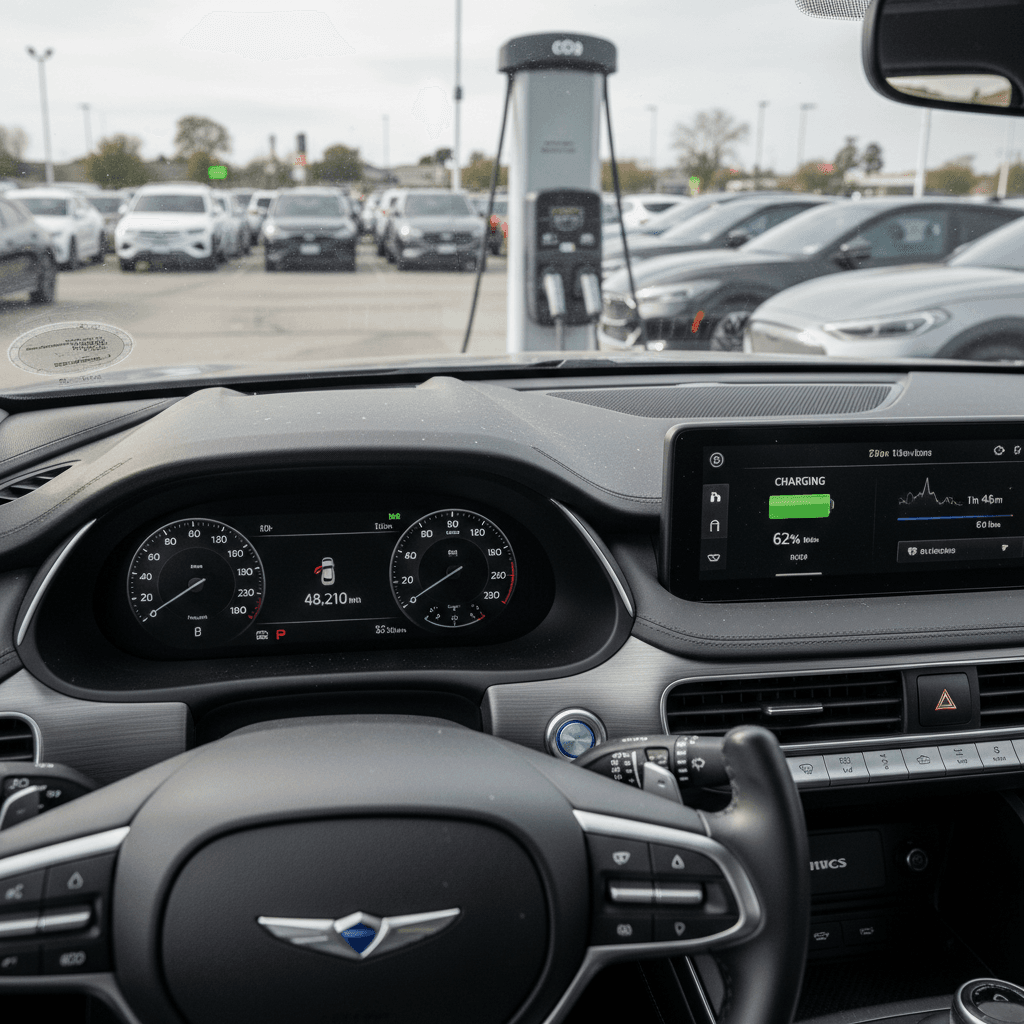
On Recharged, every used EV includes a Recharged Score Report with verified battery health diagnostics. Instead of guessing from a dash‑display estimate, you see how the pack is actually performing relative to a similar GV60 when it was new. That matters because a car that’s lost 5–8% of its usable capacity at 40,000 miles is a very different proposition from one that’s already dropped 15–20%.
- Battery state of health (SOH) compared to original capacity
- Fast‑charging versus Level 2 charging mix over time
- Error codes or high‑voltage system alerts that may not trigger a dashboard light
- Temperature and climate patterns that can affect long‑term degradation
Buying a used GV60? Ask for battery data first.
Trade-in vs private sale vs EV marketplace
Once you’ve wrapped your head around what your Genesis GV60 is likely worth in 2026, the next decision is where to sell it. Each channel has a different balance of convenience, control, and net proceeds, and the right answer isn’t the same for everyone.
Comparing your GV60 selling options in 2026
Think beyond just the headline number; time and risk matter too.
1. Dealer trade‑in
Best for: Simplicity when you’re already buying another car.
- One‑stop transaction; you can often roll equity or payoff into your next deal.
- Appraisal may be conservative, especially on a niche EV the store doesn’t know well.
- Useful when you’re upside‑down and need help structuring the numbers.
2. Private‑party sale
Best for: Maximizing your selling price if you’re willing to work.
- Potentially the highest gross number if you photograph, market, and price well.
- You manage test drives, screening buyers, payoff logistics, and paperwork.
- Some shoppers remain wary of luxury EVs without a third‑party inspection.
3. EV‑focused marketplace
Best for: Balancing convenience with fair market value.
- Platforms like Recharged understand EV demand, battery health, and pricing nuances.
- Digital offers, transparent diagnostics, and nationwide reach can improve your net outcome vs a one‑off local sale.
- Options like instant offers or consignment give you more control over speed vs price.
How Recharged fits into the picture
Should you lease or buy a GV60 in 2026?
Given everything we’ve covered about depreciation, it’s fair to ask whether you should even own a Genesis GV60 outright in 2026, or just lease and let the lender take the residual‑value risk. The answer depends on your budget, how long you like to keep vehicles, and your tolerance for market volatility.
Leasing a new or nearly new GV60
- Pros: You’re largely insulated from future resale swings. At lease‑end, you hand the car back if market values are poor, or buy it out if the residual is below what the car is actually worth.
- Cons: Mileage limits, excess wear charges, and the reality that you’re effectively renting, you don’t build long‑term equity.
- Best for: Drivers who like new tech, want warranty coverage at all times, and don’t plan to keep a GV60 more than 3–4 years.
Buying a used GV60 in 2026
- Pros: Someone else already shouldered the sharpest depreciation. You can own the car free and clear, and if you keep it long enough, total cost of ownership can be extremely competitive.
- Cons: More exposure to out‑of‑warranty repairs in later years and to any long‑term battery issues that emerge as the fleet ages.
- Best for: Value‑seekers who are comfortable with EV tech and plan to drive the GV60 for at least 5–7 more years.
A common 2026 strategy that works
Getting a strong offer on your GV60 with Recharged
If you’re ready to move on from your Genesis GV60 in 2026, treating the process like a wholesale dump will cost you. Taking a few structured steps, and working with a buyer that understands EVs, can easily be the difference between an average outcome and a great one.
Checklist: Positioning your GV60 for top‑tier offers
Gather your documentation
Pull service records, recall/TSB paperwork, charging‑equipment receipts, and anything related to software updates. A clean paper trail reassures EV‑savvy buyers and appraisal teams.
Refresh the basics
Detail the interior, address obvious scuffs and curb rash, replace missing key fobs or charge‑port caps, and make sure all included charging cables are neatly presented.
Get a battery‑health report
On <strong>Recharged</strong>, this is part of the Recharged Score. If you’re selling elsewhere, consider obtaining a third‑party EV health report so you can share objective data with prospects.
Decide between instant offer and consignment
If speed matters most, an instant offer or trade‑in through Recharged is usually best. If you can wait for the right buyer at a premium price, consignment on a dedicated EV marketplace can make sense.
Be realistic about pricing
Cross‑reference current GV60 listings, valuation tools, and any offers you’ve received. Pricing just under similar vehicles with weaker equipment or no battery documentation can help your listing move without leaving money on the table.
Recharged specializes in used EVs, including luxury crossovers like the GV60. That means our buyers and tools already understand Genesis‑specific quirks, current resale conditions, and how to weigh a strong charging and service history. Whether you’re trading in, taking an instant offer, or listing via consignment, you get EV‑specialist support from start to finish, including nationwide delivery if you’re moving into another electric vehicle through our marketplace.
Genesis GV60 resale value FAQ (2026)
Frequently asked Genesis GV60 resale questions
Bottom line: Is the GV60’s resale value a deal-breaker?
In 2026, the Genesis GV60 is a textbook example of how early‑cycle EVs can stumble on resale value even when they’re strong products. If you bought new at or near MSRP and need to sell after only a couple of years, you’re facing a tough conversation. But if you’re entering the market now as a used buyer, or you’re a current owner willing to keep the car for the long haul, the math can work decisively in your favor.
The key is to approach the GV60 like a data‑driven decision, not a guess: understand realistic depreciation curves, insist on clear battery‑health information, and choose a selling or buying channel that actually understands electric vehicles. With the right strategy, and the right partner, the Genesis GV60’s soft resale value becomes less of a red flag and more of an opportunity to get a lot of EV for the money.