If you’re looking at a Genesis GV60, especially a used one, it’s natural to wonder how much battery degradation per year you should expect. After all, the battery pack is the single most expensive component in the car, and it drives both range and resale value.
Key takeaway up front
Genesis GV60 battery degradation per year: big picture
The Genesis GV60 doesn’t have a huge public dataset the way Tesla models do yet, but it rides on Hyundai Motor Group’s E‑GMP 800‑volt platform that also underpins the Hyundai Ioniq 5/6 and Kia EV6. Those cousins have accumulated far more miles globally, and they give us useful guardrails for what’s "normal" for a GV60.
GV60 battery health at a glance (2026 context)
No one can quote an exact number
How EV battery degradation actually works
Before you focus on a specific percentage, it helps to understand what "battery degradation" really means in an electric car like the GV60. You’re not waiting for the pack to suddenly fail; you’re watching its usable capacity gradually shrink over years of use.
- Chemical aging (calendar aging) – Lithium‑ion cells slowly lose active material just by existing, especially when stored hot or at high state of charge (SoC).
- Cycle aging – Every charge–discharge cycle causes tiny irreversible changes inside the cells. More energy throughput (miles driven, energy charged) means more wear.
- High stress events – Frequent fast charging, regularly charging to 100%, repeatedly running down to very low SoC, and sustained high‑speed driving all accelerate wear.
- Thermal management – Good cooling and heating systems (which the GV60 has) keep the pack in its comfort zone and slow degradation.
In practice, you experience degradation as range loss. A GV60 that delivered, say, 248 miles of EPA range when new might show 225–235 miles after several years, depending on how it’s been used. The car masks some of this with software and range‑estimation logic, so the most accurate way to see change is by looking at usable energy via an OBD2 app or doing controlled full‑to‑empty tests.
Think in ranges, not exact decimals
What we know about E‑GMP (GV60) battery degradation so far
Because the GV60 shares its pack architecture and chemistry with the Hyundai Ioniq 5/6 and Kia EV6, most of what we know about "per‑year" degradation comes from those siblings. Owners with OBD2 readers and apps like Car Scanner have been tracking usable kWh over tens of thousands of miles, and independent studies of EV fleets give us another sanity check.
Early degradation signals from E‑GMP models
What Ioniq 5/6 and EV6 data suggest for GV60 owners
Low early‑life loss
Roughly linear trend
Heat & fast charge sensitive
On the positive side, Hyundai has showcased high‑mileage E‑GMP vehicles with hundreds of thousands of miles and relatively modest capacity loss, and internal durability testing targets long service life. That doesn’t mean every GV60 will be perfect, but it does support the view that the underlying chemistry is robust when used sensibly.
GV60 vs Tesla on degradation
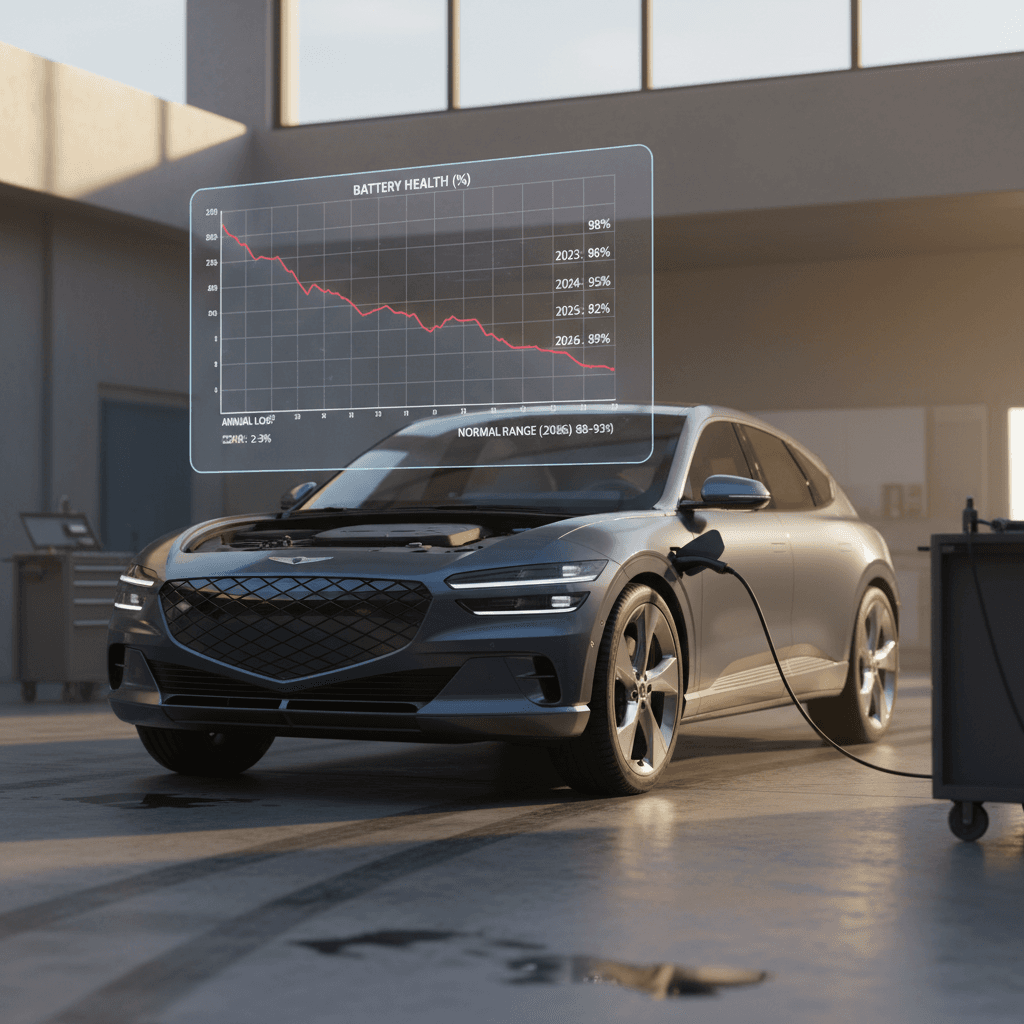
Normal Genesis GV60 battery degradation by year
With the caveat that there is no official Genesis degradation curve, here’s a realistic expectation range for Genesis GV60 battery degradation per year based on what we see from sister E‑GMP vehicles and broader EV fleet data.
Estimated GV60 battery capacity over time (typical use)
Approximate capacity retention for a GV60 with mostly home Level 2 charging, moderate climate, and mixed driving. These are estimates, not guarantees.
| Vehicle age | Estimated annual loss | Estimated remaining capacity | What that feels like |
|---|---|---|---|
| 1 year | 1.5–2.5% | 97–98.5% | Range might drop by 3–8 miles vs. new; hard to notice day‑to‑day. |
| 3 years | ~2%/yr average | 93–96% | Slightly shorter highway legs; most owners barely notice unless tracking data closely. |
| 5 years | ~2–2.5%/yr average | 88–92% | Road‑trippers may add one extra quick charge stop on long days. |
| 8 years | ~2–2.5%/yr average | 82–88% | Still very usable for daily driving; you plan fast‑charge stops a bit more carefully. |
| 10 years | ~2–3%/yr average | 75–85% | Noticeably less range than new, but still practical for many commuters if the pack is healthy. |
Assumes roughly 10,000–12,000 miles per year and good charging habits.
Hard use can be higher
Habits that speed up or slow down GV60 battery degradation
The same 77.4–84 kWh GV60 pack can age very differently in two households. The difference is usually not magic chemistry; it’s how you use and charge the car. Here are the biggest levers you control.
Do this, not that: GV60 battery‑friendly habits
1. Prefer Level 2 home charging
Use a <strong>Level 2 charger</strong> at home or work for the bulk of your charging. Reserve DC fast charging for road trips or true emergencies. This keeps pack temperatures and stress lower over the long haul.
2. Avoid living at 100%
It’s fine to charge the GV60 to 100% before a long drive, but don’t leave it parked full for days. For daily driving, target 60–80% if your schedule allows.
3. Don’t fear going below 20%, just don’t live there
The car’s management system protects the pack from true zero. Occasional low‑SoC trips are fine, but routinely arriving home at 1–2% and letting it sit that way is harder on the cells.
4. Keep the cabin (and battery) cool
Whenever possible, park in the shade or a garage, especially in hot climates. Extreme ambient heat accelerates <strong>calendar aging</strong> even when the car isn’t driven.
5. Use scheduled preconditioning
On cold days, precondition the GV60 while plugged in. You’ll draw energy from the grid to warm the pack instead of wasting usable capacity to bring it up to temperature on the road.
6. Update software and act on recalls
Hyundai–Genesis have issued software updates on the E‑GMP platform to better manage charging hardware and thermal behavior. Keeping your GV60 updated can help protect the pack and charging components long‑term.
Used‑car bonus: stable degradation
GV60 battery warranty and the 70% capacity threshold
Warranty terms vary slightly by market, but the theme is similar: Genesis backs the GV60’s high‑voltage battery for the long haul, and in many regions it explicitly references usable capacity.
- In the U.S., EV components including the high‑voltage battery are typically covered for 8 years or 100,000 miles against defects and excessive capacity loss.
- In Canada and some other markets, Genesis explicitly cites an 8‑year / 160,000 km battery capacity warranty down to 70% of the original usable capacity.
- Other regions (like parts of Europe) have similar 70%‑capacity language but slightly different mileage/kilometer limits. Always check your local warranty booklet or digital manual for exact terms.
What “70%” really means
It’s worth emphasizing that very few modern EVs actually hit the 70% threshold during their warranty period under normal use. The policy is a safety net for outliers, packs that degrade abnormally fast due to manufacturing defects or extreme conditions.
How to check battery health on a used Genesis GV60
If you’re evaluating a used GV60, you don’t have to guess about its battery. You can combine a little data with some common‑sense observation to get a clear picture of health, and, if you’re shopping through Recharged, much of this homework is already done for you.
1. Start with the range display
Fully charge the GV60 (ideally on Level 2) and look at the predicted range in the energy or cluster display. Then compare it to the original EPA rating for that trim in similar weather. A modest gap is normal; a huge gap merits more investigation.
Make sure drive history is reset or averaged over similar routes; heavy prior driving or extreme temperatures can skew the estimate.
2. Pull usable kWh via OBD2 (if possible)
Using a compatible OBD2 dongle and an app like Car Scanner, you can read the battery’s reported usable energy and state of health. Compare that to the original usable capacity (around 77.4–84 kWh depending on trim).
If you’re not comfortable doing this yourself, a knowledgeable EV shop, or a marketplace like Recharged that performs battery diagnostics, can help.
Used Genesis GV60 battery checklist
Confirm remaining battery warranty
Ask for the in‑service date and mileage so you know exactly how much of the 8‑year / 100k‑mile (or regional equivalent) battery coverage is left.
Review charging history if available
Look for patterns of extremely frequent DC fast charging or long storage at 100% SoC. A road‑trip EV isn’t a red flag by itself, but hard use plus hot climate deserves a closer look.
Check for software updates and recalls
Ask whether all <strong>charging‑ and battery‑related campaigns</strong> have been performed. On the E‑GMP platform, some updates are aimed at protecting charging components and, indirectly, long‑term battery health.
Inspect for charging issues, not just range
A pack can be healthy while other components, like the on‑board charger or ICCU, cause charging problems. Test both AC and DC charging if you can.
Test drive in mixed conditions
Do a real test drive that includes highway and city driving. Watch how quickly the state‑of‑charge percentage drops and whether the range estimate behaves logically.
Leverage third‑party diagnostics
Platforms like <strong>Recharged</strong> use tools such as the Recharged Score and dedicated battery health diagnostics to provide a <strong>transparent, verified view</strong> of a used GV60’s pack. That can save you from guesswork, and surprises later.
Real‑world range loss: what GV60 and E‑GMP owners report
Because the GV60 is still relatively new, most of the detailed degradation reports online are from Ioniq 5/6 and Kia EV6 owners. But their experience maps closely to what early GV60 drivers are seeing.
Common E‑GMP owner experiences (early life)
Patterns that likely apply to GV60 as well
Low‑mileage cars at ~100%
40k–75k miles with modest loss
Edge cases with higher loss
Don’t judge from one Reddit post
Should you worry about GV60 battery life?
From a buying‑advice perspective, the GV60’s battery is more an asset than a liability. The combination of a robust 800‑volt architecture, conservative thermal management, and an 8‑year high‑voltage warranty makes it a solid long‑term bet, especially if you’re coming from an older EV generation with steeper degradation.
Why the GV60 battery is a strong point
- Modern NMC chemistry tuned for both fast charging and durability.
- 800‑volt system keeps current (and thus heat) lower during fast charges.
- Well‑designed thermal management to keep the pack in its comfort zone.
- Competitive long‑term battery warranty with a 70% capacity reference in many markets.
- Real‑world E‑GMP data suggesting roughly 1.5–2.5% loss per year in normal use.
When to be more cautious
- The car has lived in extreme heat and fast‑charged multiple times per week.
- OBD2 or dealer diagnostics show unusually low usable kWh for its age.
- There is a history of charging‑system faults that haven’t been fully resolved.
- You’re an ultra‑high‑mileage driver planning 25,000+ miles per year for a decade.
In these edge cases, you may want a deeper inspection or a price that reflects the risk.
For most buyers, especially those considering a used Genesis GV60, the more practical question isn’t "Will the battery fail?" but "Does this specific car still offer the range I need for the next 5–8 years?" With sensible charging habits and a bit of upfront homework, or a transparent battery report from a marketplace like Recharged, the answer is usually yes.