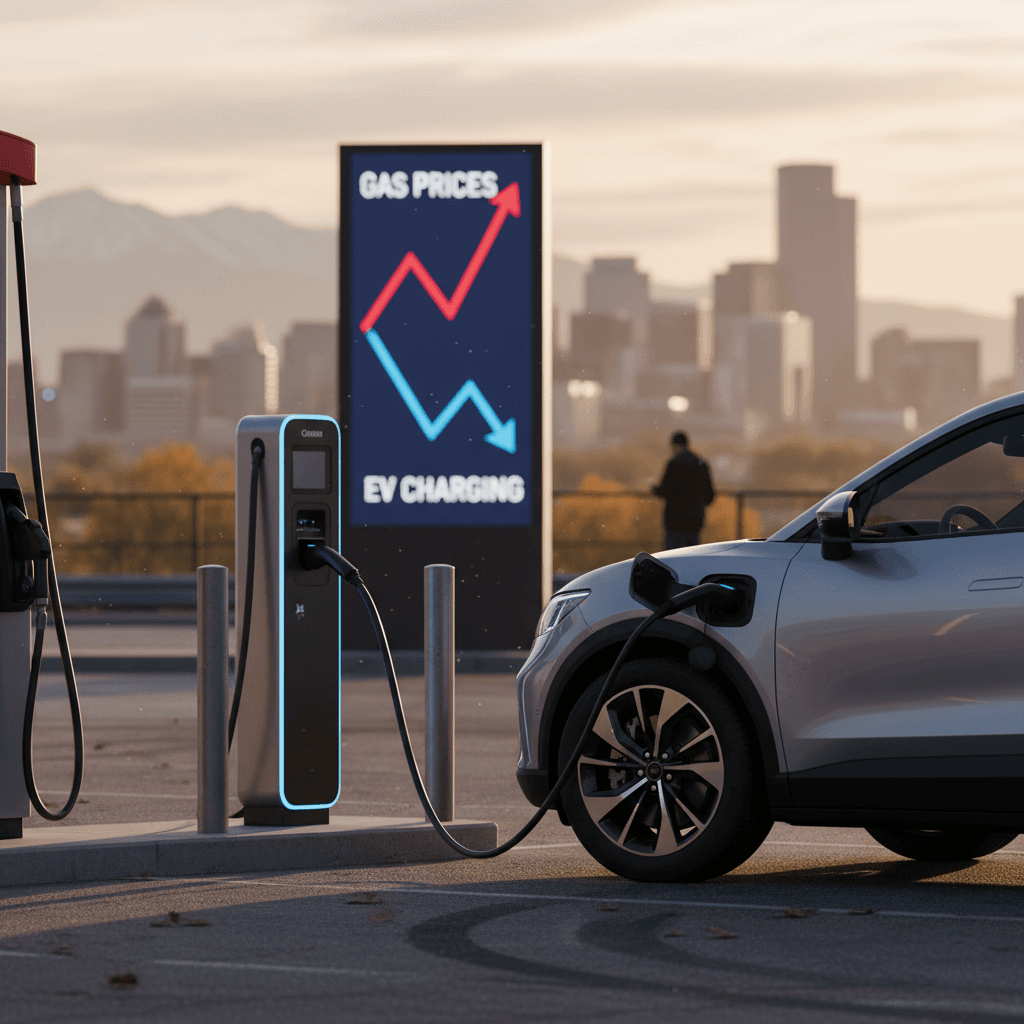
If you live in the Denver metro area in 2026, you’ve probably noticed gas creeping back toward (and in many stations, past) $4 per gallon. At the same time, electric vehicles are everywhere along I‑25 and in city neighborhoods. The natural question: in Denver specifically, how do gas prices vs. EV charging costs really compare in 2026?
What this guide covers
Why Denver drivers are asking about gas vs. EV costs in 2026
Colorado has become one of the country’s EV leaders, with state officials touting record adoption and more than 6,000 public charging ports statewide. At the same time, national gas prices pushed back above $4 per gallon in late March 2026, and Colorado drivers are feeling that at the pump. For Denver commuters staring at both gas station price boards and new charging stations, understanding the cost-per-mile difference matters more than ever, especially if you’re shopping the used‑EV market.
Denver cost snapshot for 2026 (typical ranges)
Quick answer: How gas vs. EV costs stack up in Denver
Gas vs. EV in Denver: 2026 at a glance
Assuming typical local prices and efficient vehicles
Gasoline car
- Fuel price: Around $3.80–$4.20/gal at many Denver stations in spring 2026.
- Typical efficiency: 25–30 mpg for a compact or small SUV.
- Approx. fuel cost: $0.13–$0.17 per mile.
Electric vehicle
- Home charging: ~$0.13–$0.16/kWh.
- EV efficiency: ~3–4 miles per kWh for many modern EVs.
- Approx. cost: $0.04–$0.06 per mile at home; $0.10–$0.18 per mile on DC fast charging.
Big picture
2026 gas prices in Denver: What you’re really paying
National average gas prices moved back above $4.00 per gallon in late March 2026, and Denver tends to track close to the U.S. average with some Rocky Mountain volatility. Local AAA and crowd‑sourced reports from early April 2026 show many Denver stations posting regular unleaded in the high‑$3 to low‑$4 range, with well‑over‑$4 not uncommon near the airport and along I‑70.
- Most Denver drivers should budget around $3.80–$4.20 per gallon for regular in spring 2026.
- Premium fuel can run $0.50–$0.80 per gallon higher, pushing some luxury SUVs into the mid‑$4s or more.
- Prices can swing quickly with global events and refinery outages, so think in yearly averages, not the single cheapest day you remember.
Don’t budget off yesterday’s prices
Denver electricity and EV charging prices in 2026
Unlike gasoline, your electricity cost per kWh is more predictable, and if you’re an Xcel Energy customer in the Denver area, you’ve seen rate cases in the news. Most residential customers in 2026 land in the $0.13–$0.16/kWh effective range once energy, riders, and fees are baked in, with time‑of‑use discounts for overnight charging on some plans.
Typical 2026 electricity and charging prices for Denver EV drivers
Representative ranges, not guaranteed contract rates. Always verify with your utility or charging provider.
| Charging type | Where | How you’re billed | Typical 2026 price | Notes |
|---|---|---|---|---|
| Home Level 2 | Single‑family home or dedicated condo parking | ¢/kWh on your electric bill | $0.13–$0.16/kWh | Cheapest option; some TOU plans offer lower overnight rates. |
| Workplace L2 | Office garages, corporate campuses | ¢/kWh or hourly; sometimes free | Often $0.18–$0.28/kWh | Rates vary widely; some employers subsidize costs. |
| Public Level 2 | City garages, mixed‑use lots, malls | ¢/kWh, session fee, or hourly | Roughly $0.20–$0.35/kWh | Convenient for top‑offs downtown or while shopping. |
| Public DC fast (50–150 kW) | Major corridors, grocery stores, big‑box lots | ¢/kWh or per‑minute | ~$0.40–$0.55/kWh typical around Denver | Fast and flexible, but often 2–3x home‑charging cost. |
| Tesla Supercharger (non‑Tesla EV) | Select Superchargers with Magic Dock or NACS access | ¢/kWh with per‑station pricing | Often $0.45–$0.60/kWh | Pricing varies by site and time; still competitive vs. gas for many trips. |
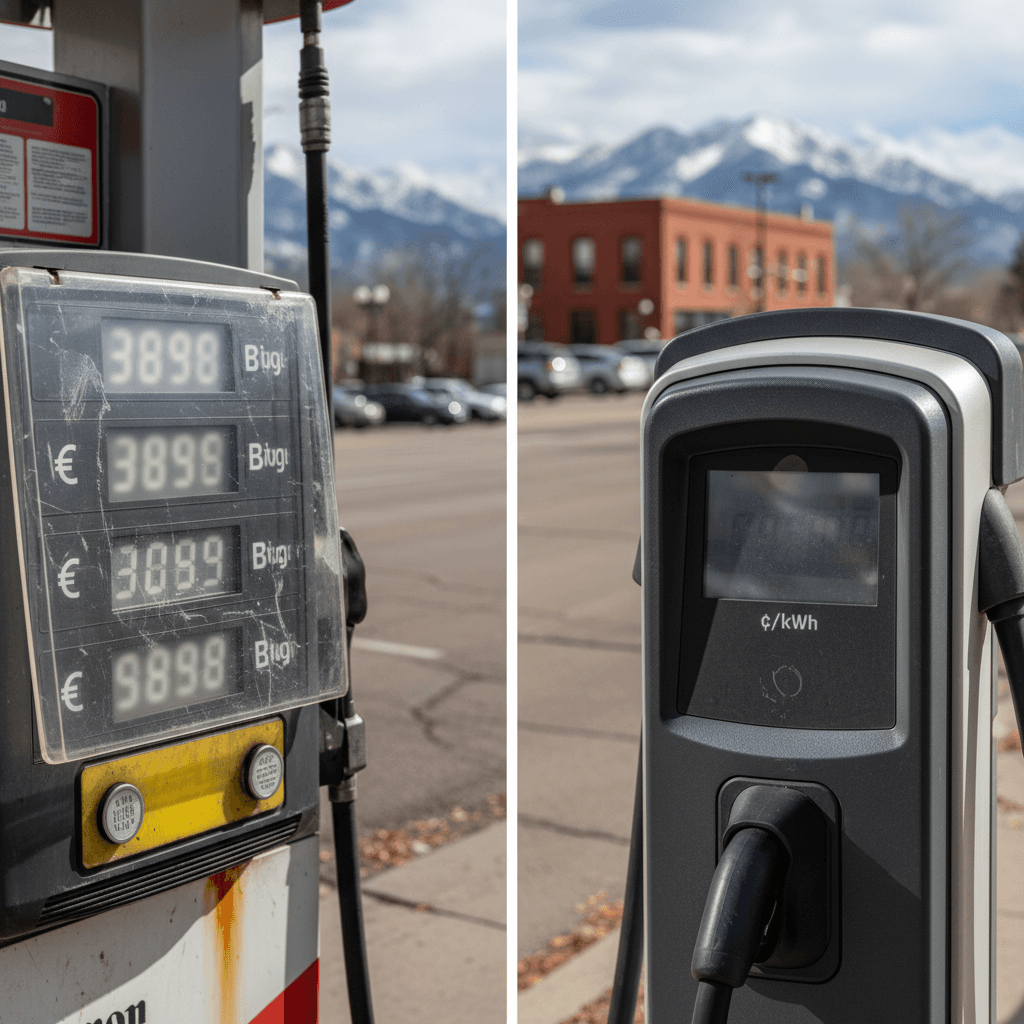
Home charging is consistently cheaper than public fast charging, but both usually beat gas on a per‑mile basis when you drive an efficient EV.
Check for EV‑specific utility rates
Per‑mile math: Gas vs. EV in Denver
To compare gas prices vs. EV charging cost in Denver, you need a common unit: cost per mile. Let’s walk through two realistic 2026 examples using current prices and typical vehicles you’ll see on I‑25.
Example 1: Popular gas compact SUV
Think of something like a Toyota RAV4 or Honda CR‑V.
- Average real‑world mpg: ~28 mpg combined.
- Gas price (Denver 2026): assume $4.00/gal for round numbers.
Cost per mile (gas):
$4.00 ÷ 28 mpg ≈ $0.14 per mile.
Example 2: Mainstream compact EV
Think Chevy Bolt EUV, Hyundai Kona Electric, or Tesla Model 3 RWD.
- Efficiency: ~3.5 miles per kWh (Denver’s mix of city, highway, and some winter).
- Home rate: $0.14/kWh mid‑range assumption.
Cost per mile (EV, home charging):
$0.14 ÷ 3.5 mi ≈ $0.04 per mile.
Side‑by‑side comparison
What if you rely heavily on DC fast charging around Denver instead of home charging? Using a mid‑range $0.45/kWh DC fast‑charge price and the same 3.5 miles per kWh efficiency:
- $0.45 ÷ 3.5 mi ≈ $0.13 per mile.
- That’s roughly in line with the $0.14/mile gas example.
- So at current Denver prices, a mostly fast‑charged EV is often cost‑competitive with a 28‑mpg gas SUV, but not dramatically cheaper. The real savings show up when most of your charging happens at home.
Annual cost comparison for common Denver driving patterns
Per‑mile math is helpful, but most households budget by the month or year. Let’s convert those figures into annual fuel or charging costs for a typical Denver driver in 2026. Surveys and DOT data suggest many Front Range commuters land around 10,000–12,000 miles per year, so we’ll use 12,000 miles for easy math.
Estimated 2026 annual fuel vs. charging costs in Denver
Assumes 12,000 miles per year. These are illustrative examples using today’s prices and typical efficiencies, not guarantees.
| Scenario | Fuel/energy price assumptions | Efficiency | Cost per mile | Estimated annual cost (12,000 mi) |
|---|---|---|---|---|
| Gas SUV commuter | $4.00/gal regular | 28 mpg | $0.14/mi | ≈ $1,680/year |
| Efficient hybrid (Prius‑style) | $4.00/gal regular | 50 mpg | $0.08/mi | ≈ $960/year |
| EV, mostly home charging | $0.14/kWh home rate | 3.5 mi/kWh | $0.04/mi | ≈ $480/year |
| EV, mixed 70% home / 30% DC fast | $0.14 home, $0.45 DC | 3.5 mi/kWh | ≈ $0.06/mi | ≈ $720/year |
| EV, heavy fast‑charge use (road‑warrior) | $0.45/kWh DC fast | 3.5 mi/kWh | $0.13/mi | ≈ $1,560/year |
The more you can shift EV charging to home (especially overnight), the more your total annual cost drops compared with a gas car.
What it means for a typical Denver household
Home charging vs. public fast charging: When EVs are cheap, and when they’re not
Not every Denver‑area driver has a garage or dedicated parking with a plug. Your personal math will depend heavily on where you charge. Here’s how the trade‑offs usually look in 2026.
How your charging pattern affects costs
1. Mostly home charging (best‑case savings)
If you live in a single‑family home or townhome with driveway/garage parking, a 240‑V Level 2 charger makes your EV incredibly cheap to run. This is the scenario where you’re paying 3–6 cents per mile, often one‑third the cost of a comparable gas car.
2. Home + workplace/public Level 2 (still very good)
If you can charge overnight and top off at work or around town on Level 2, you’ll pay slightly more overall, especially if public L2 is 20–35¢/kWh, but you’ll still usually beat gas by a wide margin over the year.
3. Mostly DC fast charging (convenient, but expensive)
Apartment dwellers sometimes rely on fast chargers at grocery stores or along I‑25. At roughly 40–55¢/kWh, your per‑mile cost can creep up close to that 28‑mpg gas SUV. You still gain maintenance and time advantages, but the pure fuel savings are smaller.
4. No reliable charging access (EV may not pencil out)
If you have no consistent place to plug in, no home outlet, no guaranteed spot at work, and fast chargers are often full, owning an EV in Denver becomes more expensive and less convenient. In this case, a high‑mpg hybrid may be the smarter play until your charging options improve.
Be realistic about your charging access
Beyond fuel: Maintenance and other costs that favor EVs
Fuel or electricity is only part of the ownership story. In Denver’s stop‑and‑go traffic and winter swings, maintenance and repair costs can quietly tilt the scales toward EVs over a 5–10 year horizon, especially if you’re buying used.
Typical maintenance differences: gas vs. EV
High level patterns Denver shoppers should know before choosing a powertrain
No oil changes
Fewer moving parts
Winter behavior
Used‑EV wild card: battery health
How Colorado incentives and utility programs shift the math
Colorado has been unusually aggressive about EV adoption, with state tax credits and infrastructure spending pushing EVs into more Denver driveways. The exact credit amounts change year by year, but the intent is consistent: make the upfront cost of an EV more competitive with gas cars while the fuel savings accumulate in the background.
- State EV tax credits have historically knocked thousands off the price of qualifying new EVs, and they influence used‑EV pricing as those vehicles filter into the secondary market.
- Utility rebates (for example, on home Level 2 chargers) can cut hardware and installation costs, making it cheaper to get that critical home‑charging advantage.
- Some workplace and municipal programs offer free or low‑cost Level 2 charging, which effectively gives you fuel at below‑home‑electricity prices.
Stacking incentives with a used EV
Using the Recharged Score to evaluate a used EV in Denver
If you’re switching from a gas car largely because of 2026 fuel prices, your biggest fear with a used EV is usually, “Am I buying someone else’s worn‑out battery?” That’s where Recharged’s diagnostic work can save you from guessing.
What the Recharged Score includes
- Verified battery health: We measure usable capacity and pack performance, not just guess based on mileage.
- Charging history insights: Frequent DC fast charging can slightly change long‑term degradation patterns; we take that into account when the data is available.
- Fair‑market pricing: Listings reflect current market conditions, including Colorado incentives baked into prior sales.
Why that matters in Denver
- Mountain driving, ski‑town cold, and long I‑70 grades stress both gas engines and EV batteries. A transparent health report helps you understand how an EV has actually been used.
- Knowing the real range you can expect at altitude and in winter lets you budget accurately for both charging cost and convenience, no rosy EPA‑only assumptions.
- With battery health verified, you can confidently compare a used EV’s annual cost (fuel + maintenance) against your current gas car using the $/mile numbers in this guide.
FAQ: Gas prices vs. EV charging cost in Denver (2026)
Frequently asked questions for Denver drivers
Bottom line: Should your next Denver commuter be electric?
In 2026 Denver, the math is straightforward: with gas hovering around $4 per gallon and home electricity sitting near the mid‑teens per kWh, an efficient EV that you charge mostly at home can cut your per‑mile fuel cost by more than half compared with a typical compact SUV. Add in lower routine maintenance and Colorado’s EV‑friendly policy environment, and the numbers favor electric for a growing share of metro‑area drivers.
The key is matching the car to your charging reality. If you can plug in overnight or at work, a used EV, especially one with a verified Recharged Score battery health report, is positioned to beat gas on both day‑to‑day costs and long‑term reliability. If you’re stuck living off DC fast chargers, you may still enjoy the benefits of electric driving, but your financial case will be tighter. Either way, going in with clear 2026 pricing and realistic $/mile expectations is the best way to decide whether your next Denver commuter should sip gas, electrons, or a bit of both.