If you live in the Mountain State, you already know the drill: gas prices in West Virginia can jump 20–30 cents seemingly overnight, then drift down just enough to make you forget how much you’re paying over a year. In 2026, with global oil shocks and lingering inflation, gas prices in West Virginia are back in the spotlight, and a lot of drivers are quietly asking whether it’s finally time to get off gasoline altogether.
A quick snapshot for 2026
Overview: Gas Prices in West Virginia in 2026
Let’s set the stage. West Virginia has enjoyed slightly cheaper gas than the national average over the last couple of years. In mid‑2025, for example, regular unleaded in the state hovered right around $3.00 per gallon while the U.S. sat closer to $3.15. That discount is real, but it doesn’t change the basic math: if you’re driving 15,000 miles a year in a truck that gets 18 mpg, you are burning through more than 800 gallons of fuel annually. At $3.20–$3.50 per gallon, that’s a serious line item in your household budget.
Recent Gas Price Benchmarks for West Virginia
The uncomfortable truth is that while models from the U.S. Energy Information Administration (EIA) point to an annual average under $3.00 nationally in 2026, short‑term spikes are already proving them optimistic. For a West Virginia household, the relevant story is not the annual average, it’s the cash you’re surrendering at the pump when prices lurch higher for weeks or months at a time.
Where Gas Prices Stand Today in West Virginia
As of early April 2026, AAA data shows the national average above $3.80 per gallon for regular unleaded, thanks largely to war‑driven disruptions in Middle East oil supply. Historically, West Virginia trails the national number by a few cents to a couple of dimes per gallon, so a reasonable working assumption is that many WV stations are posting prices in the mid‑$3s to low‑$4s for regular.
Expect wide variation by county
- Interstate corridors (I‑79, I‑77, I‑64) often run on the high side due to convenience pricing and fewer station options.
- Smaller towns off the interstate can be cheaper, but you may trade price for limited brand or pay-at-pump reliability.
- Prices can swing 20–40 cents per gallon across relatively short distances, worth planning around if you commute regularly.
Why West Virginia Gas Prices Are So Volatile
Gas in West Virginia lives at the intersection of three forces you can’t control: global oil markets, regional refining logistics, and tax policy. You can’t do much about any of them individually, but understanding the mix helps you see why a gallon costs what it does today, and why the same gallon could cost a lot more (or less) by Thanksgiving.
Three Big Forces Behind WV Gas Prices
None of them care about your monthly budget
Global oil shocks
Events like the 2026 Iran conflict can push crude oil prices sharply higher in days. West Virginia may feel those ripples within a week at the pump.
Regional supply & refining
West Virginia depends on fuel refined and shipped from out-of-state. Any refinery outage or pipeline issue in the broader region quickly tightens local supply.
Taxes & regulations
Federal and state fuel taxes are cents-per-gallon add‑ons. They don’t move with oil prices, but they set a price floor under every gallon you buy.
Why this matters to you
West Virginia Taxes and Fees on Gasoline
No one loves fuel taxes, but they’re a crucial slice of what you pay at the pump. On top of the federal gasoline excise tax of 18.4 cents per gallon, West Virginia layers in a mix of per‑gallon taxes and variable fees that move with wholesale prices.
Approximate Gasoline Tax Load in West Virginia (2025–2026)
How much of that pump price is taxes and mandatory fees?
| Component | Approx. Amount (¢/gal) | Who collects it | What it funds |
|---|---|---|---|
| Federal gasoline excise tax | 18.4 | U.S. federal government | Highways, transit, transportation projects |
| WV state gasoline tax & fees | ~35.7 | State of West Virginia | State roads and transportation |
| Total tax load | ~54.1 | Combined | Baked into every gallon, regardless of wholesale prices |
Numbers are rounded and representative, not precise to the penny for every day in 2026.
On a $3.25 gallon of regular, roughly 54 cents is taxes before station overhead and profit. At $4.00 per gallon, that tax portion looks even bigger, but it hasn’t changed at all. The volatility you feel is mostly coming from crude oil and refining margins, not the tax column.
Forecast: How Much Will Gas Cost in 2026?
Forecasting gas prices is like forecasting Appalachian weather: you can get the broad strokes right and still be completely wrong about any given Tuesday. That said, the pre‑war consensus from the EIA and other forecasters pointed to an average U.S. regular gasoline price around $2.90 per gallon in 2026, driven by modestly lower crude prices and easing refinery bottlenecks.
Then the Iran war happened
Baseline scenario
If hostilities cool and oil flows normalize in the back half of the year, it’s plausible that:
- National average prices trend back toward the low $3s by late 2026.
- West Virginia settles a shade under national averages, in the high $2s to low $3s.
- Spikes above $3.75 become less frequent but still possible during peak travel seasons.
High‑stress scenario
If disruptions drag on or widen, you could see:
- Regular swings into the mid‑$4 range nationally.
- West Virginia clinging to a small discount but still well into the $3s and $4s.
- Diesel flirting with or breaking above $5 again, affecting freight and grocery prices.
In other words, even the “good” version of 2026 still has you paying thousands of dollars a year to keep a gasoline vehicle moving. Which raises the obvious question: what are your alternatives?
Gas Prices vs. EV Costs in West Virginia
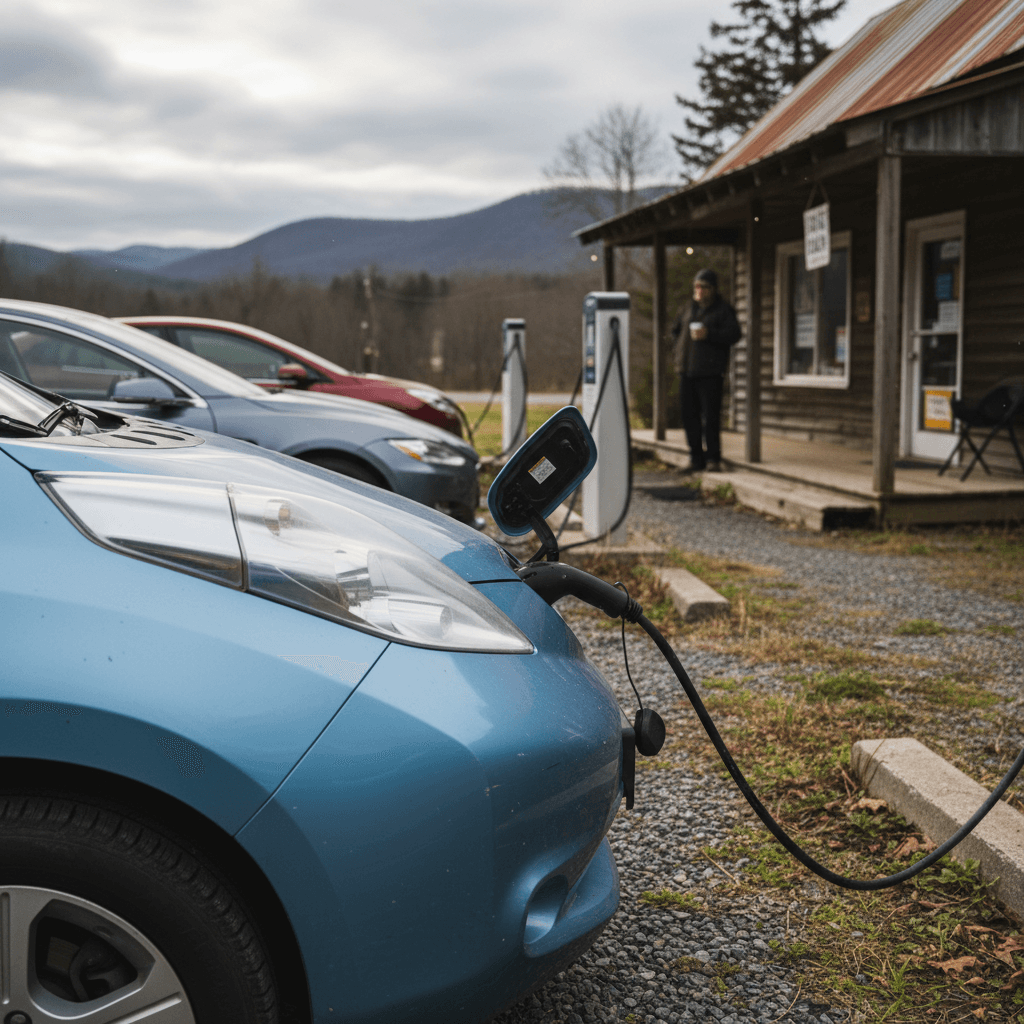
Here’s where the story gets interesting. While gasoline is chained to geopolitics, electric rates in West Virginia move mostly with regional power markets and utility regulation. They’re not perfectly stable, but they’re a lot less jumpy than crude oil futures being shoved around by the nightly news.
Gas vs. Electric: Back‑of‑the‑Envelope Math in WV
Even if those numbers slide up or down with actual local electricity rates and your driving habits, the direction is consistent: electricity is simply cheaper energy per mile than gasoline, particularly for the full‑sized pickups and SUVs that dominate West Virginia roads.
Think in cost per mile, not cost per gallon
How a Used EV Can Change Your Monthly Budget
When you compare gas vs. electric, it’s easy to focus on fuel and forget the rest of the ownership stack: maintenance, repairs, depreciation, and financing. Used EVs change that stack in ways that matter if your budget is already stretched by rising fuel and grocery prices.
Four Budget Levers a Used EV Pulls
Why fuel is only part of the story
Less maintenance
No oil changes. Fewer moving parts. Regenerative braking that extends brake life. Over several years, that’s hundreds of dollars back in your pocket.
Battery transparency
With Recharged, every used EV comes with a Recharged Score Report and verified battery health, so you’re not guessing about the most expensive component in the car.
Lower fuel volatility
Your electricity rate isn’t immune to change, but it’s far less exposed to geopolitical shocks than gasoline. You can actually budget.
Smarter financing
Recharged offers financing options tailored to used EVs, so you can roll that fuel and maintenance savings into a predictable monthly payment.
Where Recharged fits in
Ready to find your next EV?
Browse VehiclesIf gas prices in West Virginia stay jumpy through 2026, and every signal suggests they will, the driver who switched to a reasonably priced used EV in 2024 or 2025 is going to look very wise by 2027. Your future self will thank you for getting off the roller coaster early.
Who Should Stick With Gas, for Now?
Electric evangelism is cheap when you live in a city with chargers on every corner. West Virginia is not that state. It’s important to be honest: some drivers should probably stay with gasoline a little longer, even with ugly pump prices.
Good EV candidates in West Virginia
- Daily commuters under 60–80 miles round‑trip, especially with driveway or garage parking.
- Two‑car households that can keep a gas truck or SUV for towing and a used EV for daily errands.
- Drivers near major corridors (Charleston, Huntington, Morgantown, along I‑79/I‑64/I‑77) where public DC fast charging is growing.
Better off staying on gas (for now)
- Drivers in extremely remote areas with no realistic path to home charging.
- Heavy‑duty users regularly towing at maximum capacity long distances, where current EV options aren’t practical yet.
- Households unable to install or access a stable 120V or 240V outlet for overnight charging.
Don’t force an EV into an impossible situation
Roadmap: Switching from Gas to a Used EV in West Virginia
Three Paths Off the Gas Price Roller Coaster
Daily Commuter (Under 60 Miles/Day)
Confirm you have at least a regular 120V outlet where you park; if possible, plan a 240V outlet for faster Level 2 charging.
Estimate your current fuel burn: miles per year ÷ mpg × expected 2026 gas price (e.g., $3.25) to see your annual fuel spend.
Browse used EVs on Recharged that match your range needs with 20–30% buffer for winter and detours.
Use Recharged’s financing tools to line up a monthly payment that’s offset by fuel and maintenance savings.
Plan a "shakedown month" where you track charging habits and costs to validate your savings math.
Two‑Car Household (Keep a Gas Vehicle)
Designate the used EV as your default around‑town and commuting car; keep the gas truck/SUV for tow and haul duty.
Right‑size the EV battery: you may not need a huge‑battery SUV if the EV isn’t your road‑trip rig.
Check your local public charging options along regular routes, especially grocery, work, and kids’ activities.
Consider a slightly older, more affordable EV with a strong Recharged Score to maximize monthly savings.
Use the gas vehicle less; you’ll see the fuel savings immediately at the pump.
Long‑Haul Traveler (Frequent Interstate Trips)
Audit your actual road‑trip patterns: how many trips over 200 miles per year, and which corridors?
Use public charger maps to check DC fast‑charging coverage along those corridors through West Virginia and neighboring states.
If the network looks solid, shop for used EVs that support fast DC charging and have realistic highway range for your needs.
Plan to keep a gas or hybrid backup in the household for the next few years if you’re nervous about charging gaps.
Lean on Recharged’s EV‑specialist support to sanity‑check your plan before you sign anything.
Quick Checklist Before You Dump the Pump
1. Know your real fuel spend
Don’t guess. Pull a few months of bank or credit card statements and total up what you actually spent on gas. Then annualize it.
2. Check your home charging reality
Can you safely plug in at home every night? A simple outdoor 120V outlet can work for light commuters; a 240V outlet is even better.
3. Consider your winter range needs
West Virginia winters cut EV range. Choose a used EV with enough buffer that a cold snap doesn’t wreck your commute.
4. Run the total cost numbers
Factor in fuel, maintenance, insurance, and financing, not just sticker price. A slightly higher car payment can be offset by slashing fuel spend.
5. Use a trusted EV marketplace
Buying used EVs blind is risky. Platforms like Recharged offer verified battery health, fair pricing, and EV‑savvy advisors to keep you out of trouble.
FAQs About Gas Prices in West Virginia in 2026
Frequently Asked Questions
Bottom Line: Planning Around West Virginia Gas Prices in 2026
Gas prices in West Virginia in 2026 are not on your side. Even if they drift down from early‑year spikes, you’re still tethered to a commodity being yanked around by wars, refinery outages, and traders you’ll never meet. For many West Virginians, the financially rational move over the next couple of years is to start decoupling your life from gasoline, first by driving fewer gas miles, and then by replacing at least one household vehicle with an efficient used EV.
The good news is that you don’t have to navigate that transition alone. Recharged specializes in used electric vehicles, with a Recharged Score battery health report on every car, transparent pricing, financing and trade‑in options, and EV‑savvy specialists who actually understand the quirks of life in the Mountain State. If you’re tired of building your monthly budget around a gas price you can’t predict, exploring a used EV today is one of the few levers you can confidently pull.