If you drive an electric car in Portland, OR, you’ve probably wondered how much charging you can get for **free**, or at least for a lot less than filling a gas tank. The good news is that between public stations, curbside pilots, and local utility programs, Portland offers more ways than most cities to cut your EV charging costs. This guide walks you through where to find free EV charging in Portland, how to use it without headaches, and how to build a low-cost charging strategy that actually fits daily life.
First, a quick reality check
Why free EV charging matters in Portland
Portland drivers face a familiar problem: many live in older houses or multifamily buildings without easy access to a driveway outlet. That makes reliable, affordable public charging especially important. If you’re apartment‑based in inner Southeast or North Portland, a few free Level 2 sessions per week can be the difference between an EV working beautifully and feeling like a science project.
EV charging context in Oregon
You don’t need to chase every free kilowatt in the city. Instead, think about free and low‑cost charging as tools to **reduce your average cost per mile**. A dependable home or workplace setup, backed up by a few well‑chosen public options, will almost always beat trying to live 100% off free plugs.
Types of free or low-cost EV charging you’ll see
Common free and cheap charging setups in Portland
Know what you’re looking at before you plug in
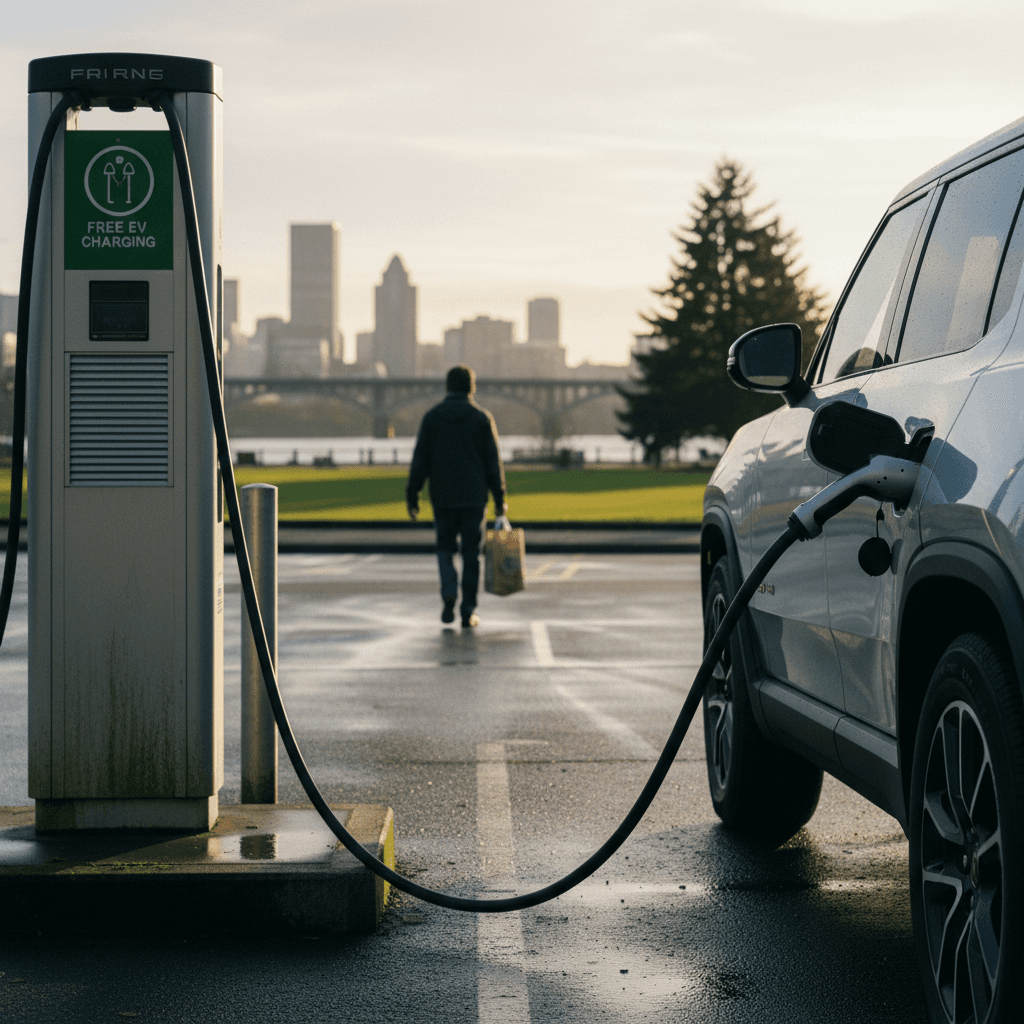
Completely free Level 2
These are the unicorns you’re hunting:
- Usually at workplaces, hotels, hospitals, or city facilities.
- Time‑limited (e.g., 2–4 hours) or tied to parking rules.
- May require a network app but show $0/kWh.
Free for a few hours
Some sites offer introductory or daytime windows:
- “Free first 2 hours, then idle fees.”
- Special events or pilot programs.
- Good for errands or appointments near downtown.
Discounted or smart-charging rates
Utility programs don’t feel “free,” but they’re cheap:
- Lower overnight home rates with Time‑of‑Day plans.
- Smart charging rebates if you let the utility pause charging briefly.
- Can cut home charging cost per mile by half or more.
When you open a charging app, don’t just look for the green “free” icon. Check the fine print, especially **parking rules and idle fees**. A station can be free to use but located in a garage that charges $3–$4 an hour, or it might hit you with a per‑minute fee if you stay plugged in after your session ends.
Apps and tools to locate free EV charging in Portland
The fastest way to uncover free or low‑cost EV charging in Portland is through crowd‑sourced and network apps. Each has its strengths, so it’s smart to keep more than one on your phone.
Best apps for finding free EV charging in Portland
Use at least two, data is never perfect
PlugShare
Best for user reports.
- Filter for “Free” to see no‑cost stations.
- Read recent check‑ins for accuracy and outages.
- Great for spotting free chargers at hotels or small businesses.
ChargeHub / ChargePoint / EVgo
Best for network details.
- Many networks let owners set $0 session cost.
- Show pricing, speed, and parking notes.
- Good for tracking promos and limited‑time free sessions.
OEM & utility apps
Best for planning and promotions.
- Some automakers’ apps show nearby chargers and pricing.
- PGE and Oregon’s Go Electric site offer charger maps and links.
- Great starting point if you’re brand‑new to EVs.
Pro tip: filter and favorite wisely
Where to look for free charging around town
Free chargers in Portland rarely advertise themselves with big signs. They’re tucked into places that already make money on something else, parking, coffee, retail, or office leases. Here’s where you’re most likely to find them.
1. Workplaces and campuses
Many Portland employers, medical centers, and colleges offer free or subsidized EV charging for staff, students, or visitors. Examples include hospital campuses, government buildings, and university garages.
- Check your HR or facilities portal for EV perks.
- Some lots are badge‑access only during business hours.
- Even a few free sessions a week can cover most commuting miles.
2. Hotels, museums, and retail
Some hotels and attractions use free charging as a way to attract guests:
- Museums and cultural sites sometimes partner with utilities for **sponsored chargers** in their lots.
- Hotels near downtown or the Lloyd District may offer Level 2 charging bundled with parking.
- Occasionally, grocery chains or malls provide free charging to draw shoppers, though many have gone to paid or time‑limited models.
3. City facilities and park‑and‑rides
As the city and regional agencies add chargers at community centers, libraries, and transit‑adjacent parking, some locations may start out with little or no usage fees while programs are in pilot phase. These are worth keeping an eye on in your apps and on Portland’s EV page.
Even when the electricity isn’t free, combining a modest parking fee with $0.10–$0.20/kWh charging can undercut what you’d spend on gas for the same trip.
4. Smaller utilities and neighboring cities
Outside the Portland city limits, some local utilities and public power districts have experimented with **free or ultra‑cheap charging** to encourage EV adoption. If you commute from places like Gresham, Hillsboro, or further afield, it’s worth checking their utility websites and PlugShare reviews for hidden gems that don’t show up in big national marketing campaigns.
Utility programs that lower your home charging costs
If you can plug in at home, whether at a driveway, carport, or dedicated parking space, your most reliable “cheap fuel” often isn’t public charging at all. It’s **off‑peak electricity** plus utility programs that reward smart charging behavior.
Key Portland-area utility programs that reduce charging costs
Offers and details change regularly, so always confirm with your utility before you buy equipment or enroll.
| Program type | Who offers it | Typical benefit | What it means for you |
|---|---|---|---|
| Time‑of‑Day (TOD) or time‑varying rates | Portland General Electric, Pacific Power | Cheaper electricity during off‑peak hours (often late evening to morning) | Shift charging after 9–10 p.m. and your cost per mile can drop dramatically vs. daytime or public fast charging. |
| Smart charging / managed charging | PGE smart charging programs and supported chargers | Up‑front rebate on a Wi‑Fi connected Level 2 charger plus annual bill credits | Let the utility pause charging briefly during peak demand, and you get paid to be flexible. |
| Home charger rebates | PGE, Pacific Power, and OEM‑partner offers | Hundreds of dollars off purchase and/or installation of a Level 2 charger | Reduces up‑front cost so you can charge faster at home and rely less on public DC fast charging. |
| Community / multifamily incentives | Utilities + property owners | Grants or rebates to add shared Level 2 chargers in apartment garages and lots | If you rent, your building might add resident‑only chargers that are cheaper than public DC fast charging, even if not free. |
Utility incentives can make home charging the cheapest way to “fill up” your EV in Portland, especially if you drive daily.
Why this matters even in a “free charging” article
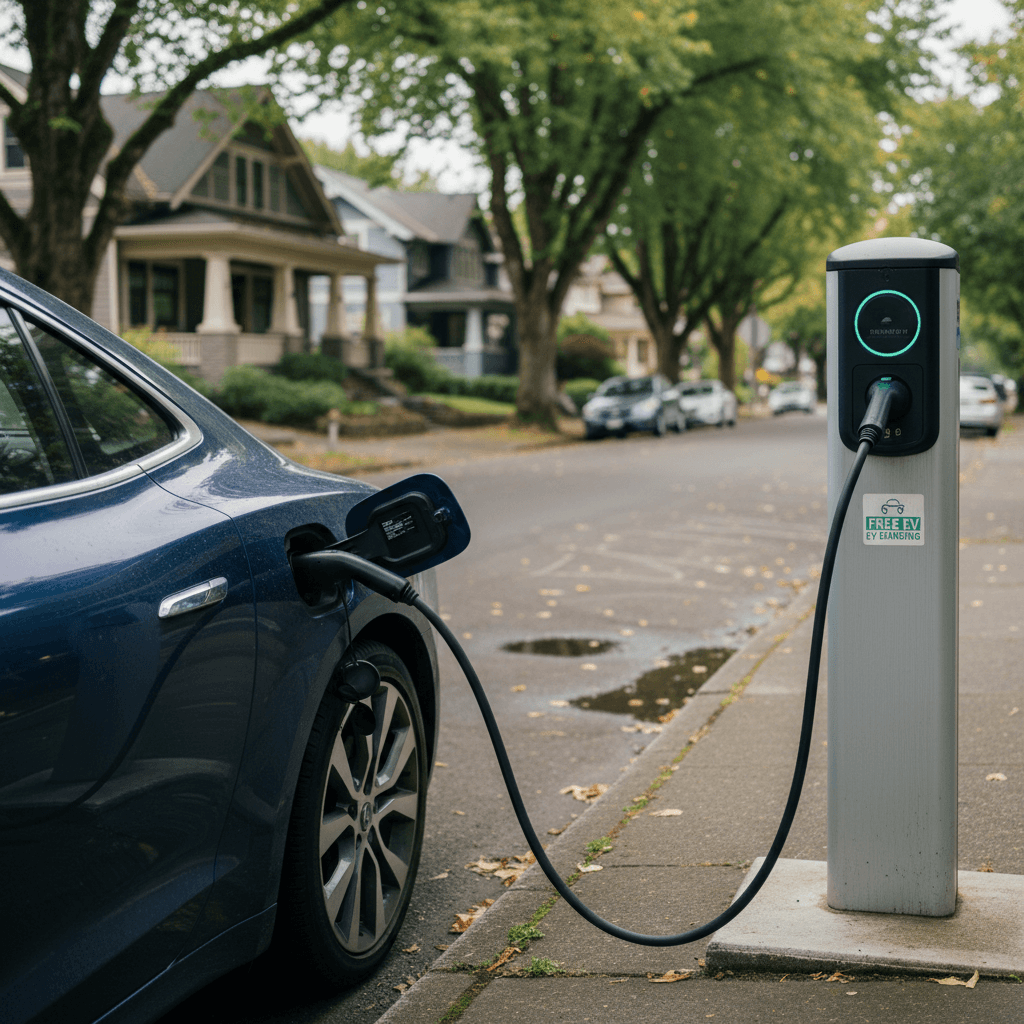
New curbside and right-of-way chargers
Portland knows that renters and older neighborhoods with little off‑street parking can’t go fully electric without somewhere to plug in. That’s why the city is rolling out a wave of **curbside and utility‑pole‑mounted chargers** between 2025 and early 2026, focusing on areas with limited private parking.
What Portland’s curbside chargers mean for you
1. More options where you actually park
Instead of hunting for a garage downtown, you’ll see more Level 2 plugs on neighborhood streets near apartments and small businesses, especially in underserved areas the city has flagged as charging deserts.
2. Competitive pricing, sometimes free pilots
Many early installations roll out with attractive rates to encourage usage. Some may offer introductory free windows or discounted pricing while the city and utilities gather data.
3. Better equity for renters
If you don’t control your building’s parking, curbside chargers give you a path to EV ownership that doesn’t require convincing your landlord to invest thousands of dollars.
4. Clearer rules and signage
Standardized signs (for example, “EV charging only” during certain hours) make it easier to understand when you can park, how long you can stay, and whether you’re paying only for electricity or also for parking.
How to keep tabs on new chargers
Strategy: how to mix free public and cheap home charging
Instead of asking, “Can I do all my charging for free in Portland?” a better question is, “How can I keep my **average cost per mile** as low as possible without wasting time?” Here’s a practical framework.
Charging strategies for different Portland lifestyles
Apartment or street-parked driver
Ask your employer about free or subsidized workplace charging; even two days a week can cover most commuting miles.
Identify 2–3 reliable free or cheap Level 2 stations near home (grocery, community center, library) and build routine errands around them.
Watch for new curbside chargers in your neighborhood and pilot programs that offer introductory free or discounted charging.
Consider an EV with strong efficiency and moderate battery size rather than the biggest pack you can find; smaller packs often charge faster on Level 2.
Homeowner with driveway or dedicated space
Install at least a 240V outlet or Level 2 charger if feasible; combine it with a Time‑of‑Day rate or smart‑charging program.
Schedule charging for late evening or overnight so nearly all your miles are powered at the cheapest rate.
Treat free public charging as a bonus, use it when convenient at work, during long errands, or on road trips, but don’t depend on it.
If you’re shopping for a used EV, prioritize models with strong Level 2 charging performance (7–11 kW) so you can easily refill overnight.
Frequent long-distance driver
Rely mainly on DC fast charging corridors for speed, but use free or cheap Level 2 whenever you’re stopped for multiple hours (meetings, overnights).
Plan trips around a blend of paid fast chargers and free or inexpensive Level 2; apps like PlugShare can reveal low‑cost sites right off I‑5 and I‑84.
At home, pair a Level 2 charger with off‑peak rates. That way, you start every trip with a full, low‑cost battery instead of paying high prices for the first 100 miles at a DC fast charger.
Consider total travel cost when picking an EV, slightly more efficient models can save hundreds per year on electricity alone.
Common pitfalls with free EV charging
Free EV charging sounds like a dream, but in the real world it comes with trade‑offs. Knowing the common traps helps you decide when “free” is really worth it.
- Relying on a single favorite free station that’s often blocked, broken, or ICEd (parked by a gas car).
- Ignoring idle fees: some “free energy” sites charge steep per‑minute rates if you stay plugged in after your session ends.
- Forgetting about parking costs, downtown garages can eclipse the value of the free electricity.
- Spending 30 extra minutes per week babysitting charging sessions instead of charging reliably at home overnight for pennies per kWh.
- Assuming every new curbside or pilot charger will remain free forever; many transition to standard pricing after the pilot phase.
Don’t let “free” cost you more
How free charging fits into buying a used EV
If you’re shopping the Portland market for a used EV, it’s tempting to fixate on where you’ll find free charging. A smarter move is to pick the **right car first**, then use free or cheap charging to make a good match even better.
Used EV shopping questions for Portland drivers
Free charging is part of the story, not the whole story
1. Where will I charge 80% of the time?
Before you worry about that one free charger near work, answer:
- Can I plug in at home, even with a regular 120V outlet?
- Does my workplace, school, or regular parking have Level 2?
- Are there curbside or community chargers near my building?
The more predictable your primary charging spot, the less you’ll stress about finding free public stations.
2. How healthy is the battery?
A used EV with a worn battery might push you to rely more on DC fast charging, which is the most expensive option. That’s where tools like the Recharged Score and verified battery health reports are invaluable, they tell you how much usable range you’re really getting.
3. Does the charging hardware fit Portland?
Look for a used EV that:
- Charges at 7 kW or more on Level 2, so overnight home charging is easy.
- Has widely supported connectors and adapter options if you plan to use multiple networks.
- Works smoothly with utility smart‑charging programs if you want those rebates.
This matters more to your day‑to‑day costs than one or two free stations across town.
4. Can the seller help me think it through?
When you shop with Recharged, every vehicle comes with a Recharged Score battery health report and **expert EV guidance**. Our specialists can help you map out how you’d actually charge a particular car around Portland, home, work, curbside, and on road trips, before you ever sign paperwork.
If you’re planning to lean on public or free charging, that conversation is especially important.
FAQs: free EV charging in Portland, OR
Frequently asked questions about free EV charging in Portland
Bottom line on free EV charging in Portland
Free EV charging in Portland, OR isn’t a myth, but it’s not a full‑time replacement for a solid charging plan, either. Think of it as the icing on the cake: nice when you can get it at work, near your favorite grocery store, or from a new curbside pilot, but not something you should chase across town.
If you build your strategy around **cheap home charging or reliable workplace charging**, then layer in free or discounted public sessions when they’re convenient, you’ll keep your cost per mile well below what most people pay for gas, without rearranging your life around a plug. And if you’re still choosing the right EV for Portland traffic, rain, and parking realities, browsing used models on Recharged is a smart next step. Every car comes with verified battery health data and expert guidance, so your charging plan and your EV choice work together from day one.