If you own or are considering a used Fisker Ocean, you’re in an unusual spot. You still need a clear Fisker Ocean maintenance schedule, but the automaker has gone through bankruptcy and traditional factory support has largely disappeared. This guide walks through what to service, how often to do it, and realistic options for keeping an Ocean on the road in 2026 and beyond.
Important context for Fisker owners
Why Fisker Ocean maintenance is different right now
With most EVs, you can open the owner’s manual or app and see a neat, official maintenance schedule. With the Fisker Ocean, two things complicate that picture: the company’s bankruptcy and a thin, shifting network of service partners. That makes it even more important to understand the underlying EV maintenance fundamentals so you’re not relying on guesswork or a dead app menu.
Three realities that shape Fisker Ocean service
Why you can’t just follow a normal dealer schedule
1. EV platform, not a gas SUV
2. Factory support is limited
3. Mixed track record
Don’t assume “no maintenance” because it’s an EV
Fisker Ocean maintenance basics: what actually needs service
Even without a fully supported factory maintenance book, most of what a Fisker Ocean needs follows the same pattern as other EV crossovers. Here’s the short list of systems you should plan to maintain:
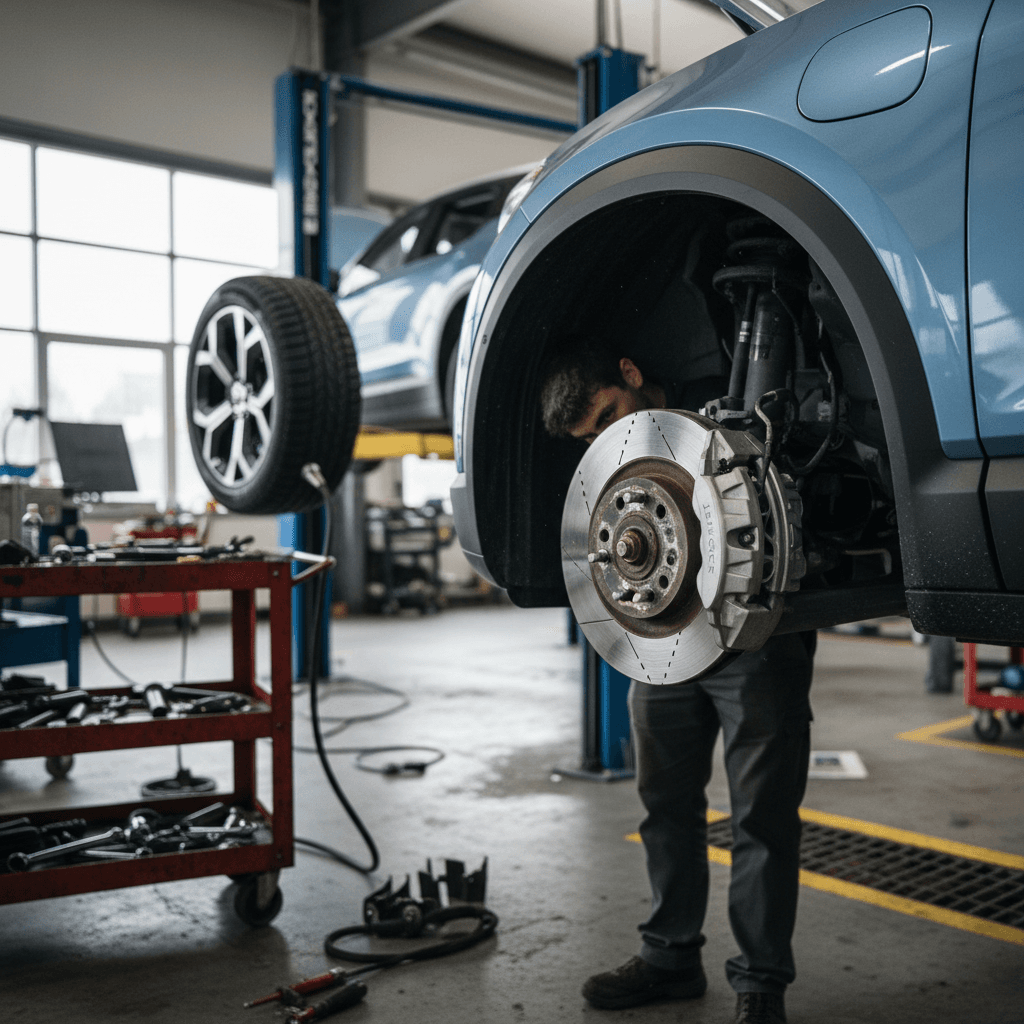
- Tires and wheels: rotation, balance, alignment, and eventual replacement, heavy EVs burn through tires faster than comparable gas SUVs.
- Brakes: pads and rotors last longer thanks to regenerative braking, but calipers can seize and fluid still absorbs moisture over time.
- High-voltage cooling system: coolant for the battery, inverter, and drive units needs periodic inspection and eventual replacement.
- Cabin air filter and HVAC: keeps the interior air clean and HVAC efficient, especially in climates with dust or pollen.
- Suspension and steering: bushings, control arms, tie rods, and dampers can wear just like any other SUV.
- 12‑volt battery: critical on modern EVs; a weak 12‑volt can leave the car "dead" even if the main pack is charged.
- Software and connectivity: updates, bug fixes, and recall campaigns when available from specialists or remaining partners.
- Body and water sealing: door seals, drain paths, and underbody protection, especially important on a relatively rare, early‑run EV.
Suggested Fisker Ocean maintenance schedule
Until an official, consistently supported schedule exists again, the safest move is to borrow intervals from other EVs in the segment (like Tesla Model Y, Hyundai Ioniq 5, Kia EV6, and VW ID.4) and adapt them to the Ocean. Use the table below as a practical, conservative Fisker Ocean maintenance schedule.
Practical Fisker Ocean maintenance schedule (time or mileage, whichever comes first)
A brand-agnostic EV schedule tailored to what Fisker Ocean owners and independent specialists are actually dealing with.
| Interval | Recommended service items | Notes |
|---|---|---|
| Every 6 months or 5,000–7,500 miles | Tire rotation; visual check of tread and sidewalls; quick brake and suspension inspection | Heavy EV curb weight makes regular rotation essential to avoid cupping and edge wear. |
| Every 12 months or 10,000–15,000 miles | Full multi‑point inspection; alignment check (if tire wear suggests); wiper blades; washer fluid; check all exterior lights | Ask the shop to document any warning lights or stored fault codes. |
| Every 2 years | Brake fluid test and replacement if contaminated; HVAC cabin filter replacement | Many EV brands recommend a 2–3 year brake fluid check; dusty or humid areas may need more frequent service. |
| Every 3–4 years | Coolant health check for the battery/drive-unit system; detailed underbody and corrosion inspection | Exact coolant spec and procedure matter, use a shop comfortable with EVs and following OEM-style standards. |
| Every 4–5 years | 12‑volt battery testing and likely replacement; deeper inspection of suspension bushings and dampers | A weak 12‑volt battery is a frequent culprit behind "bricked" EVs that won’t wake up. |
| As needed | Tire replacement; brake pads/rotors; software/firmware updates; recall or campaign work; water-leak investigation | On a Fisker Ocean, factor in extra time for parts sourcing and scheduling with specialists. |
Treat this schedule as a floor, not a ceiling, shorter intervals are fine, especially if you drive hard or in harsh climates.
Build a simple maintenance log
Where Fisker Ocean owners should focus first
Software updates, recalls, and electronic gremlins
Beyond mechanical wear items, the Fisker Ocean’s other pain point is software. Owners have reported issues like infotainment freezes, ADAS cameras misbehaving, boot loops, and, in some cases, vehicles that won’t "wake up" after sitting or updating. With factory infrastructure in flux, software maintenance now runs through a mix of approaches rather than one clean over‑the‑air pipeline.
What to do as an existing owner
- Document any error messages, warning lights, and when they occur.
- Try basic power cycles only as recommended; avoid "DIY" resets you find in random forums unless a known specialist endorses them.
- When you connect with a former Fisker tech or independent shop, ask them to scan and save diagnostic reports for your records.
If you’re buying used
- Ask the seller for proof of major software updates or recall work, especially water pump and HV-related campaigns.
- During a pre‑purchase inspection, have a shop pull fault codes and software versions rather than relying on whatever the center screen shows.
- Budget time and money to get the car in front of a specialist early in ownership, even if it seems fine.
Be cautious with unsupported updates
Who can actually service a Fisker Ocean now?
Fisker’s dealer and service footprint never matched the big brands, and after bankruptcy many owners have turned to a patchwork of options: European service partners, a handful of legacy dealer partners, independent EV shops, and mobile outfits started by former Fisker technicians.
Real-world service options for Fisker Ocean owners
Expect to mix and match over the life of the vehicle
EV-savvy independent shops
Former Fisker technicians & mobile specialists
Legacy dealer or European partners
How to vet a non-Fisker shop
What Fisker Ocean maintenance is likely to cost
Routine maintenance on an Ocean shouldn’t be ruinous, but it will rarely be as cheap or convenient as a mainstream EV with a full dealer network. Plan for normal EV wear‑and‑tear costs plus a "rarity premium" for anything that involves unique parts or software.
Typical maintenance and repair cost drivers
Tires and alignment
Expect EV‑rated tires to run higher than mainstream SUV rubber, especially in 20–22 inch sizes. Misalignment or aggressive driving can cut life dramatically, so spending on a quality alignment can save money in the long run.
Brake service
Thanks to regen, pad and rotor replacement may be infrequent, but corrosion and sticking calipers are still a risk, especially in salty climates. A periodic clean-and-lube or fluid change is cheap insurance.
Cooling system work
Coolant leaks, faulty pumps, or contaminated fluid can be more expensive on low‑volume EVs. Parts lead time shows up in your bill through extra shop time and potential towing.
12-volt battery and electrical
A preventative 12‑volt replacement every 4–5 years isn’t glamorous, but it’s cheaper than a tow and diagnostic session when the car won’t boot.
Software & specialist visits
If you rely on traveling mobile specialists, factor in trip fees or minimum visit charges. Group sessions in your region can help share costs among multiple owners.
Insurance and extended coverage
Maintenance red flags when you’re buying a used Fisker Ocean
If you’re cross‑shopping a used Fisker Ocean against more common EVs, the maintenance story should be part of your decision, not an afterthought. A good Ocean can be a compelling value, but only if you go in eyes‑open on past care and future support.
- No proof of software or recall work: If there’s no documentation of updates or recall campaigns, assume you’ll need to invest in catching the car up.
- Uneven or severe tire wear: Often a sign of alignment issues or suspension problems; on a heavy EV, this can hint at deeper damage from potholes or curb hits.
- Warning lights or "Christmas tree" dashboards: Any persistent high‑voltage, battery, or drivetrain warnings should be investigated with a full scan before you commit.
- Repeated no‑start or "bricked" history: Ask directly whether the vehicle has ever required a mobile tech visit or transport due to not waking up or failing an update, and who fixed it.
- Evidence of water leaks: Damp carpets, foggy lights, or mildew smells deserve extra scrutiny. Water plus high‑voltage hardware is a combination you don’t want to inherit.
- DIY repairs with no documentation: Creative fixes are common when official parts are scarce, but they can complicate future diagnosis and resale value.
Always get an independent EV inspection
How Recharged approaches used Fisker Oceans
At Recharged, the bar for listing any used EV is already high. With niche models like the Fisker Ocean, that bar gets even higher. We combine physical inspections with battery‑health diagnostics and market data so buyers aren’t gambling on a pretty spec sheet.
1. Battery and high-voltage health
Every EV on our marketplace gets a Recharged Score Report that includes verified battery health. On an Ocean, where long‑term factory support is uncertain, knowing how the pack is holding up is critical.
We also look at cooling performance, scan for HV‑related fault codes, and note any history of water‑pump or thermal‑system work.
2. Real-world serviceability
Our EV specialists evaluate whether there is a realistic path to ongoing maintenance for that specific VIN, regional specialists, parts availability, and known campaign status.
If we don’t believe an Ocean can be maintained responsibly for the next owner, we simply don’t list it.
End-to-end help with niche EVs
Ready to find your next EV?
Browse VehiclesFisker Ocean maintenance schedule FAQ
Common questions about Fisker Ocean maintenance
Bottom line: How to live with a Fisker Ocean long term
A solid Fisker Ocean maintenance schedule looks less like a fixed dealer printout and more like an organized checklist: rotate tires early and often, get annual inspections, test brake fluid every couple of years, keep the cooling and 12‑volt systems healthy, and stay conservative with software. If you’re already an owner, building relationships with one or two trusted EV shops and, ideally, a former Fisker tech will matter as much as any specific mileage number.
If you’re shopping for a used Ocean, the same maintenance lens can turn a high‑risk gamble into a calculated bet, or steer you toward a different EV that better fits your appetite for support and simplicity. Either way, tools like Recharged’s battery‑health diagnostics, fair‑market pricing, and EV‑specialist guidance can give you a clearer picture of what ownership will really look like, before you ever click “buy.”