If you own a Fisker Ocean, or you’re tempted by a bargain-priced one, the question on your mind is simple: what’s the Fisker Ocean depreciation rate now that the company has gone bankrupt? The short answer: it’s one of the steepest value drops we’ve ever seen for a modern EV, and it behaves very differently from a Tesla, Hyundai Ioniq 5, or Ford Mustang Mach-E.
Context: Fisker’s rapid rise and fall
Why Fisker Ocean depreciation is very different from a normal EV
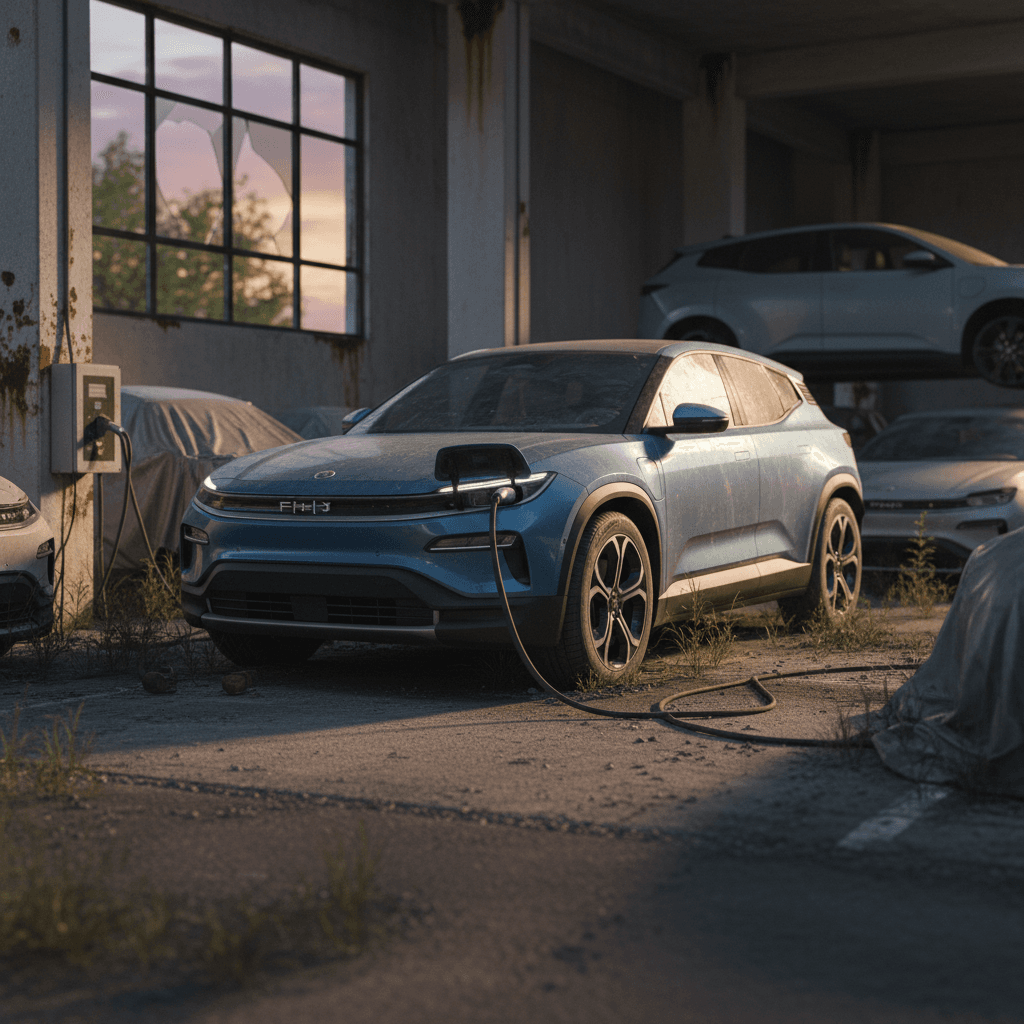
Every new vehicle loses value, but the Fisker Ocean sits in a unique, and uncomfortable, category. It’s an orphaned EV: the manufacturer is bankrupt, factory support has ended, and software and parts are being kept alive mostly by third parties and owner groups, not by Fisker itself. That reality warps the usual depreciation curve you’d expect from any mainstream SUV.
Three forces that make Ocean depreciation extreme
More than just normal EV price drops
Automaker bankruptcy
Once Fisker entered bankruptcy in mid-2024, confidence evaporated. Buyers and lenders priced in the risk of no factory support, which drags values down sharply.
Software + support risk
Reports of buggy software, recalls, and uncertain long-term updates make potential buyers wary, especially when fixes depend on small third parties instead of a global OEM.
Parts and repair uncertainty
Because Fisker relied on contract manufacturing and a fragile supply chain, there’s real concern about parts availability over the next 5–10 years. That uncertainty is baked into today’s resale prices.
Contrast that with a Tesla Model Y or Hyundai Ioniq 5. Those brands have deep dealer networks, steady over-the-air support, and clear parts pipelines. Even if resale values soften as more EVs hit the market, shoppers trust those cars can be serviced for years. With the Ocean, every prospective buyer is asking, “Who keeps this functional five years from now?” That question is what’s crushing the depreciation curve.
Fisker Ocean value collapse at a glance
How fast are Fisker Oceans depreciating right now?
Because production was low and the used market is thin, we don’t have the same clean datasets you’d see for a Model Y or Mach-E. But piecing together auction data, dealer listings, and owner reports paints a clear picture: Fisker Oceans have lost an unusually large share of their value in just a couple of years.
Illustrative Fisker Ocean depreciation curve
Approximate real-world value changes, based on reported transactions and pricing moves. Actual values vary by condition, trim, and mileage.
| Time from delivery | Context | Typical original MSRP range | Observed asking / transaction range |
|---|---|---|---|
| New launch (late 2022–early 2023) | Early adopters taking delivery | $40,000–$65,000 | Full sticker, some paid premiums |
| Early 2024 (pre-bankruptcy) | Fisker slashes new prices to move inventory | $39,000–$63,000 (original) | New discounted to roughly $25,000–$40,000 |
| Mid–late 2024 | Bankruptcy, fleet sale, recalls | Same MSRP | Reported auction/fleet pricing around $14,000–$15,000 per vehicle |
| 2025–early 2026 used market | Thin used listings, wary buyers | Originally $40,000–$65,000 | Many used Oceans advertised around the high teens to low $20,000s; some trade-in offers reportedly as low as $5,000–$15,000 |
These figures are directional, not guarantees, local demand and individual vehicle condition matter.
Important caveat on the numbers
If you zoom out, it’s reasonable to say that many Fisker Oceans have shed 50–70% of their original MSRP within roughly two years of launch, far beyond the 30–45% you’d expect from a typical premium EV over the same period.
What drove the Fisker Ocean depreciation crash
The Ocean’s depreciation rate isn’t just about one bad headline; it’s the accumulation of structural and reputational hits that all showed up in the resale data.
Key factors pushing Fisker Ocean values down
1. Aggressive factory price cuts
When Fisker cut new-Ocean prices by roughly a third in March–April 2024, it instantly reset the reference price. A $60,000 Ocean Extreme suddenly had a new-car advertised price in the upper $30,000s, erasing equity for anyone who bought earlier.
2. Bankruptcy and liquidation
Filing for bankruptcy in June 2024, then liquidating unsold inventory in bulk for around $14,000–$15,000 per SUV, told the market exactly how little institutional buyers were willing to pay. Retail shoppers and lenders took notice.
3. Safety and quality concerns
Reports of software glitches, braking issues, and reliability complaints raised concerns about daily usability and long-term safety. Recalls are harder to navigate when the original automaker is gone.
4. Thin service and parts network
Even before Fisker’s collapse, service coverage was limited. After bankruptcy, owners faced real questions: “Who fixes my SUV?” Short answers and uncertain parts pipelines pull trade-in and auction bids down.
5. Limited brand equity
The Ocean didn’t have decades of brand loyalty or a large fan base behind it. Once the news turned negative, there wasn’t a deep pool of buyers willing to absorb those risks at higher prices.
Grassroots support helps, but doesn’t erase depreciation
How bankruptcy and “orphan” status affect resale value
When an automaker disappears, the vehicles it leaves behind become orphans. We’ve seen this before with Saab and Saturn, and more recently with several EV startups. The pattern is familiar: early owners absorb heavy losses, while a smaller group of enthusiasts and bargain hunters eventually support a thin but stable niche market.
Short-term: sharp value shock
- Liquidity evaporates: Major buyers (CarMax-style retailers, fleets, some dealers) step back or offer only minimal bids.
- Financing gets harder: Lenders tighten loan terms, lower advance rates, or avoid the brand entirely.
- Trade-in values collapse: Owners report low-ball offers or outright refusals to bid on the vehicle.
Longer term: a smaller, niche market
- Steep discount becomes the new normal: Prices eventually stabilize at a much lower level relative to original MSRP.
- Enthusiast and budget buyers emerge: A subset of shoppers decide the low entry price outweighs the risk.
- Parts and knowledge concentrate: Independent specialists and owner groups become de facto support networks.
The core risk with orphaned EVs
Fisker Ocean vs other EVs: how its depreciation compares
To understand how extreme the Fisker Ocean depreciation rate is, it helps to compare it with more established EVs over a similar ownership window (roughly two to three years from new).
Approximate 3-year depreciation comparison
High-level look at how the Ocean’s value drop stacks up against other popular EVs purchased new around the same time.
| Model | Brand status | Approx. 3-year depreciation from MSRP | Market perception |
|---|---|---|---|
| Fisker Ocean | Automaker bankrupt, orphaned EV | Often 50–70%+ | High risk, thin market, steep discounts required |
| Tesla Model Y | Strong, growing brand | Roughly 30–45% | High demand, large used market, robust charging network |
| Hyundai Ioniq 5 | Established OEM | Roughly 35–50% | Good warranty, expanding dealer support |
| Ford Mustang Mach-E | Established OEM | Roughly 35–50% | Mainstream appeal, improving charging support |
| Older Nissan Leaf (early 40 kWh) | Established OEM, older tech | Often 55–65% | High depreciation due to range and older battery tech, but still better support than most orphan EVs |
These are broad, directional ranges for typical vehicles in average condition with average mileage.
The takeaway: the Ocean is depreciating more like a worst-case, low-range early Leaf, except it started as a $60,000+ SUV, not a compact commuter. That’s why the nominal dollar losses look so brutal for first-wave buyers.
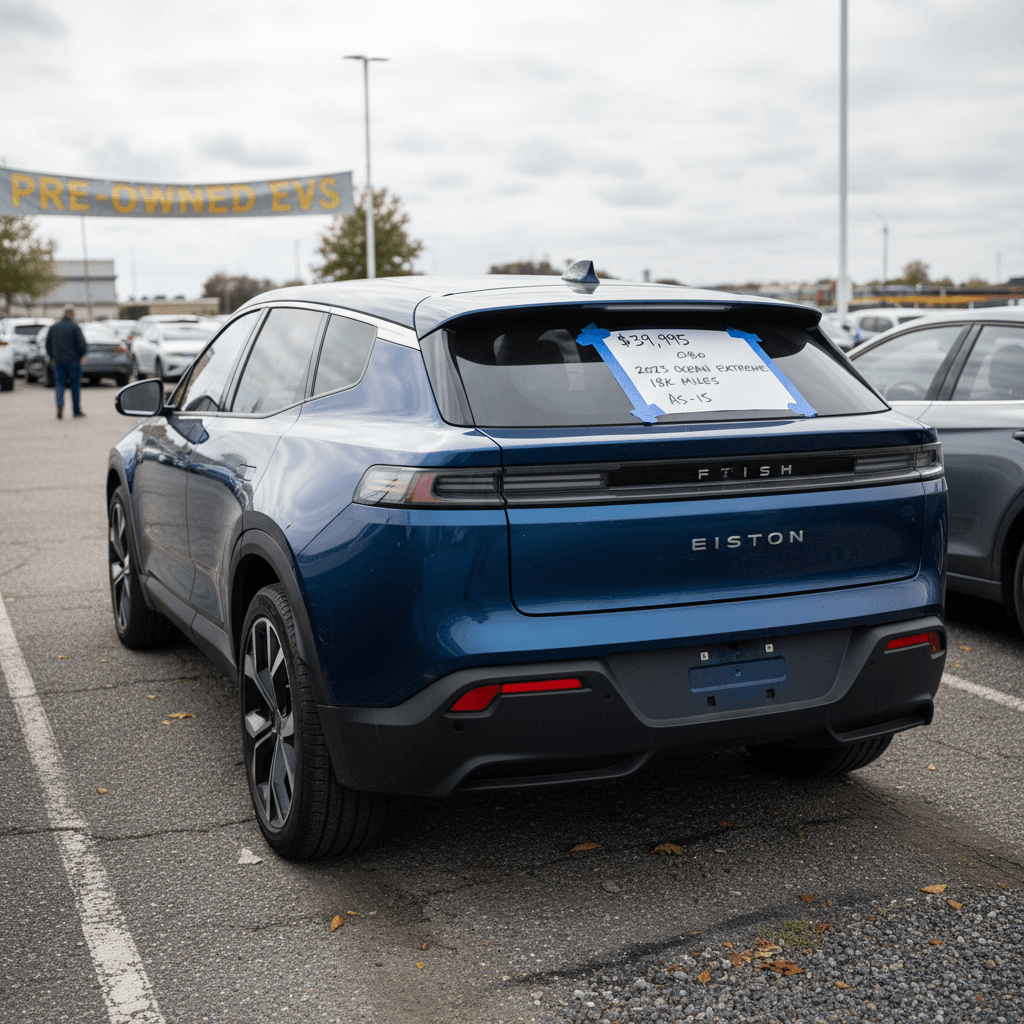
Should you buy a used Fisker Ocean at a deep discount?
You’ll occasionally see a used Fisker Ocean advertised at a price that looks too good to ignore, often well under $25,000 for a low-mileage, well-equipped SUV. That’s the upside of severe depreciation. The downside is that you’re signing up for higher ownership risk than almost any other modern EV.
Pros and cons of buying a heavily depreciated Fisker Ocean
Who it might make sense for, and who should walk away
When a used Ocean might make sense
- You understand orphan risks: You’re comfortable with limited support and potential parts scarcity.
- You have a backup vehicle: If the Ocean is grounded for weeks or months, life doesn’t grind to a halt.
- You value spec over badge: The combination of range, features, and price still works for your use case.
- You’re technically inclined: You’re comfortable following owner forums, using third-party apps, and working with independent EV shops.
When you should probably avoid it
- This is your only car: A long repair or parts delay could strand you.
- You need predictable costs: Budgeting around an unknown support situation is difficult.
- Local service is nonexistent: If there are no independent EV shops nearby willing to touch an Ocean, you’re on your own.
- You’re financing heavily: Lenders may be hesitant, and you don’t want to owe more than the car will ever be worth.
Protect yourself if you’re tempted by a cheap Ocean
Options if you own a Fisker Ocean today
If you already own an Ocean, you can’t rewind the clock on depreciation, but you can decide how to respond. Broadly, you have three paths: keep and maximize the value you get from it, exit at the best price available, or treat it as a short-term bridge while you move into a more supported EV.
Practical strategies for current Fisker Ocean owners
1. Keep it and extract maximum utility
If your Ocean is behaving reliably, the most rational move may be to <strong>drive it as long as possible</strong>. The worst depreciation has likely already happened; every additional year you keep the SUV and avoid another big purchase effectively lowers your cost per mile.
2. Strengthen your support network
Join owner communities, bookmark independent parts and software providers, and identify at least one local or regional EV shop willing to work on high-voltage systems. The stronger your network, the easier it is to live with the car.
3. Get multiple exit offers
If you want out, don’t accept the first low-number trade offer. Solicit bids from local dealers, specialty EV retailers, and online platforms, and consider a well-presented private-party listing with full transparency about the vehicle’s history.
4. Be realistic on price and timeline
Many potential buyers will have read the same headlines you have. Pricing your Ocean like any other premium EV is likely to result in no calls. If you must sell quickly, you may have to accept that the market has already priced in the risks.
5. Plan your next EV with depreciation in mind
If you’re moving on, look for models from well-capitalized brands with strong service networks and long battery warranties. That doesn’t eliminate depreciation, but it narrows the odds of another “orphan” scenario.
Turn a sunk cost into value you control
How Recharged thinks about “orphaned” EVs like the Ocean
At Recharged, our goal is to make used EV ownership transparent, even when the story is complicated. Orphaned EVs like the Fisker Ocean sit at the far end of the risk spectrum, so we treat them differently from mainstream models when it comes to valuation, inspection, and support.
1. Start with the battery, not the badge
Regardless of brand status, an EV’s long-term value is anchored in its battery health and charging behavior. That’s why every vehicle Recharged sells includes a Recharged Score Report with verified battery diagnostics, charging performance data, and range estimates, not just a generic guessed value.
For orphaned EVs, a healthy pack doesn’t erase all the risk, but it’s the difference between a potentially usable bargain and a short-lived headache.
2. Price for reality, not nostalgia
We benchmark against real-world transactions, auction activity, and support risks instead of clinging to original MSRPs. That’s especially important for vehicles like the Ocean where a $60,000+ window sticker no longer reflects market reality.
If and when we list orphaned EVs, they’re priced to reflect today’s risk-adjusted value, not yesterday’s launch press release.
If you’re sitting on an EV you’re not sure about, Fisker or otherwise, you can use Recharged as a sounding board. Our EV specialists live in the numbers and see depreciation trends every day, so they can walk you through whether it makes more sense to hold, trade, or sell.
Fisker Ocean depreciation FAQs
Frequently asked questions about Fisker Ocean depreciation
The Fisker Ocean’s depreciation rate is a cautionary tale: brand risk, support uncertainty, and software complexity can erase tens of thousands of dollars in paper value almost overnight. If you already own one, the most rational response is to either maximize the miles you extract from it or exit thoughtfully with open eyes about what the market will pay. If you’re considering buying an Ocean at a steep discount, treat it like a high-risk, high-variance bet, not a typical family SUV. And if you’d rather avoid that gamble altogether, a used EV from a stable brand, with verified battery health and clear support options, will almost always deliver a calmer ownership experience, even if the upfront price is higher.