If you’re considering a Fiat 500e, you’re probably drawn to its style, size, and city-friendly electric range. But when you search for a Fiat 500e safety rating or crash test, the information can be confusing, especially because there are actually two different 500e generations and several different test programs.
Two different 500e models, two different safety stories
Fiat 500e safety overview
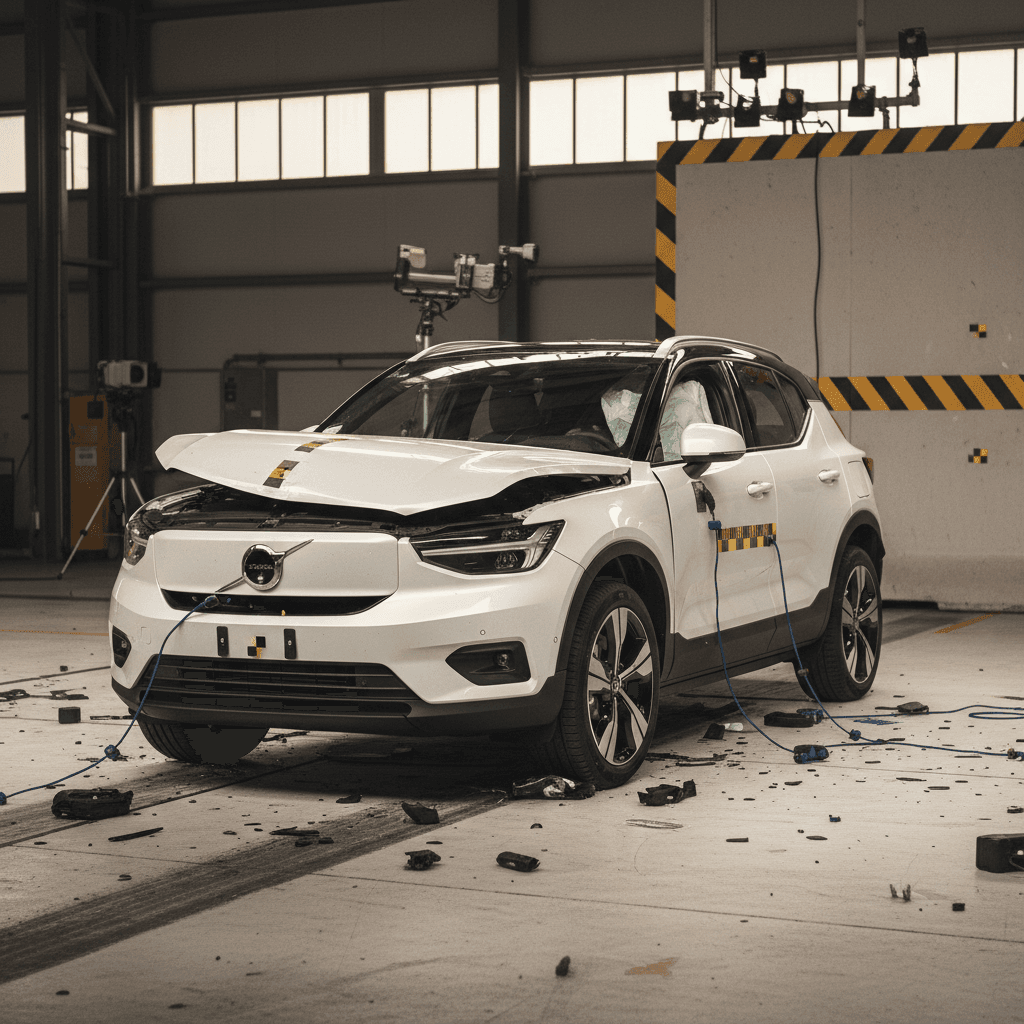
Every modern car sold in the U.S. has to meet federal crash standards, and the Fiat 500e is no exception. But independent crash tests from organizations like IIHS, NHTSA, and Euro NCAP reveal how well a vehicle protects you compared with others on the road.
Fiat 500e crash test snapshot
The headline: the original Fiat 500/500e doesn’t score as well in U.S. crash tests as many newer small EVs, while the redesigned New 500e sold in Europe earns a solid, but not top-tier, four-star rating. Neither car is unsafe by legal standards, but there are important trade-offs to understand, especially if you’re shopping used.
Safety is relative, not absolute
How the Fiat 500e was crash tested
To make sense of any Fiat 500e crash test, it helps to know who did the testing and what they actually measured. Three main organizations matter here:
- IIHS (Insurance Institute for Highway Safety) – U.S. nonprofit that runs demanding front and side crash tests and grades headlights and crash-avoidance tech.
- NHTSA (National Highway Traffic Safety Administration) – U.S. government agency that assigns 1–5 star ratings for frontal, side, and rollover performance.
- Euro NCAP (European New Car Assessment Programme) – European organization that evaluates crash protection and active safety tech using percentage scores and star ratings.
Frontal & overlap tests
These simulate head-on impacts or partial front-end crashes with another vehicle or object. IIHS uses a moderate overlap front test (40% of the car’s width) and, on many models, a small overlap test that hits only the outer corner of the front structure.
Side & rollover evaluations
Side tests simulate being hit in an intersection or sliding into a pole. Rollover evaluations estimate how likely a vehicle is to tip in a single-vehicle crash. Together, they paint a much fuller picture than a simple head-on test alone.
Because the Fiat 500e is a low-volume EV based on a small city car, it hasn’t been run through every possible test. That’s why you’ll see some categories marked “Not Rated,” especially in U.S. government data. The good news is that the core crash structure has been tested by IIHS, and the New 500e has been thoroughly evaluated by Euro NCAP.
IIHS and NHTSA ratings for the Fiat 500e
In the U.S., IIHS rates the gasoline Fiat 500 two‑door hatchback built from 2012–2019, which shares its basic structure with the U.S.-spec 500e. That gives us the best window into how the original 500e behaves in a serious crash.
IIHS moderate-overlap front test: 2012–2019 Fiat 500/500e structure
How the original Fiat 500 platform performed in a key IIHS crash test (ratings: G=Good, A=Acceptable, M=Marginal, P=Poor).
| Area | IIHS rating | Notes |
|---|---|---|
| Overall evaluation | P (Poor) | Front structure didn’t manage crash forces as well as many rivals. |
| Structure & safety cage | P (Poor) | Significant deformation of the occupant compartment. |
| Driver head/neck | G (Good) | Airbag protected the head and neck from severe injury forces. |
| Driver chest | G (Good) | Chest injury measures remained low. |
| Driver hip/thigh | M (Marginal) | Some elevated forces recorded in lower body. |
| Lower leg/foot | P (Poor) | High forces and intrusion around the footwell. |
These ratings apply to the gasoline 500, but the 500e uses the same basic body shell and crash structure.
The door opening issue
NHTSA, the U.S. government agency that assigns 1–5 star ratings, has not published a complete set of crash star ratings specifically for the Fiat 500e. That doesn’t mean the car skipped safety checks, only that NHTSA hasn’t chosen it for full NCAP testing. All U.S. 500e models still had to comply with federal crash standards before they could be sold.
Interpreting missing ratings
Euro NCAP scores for the New 500e
The completely redesigned New Fiat 500e, introduced in Europe in 2020–2021, rides on a different platform than the older U.S.-market 500/500e. Euro NCAP tested this newer model and gave it an overall 4‑star rating, respectable, but just shy of five-star performance.
Euro NCAP safety scores for the New Fiat 500e
Percentage scores from Euro NCAP’s 2021 test of the New 500e.
| Category | Score | What it means |
|---|---|---|
| Adult Occupant Protection | 76% | Good overall protection, though some rivals score 80%+. |
| Child Occupant Protection | 80% | Strong child seat performance and restraint systems. |
| Vulnerable Road Users (pedestrians/cyclists) | 67% | Reasonable pedestrian impact design, but not class-leading. |
| Safety Assist | 67% | Decent driver-assist tech availability, but not as advanced as top-scoring EVs. |
Four stars overall, with solid protection for adults and children but room to grow in pedestrian and active safety tech.
Those numbers place the New 500e in the middle of the modern small‑EV pack. It’s clearly safer by design than the older 500e sold in the U.S., but it doesn’t quite match the very best small cars and small SUVs that now reach five stars and 80%+ scores across the board.
Strengths and weak spots in a crash
Original Fiat 500e: pros and cons for safety
Understanding where this tiny EV helps you, and where physics still wins.
Where the 500e works in your favor
- Modern restraint systems: Front, side, and curtain airbags help manage severe head and chest forces.
- EV battery placement: The heavy pack under the floor helps keep the center of gravity low, which can reduce rollover risk compared with a tall crossover.
- City-speed focus: The 500e is most at home in urban and suburban traffic where crash energies are typically lower than on rural highways.
Where the 500e falls short
- Crash structure age: The original 500 platform was designed before today’s toughest tests; IIHS rated the structure Poor in a key frontal crash.
- Very small footprint: In a collision with a heavier SUV or pickup, you’re at a mass disadvantage no matter what.
- Limited active safety tech: Many older 500e models lack modern crash‑avoidance aids like automatic emergency braking.
Think about where, and how, you drive
Safety features on different Fiat 500e models
Crash tests tell you how the structure behaves in a single big impact. But real‑world safety also depends on what the car does to help you avoid the crash in the first place. That’s where active safety features and driver‑assistance tech come in.
Key Fiat 500e safety and driver-assist features by era
Typical equipment by model generation; exact features may vary by trim and market.
| Model / market | Passive safety basics | Common driver assists | What to double-check |
|---|---|---|---|
| 2013–2019 Fiat 500e (U.S.) | Front, side, and curtain airbags; electronic stability control; ABS; tire pressure monitoring. | Basic cruise control, rear parking sensors on many, hill start assist. | Whether it has a rearview camera (later years) and if any optional safety packages were added. |
| 2021+ New 500e (Europe) | Updated body structure and airbags; seatbelt pretensioners; improved side-impact protection. | Lane keeping assist, traffic sign recognition, available adaptive cruise and automatic emergency braking on many trims. | How much of the advanced safety tech is actually fitted, base trims may have less than press cars. |
Always check the specific car you’re buying, especially used imports, for its actual safety feature list.
EV-specific safety note
What this means if you’re buying a used Fiat 500e
Most used 500e models you’ll see in the U.S. today are the original 2013–2019 cars, often coming off lease or brought in from California or Oregon. They can be fantastically affordable city EVs, but you should walk in with clear eyes about safety.
Used Fiat 500e safety checklist
1. Confirm exactly which 500e you’re looking at
Is it the U.S.-spec 2013–2019 500e, or a newer European-market New 500e that’s been imported? The VIN, build year, and photos of the dashboard will help you tell them apart.
2. Review crash test information in context
Know that IIHS rated the 2012–2019 Fiat 500 platform Poor in a key frontal test. Decide whether that trade-off aligns with how and where you’ll drive.
3. Look for active safety basics
At minimum, you’ll want electronic stability control, a functioning ABS system, and a rearview camera. On many used 500e models, that’s about the extent of the driver‑assist tech.
4. Inspect airbags and structural repairs
If the Carfax or similar history report shows a prior accident, verify that airbag replacement and structural repairs were done professionally with documentation.
5. Check recalls and software updates
Earlier 500e models had recalls related to the electric drive system control modules. Make sure <strong>all open recalls are completed</strong> before you take delivery.
6. Consider your typical routes
If you mainly commute in city traffic under 50 mph, the 500e’s compact size is a benefit. If you spend hours on interstates or rural two‑lanes, a larger EV may be a better fit. "Safe enough" depends heavily on your environment.
Where a used 500e shines
How Recharged evaluates Fiat 500e safety
At Recharged, every used EV we list goes through a structured evaluation that goes beyond a simple visual once‑over. For a model like the Fiat 500e, that process focuses on three buckets: crash protection, crash avoidance, and EV‑specific safety.
1. Crash protection
- Review of IIHS/Euro NCAP results for the underlying platform.
- Inspection for prior structural damage or airbag deployment.
- Verification that seatbelts, airbags, and seat mounts are intact and functioning.
2. Crash avoidance
- Test of ABS, stability control, and basic driver-assist features where equipped.
- Check that warning lights are off and no relevant fault codes are stored.
- Assessment of tire condition, alignment feel, and braking behavior on the road.
3. EV-specific safety
- Verification of high-voltage isolation and proper operation of contactors.
- Inspection of orange high-voltage cabling for damage or improper repairs.
- Recharged Score battery health diagnostics to catch hidden pack issues.
Those findings are rolled into the Recharged Score Report you see on every listing: a plain‑English breakdown of battery health, structural history, and fair market pricing. If you’re comparing a Fiat 500e to other used EVs, this makes it much easier to weigh cost savings against safety and longevity.
Want help comparing options?
FAQ: Fiat 500e safety and crash tests
Frequently asked questions about Fiat 500e safety
Bottom line: Is the Fiat 500e safe enough?
The Fiat 500e isn’t a crash‑test superstar, and it was never intended to be. The original U.S.‑market 500e is an ultra‑compact city car based on a platform that earned mixed marks from IIHS, while the newer European New 500e improves the formula with a 4‑star Euro NCAP rating and better active safety tech.
If your daily life is mostly short hops through dense traffic and you value tiny size, easy parking, and low running costs, the 500e can be a reasonable choice, as long as you understand the safety trade‑offs of driving one of the smallest vehicles on the road. If you regularly mix it up with heavy highway traffic, a slightly larger EV with stronger crash ratings may give you more peace of mind.
Either way, the key is transparency. A Recharged Score Report, paired with a clear look at crash test results and safety equipment, lets you decide whether a Fiat 500e is “safe enough” for your roads, passengers, and budget, and that’s the kind of confidence every used‑EV buyer deserves.