If you’re shopping for a car in 2026, you’re almost guaranteed to ask the big question: EV vs gas car, which is better? You’ve heard that electric vehicles are cheaper to run and nicer to drive, but gas cars are familiar, easy to refuel and often cheaper to buy. This guide walks you through the trade-offs using up-to-date 2025–2026 data so you can pick the car that actually fits your life and budget, not the headlines.
Short answer
EV vs gas in 2026 at a glance
Key 2025–2026 numbers that matter
Those numbers set the stage: EVs shine on operating costs, but initial price and resale are more complicated, especially with incentives changing and a wave of off-lease EVs hitting the used market in 2026.
How we’re comparing EVs and gas cars in 2026
What we’ll compare
- Purchase price & incentives – what you actually pay to get into the car.
- Fuel vs electricity – cost per mile in the real world.
- Maintenance & repairs – oil changes vs software updates.
- Range & charging – daily driving and road trips.
Assumptions we’ll use
- Typical U.S. driver: 12,000–15,000 miles/year.
- Keeping the car at least 5 years.
- Comparing similar size/trim EV and gas models where possible (e.g., compact SUV vs compact SUV).
- Focusing on U.S. conditions and prices in late 2025–2026.
Think total cost of ownership, not just sticker
Purchase price, incentives and financing
Walk into a dealer in 2026 and, model for model, you’ll still usually see a higher sticker price on a new EV than on its gas twin. AAA’s 2025 cost study, for example, pegs the average new EV at around $55,000 vs roughly $48,000 for a gas car, with popular plug‑in hybrids like a RAV4 Prime carrying a five-figure premium over the gas version. That up-front gap is one reason some buyers feel EVs are “too expensive,” even though running costs are lower.
How EV vs gas purchase costs stack up in 2026
Higher sticker price for many EVs, but more ways to bring it down
Sticker price
Gas cars: Usually cheaper to buy new, especially in entry-level trims and basic compact SUVs.
EVs: Still carry a premium in many segments, though price cuts and new models are narrowing the gap.
Incentives & tax credits
Gas cars: No federal purchase incentives.
EVs: Federal and state incentives changed in 2025–2026 and are more limited than a few years ago, but some models and buyers still qualify, and local utilities often offer home charging rebates.
Financing & payments
Both: Lower interest rates and easing new-car prices have brought average monthly payments down a bit from 2024.
EVs: Slightly higher sale price can mean a higher payment, but cheaper running costs can offset that over time.
Watch out for option creep
Fuel vs electricity: what it really costs to drive
Energy is where EVs earn their keep. Over five years at 15,000 miles a year, a typical gas car can burn around $9,000 in fuel at recent U.S. prices, while a comparable EV might use roughly $2,250 in electricity at average residential rates. Off‑peak time‑of‑use plans can knock that closer to $250 per year if you mostly charge overnight at home. Even with swings in gasoline and slight upticks at public fast chargers, electricity remains dramatically cheaper per mile for nearly every U.S. driver.
Sample 5‑year energy costs: EV vs gas (2026 snapshot)
Approximate costs for a typical compact SUV driven 15,000 miles per year, assuming mostly home charging for EV drivers.
| Vehicle type | Energy use | Assumed price | 5‑year energy cost (75,000 miles) | Cost per mile |
|---|---|---|---|---|
| Gas compact SUV | 30 mpg, 2,500 gallons | $3.00/gal average | ≈$7,500 | $0.10/mi |
| Efficient gas hybrid | 40 mpg, 1,875 gallons | $3.00/gal average | ≈$5,625 | $0.075/mi |
| EV compact SUV, home charging | 0.30 kWh/mi, 22,500 kWh | $0.15/kWh home average | ≈$3,375 | $0.045/mi |
| EV compact SUV, off‑peak plan | 0.30 kWh/mi, 22,500 kWh | $0.10/kWh off‑peak | ≈$2,250 | $0.03/mi |
Actual costs will vary by state, utility rates, gas prices and how often you use fast charging.
What about public fast charging?
Maintenance, repairs and reliability
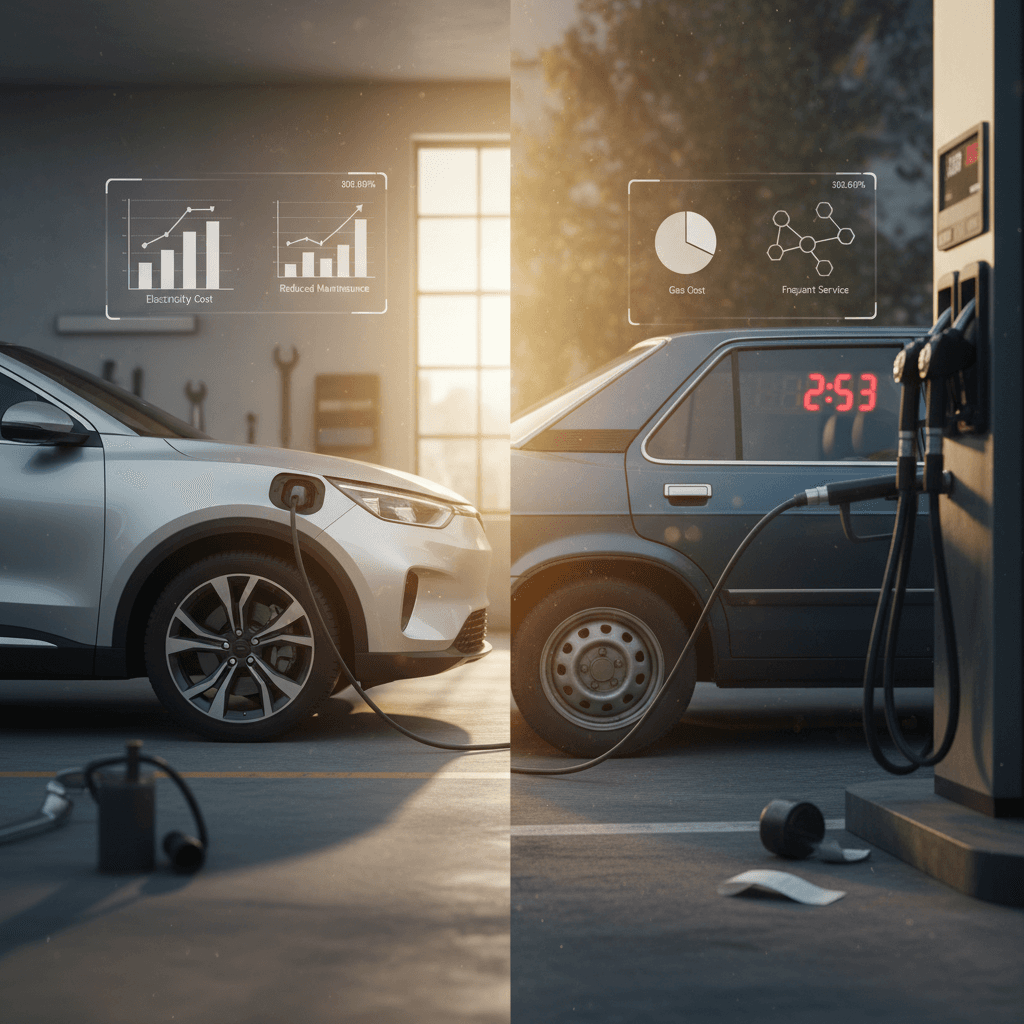
Pop the hood on an EV and there’s simply less there to break. No engine, no multi‑speed automatic transmission, no exhaust or emissions hardware. That simplicity shows up in the shop bills: recent analyses suggest EVs require roughly 50% fewer maintenance items over five years compared with gas cars, largely because you never pay for oil changes, spark plugs, timing belts or exhaust repairs. Brakes last longer too, thanks to regenerative braking doing much of the stopping.
Typical maintenance differences: EV vs gas
The hidden cost advantage that shows up year after year
Gas car maintenance
- Regular oil and filter changes (2–4 per year).
- Transmission fluid services.
- Spark plugs, coils, belts and hoses.
- More frequent brake pad and rotor replacement.
Over 5 years, that often adds up to several thousand dollars, even on a reliable car.
EV maintenance
- No oil changes, no exhaust, no multi‑gear transmission.
- Fewer moving parts, fewer wear items.
- Brake pads often last 60,000+ miles thanks to regen.
- Most “service” is software updates.
Owners commonly see maintenance and repair costs in the $1,000–$2,000 range over 5 years, vs well over $4,000 for many gas equivalents.
The elephant in the room: battery replacement
Range, charging and road trips
If your daily routine is a 20‑mile commute, range anxiety is more of a marketing term than a real problem. Most 2025–2026 EVs offer 250–320 miles of EPA‑rated range, and you’ll leave home every morning with a “full tank” if you can charge overnight. The stress shows up when you don’t control where and when you can plug in, apartment parking, street parking, or frequent long highway runs through areas with spotty fast-charger coverage.
Questions to answer before choosing an EV over gas
1. Can you charge where you sleep?
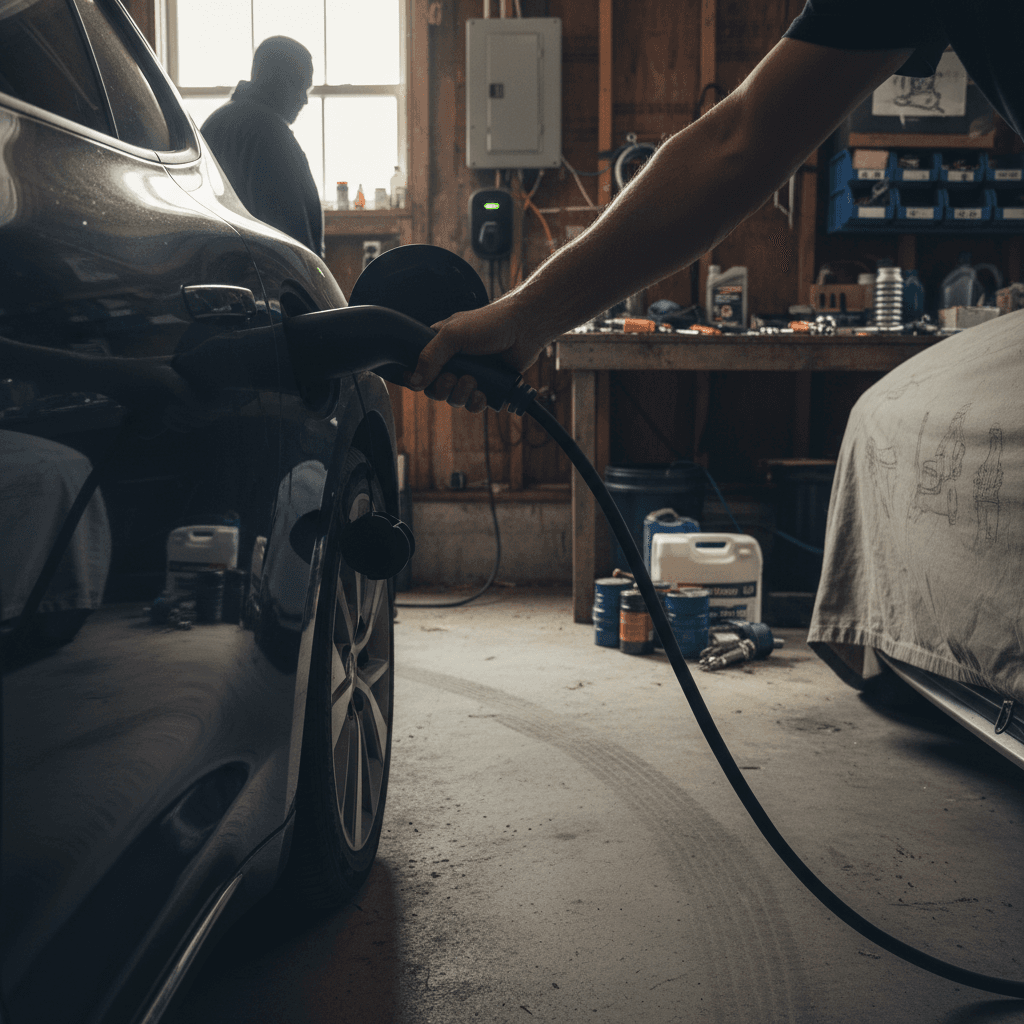
A dedicated outlet or Level 2 charger in a garage or driveway is the single biggest quality-of-life boost for EV ownership. Without it, you’ll lean more on public networks and lose some cost advantage.
2. How often do you road trip?
If you regularly drive 400–600 miles in a day, especially off the interstate grid, a gas car is still simpler. If most drives are under 200 miles, an EV will feel effortless.
3. What’s charging like in your area?
Urban and suburban corridors are steadily adding fast chargers, but some rural regions still have big gaps. Check apps like PlugShare, ChargePoint or Tesla’s map before you commit.
4. Are you okay planning fuel stops?
EV road trips work best when you <strong>plan around 20–40 minute charging stops</strong>. If you prefer to wing it and stop only when the low-fuel light screams, a gas tank fits that habit better.
Hybrid as a middle ground
Resale value and the 2026 used-EV flood
Depreciation is the single biggest cost of owning any new vehicle, EV or gas. In 2025 and into 2026, we’ve watched something unusual: a wave of off-lease EVs hitting the market just as incentives shrank and some shoppers pulled back. That combination has pushed many used EV prices down faster than equivalent gas models, great news if you’re buying used, not so great if you paid new‑car money two or three years ago.
New EV buyers
- Expect heavier early‑year depreciation than a mainstream gas car, especially in segments with lots of new competition.
- Battery warranty (often 8 years/100,000+ miles) helps, but buyers still discount for perceived risk.
- If you’re leasing, the bank eats that risk; if you’re buying, plan to keep the car longer to let low running costs make up the difference.
Used EV shoppers
- You’re the big winner in 2026. Depreciation has already done the hard work.
- Well‑cared‑for 3–5‑year‑old EVs can offer luxury‑car tech and very low running costs for the price of an ordinary used gas car.
- The key is knowing whether you’re getting a healthy battery or a tired one, that’s where tools like the Recharged Score matter.
How Recharged helps on resale risk
Environmental impact, noise and driving feel
Under the skin, EVs and gas cars feel like wildly different tools. An EV delivers instant torque, near‑silent acceleration and one‑pedal driving in traffic. You’ll never smell fuel on your hands at a pump, and your neighbors will appreciate the lack of cold‑start racket at 6 a.m. Tailpipe emissions are zero, and even after accounting for power‑plant generation, most U.S. grids make an EV cleaner over its lifetime than a comparable gas car, especially in regions with lots of renewables.
- If you love the sound and feel of shifting gears, a gas performance car still scratches an itch an EV can’t fully replace.
- If you want a calm, quiet commute and instant passing power, even a modest EV often feels like a luxury upgrade.
- Urban and suburban drivers will see the biggest emissions benefit; in coal‑heavy grids, the advantage shrinks but rarely disappears entirely.
- Many cities are already nudging drivers toward EVs with perks like preferred parking, HOV access or lower congestion fees. That trend will only grow through the late 2020s.
Who should choose an EV in 2026?
Drivers who usually come out ahead with an EV
If several of these sound like you, the math likely favors electric
You can charge at home
Your driving is predictable
You keep cars 5+ years
You care about emissions
You like tech
You qualify for incentives
Who should stick with gas, for now
Situations where gas still wins in 2026
- No reliable place to charge – You street‑park in a dense city, or your building won’t allow charging and nearby public options are scarce or expensive.
- Frequent long‑distance driving – You regularly tow, haul or drive through rural regions where fast chargers are few and far between.
- Lowest possible purchase price – Your budget tops out at the low end of the new‑car market or at the very bottom of the used market, where gas cars still dominate choices.
- Very short ownership cycles – You trade in every 2–3 years, so you feel depreciation more than fuel savings.
Why a gas car might be a “bridge” decision
If you’re close to EV‑ready but not quite there, maybe your next apartment will have charging, or your employer is planning to add workplace chargers, a relatively efficient gas or hybrid vehicle can be a smart bridge. You’ll save fuel now while keeping your options open for a used EV later, when infrastructure and prices are even better.
Don’t overbuy range you don’t need
How used EVs change the equation
So far we’ve talked mostly about new vehicles, but 2026 is shaping up to be a breakout year for used EVs. Lease returns from the big 2021–2023 sales push are pouring into the market just as shoppers grow more comfortable with electric and prices soften. In plain English: a lot of very good EVs are suddenly affordable.
Why a used EV can beat a new gas car in 2026
Lower purchase price, same electric benefits
You can often buy a 3‑year‑old EV with modern safety tech and plenty of range for the price of a new entry‑level gas compact, and still enjoy cheap electricity and low maintenance.
Depreciation has already done its worst
The steepest value drop usually happens in the first few years. By buying used, you let the first owner take that hit and you enjoy a slower glide afterwards.
Battery health can be measured
You no longer have to guess. Tools like the <strong>Recharged Score battery health diagnostics</strong> use real data to show you how much usable capacity remains, model by model and car by car.
Flexible buying, selling and financing
With services like Recharged, you can <strong>finance, trade in, or even sell your gas car</strong> and move into a used EV with expert guidance, a digital buying process and nationwide delivery.
Where Recharged fits in
FAQ: EV vs gas car in 2026
Frequently asked questions about EVs vs gas cars in 2026
Bottom line: which is better in 2026?
When you strip away the marketing noise, the EV vs gas debate in 2026 is less about which technology is “better” in the abstract and more about which fits your life. If you can charge at home, keep cars for several years and mostly drive within a few hundred miles of home, an EV will likely cost less to run and be more pleasant to live with than a comparable gas car. If you can’t charge easily or you live on the open road, a fuel‑efficient gas or hybrid vehicle may still be the smarter tool for the job.
Where things get especially interesting is the used EV market. In 2026, a well‑vetted used EV can deliver low running costs, modern tech and strong performance for the price of an ordinary gas car, and services like Recharged are built to make that path simple and transparent. Take a clear‑eyed look at how you actually drive, run the numbers, and choose the car that fits your real life, not someone else’s argument.