If you own an electric vehicle in the Garden State, you’ve probably wondered, “What’s my EV trade-in value in New Jersey, and how do I make sure I’m not leaving money on the table?” Between fast-changing incentives, shifting demand for certain models, and big questions about battery health, getting a fair number for your used EV can feel opaque, especially if you only talk to one franchise dealer.
Why this matters now in NJ
How EV trade-in value works in New Jersey
At a high level, dealers in New Jersey build EV trade-in offers using three inputs: wholesale auction data, local retail demand, and your vehicle’s condition. That’s broadly similar to gas cars, but used EVs add a complicating factor: battery health. Two seemingly identical Teslas, same trim, mileage, and year, can have very different ranges left, and therefore very different real-world value.
- Franchise dealers typically start from recent auction prices for similar EVs, then work backward to leave room for reconditioning and margin.
- Large used-car chains often plug your VIN and mileage into a national pricing model that may not fully reflect New Jersey’s above-average EV demand.
- EV‑focused marketplaces like Recharged use battery diagnostics and local demand data to fine-tune value, often resulting in more accurate, and sometimes higher, offers.
Don’t anchor on generic pricing sites
Why New Jersey is a strong market for used EVs
Your EV isn’t valued in a vacuum. New Jersey has quietly become one of the strongest EV markets in the U.S., with one of the highest EV market shares on the East Coast and dense commuter corridors where EVs make a lot of economic sense. That demand supports healthier used prices than you might see in states where EV adoption is lagging.
New Jersey’s EV market at a glance
Why this helps your trade-in
How NJ sales tax rules affect your EV trade-in
One underappreciated lever in New Jersey is how the state treats sales tax and trade-ins. Even as the state phases out its historic zero‑sales‑tax treatment for new EVs, trade-ins still play a big role in how much tax you pay on your next car, and therefore in what the “real” value of your old EV is to you.
New Jersey sales tax basics for EV trade-ins (2026 snapshot)
Current high-level rules that affect what your EV trade-in is really worth when you buy another vehicle in New Jersey.
| Factor | How it works for EVs in NJ (2026) | Why it matters for your trade-in |
|---|---|---|
| Base sales tax rate | Standard 6.625% rate applies to most vehicle purchases. | This is the starting point before any EV‑specific provisions or phase‑out rules. |
| Zero‑emission vehicle (ZEV) treatment | New EVs previously enjoyed a full exemption; as of late 2024–2025, New Jersey is phasing that out with reduced‑rate sales tax and, ultimately, normal rates. | The exact rate on a new EV depends on when you buy and current phase‑out rules; used EVs are generally treated like other used cars for sales tax. |
| Trade‑in credit | New Jersey typically taxes only the difference between your purchase price and trade‑in value when you trade with a dealer. | The higher your trade‑in value, the smaller the taxable “difference,” reducing your out‑of‑pocket tax bill. |
| Private‑party purchase | If you sell your EV yourself and then buy another car later, there’s no direct trade‑in credit on the purchase. | You might get more selling privately, but you lose the automatic tax reduction that comes from a same‑transaction trade‑in. |
Always confirm rates and rules with the NJ Division of Taxation or a tax professional, as policies can change.
Trade-in credit can outweigh a slightly higher cash offer
Scenario A: Trade-in your EV
You buy a replacement vehicle for $40,000 at a New Jersey dealer and get $20,000 for your EV trade-in:
- Taxable amount ≈ $20,000
- Sales tax at 6.625% ≈ $1,325
Your trade-in both lowers your financed amount and shrinks the tax bill.
Scenario B: Sell privately, then buy
You sell the same EV privately for $21,000, then buy the same $40,000 replacement later:
- Taxable amount ≈ $40,000 (no trade-in credit)
- Sales tax at 6.625% ≈ $2,650
You made $1,000 more on the sale, but paid roughly $1,325 more in tax. Your net position is actually worse.
Tax rules are moving targets
What really drives EV trade-in value
Traditional trade-in guides focus on mileage, trim, and cosmetic condition. Those still matter, but for EVs in New Jersey, three additional levers can move your number thousands of dollars: battery health, fast‑charging behavior, and how your model fits current demand in the region.
Key value drivers for EV trade-ins in New Jersey
What dealers and EV specialists actually look at when pricing your car.
Battery state of health (SOH)
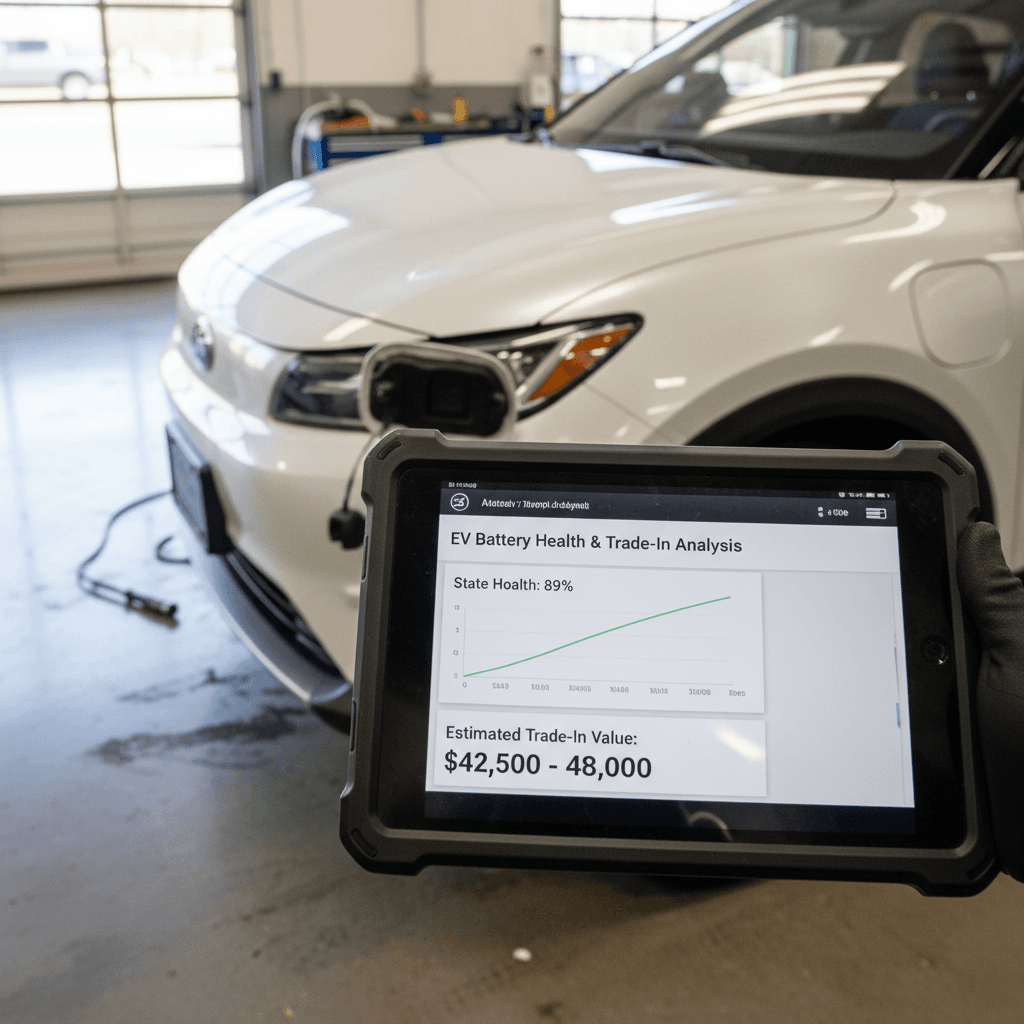
Battery SOH is a measure of how much usable capacity your pack still has compared to new. A car that originally had 300 miles of range but now reliably delivers 260+ miles is far more valuable than one that only manages 210 miles, even at the same mileage.
Real-world range and DC fast charging
Heavy DC fast‑charging can accelerate degradation on some models, while mostly Level 2 home charging is generally easier on the pack. Buyers and dealers in NJ look closely at whether the car can still cover common Turnpike or Parkway commutes on a single charge.
Model‑specific demand in NJ
Some EVs, like popular crossovers and all‑wheel‑drive models, move quickly in New Jersey’s used market. Others with shorter range or limited charging speeds can sit longer, which pushes trade‑in values down.
- Software and feature set: Cars with modern driver‑assist features, heat pumps for winter efficiency, and up‑to‑date infotainment generally command stronger offers.
- Warranty status: Remaining battery and powertrain warranty is especially important for second owners; it de‑risks the purchase and lifts trade‑in value.
- Charging standard: With most manufacturers adopting NACS (the Tesla connector) by 2026, vehicles that already have NACS access or easy adapter support may see stronger demand.
Typical trade-in values for popular EVs in NJ
Exact numbers will depend on mileage, options, and battery health, but it helps to understand the ballpark for common models on New Jersey roads. Think of these as directional starting points for a clean, average‑mileage example with solid battery health traded in to a dealer or specialist in early 2026, not quotes.
Illustrative EV trade-in value ranges in New Jersey (early 2026)
Approximate wholesale‑to‑retail trade-in ranges for popular models with average mileage and good battery health. These are not offers, just directional context.
| Model & year (example) | Mileage assumption | Typical NJ trade-in range* | Key value swing factors |
|---|---|---|---|
| 2019–2020 Tesla Model 3 Long Range | 45,000–60,000 miles | $15,000–$22,000 | Battery SOH, FSD option, winter range performance, DC fast‑charging history. |
| 2021–2022 Tesla Model Y Long Range | 30,000–45,000 miles | $25,000–$33,000 | AWD demand, wheel/tire setup, cosmetic condition, Autopilot/FSD configuration. |
| 2020–2021 Chevrolet Bolt EV | 40,000–55,000 miles | $9,000–$14,000 | Battery recall status, DC fast‑charge behavior, commuter demand around NYC/Philly corridors. |
| 2021–2022 Hyundai Ioniq 5 | 25,000–40,000 miles | $24,000–$32,000 | Trim (SE vs Limited), AWD, software updates, 800‑V charging performance in winter. |
| 2021–2022 Ford Mustang Mach‑E | 25,000–45,000 miles | $20,000–$29,000 | Battery pack size, AWD vs RWD, BlueCruise capability, charging curve on East Coast networks. |
Values assume typical mileage and clean history. Your actual EV could be above or below these ranges based on condition, options, and battery diagnostics.
Don’t treat this as a quote
How to maximize your EV trade-in offer
Improving your EV trade-in value in New Jersey isn’t just about haggling at the last minute. The biggest gains come from preparation: documenting battery health, presenting a clean history, and getting multiple offers, especially from buyers that understand EVs.
7 steps to boost your EV trade-in value in NJ
1. Get a real battery health report
If possible, obtain a diagnostic showing your battery’s state of health rather than relying on the dashboard range alone. Recharged’s <strong>Score Report</strong> includes verified battery health data that you can use both as a seller and to reassure buyers.
2. Pull a clean, recent vehicle history report
Dealers and marketplaces will run their own, but having a recent report handy helps you spot and correct errors early, like misreported accidents or mileage issues that can crush value.
3. Gather service and recall documentation
Organize receipts for tire rotations, brake service, firmware updates, and recall completions (especially battery recalls). For EVs, documented software and battery care can matter as much as oil‑change records do for gas cars.
4. Detail the car, inside and out
Professional or at least thorough DIY cleaning makes a bigger difference on EVs than many owners expect. Dark stains on light interiors or curb‑rashed aero wheels can change a dealer’s impression, and therefore their offer, in seconds.
5. Take clear, honest photos before getting online offers
If you’re shopping offers with online buyers or marketplaces, high‑quality photos of the exterior, interior, tires, and screens (including range at a given state of charge) can help you get firmer, more accurate bids.
6. Get at least two EV‑savvy offers
Compare at least one franchise dealer’s trade-in offer to an EV‑specialist buyer like <strong>Recharged</strong>. Specialists who sell only EVs are generally better at pricing battery health and local demand, which can reveal value that a generic algorithm misses.
7. Time your appraisal with your next purchase
Because New Jersey’s trade‑in credit reduces the taxable amount on your next vehicle, having an up‑to‑date written offer when you’re ready to buy makes it easier to compare real, after‑tax numbers across dealers.
Where Recharged fits in
Ready to find your next EV?
Browse VehiclesTrade-in vs. selling your EV with Recharged
You effectively have three ways to turn your used EV into your next car: classic dealer trade‑in, private‑party sale, or selling through a specialist like Recharged. Each path has different implications for price, taxes, and hassle, especially in New Jersey.
EV trade-in vs. other selling paths for New Jersey owners
How different selling routes compare on price, effort, and tax impact for Garden State EV drivers.
| Selling path | Typical price vs. trade-in | Tax treatment in NJ | Effort level | Best for… |
|---|---|---|---|---|
| Dealer trade-in (franchise store) | Baseline | Trade-in value usually reduces the taxable amount on the new purchase. | Low – everything done in one visit, but pricing may be conservative for EVs. | Speed and simplicity when buying from the same dealer. |
| Private‑party sale | Often +5–15% headline price | No trade-in credit on your next purchase; you pay sales tax on full purchase price. | High – listings, test drives, paperwork, potential flaky buyers. | Maximizing headline price if you’re comfortable doing the work. |
| Sell or consign with Recharged | Often higher than generic trade-in, closer to true EV market value | If you roll proceeds into another purchase, you still get trade‑in‑like financial benefits; Recharged can also help structure deals alongside financing. | Medium – Recharged handles marketing, buyer vetting, and paperwork; you get expert EV support. | Owners who want strong value and an EV‑savvy partner to manage the process. |
“Net value” assumes you’re buying another vehicle soon; if you’re simply exiting car ownership, the trade‑in tax benefit may matter less.
Think in terms of net, not just sticker
Timing your EV trade-in in New Jersey
EV values are shaped by more than just model year. In New Jersey, timing your trade-in around policy, seasonality, and local demand can make a surprisingly large difference in what you’re offered.
Smart timing strategies for New Jersey EV owners
When the calendar, and Trenton, can help or hurt your trade-in value.
Watch policy and tax changes
New Jersey’s EV incentives have been in motion: full sales‑tax exemptions, partial rates on EVs, changing income caps, and evolving rebate programs. As the state tweaks programs like Charge Up New Jersey and phases out old sales‑tax breaks, both new and used EV prices can adjust quickly.
If tax on new EV purchases increases again, some buyers may pivot toward late‑model used EVs, strengthening your trade-in value.
Seasonality and weather
Cold New Jersey winters reduce real‑world range, which can temporarily sour buyers on short‑range EVs. On the flip side, demand and pricing for efficient commuter EVs often firm up in late spring and early summer as road‑trip and moving season kicks in.
If your EV has modest winter range, you may see better interest and stronger offers once temperatures climb.
- Model refreshes and price cuts: When an automaker slashes prices on new EVs or launches a heavily updated refresh, older versions can take a quick hit. If you see rumors of major cuts or a big new battery pack, it’s often better to be early than late with your trade-in.
- Mileage milestones: Crossing big psychological thresholds, like 60,000 or 75,000 miles, can affect some buyers’ comfort with long‑term ownership. If you’re close, consider trading in before you roll past them.
- Battery warranty cliffs: Many EVs have 8‑year/100,000‑mile battery warranties. In a market like New Jersey where buyers travel long distances, being comfortably under those numbers tends to support stronger offers.
Different New Jersey owner scenarios, and what to consider
Daily commuter from suburbs to NYC/Philly
Prioritize models with strong highway range at winter temperatures, these remain in high demand.
If your EV can no longer reliably cover your round‑trip commute on one charge, trading in earlier can preserve more value.
Time your trade for late spring when range looks best and buyer interest picks up.
Two‑EV household downsizing to one car
If you no longer need both EVs, compare which one has stronger remaining warranty and range.
Selling the older or shorter‑range EV may free up more overall value, especially if the newer car has NACS access or faster charging.
Consider consigning with Recharged if you want to extract maximum value from a low‑mileage, high‑spec car.
Leased EV approaching end of term
Check your buyout price against current market values in New Jersey, sometimes it’s smart to buy, then immediately resell.
If market value is below your residual, you may be better off simply turning the car in.
Recharged can help you understand whether there’s equity in your leased EV and whether it’s worth capturing.
Frequently asked questions: EV trade-ins in New Jersey
Common questions from New Jersey EV owners
Key takeaways for EV trade-in value in NJ
If you’re an EV owner in New Jersey, your trade-in is sitting at the crossroads of three powerful forces: a maturing EV market, fast‑evolving state tax rules, and the simple physics of battery health. You can’t change policy, but you can control how well your EV is presented, how clearly you document its condition, and who you invite to bid on it.
- Document your battery health and service history, these are the new oil‑change records.
- Use New Jersey’s trade-in tax credit to your advantage by comparing net, after‑tax numbers, not just headline offers.
- Get at least one offer from an EV‑specialist buyer such as Recharged, which can value your car based on real battery diagnostics and NJ‑specific demand.
- Think about timing: policy shifts, seasonality, and warranty cliffs all affect what your EV is worth.
- If you value transparency and simplicity, consider Recharged’s Recharged Score Report, EV‑specialist support, and flexible options to trade in, get an instant offer, or consign your car while you shop your next EV.
The used EV market in New Jersey is maturing rapidly, and that’s good news for you as a seller. With the right prep and the right partner, your EV’s trade-in value can reflect what actually matters, battery health, real‑world range, and the fact that you’ve been driving one of the most EV‑forward corridors in the country.