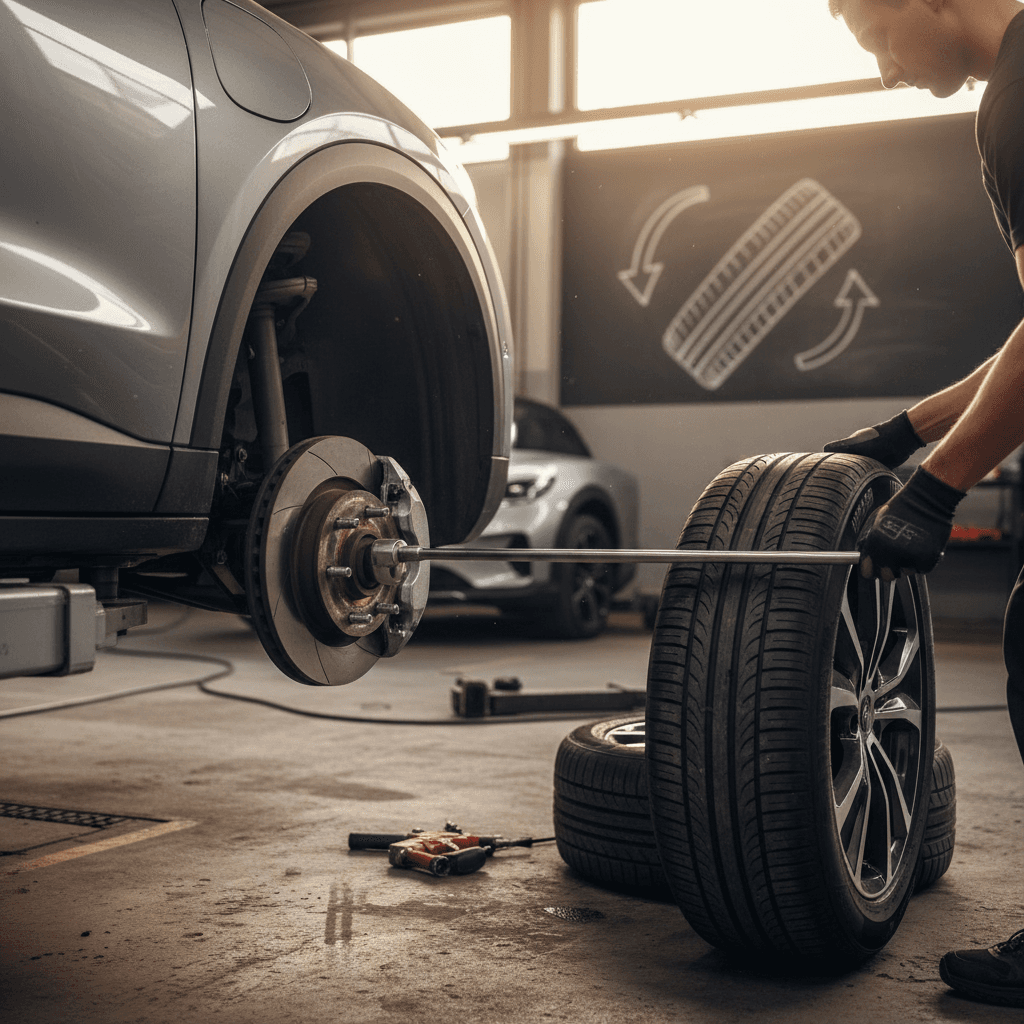
If you’ve switched to an electric vehicle, you’ve probably heard that **EV tires wear out faster**. That’s partly true, and it makes your EV tire rotation schedule more important than it was with your last gas car. The right rotation interval can extend tire life, protect range, and keep your EV tracking straight and safe at highway speeds.
EV tires: not your old maintenance routine
Why EV tire rotation matters more than you think
On an EV, tires do more than carry the car. They also help determine **how far you can drive on a charge**, how quiet the cabin feels, and how confident the car is in emergency maneuvers. Uneven wear doesn’t just shorten tire life; it can add noise and vibration, increase stopping distances, and trim usable range.
Four big payoffs of a good EV tire rotation schedule
Rotating on time protects more than just tread depth
Safety
Range
Cost
Ride & noise
Tie rotations to charge milestones
How EVs wear tires differently than gas cars
Electric vehicles stress tires in ways that are similar to performance cars, even if you’re just commuting. A typical EV is heavier than a comparable gas car because of the battery pack, and it delivers near‑instant torque to the driven wheels. Add strong **regenerative braking**, and the drive axle does more of the work in both acceleration and deceleration.
What’s different with EVs
- More weight: Battery packs can add hundreds of pounds, increasing load on all four tires.
- Instant torque: Quick launches and strong mid‑range pull scrub tread from the drive tires.
- Regen braking: Instead of the friction brakes, the motor slows the car, concentrating wear on the drive axle again.
- Low‑rolling‑resistance compounds: Designed for efficiency, some EV‑specific tires trade ultimate tread life for range.
What stays the same
- Alignment still matters: Toe and camber angles that are off will chew through tires, EV or not.
- Inflation is critical: Under‑inflation means more heat and faster wear; over‑inflation can cause center wear.
- Driving style counts: Hard cornering and high sustained speeds accelerate wear on any tire.
- Road conditions: Rough pavement and potholes shorten life and can knock your alignment out.
Beware “performance EV” behavior in daily driving
Recommended EV tire rotation schedule by mileage and time
Manufacturers vary slightly, but most modern EVs land in the same neighborhood: **rotate your tires every 5,000–7,500 miles or about every 6–12 months**, whichever comes first. The right spot in that range depends on how and where you drive.
EV tire rotation schedule benchmarks
Use this table as a starting point; always confirm against your owner’s manual for model‑specific guidance.
| Driving profile | Typical EV examples | Recommended rotation interval | Time limit |
|---|---|---|---|
| Mostly city / stop‑and‑go | Compact EVs, crossovers used for commuting | 5,000–6,000 miles | Every 6 months |
| Mixed city & highway | Suburban commuters, light road trips | 6,000–7,500 miles | Every 6–9 months |
| Mostly highway / steady speeds | Long‑range EV sedans on interstates | 7,500 miles | Every 9–12 months |
| Aggressive or heavy loads | High‑performance EVs, towing, rideshare | 4,000–5,000 miles | Every 4–6 months |
Intervals assume normal driving and no unusual tire wear or damage.
Always check your owner’s manual
How much EV tire rotation really saves
Different schedules for FWD, RWD and AWD EVs
Your **drivetrain layout** changes how quickly different tires wear, and how strict you should be about your EV tire rotation schedule. The general rule: the axle doing the most work usually wears faster.
- Front‑wheel‑drive (FWD) EVs: Front tires handle steering, acceleration, and most of the braking. Expect faster front wear; stay closer to the 5,000–6,000‑mile rotation interval.
- Rear‑wheel‑drive (RWD) EVs: Common on Teslas and some performance EVs. Rear tires typically wear faster thanks to torque and regen. Again, think 5,000–7,500 miles, depending on how you drive.
- All‑wheel‑drive (AWD) EVs: Wear tends to be more balanced, but these vehicles are heavier and more powerful. Plan on 5,000–7,500 miles, and don’t skip rotations, AWD systems are picky about tire diameter matching across all four corners.
Never mix wildly different tread depths on AWD EVs
Best tire rotation patterns for EVs
The “right” pattern for an EV isn’t fundamentally different, but more EVs use **directional** tires or **staggered** setups (different sizes front and rear), which limits what you can do. That’s why you should identify what you have before anyone starts moving wheels around.
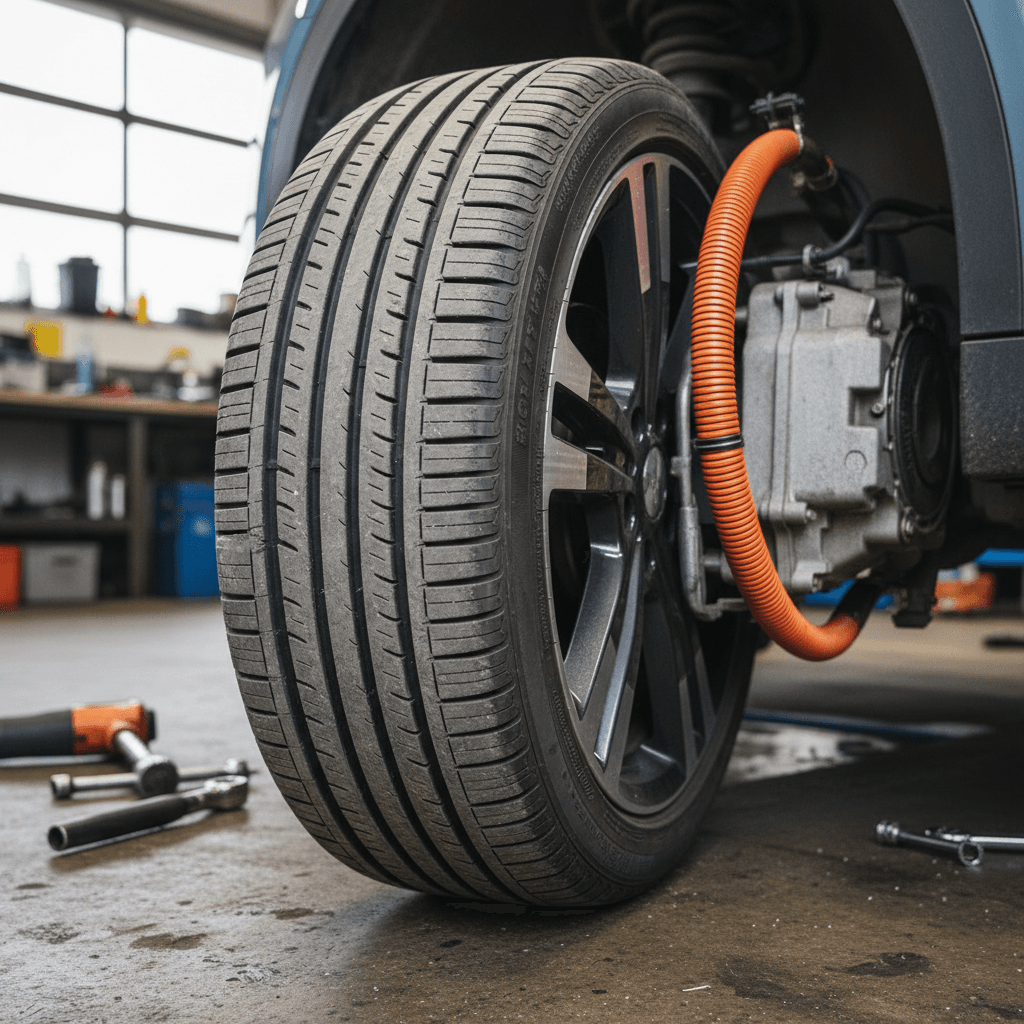
Identify your EV’s tire setup before rotating
1. Check for directional arrows
Look at the sidewall for an arrow or “rotation” marking. These tires are designed to roll in only one direction, which affects whether you can swap sides.
2. Compare front and rear sizes
If the front and rear tire sizes are different (staggered), you usually can’t rotate front to back without remounting tires on different wheels.
3. Confirm run‑flat or foam‑filled designs
Some EVs use special noise‑reduction foam or run‑flat technology. These don’t change the schedule but may affect who’s willing to service them.
4. Inspect for existing uneven wear
Cupping, feathering, or inner‑edge wear are signs you may need an alignment in addition to rotation.
Common rotation patterns for EVs
- Front‑to‑rear (same side): Simplest option for directional or staggered tires, move front to back on each side.
- Rearward cross: Popular on rear‑drive EVs with non‑directional tires; rear go straight forward, fronts cross to the rear.
- X‑pattern: All‑around cross for non‑directional tires on same‑size wheels.
When patterns are limited
- Directional tires, square setup: You can swap front and rear on the same side, but not left to right.
- Directional, staggered setup: Rotation options are very limited without remounting tires. You may mainly swap tires on the same axle.
- Check with a tire pro: If you’re unsure, a shop familiar with EVs can recommend a safe pattern based on tread wear and design.
Use EV‑savvy shops
Signs your EV needs a tire rotation sooner
Even with a set schedule, real life intervenes. Hitting a nasty winter, changing jobs, or starting regular road trips can all alter wear. Watch for these **early warning signs** that your EV is overdue for a rotation, even if you haven’t hit the mileage target yet.
- Noticeable tread depth difference between front and rear when checked with a gauge or coin.
- A faint steering wheel vibration at highway speeds that wasn’t there before.
- Increased road noise or a humming that rises with speed.
- The car pulls slightly to one side on a flat road (could also indicate alignment issues).
- Uneven wear patterns, like more wear on inner or outer edges of one axle.
Don’t ignore noise and vibration
DIY vs. professional EV tire rotation
If you rotated tires on your gas car, you might be tempted to do the same with your EV. It’s possible, but there are extra considerations, especially around lifting points and torque specs. For many owners, a **low‑cost professional rotation** is the safer play.
DIY EV tire rotation
- Pros: Free (after tools), flexible timing, satisfying if you’re hands‑on.
- Cons: Requires correct jack points, jack stands rated for EV weight, and a torque wrench. You must know your rotation pattern, tire type, and tightening specs.
- Best for: Experienced DIYers who already work on their vehicles and have reviewed EV‑specific lifting instructions.
Professional EV tire rotation
- Pros: Fast, inexpensive (often $25–$50 or bundled with other services), and includes a quick inspection for damage or alignment issues.
- Cons: Requires an appointment or wait time; quality varies by shop.
- Best for: Most EV owners, especially with new or leased vehicles where documentation of maintenance can support warranty and future resale value.
Leverage free rotations
Costs, savings and impact on used EV value
From a dollars‑and‑cents perspective, rotations are one of the cheapest EV maintenance items you can buy. A typical rotation runs about the same price as a week of fast charging on a road‑trip, but it can delay an $800–$1,600 tire bill by several months or more. That matters even more if you’re planning to **trade in or sell your EV** in the next few years.
Direct financial impact
- Fewer premature replacements: Even one extra year out of a tire set is meaningful on EV‑grade rubber.
- Better efficiency: Smooth, evenly worn tires help preserve your EPA‑rated efficiency, keeping your charging costs predictable.
- Avoid alignment‑related waste: Catching abnormal wear early can save a full set of tires from being scrapped ahead of schedule.
Why it matters when you sell
- First impression: Worn or noisy tires are one of the first things a buyer or appraiser notices.
- Higher appraisal: A set of healthy, evenly worn tires supports a higher offer from dealers and online buyers.
- Documentation helps: Showing receipts for regular rotations and inspections can reassure the next owner that the EV was cared for properly.
How Recharged looks at tires on used EVs
Quick EV tire rotation checklist
Before and during each EV tire rotation
1. Confirm interval and pattern
Check your owner’s manual for the recommended mileage and any notes about directional or staggered tires, then choose the correct rotation pattern.
2. Inspect tread depth at all four corners
Measure and record tread depth (or at least eyeball it). You’re looking for differences between front and rear and any unusual patterns.
3. Check tire pressures when cold
Set pressures to the values on the door‑jamb sticker, not the sidewall max. EVs are sensitive to pressure changes for both range and wear.
4. Look for damage or bulges
Scan sidewalls and tread for cuts, bubbles, nails, or cords showing. Replace any compromised tire instead of just rotating it.
5. Request a balance and alignment check if needed
If you’ve noticed vibration, pulling, or rapid inner‑edge wear, ask the shop to balance the wheels and check alignment along with rotation.
6. Log the mileage and date
Record the rotation in your glovebox, app, or service history. It’s a useful reminder for the next interval, and good documentation when you sell.
EV tire rotation FAQ
Common questions about EV tire rotation schedules
Key takeaways and next steps
If you remember only one thing, make it this: your **EV tire rotation schedule** is a small habit with outsized impact. Rotating every 5,000–7,500 miles, watching for early signs of uneven wear, and using shops that understand EVs will help you get the most from every set of tires, without sacrificing range, comfort, or safety.
If you’re shopping for a used EV, pay attention to tire condition and documented maintenance. At Recharged, every vehicle comes with a transparent Recharged Score Report covering battery health, pricing, and overall condition, so you can see at a glance how the previous owner cared for the car, including clues from its tires. And when you’re ready to upgrade, Recharged can help you find your next used EV or sell or trade in the one you have with expert guidance at every step.