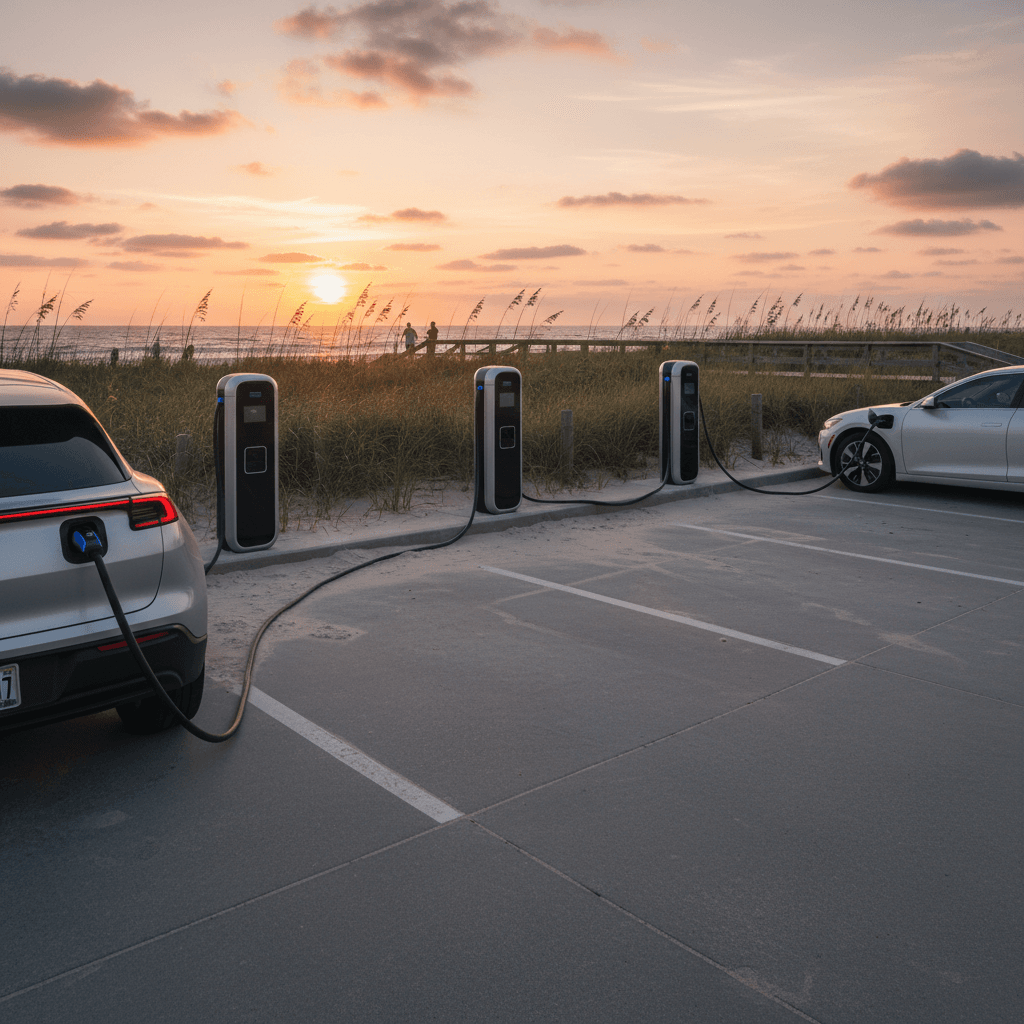
If you’re planning road trips in an EV, **EV Supercharger cost per kWh** isn’t a trivia question; it’s your fuel bill. Home charging is the cheap, quiet romance. DC fast charging is the bougie weekend fling, convenient, thrilling, and absolutely capable of blowing up your budget if you’re not paying attention.
Key takeaway up front
Why EV Supercharger cost per kWh matters
For most owners, **80–90% of charging happens at home or work**. That’s cheap, boring electricity, exactly what you want. But that last 10–20% is where the drama lives: road trips, winter weekends, getting home when you left with 8% “because it’ll be fine.” That’s DC fast charging, and on today’s networks, it’s priced like airport food.
- DC fast charging now averages around **$0.45–$0.50 per kWh** nationally across networks, based on late‑2025 and early‑2026 data.
- Tesla’s Supercharger network typically undercuts or matches other networks but is still **far more expensive than home power**, which is often in the **$0.12–$0.18 per kWh** range depending on your state.
- If you rely heavily on Superchargers, because you live in an apartment or road‑trip constantly, your **true cost of ownership** can swing by hundreds of dollars per year.
Don’t confuse kW and kWh
Typical EV Supercharger cost per kWh in 2026
Typical U.S. fast‑charging prices in 2025–2026
Different analysts slice the numbers slightly differently, but the theme is consistent: **Superchargers sit on the lower end of DC fast‑charging prices**, yet miles from your cozy home rate. Tesla’s own pricing varies site‑by‑site and hour‑by‑hour, which is why you’ll see a 30‑something‑cent rate in one town and wince‑inducing 50‑something in another.
At‑a‑glance: Typical U.S. charging prices
These are representative ranges, not guaranteed prices at a given station. Always check your car or app before plugging in.
| Charging type | Typical price per kWh (U.S. 2025–2026) | Where you see it | Typical use case |
|---|---|---|---|
| Home Level 2 | $0.12–$0.18 | House, apartment with dedicated parking | Overnight daily charging; cheapest fuel. |
| Public Level 2 | $0.20–$0.38 | Workplace, parking garages, grocery | Topping off while parked, often time‑based billing. |
| Tesla Supercharger | ~$0.30–$0.45 (many sites), up to ~$0.60+ | Highways, major travel corridors | Road‑trip fast charging, quick top‑ups. |
| Other DC fast (EA, EVgo, etc.) | ~$0.45–$0.65 | Highways, big retail, urban sites | Fast charging when Supercharger isn’t an option. |
Superchargers are fast and generally cheaper than many rival DC fast networks, but you still pay a premium over home power.

How Supercharger pricing actually works
Per‑kWh vs per‑minute pricing
In most U.S. states, Tesla charges **per kWh** at Superchargers: you pay for the energy, just like at home. A handful of states still require **per‑minute** billing, sometimes with speed tiers (slower charging = cheaper per minute; fastest tier = most expensive).
The practical effect: if you’re in a per‑minute state and your car charges slowly, because it’s cold, your battery is nearly full, or it’s an older model, you’re effectively paying more per kWh than the headline rate suggests.
Dynamic pricing and peak hours
Tesla has leaned harder into **time‑of‑day pricing**. You may see midday or weekend rates 10–20 cents higher than late‑night off‑peak rates at the same station. Energy is more expensive when the grid is stressed; Tesla passes that signal directly to you.
Your best move: if you can, push big charging sessions into **off‑peak windows** when the app shows lower prices.
Check the price before you plug in
Supercharger vs home charging: cost per mile
Raw cents‑per‑kWh is only half the story. What you really feel is **cents per mile**. Let’s run a simple thought experiment with a typical modern EV that averages about **3.0 miles per kWh** on the highway: - At **$0.16/kWh** (a very average U.S. home rate), you’re paying roughly **5.3¢ per mile**. - At **$0.40/kWh** (a middle‑of‑the‑road Supercharger price), you’re at about **13.3¢ per mile**. - At **$0.55/kWh** (busy urban DC fast or peak pricing), you’re knocking on **18.3¢ per mile**, getting uncomfortably close to gas‑SUV money.
Example: Cost per mile at different charging prices
Assumes an EV averaging 3.0 miles per kWh on mixed highway driving.
| Price per kWh | Cost per mile | What that feels like |
|---|---|---|
| $0.16 (home) | ~$0.05/mi | Like driving a very efficient hybrid. |
| $0.30 (low Supercharger) | ~$0.10/mi | Still clearly cheaper than most gas cars. |
| $0.40 (typical Supercharger) | ~$0.13/mi | Comparable to a decent gas sedan at current fuel prices. |
| $0.55 (expensive DC fast) | ~$0.18/mi | In the ballpark with a mid‑size gasoline SUV. |
Home charging keeps you in the “cheap fuel” zone; Superchargers are still competitive with gasoline for many drivers, just not the screaming bargain you might imagine from the ads.
The 90–100% trap
Regional and network price differences
The “average” EV Supercharger cost per kWh hides a wild U.S. pricing carnival. A Supercharger in Omaha on a Tuesday night is not the same economic animal as one outside Los Angeles on a holiday weekend.
Why Supercharger pricing varies so much
Same logo, very different local realities.
Local electricity rates
Fast‑charging operators buy power on **commercial tariffs** with demand charges, riders, and taxes layered in. States like Washington or Idaho enjoy cheap kWh; Hawaii and much of New England, not so much.
Real‑estate and congestion
Prime freeway interchanges, tourist corridors, and high‑rent metros often carry **higher land and utility costs**. Translation: your kWh at a desert travel plaza can cost less than the same kWh under an urban parking structure.
Competition (or lack of it)
On corridors where Tesla faces strong competition from Electrify America, EVgo, and others, you’re more likely to see **sharp, competitive pricing**. In one‑horse towns, the market power cuts the other way.
Non‑Tesla networks vs Superchargers
Idle fees and other Supercharger gotchas
The line item that blindsides new owners isn’t always the energy price. It’s the **idle fee**, the financial cattle prod Tesla uses to keep stalls moving when a station is busy.
- At many crowded sites, once your charging completes, you get a short grace period, often **about five minutes**, to unplug and move.
- After that, idle fees can run **$0.50–$1.00 per minute** when the station is near capacity. Sit there for half an hour answering emails and you’ve just bought yourself a spectacularly expensive parking spot.
- Other networks do similar things, but Tesla tends to be more aggressive and more consistent about actually enforcing idle fees. The goal is throughput, not hospitality.
Use your phone as a guilt alarm
How to lower your Supercharger bill
Six ways to keep fast‑charging costs in check
1. Treat Superchargers as road‑trip tools
Use fast charging primarily for **long‑distance travel** and emergency top‑ups. The more you can do your routine charging at home or work, the more your overall cost per mile drops.
2. Charge in the cheap part of the curve
Aim to arrive at a Supercharger around **10–20%** and leave around **60–70%**. That’s where you get the most miles per minute, which means more value out of every kWh you buy.
3. Watch off‑peak windows
Many sites now show **lower overnight or mid‑day prices**. If you’re staying at a hotel near a station, a late‑night session can be notably cheaper than an evening rush‑hour blast.
4. Precondition the battery
If your car supports it, start navigation to the Supercharger in advance so the pack **warms to ideal temperature**. A warm battery charges faster, which reduces how long you sit on any per‑minute or tiered rates.
5. Avoid stacking sessions
Two short fast‑charging sessions back‑to‑back are often less efficient than one well‑planned stop. Each time you restart, you may spend extra minutes in the slower part of the charging curve.
6. Use slower, but cheaper, options when parked
If you’re going to be parked for hours (hotel, restaurant, office), a **Level 2 charger at $0.20–$0.30 per kWh** can be cheaper than a quick DC blast, even if the sticker kWh price looks similar.
What non‑Tesla drivers should know about Supercharger pricing
With most major automakers adopting the **NACS connector** and gaining Supercharger access, this isn’t just a Tesla conversation anymore. A Kia EV6 or Ford F‑150 Lightning owner cares about EV Supercharger cost per kWh every bit as much as a Model Y driver, maybe more, because they’re often comparing it against Electrify America or EVgo in the same area.
Non‑Tesla on Superchargers: pricing realities
Same stalls, slightly different paperwork.
Pricing is usually similar or identical
In many markets, Tesla now posts **the same per‑kWh rate** for Tesla and non‑Tesla sessions at a given station, especially where NACS is rolling out broadly. In some early rollouts, non‑Tesla sessions carried a small premium, but the long‑term direction is toward parity.
Access lives in the Tesla app
Non‑Tesla drivers typically pay and start sessions through the **Tesla app**, which shows **station availability, current price per kWh, and estimated session cost**. If you’re cross‑shopping with another network nearby, pull up both apps and compare live pricing before you plug in.
Good news for used‑EV shoppers
Is fast charging still cheaper than gas?
This is where the marketing glow wears off and the spreadsheet shows up with a black coffee. The answer is: **usually**, but not by a landslide, and it depends where you live and how you drive.
A simple head‑to‑head
Imagine a compact crossover EV that averages **3.0 mi/kWh** on highway trips and a gas equivalent that gets **30 mpg**.
- At **$0.40/kWh Supercharging**, the EV costs about **$0.13/mi**.
- At **$3.25/gal gasoline**, the 30‑mpg crossover runs about **$0.11/mi**.
So on **pure DC fast‑charging**, you’re in the same neighborhood as gas. If you’re consistently paying **$0.50–$0.60/kWh**, your per‑mile cost can actually edge higher than a thrifty gasoline car.
The real‑world blend
But owners don’t live at Superchargers. A more realistic pattern is **80% home charging, 20% fast charging** over a year.
Blend **$0.16/kWh at home** with **$0.40/kWh on the road**, and your effective price per kWh might land around **$0.21–$0.23**, or roughly **7–8¢ per mile** for that 3.0 mi/kWh EV. That’s still meaningfully cheaper than the 11¢ per mile gas crossover, even before you factor in maintenance savings.
How Supercharger costs fit into total EV ownership
Supercharger receipts feel dramatic in the moment, $28 here, $36 there, but zoom out to a year of driving and they’re just one part of the ownership picture, alongside depreciation, insurance, tires, and financing. Recent cost‑of‑ownership analyses still show **electric vehicles carrying higher upfront and depreciation costs** than gas cars, even as energy prices for charging stay relatively modest. In other words, saving on fuel doesn’t automatically make every EV the cheaper choice overall.
Fuel is only one lever
This is also where a marketplace like Recharged earns its keep. Because every vehicle comes with a **Recharged Score battery health report** and transparent pricing, you’re not guessing how an older pack will behave on fast chargers. You can budget realistically: how much of your life will be home charging, how much will be road‑trip Superchargers, and what that blend does to your annual costs.
FAQ: EV Supercharger cost per kWh
Frequently asked questions about Supercharger pricing
Bottom line on EV Supercharger costs
EV Supercharger cost per kWh in 2026 is neither the fairy‑tale bargain of early EV evangelism nor the doom‑scroll headline some skeptics make it out to be. It’s simply **market‑priced, premium electricity**: cheaper than gasoline in many blended use cases, but nowhere near as cheap as plugging in at home.
If you do the bulk of your charging in a driveway or garage and reserve Superchargers for road trips, you still get the **EV cost advantage** most people expect. If you live in a walk‑up and your entire charging life happens on fast chargers, you’re playing a different game, one where price per kWh and idle fees matter as much as battery chemistry and trim packages.
That’s why, when you’re shopping for a used EV, it pays to look beyond the paint color. Think about where you’ll charge, how often you’ll hit the Supercharger network, and what that does to your budget over five years. On Recharged, every vehicle’s **battery health, pricing, and road‑trip readiness** are laid bare, so your next EV isn’t just thrilling to drive, it makes sense when the charging bill arrives, too.