If you live in Raleigh, Durham, Chapel Hill, or nearby suburbs, you’ve probably heard that there are plenty of **EV rebates in the Research Triangle**, but figuring out exactly what you qualify for is another story. Between changing federal tax rules, North Carolina’s utility programs, and new home energy rebates, it’s easy to leave money on the table when you buy an electric car.
What this guide covers
Why EV rebates matter in the Research Triangle
The Triangle is a near-perfect EV market: dense job centers, relatively mild winters, and a fast-growing tech workforce that cares about sustainability and total cost of ownership. At the same time, **North Carolina does not offer a statewide EV purchase rebate**, so Triangle drivers have to be smart about stacking what *is* available, federal credits, utility programs, and home upgrades, if they want to keep their payment in check.
The good news is that between **federal tax credits on new and used EVs**, Duke Energy’s **EV Charger Prep** incentives, and North Carolina’s new **Energy Saver NC home energy rebates**, the total savings can easily reach several thousand dollars if you plan ahead.
Triangle EV incentives at a glance (2025–2026)
Quick overview of EV rebates in the Triangle
Where Triangle EV incentives actually come from
You won’t see a big “Raleigh EV rebate” sign, but you can still stack multiple programs.
1. Federal EV tax credits
New EVs: Up to $7,500 for eligible models when you meet income and price caps.
Used EVs: Up to $4,000 or 30% of the price, whichever is lower, on qualifying used cars.
2. Utility & charger incentives
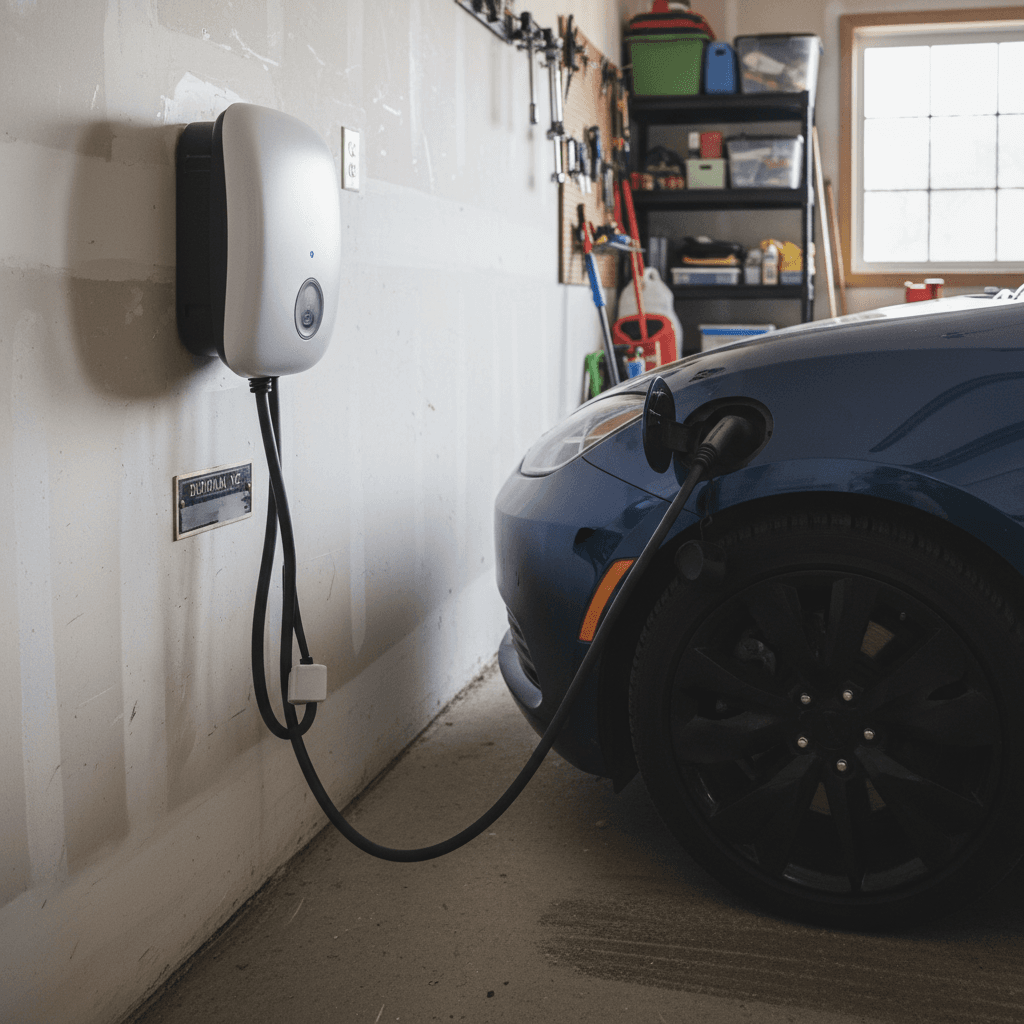
Duke Energy Progress: EV Charger Prep Credit helps cover panel, wiring, and circuit work for Level 2 charging at home. Commercial and multifamily sites can qualify for larger per-port rebates.
3. Home energy rebates
Energy Saver NC: State-run, federally funded rebates for electrical panels, wiring, and efficiency upgrades that often overlap with EV charging projects.
Think like an accountant, not a gearhead
Federal EV tax credits for Triangle buyers (new and used)
No matter where you live in the Triangle, the **federal EV tax credits** are your single biggest potential savings lever, at least through the end of 2025, when current federal EV incentives are scheduled to wind down. Two separate federal credits matter here: one for new EVs and one for used.
New EV federal tax credit (up to $7,500)
- Who it’s for: Buyers of qualifying new EVs and plug-in hybrids.
- How much: Up to $7,500, depending on battery sourcing and assembly rules.
- Income caps: Higher earners phase out of eligibility; check the latest IRS limits before you buy.
- Price caps: MSRP caps apply (sedans vs. SUVs/trucks have different limits).
- Timing: Existing federal EV purchase incentives are slated to end after September 30, 2025, so Triangle buyers have a limited window.
Used EV federal tax credit (up to $4,000)
- Who it’s for: Buyers of qualifying used EVs at least two model years old.
- How much: 30% of the purchase price, up to $4,000.
- Price cap: Vehicle sale price must be $25,000 or less.
- Income caps: Lower than for new EVs, aimed squarely at middle-income households.
- One per vehicle: A given VIN can only qualify once for the used credit.
Don’t confuse rebates with tax credits
If you’re shopping the used market, this is where platforms like Recharged can help. Recharged specializes in used EVs and provides a detailed Recharged Score Report on every vehicle, including verified battery health and fair market pricing, making it easier to spot models that both qualify for the federal used EV credit and fit your commute.
North Carolina state and local EV incentives
Here’s the blunt truth: **North Carolina doesn’t currently offer its own statewide EV purchase rebate or tax credit.** Instead, the state has focused on building out charging infrastructure and supporting utility-led programs. That means most of your direct savings will come from federal incentives and your utility, not from the state DMV or tax department.
Local governments in the Triangle, Raleigh, Durham, Chapel Hill, Cary, Apex, are investing in public charging and electrifying their fleets, but they generally aren’t writing checks to individual residents for buying an EV. However, that local investment does matter: it expands your charging options and supports property values for homes that are EV-ready or near public chargers.
Raleigh & Chapel Hill are leaning into charging
Utility EV incentives in the Research Triangle
For most Triangle households, **utility incentives are the closest thing you’ll get to a local EV rebate.** The key player is Duke Energy Progress, which serves much of the Raleigh–Durham area. Some pockets, like parts of Apex or municipal utilities, may not qualify, so your first step is to look at the name on your electric bill.
Major EV-related utility incentives affecting the Triangle
Programs change frequently, so always confirm eligibility and current terms before committing to a specific charger or contractor.
| Program | Who offers it | Who it helps | What it typically covers | Triangle catch |
|---|---|---|---|---|
| EV Charger Prep Credit (Residential) | Duke Energy Progress | Homeowners installing a Level 2 charger on a new dedicated circuit | One-time credit, often around several hundred dollars, toward panel upgrades, wiring, conduit, and outlet for a home EV charger | Available only if you’re a direct Duke customer; some towns (like Apex municipal customers) are not eligible even though they’re in the Triangle. |
| EV Charger Prep Credit (Commercial/Multifamily) | Duke Energy Progress | Workplaces, apartment communities, and public sites | Per-port rebates that can reach into the low thousands of dollars, depending on charger type and use case | Owners of multifamily buildings in Raleigh–Durham can substantially reduce the cost of shared chargers for residents. |
| Time-of-Use EV Rates / Off-peak programs | Select utilities, including Duke | Homeowners willing to charge mainly overnight | Lower kWh pricing during off-peak hours | Can materially lower your fuel cost per mile if you can schedule overnight charging. |
Not all utilities serving Triangle communities participate in these programs; eligibility usually depends on who delivers your electricity, not just where you live.
Confirm your utility before you count the money
Home upgrade rebates that quietly help EV owners
Even though North Carolina doesn’t hand out checks for buying an EV, the state launched **Energy Saver North Carolina** in January 2025, a major home energy rebate program funded by the federal Inflation Reduction Act. The spotlight is on heat pumps and insulation, but if you read the fine print, many of these rebates are perfect companions to a future EV charger.
Energy Saver NC rebates that matter for future EV charging
These aren’t EV-specific, but they reduce the same electrical work you’d otherwise pay for out of pocket.
Electrical panel upgrades
Rebates of up to $4,000 toward a new electrical panel can make it much easier to add a 40–60 amp circuit for a Level 2 EV charger.
Electrical wiring
Up to $2,500 toward wiring and related electrical work. That often overlaps directly with the conduit and wiring you’d need for a garage charger.
Heat pumps & efficiency
Whole-home savings can reach $16,000 for deep energy retrofits, freeing household cash to go toward an EV payment instead of utility bills.
Stacking Energy Saver NC with EV incentives
Which rebates apply if you buy a used EV from Recharged?
If you’re shopping the used market, especially in a data-driven region like the Research Triangle, it’s natural to gravitate toward platforms that specialize in EVs. That’s exactly where **Recharged** comes in.
- Every vehicle listed on Recharged includes a Recharged Score Report with verified battery health, so you aren’t guessing about range before you claim a federal used EV credit.
- Recharged focuses on fair-market pricing for used EVs, which is critical if you’re trying to stay under the $25,000 price cap for the federal used EV tax credit.
- Because Recharged is fully digital, you can shop from anywhere in the Triangle and have the vehicle delivered to your driveway, no extra dealer fees for being in Raleigh, Durham, or Chapel Hill.
From an incentives standpoint, a used EV purchased through Recharged can potentially qualify you for:
- The federal used EV tax credit (if you and the vehicle meet the income, age, and price requirements).
- Duke Energy’s Charger Prep Credit if you’re a Duke customer and you install a Level 2 charger at home.
- Energy Saver NC rebates for panel and wiring upgrades if you’re income-eligible and completing broader home energy improvements.
Step-by-step: How to stack your EV rebates
Practical playbook for Triangle EV shoppers
1. Confirm your federal eligibility first
Use the official IRS guidance or an up-to-date EV incentive tool to see whether you qualify for the new or used EV credit. Pay special attention to your household income, filing status, and whether your chosen vehicle is on the approved list.
2. Check who actually supplies your electricity
Pull out your latest power bill. If it says Duke Energy Progress, you may qualify for the EV Charger Prep Credit. If it’s from a city utility (like the Town of Apex), you may be outside Duke’s programs even though you live in the Triangle.
3. Map out your home electrical situation
Before you fall in love with a specific EV, talk to an electrician about your panel capacity and how hard it will be to get a 240V circuit to your parking spot. Ask which parts of the work could qualify for Duke’s credit or Energy Saver NC.
4. Price the car after incentives, not before
When you compare a gas car to an EV, run the numbers <em>after</em> you subtract any federal EV tax credit, estimated utility rebates, and fuel savings. The monthly payment gap often shrinks, or disappears, once you include everything.
5. Use a specialist for used EVs
Buying a used EV is not like buying a used crossover. Battery health, fast-charging history, and software support matter. Platforms like <strong>Recharged</strong> specialize in these details and back every vehicle with a Recharged Score Report so you’re not guessing.
6. Keep every invoice and approval email
For tax credits and utility rebates, documentation is everything. Save installer quotes, panel upgrade invoices, charger receipts, and any pre-approval letters from Energy Saver NC or Duke Energy.
Common pitfalls with EV rebates in the Triangle
Watch out for these Triangle-specific gotchas
- Assuming all Triangle residents qualify for Duke EV credits. If your bill comes from a municipal utility (for example, some Apex residents), you may be outside Duke’s programs even though your neighbor qualifies.
- Waiting too long on federal credits. Current federal EV purchase incentives are scheduled to end after September 30, 2025. If you’re planning a new EV, you’re on the clock.
- Not coordinating panel work with rebates. Doing a panel upgrade now and “worrying about a charger later” can make it harder to claim Energy Saver NC or Duke Charger Prep Credits on the same work.
- Ignoring income caps. Both federal EV credits and Energy Saver NC target specific income ranges. A quick check before you shop can prevent an expensive surprise in April.
- Buying a used EV without battery data. A cheap used EV that doesn’t qualify for a tax credit and has a tired battery can quickly erase any savings you expected. Look for third-party battery health reports like the Recharged Score.
EV rebates in the Research Triangle: FAQ
Frequently asked questions about EV rebates in the Triangle
Bottom line: Making an EV affordable in the Triangle
The Research Triangle doesn’t have a flashy, one-click “Raleigh EV rebate,” but that doesn’t mean the savings aren’t there. Instead of a single program, you’re working with a **stack of overlapping incentives**, federal tax credits, Duke Energy charger rebates, and Energy Saver NC home upgrades, that, together, can make owning or leasing an EV far more affordable than it looks on a window sticker.
Your job as a shopper is to line those pieces up in the right order: confirm your federal eligibility, verify your utility, plan your home electrical work, then pick the right EV, new or used, for your commute and budget. That’s where partners like Recharged can simplify the process, with verified battery health, fair market pricing, and EV specialists who understand incentives, not just horsepower.
If you’re in the Triangle and thinking about going electric in the next year or two, now is the time to map out your incentives before federal credits wind down. With a bit of planning, you can turn a complex patchwork of **EV rebates in the Research Triangle** into a straightforward path to lower running costs and cleaner miles.