If you live in Fairfax, Arlington, Alexandria, Loudoun, or Prince William, you’ve probably heard that **EV rebates in Northern Virginia** aren’t as generous as in some other states. That’s partly true, but it also misses a lot of real savings from federal tax credits, utility rebates, and local charger programs that can add up to thousands of dollars off the real cost of owning an electric car.
Key takeaway for Northern Virginia shoppers
Why EV rebates in Northern Virginia matter in 2026
In 2026, EV shoppers are dealing with a moving target. Federal incentives created under the Inflation Reduction Act have firm sunset dates, Congress has adjusted or curtailed some clean-energy credits, and utilities across Virginia are rolling out their own EV and home-charging programs. For Northern Virginia drivers who face some of the longest and most congested commutes in the country, getting this right can mean **saving thousands up front and hundreds every year** on fuel and maintenance.
Why incentives are worth the homework
Because incentives are scattered across **federal tax law, utility rate plans, and local grant programs**, the job for a Northern Virginia shopper is to pull the pieces together. That’s where a used‑EV specialist like Recharged can help you understand how a specific model, price point, and charger setup will interact with today’s incentives.
Federal EV tax credits: what’s still available
Before you look at local EV rebates in Northern Virginia, start with the federal picture. Federal tax credits have been the single biggest pot of money for most EV buyers, especially if you move quickly before key programs sunset.
Major federal incentives for Northern Virginia EV drivers
These are national programs, but they matter a lot if you file Virginia taxes from a Northern Virginia address.
1. New EV purchase credit
The well‑known federal credit of up to $7,500 for qualifying new EVs is available through September 30, 2025, subject to vehicle price, battery sourcing, and income limits. Many popular models still qualify, though some automakers have aged out or lost eligibility over time.
2. Used EV purchase credit
For qualifying used EVs purchased from a dealer, there’s a separate federal credit of up to $4,000 (or 30% of the sale price, whichever is lower). This also runs through September 30, 2025 under current law and is especially relevant if you’re shopping the used market in Northern Virginia.
3. Home EV charger credit
The residential charger credit, often called the 30C credit, covers 30% of the cost of purchasing and installing home EV charging equipment, up to $1,000. As of early 2026, it is scheduled to remain available through June 30, 2026, making it one of the longer‑lived incentives on the table.
Timing matters
Remember that these are **tax credits**, not instant rebates. You must have enough federal tax liability to use the credit in the year you claim it. This is where a platform like Recharged can help you model total cost of ownership and, if needed, focus on vehicles that make financial sense even without assuming the maximum federal credit.
Does Virginia offer state-level EV rebates?
Virginia has debated a dedicated state EV rebate more than once, but as of early 2026 there is **no broad statewide purchase rebate** for individual EV buyers similar to what you might see in states like Colorado or New Jersey. That often leads Northern Virginians to assume there’s “nothing” available, which isn’t quite right.
- Virginia does **not** currently offer a statewide per‑vehicle rebate for buying an EV.
- Earlier HOV lane perks for solo EV drivers in some Northern Virginia corridors have been reduced or eliminated as federal rules changed.
- Instead, the Commonwealth has leaned on **federal incentives plus utility‑run programs** to support EV adoption.
For you as a Northern Virginia shopper, this means the real action is at the **utility and local level**, plus whatever you can capture from federal tax credits. Let’s look at those next.
Utility incentives in Northern Virginia (Dominion, NOVEC & Appalachian Power)
Utility programs are where many **Northern Virginia EV rebates** actually live. Depending on where you live and who sends your electric bill, you may qualify for bill credits, charger rebates, or turnkey installation programs that dramatically lower your out‑of‑pocket cost.
Major utility EV programs affecting Northern Virginia
Check your electric bill to see which utility serves your home, then look at the matching row.
| Utility | Typical Northern Virginia Coverage | Key EV/Charger Programs | What You Can Get |
|---|---|---|---|
| Dominion Energy Virginia | Most of Northern Virginia including much of Fairfax, Arlington, Alexandria, Loudoun and Prince William | EV Charger Rewards; Residential Charger Program; Environmental Justice Community EV Charging Program | • Up‑front rebate for eligible smart Level 2 charger • Ongoing annual bill credits (~$40/year) for allowing managed charging events • Option to spread charger + installation costs over monthly bill; income‑qualified customers may pay little or nothing |
| NOVEC (Northern Virginia Electric Cooperative) | Parts of Loudoun, Prince William, Fairfax and surrounding areas | Member EV charger rebate programs (varies) | • Rebate toward purchase/installation of a qualifying Level 2 home charger • Time‑of‑use or off‑peak rates in some cases |
| Appalachian Power (VA territory) | Primarily western and southwestern VA; limited impact on core NoVA but relevant if you own property elsewhere in the state | Residential EV Charger Rebate | • Around $100 per Level 2 charger, up to the cost of the equipment itself |
Programs and amounts change over time; always verify current terms before you apply.
Dominion EV Charger Rewards in a nutshell
Dominion’s newer **Residential Charger Program** also tackles the biggest barrier for many Northern Virginia homeowners: the cost and hassle of installing a 240‑volt circuit and a wall‑mounted charger. Instead of writing a large check to an electrician, you can roll hardware and installation into a fixed monthly charge on your Dominion bill over about five years, with enhanced support and potentially no up‑front payment for qualifying households.
Local Northern Virginia rebate programs and grants
Beyond the large utilities, several local governments in Northern Virginia have started offering their own **site‑level EV charger support**, especially for condos, HOAs, and workplaces where access has lagged behind single‑family homes.
Examples of local programs in Northern Virginia
These programs don’t put cash directly in your pocket as a driver, but they can bring chargers closer to where you live and work.
Fairfax County – Charge Up Fairfax
Charge Up Fairfax helps community associations, multifamily properties, and places of worship install Level 2 chargers. Starting with the 2025 funding cycle, participating organizations can apply for reimbursement grants of around $8,000–$12,000 depending on vulnerability level and whether they pair the project with Dominion’s Level 2 programs.
For you as a resident or condo owner, this can be the difference between “no charging in my building” and a reliable shared charger in your garage.
Other Northern Virginia communities
Localities like Arlington, Alexandria, and Loudoun periodically offer pilot grants, zoning support, or fee reductions for EV infrastructure. These programs tend to be smaller, competitive, and time‑limited, but if your HOA or employer is interested in installing chargers, it’s worth asking the local sustainability office what’s available this budget year.
Talk to your HOA or property manager
Home EV charger rebates & financing options
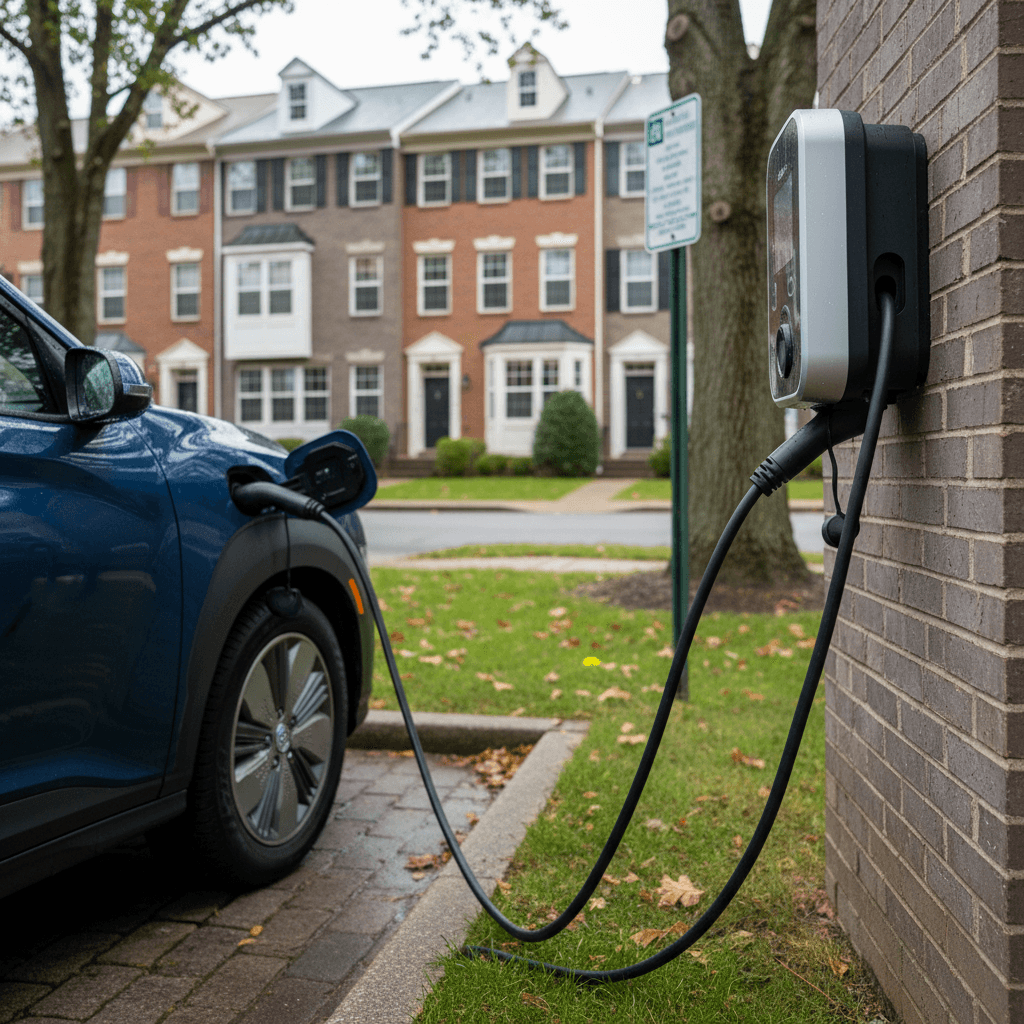
For Northern Virginia drivers, **home charging is the most valuable “rebate” you’ll ever get**. Level 2 charging at home is almost always the cheapest way to fuel an EV, and stacking incentives correctly can reduce or even eliminate your out‑of‑pocket installation cost.
What a typical NoVA home charger project costs
- Level 2 charger hardware: Often $400–$800 for a smart, Wi‑Fi‑enabled unit.
- Electrical work: $600–$1,500+ depending on panel capacity, distance to parking, and any trenching or conduit.
- Permits and inspections: Varies by locality but can add a few hundred dollars.
Before incentives, many Northern Virginia homeowners see quotes in the $1,000–$2,500 range for a complete, code‑compliant installation.
How incentives can reduce that bill
- Dominion / NOVEC rebates: Help cover the cost of qualifying smart Level 2 chargers and, in some cases, a portion of installation.
- Federal 30C tax credit: Covers 30% of eligible charger + installation costs up to $1,000 if you claim it on your federal return.
- Turnkey programs: Dominion’s Residential Charger Program lets you spread equipment and installation costs over your bill, and income‑qualified customers may pay little or nothing up front.
Plan your project around these incentives and you can often bring your net cost down to a manageable monthly number, sometimes close to zero up front.
Don’t DIY 240‑volt work
How to stack EV rebates on a used EV purchase
If you’re shopping a used EV in Northern Virginia, your playbook looks a little different than someone leasing a new luxury model. The good news is that **used buyers can still combine multiple incentives**, you just need to be realistic about eligibility and timing.
Smart stacking strategy for a used EV in Northern Virginia
1. Confirm whether the used EV qualifies for the federal credit
Not every used EV is eligible. The vehicle must be purchased from a dealer, meet price caps, and you must meet income limits. Before you fall in love with a particular car, verify whether it qualifies for the federal used EV credit and how much you could realistically claim.
2. Work with a seller who understands incentives
Buying through a used‑EV specialist like <strong>Recharged</strong> means you’ll get a clear view of which incentives apply, plus a detailed <strong>Recharged Score</strong> report on battery health and fair market pricing. That transparency matters more as incentives become more complex and time‑limited.
3. Plan a Level 2 charger project around utility and federal programs
Once you’ve chosen a car, look at Dominion or NOVEC charger rebates, then layer in the 30% federal charger credit. Getting the paperwork and timing right can easily save you several hundred dollars on your home setup.
4. Include financing and ownership costs, not just the sticker price
Rebates and credits lower your effective cost, but so do lower fuel and maintenance expenses. When you pre‑qualify for financing and run a total cost‑of‑ownership comparison, you may find a higher‑trim EV is actually cheaper to own than a budget gas car.
Step-by-step checklist to claim your EV rebates
Let’s pull this together into a concrete, Northern‑Virginia‑specific game plan you can follow before you sign a purchase agreement or schedule a charger install.
Northern Virginia EV rebate action plan
1. Confirm your utility and local programs
Look at your electric bill to see whether you’re with Dominion, NOVEC, or another provider. Visit their EV or “save energy” pages to confirm current rebates, enrollment bonuses, and any income‑qualified offers. If you’re in Fairfax County, review Charge Up Fairfax if you live in a condo or HOA.
2. Decide new vs. used and check federal eligibility
List the EVs you’re considering and check whether they still qualify for the new or used federal credits given price, battery sourcing, and income rules. Focus your shopping on models that make financial sense <em>even without</em> the maximum credit, in case Congress changes the rules again.
3. Run the numbers on home charging
Get at least one quote for a Level 2 installation, then subtract any utility rebates and estimate the 30% federal charger credit. Compare that net cost to what you’d spend using only public fast charging. For most Northern Virginians, home charging wins quickly.
4. Time your purchase and installation
If you’re targeting a federal EV credit that expires on September 30, 2025, or the charger credit that runs through June 30, 2026, give yourself several months of cushion for vehicle delivery, installation scheduling, and paperwork.
5. Keep documentation organized
Save purchase agreements, charger invoices, utility rebate approvals, and screenshots or PDFs of program terms. You’ll need them for both your tax preparer and any post‑installation rebate claims.
Common pitfalls Virginia EV buyers should avoid
1. Counting on incentives you can’t actually use
Tax credits only help if you owe enough tax to use them, and some programs exclude higher‑income households or vehicles above a certain price. Don’t build your budget around a credit you might not qualify for, treat it as upside, not a guarantee.
2. Ignoring the cost of charging access
A cheap EV without reliable charging is no bargain. If you rent or live in a condo, factor in whether your building can realistically add chargers using programs like Charge Up Fairfax or Dominion’s Environmental Justice Community EV Charging Program.
3. Overlooking battery health on used EVs
A used EV with a heavily degraded battery can erase the value of any rebate. That’s why every vehicle on Recharged includes a Recharged Score with verified battery health, so you understand real‑world range before you buy.
4. Waiting too long to act
Key federal EV and charger credits now have clear end dates. You don’t need to rush into a bad deal, but if you’re already convinced an EV fits your life, waiting multiple years could mean leaving substantial money on the table.
Think of incentives as icing, not the cake
EV rebates in Northern Virginia: FAQs
Frequently asked questions about EV rebates in Northern Virginia
The bottom line on EV rebates in Northern Virginia
Northern Virginia doesn’t offer a flashy, one‑size‑fits‑all EV rebate, but that doesn’t mean you’re on your own. In reality, the most meaningful incentives here come from **federal tax credits, Dominion and NOVEC charger programs, and local grants that make home or community charging practical**. If you line those up properly, and choose a used EV with solid battery health and fair market pricing, you can cut thousands from your real cost of ownership while turning your daily Beltway slog into something a little quieter and a lot cheaper to fuel.
If you’re ready to explore specific vehicles, Recharged can help you compare **used EVs with verified battery health, transparent pricing, and financing options**. From there, you can layer on the Northern Virginia incentives that fit your situation and make the switch to electric on your terms.