If you believed the loudest headlines, you’d think the electric-vehicle revolution slammed into a wall. Terms like “EV winter” and “demand collapse” are everywhere. But when you look beyond the noise at actual sales data, used-market pricing, and policy shifts, a different story emerges. EV demand isn’t dying, it’s changing lanes. And if you’re considering a used EV, that shift is largely working in your favor.
The short version
EV demand slowdown: headlines vs. hard data
What the numbers actually show
The disconnect is simple: growth rates are slowing from rocket-ship levels, and that feels like a crash, even when total sales are still hitting records. Globally, EVs went from niche to nearly one in five new cars sold in 2023, and projections suggest they’ll account for more than a quarter of sales in 2025, with China already above 40% EV share and pushing past 50%. That’s not a demand collapse; that’s a market maturing at high speed.
In the US, the story is more complicated: EVs crossed the 10% share mark, then ran into a mix of higher interest rates, infrastructure anxiety, and shifting federal incentives. Growth slowed from 60%-plus annual gains to single digits. That’s a comedown, but it’s also what happens when you move from early tech adopters to the broader, more cautious middle of the market.
Globally, EV demand is not collapsing
Start outside the US, and the “EV demand is dead” story falls apart quickly. According to recent international outlooks, global EV sales hit roughly 17 million in 2024, about 18–20% of all cars sold, and are on track to pass 20 million in 2025, or more than one in four new cars. Those are smartphone‑era growth numbers in an industry that usually moves at glacial speed.
- China now accounts for nearly half of global EV sales and well over 40% market share for EVs, with some months passing 50%.
- Europe’s EV market has cooled as subsidies fade, but EVs still hold around a fifth of new-car sales.
- Emerging markets in Asia and Latin America are shifting from rounding error to real volume, with EV sales jumping more than 60% across those regions in 2024.
Think S‑curve, not straight line
In the US, is EV demand slowing or just maturing?
In the United States, the EV story reads like a plot twist: after years of 30–60% annual growth, 2024 and early 2025 brought a comedown. EVs hovered around 9–10% of new light‑vehicle sales. Early 2025 data shows EV sales growing around 9% year over year, still ahead of the overall market, but nowhere near the doubling behavior of 2021.
The slowdown case
- Growth rates fell hard from 60%+ annually to single digits in 2024–2025.
- Several automakers delayed or canceled EV programs and shifted focus back to hybrids.
- Some dealers report EVs sitting on lots longer than expected, especially higher‑priced models.
- Federal purchase incentives for many new and used EVs expired in late 2025, creating a post‑credit hangover.
The maturity case
- Even at lower growth, US EV sales are still rising and total volumes are at record highs.
- EV share has climbed from ~2% in 2019 to ~10% today, this is a much bigger base.
- Infrastructure, model variety, and used‑market supply are finally catching up to early hype.
- Consumers are moving from curiosity to hard‑nosed math about monthly payments and charging access.
Beware percentage whiplash
Why it feels like EV demand is falling
If the data says EV demand is still growing, why does it feel like a rout? Because a lot of visible things are happening at once, and most of them are noisy, painful, and easy to misread.
Four big forces distorting the picture
They make a growing market feel like a collapsing one
Automaker pullbacks
Incentives expiring
Charging anxiety
Doomy narratives
The real risk: policy whiplash
“EV winter” or healthy demand reset?
The phrase “EV winter” gets thrown around a lot in 2026, usually next to stories about layoffs at startups or price cuts from legacy brands. But winters in industry are rarely permanent; they’re a reset after an overheated boom. In EV‑land, that boom looked like aggressive volume targets, thin‑margin models, and infrastructure promises that outpaced reality.
- Startup automakers that raced to scale on premium SUVs and sedans are now wrestling with high costs and softer luxury demand.
- Some legacy brands bet big on large, expensive EVs just as high interest rates hit, stretching monthly payments too far for mainstream buyers.
- Fleet and commercial buyers are renegotiating timelines as they watch total cost of ownership data come in and wait for the next battery‑tech step change.
“What we’re seeing isn’t the end of EVs. It’s the end of wishful thinking about how fast an industry this big can turn over.”
Underneath the drama, the fundamentals keep improving: battery pack costs are down roughly 90% since 2008 and another ~20% just in 2024, pushing toward the magic <$100/kWh threshold. As batteries get cheaper and more durable, automakers can build EVs that make sense without heroic subsidies, and buyers can justify the switch on simple math.
Used EVs: where demand is quietly booming
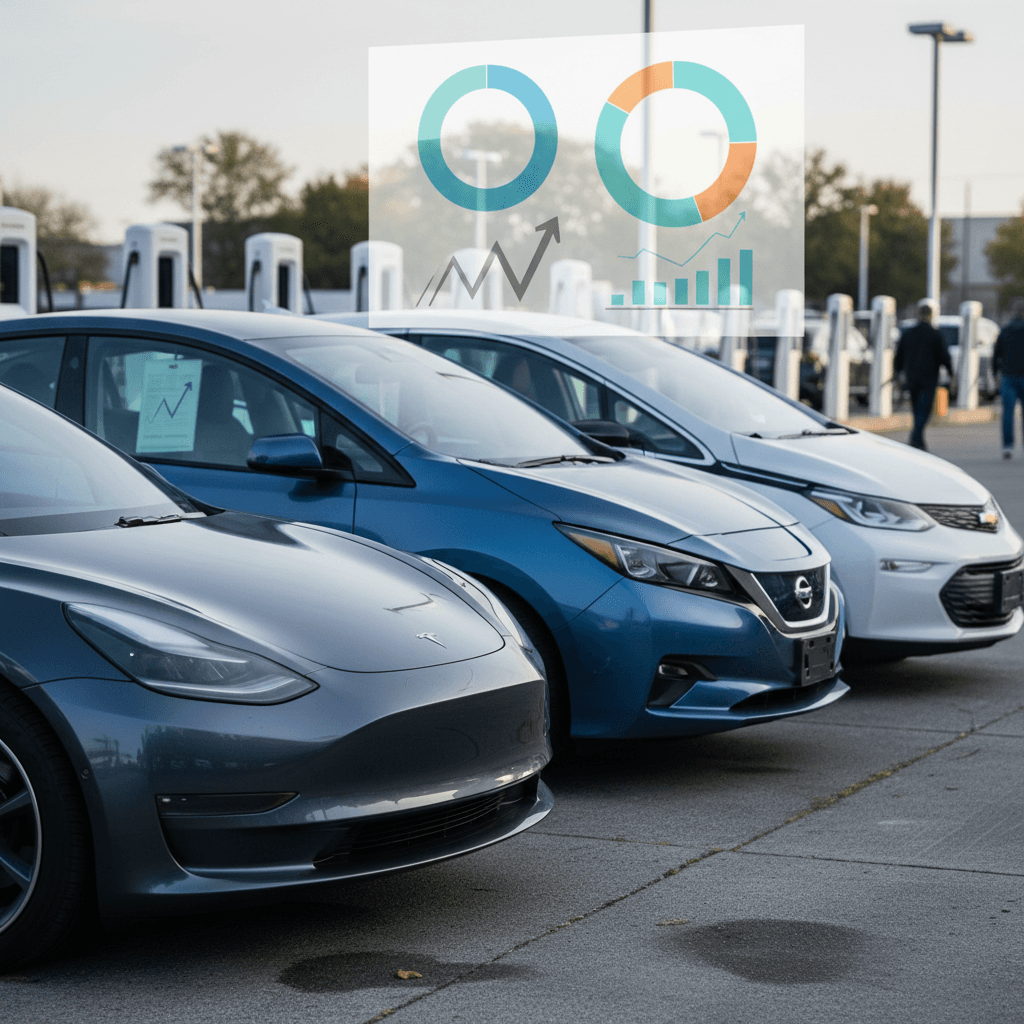
Here’s the part of the story that rarely makes front pages: used EVs are having a moment. As early adopters trade out of their first or second EVs, a wave of 1–5‑year‑old electric cars is hitting the market, and pricing has adjusted fast.
Used EVs by the numbers
Zoom into late 2025 and early 2026 and you see more nuance. After federal credits for new and used EVs expired on September 30, 2025, used Tesla prices actually rose about 4.3% while prices for most other used EVs slipped around 3–4%. Market share for used EVs dipped from about 3.5% of late‑model used sales to under 3%, a clear signal that incentives and brand strength both matter.
Two used EV markets, one lot
What this market shift means if you’re shopping used
So is EV demand slowing down, myth or reality? For you as a buyer, the more important question is: what kind of EV market am I walking into? In 2026, the answer is: one where the new‑car party has calmed down, but the used EV aisle has never been more interesting.
How to use the “slowdown” to your advantage
1. Treat lower hype as a buying opportunity
Fewer people chasing the same shiny new EVs means you’re less likely to pay over the odds. Dealers and online retailers are more open to realistic pricing and better financing on both new and used electric cars.
2. Look hard at total cost of ownership
Even if monthly payments are similar to a gas car, you can save heavily on fuel and maintenance. Run the numbers on your commute, local electricity prices, and service costs before deciding EV demand is “too risky” to join.
3. Prioritize battery health, not just mileage
Unlike gas cars, <strong>battery state of health</strong> is the star metric for used EVs. Tools like the Recharged Score use diagnostics to show how much capacity a pack has actually lost, so you’re not buying a mystery range figure.
4. Don’t overpay for range you won’t use
The market has shifted from 200‑mile to 300‑plus‑mile EVs. If your real‑world driving rarely tops 60–80 miles a day, an older 200‑mile EV, priced lower thanks to the “slowdown” mood, can be a bargain.
5. Use policy changes to negotiate
When incentives expire or change, dealers feel it. If you’re losing a federal or state credit on paper, ask what the seller can do on price, financing, or trade‑in to bridge the gap. The mood of “soft demand” is leverage in your corner.
6. Shop cross‑brand, not just Tesla
With used Tesla prices rebounding, there’s real value in well‑specced Hyundai, Kia, Chevrolet, Nissan, and Ford EVs. Many deliver similar real‑world utility for less money, especially once you factor in warranty coverage and battery health.
Why used EVs make more sense in 2026
How Recharged helps you navigate the EV noise
A choppy market is confusing for buyers, but it’s also the moment when careful, transparent shopping matters most. That’s where Recharged is designed to help. Instead of treating every used EV as a black box, Recharged builds the whole experience around clarity: what you’re paying, what you’re getting, and how healthy the battery really is.
Recharged in a “slowdown” world
Why our model is built for exactly this kind of market
Recharged Score battery health report
Fair, data‑driven pricing
EV‑specialist help, start to finish
Nationwide delivery
Financing & trade‑in options
Experience Center in Richmond, VA
FAQ: EV demand slowdown, incentives, and timing your purchase
Frequently asked questions about EV demand in 2026
Bottom line: EV demand slowdown, myth vs. reality
So, is EV demand slowing down, myth or reality? The reality is less dramatic and more useful than the headlines. Globally, EVs continue to gain share and set sales records. In the US, growth has cooled from hyper‑speed to merely fast, and policy swings have turned the rollout into a start‑stop affair. That turbulence is painful for automakers, and occasionally confusing for shoppers, but it doesn’t spell the end of electric cars.
For you as a buyer, the current moment looks more like a buyers’ market in the making. New‑EV hype has eased. Used EV supply is up. Prices are more reasonable. And the tools to judge battery health and fair value are finally catching up. If you’re willing to look past the “EV winter” headlines and focus on the fundamentals, 2026 can be an excellent time to move into a used EV that fits your life.
Recharged exists for exactly this chapter of the story: a market where information, not hype, should call the shots. With verified battery diagnostics, fair market pricing, EV‑savvy support, and nationwide delivery, Recharged helps you buy the right EV for the right reasons, no matter what this week’s demand narrative looks like.