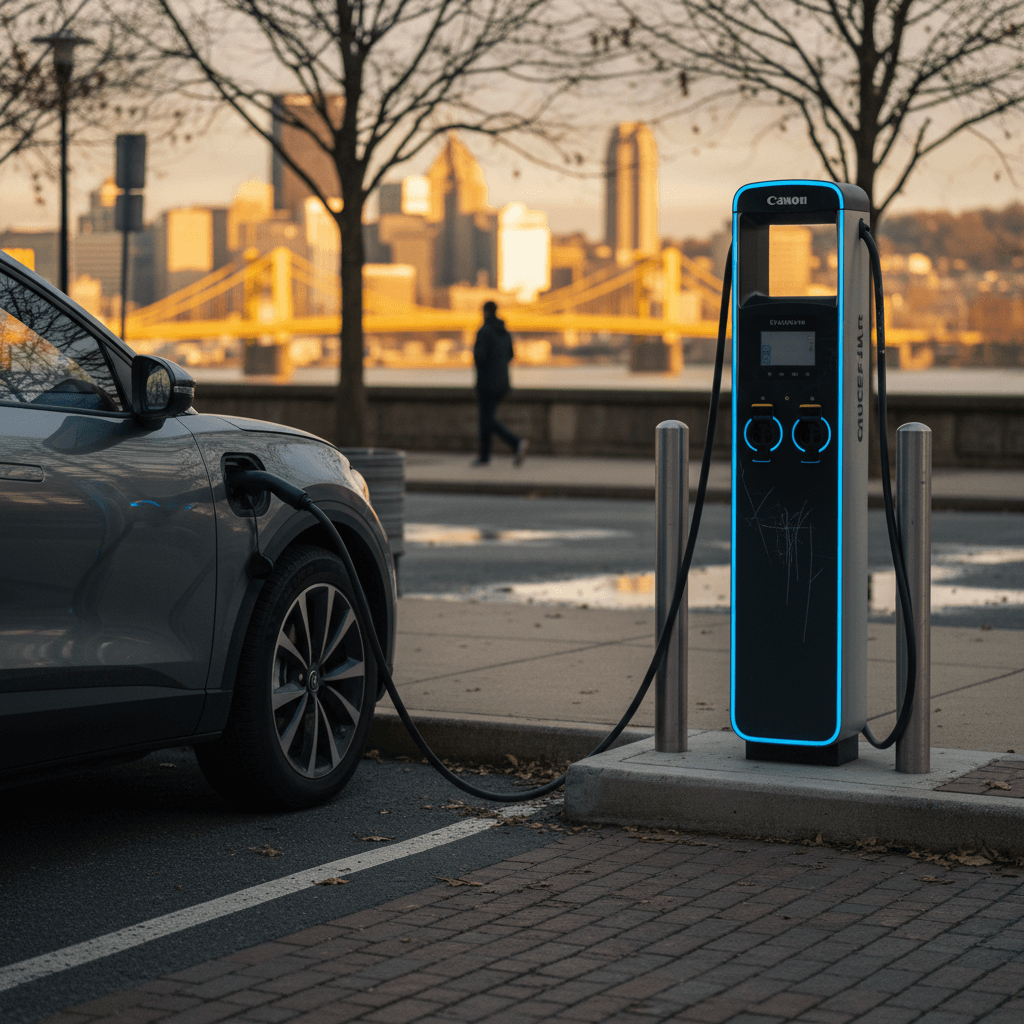
If you drive an electric vehicle in Western Pennsylvania, you’re in better shape than you might think. Pittsburgh’s EV charging stations have grown quickly: today the metro has well over 300 public charging locations and roughly 100 DC fast ports across the region, putting it among the best‑served cities in the state. Whether you live in a walk‑up in Lawrenceville, commute from Wexford, or road‑trip the Turnpike, understanding how to use this network will make EV ownership a lot less stressful.
Why Pittsburgh is a bright spot for EV charging
EV charging in Pittsburgh at a glance
Pittsburgh EV charging snapshot (2026)
The headline for Pittsburgh is simple: there are enough chargers for everyday driving, but they aren’t evenly distributed. Downtown, Oakland, the Strip, and the North Shore are rich with Level 2 options in garages and lots, while DC fast charging clusters along I‑79, I‑376, I‑279, and the Turnpike. Knowing which networks operate where, and how long you can leave a car parked while charging, is more important than memorizing raw station counts.
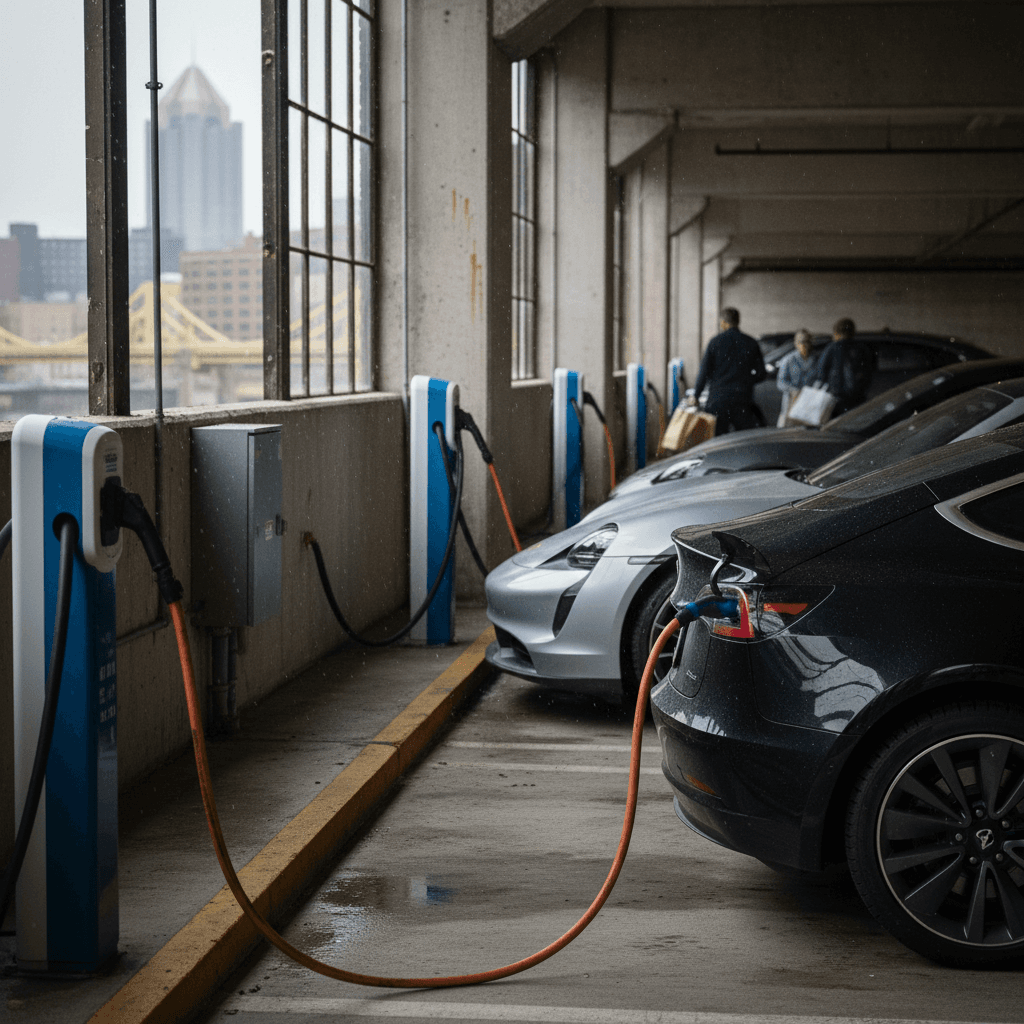
Where to find EV charging stations in Pittsburgh, PA
Best tools for locating EV chargers in Pittsburgh
Use more than one app, each network sees its own stations best.
1. PlugShare & ChargeHub
Crowdsourced maps like PlugShare and ChargeHub aggregate nearly every public charger in the region.
- Filter by plug type (CCS, NACS, CHAdeMO, J1772)
- See user reviews, photos, and uptime history
- Great for destination Level 2 charging in garages and lots
2. Network‑specific apps
Apps from Electrify America, EVgo, ChargePoint, and others give the most reliable real‑time status.
- Check which stalls are in use before you arrive
- See exact kW power, pricing, and idle fees
- Start and stop sessions from your phone
3. In‑car navigation
Most modern EVs (Hyundai, Kia, Ford, Tesla, VW, GM, etc.) integrate Pittsburgh charging into their nav.
- Route planning with automatic charging stops
- Battery‑aware arrival estimates on hilly routes
- Some can pre‑condition the battery for faster DC charging
Pro tip: Cross‑check locations
- Downtown garages and city lots are your best bet for daytime Level 2 charging if you work in or near the Golden Triangle.
- University campuses (Pitt, CMU, Duquesne, Point Park) host a growing number of Level 2 chargers for faculty, staff, and visitors.
- Suburban hubs like Cranberry, Wexford, Monroeville, and Robinson host DC fast sites along I‑79, I‑76, and I‑376, useful for topping up during errands or road trips.
Major EV charging networks around Pittsburgh
Pittsburgh doesn’t have a single dominant non‑Tesla network the way some Sunbelt metros do. Instead, you’ll see a mix of Electrify America, EVgo, ChargePoint, utility‑hosted stations, and a rapidly expanding Tesla Supercharger footprint, some of which is accessible to non‑Teslas.
Common public charging networks in and around Pittsburgh
You’ll see these logos most often when scouting for charge around the metro.
| Network | Typical locations | Primary connector types | Best use case |
|---|---|---|---|
| Tesla Supercharger | Interstates, shopping areas, Turnpike plazas | NACS (some with CCS access via Magic Dock) | Fast road‑trip charging for Tesla; select non‑Tesla models at some sites |
| Electrify America | Sheetz, Walmart, highway exits (e.g., Cranberry) | CCS, limited CHAdeMO | High‑power DC fast charging on regional trips |
| EVgo | Urban lots, Duquesne Light‑partner sites, some garages | CCS, CHAdeMO, some NACS | Quick top‑ups near Downtown and dense neighborhoods |
| ChargePoint | Workplaces, parking garages, hospitals, universities | J1772 Level 2, some CCS DC fast | Daily commuting, workplace and destination charging |
| Municipal & utility sites | City‑owned garages, parks, public facilities | Mostly J1772 Level 2 | Affordable public charging for residents without home options |
Always confirm connector types and power levels in the app before you drive out of your way.
Watch for network quirks
Level 2 vs. DC fast charging in Pittsburgh
Level 2 charging in the city
Level 2 chargers (240 V, typically 6–11 kW) are Pittsburgh’s workhorses. They dominate garages, campuses, and workplaces, and they’re ideal if you park for several hours.
- Add roughly 20–35 miles of range per hour depending on your car.
- Great for commuters who can plug in while at work or during events.
- Many sites offer lower prices than DC fast and some are free for customers or employees.
DC fast for highway and quick turns
DC fast chargers in the region range from 50 kW all the way up to 350 kW at newer sites along I‑79, I‑76, and I‑376.
- Can add 150–200+ miles of range in 20–40 minutes on modern EVs.
- Perfect for road trips, ride‑hail drivers, or apartment dwellers who need a weekly quick fill‑up.
- Pricier than Level 2 and often come with idle fees if you stay after charging finishes.
Most Pittsburgh EVs still charge at home
What it costs to charge an EV in Pittsburgh
Charging costs in Pittsburgh depend on where you plug in, what time of day you charge, and whether your EV is sipping Level 2 or gulping DC fast. Power prices have been climbing in the Duquesne Light territory, so it pays to understand the basics before you start relying on public stations.
Typical EV charging costs in Pittsburgh (2026 ballpark)
Exact rates vary by provider and time of day, always check the app before starting a session.
Home Level 2 (Duquesne Light area)
- Energy: often around $0.12–$0.16/kWh depending on supplier.
- Full 70 kWh battery: roughly $9–$11.
- Best value if you can charge overnight and enroll in smart‑charging programs.
Public Level 2
- Pricing: free to about $1.00–$2.00 per hour, or per kWh.
- Effective cost: roughly $0.15–$0.30/kWh once you convert hourly rates.
- Great for topping up while you work, shop, or attend a game.
DC fast charging
- Pricing: commonly $0.35–$0.55/kWh in Western PA on major networks.
- 80% fill on 70 kWh pack: about $20–$30.
- Think of it like highway gas: worth paying when speed really matters.
Avoid relying on DC fast every day
EV charging by Pittsburgh neighborhood
If you’re used to pumping gas on practically any corner, EV charging will feel more clustered. Here’s how access generally breaks down across the city and inner suburbs. Specific sites change frequently, so treat this as a pattern, not a directory.
How EV charging access varies across Pittsburgh
Charging density and station types by major area.
| Area | Charging profile | What it’s best for | What to watch for |
|---|---|---|---|
| Downtown & North Shore | High density of Level 2 in garages and some DC fast nearby | All‑day workplace charging; topping up while at events or games | Garage time limits and parking fees; check if charging is included or extra. |
| Oakland, Shadyside, Squirrel Hill | Campus and hospital Level 2, some workplace chargers | Students, staff, and hospital employees who can park for several hours | Access restrictions (permit‑only lots) and time‑of‑day rules. |
| Strip District & Lawrenceville | Mix of public lots and private/retail Level 2; DC fast within a short drive | Destination charging while you eat, shop, or work in co‑working spaces | Some chargers are for customers only; check signage before leaving your car. |
| Cranberry, Wexford, Robinson, Monroeville | Several DC fast hubs near I‑79, I‑76, I‑376 plus retail Level 2 | Suburban commuters, weekend errands, road‑trip top‑ups | Busy periods on weekends and holidays; plan for possible wait time. |
| South Hills & East Hills | Patchier coverage, mostly Level 2 at a few plazas, garages, and workplaces | Drivers who can plan around a limited set of familiar chargers | Long gaps between DC fast sites, map options before longer drives. |
Use PlugShare or your network app to confirm exact locations and connector types before you count on any individual station.
Talk to your building or employer
Planning road trips from Pittsburgh
Western Pennsylvania’s geography, hills, cold winters, and long rural gaps, magnifies any planning mistakes. The good news is that by 2026, there’s a workable DC fast spine in almost every direction from Pittsburgh, especially on the Turnpike and I‑79. The trick is planning around elevation, weather, and charger reliability rather than just distance on a map.
Road‑trip checklist for EV drivers leaving Pittsburgh
1. Use an EV‑aware route planner
Apps like A Better Routeplanner or advanced in‑car nav understand hills, temperature, and your car’s real‑world efficiency. They’ll suggest realistic stops along I‑76, I‑79, I‑80, and I‑70 rather than just the closest plug.
2. Aim to arrive with 10–20% battery
In winter or when climbing out of the river valleys, don’t cut arrival estimates too close. Reserve extra buffer on routes with big grade changes or few backup chargers.
3. Prefer newer high‑power sites
When you can, pick stations with multiple 150–350 kW plugs rather than aging 50 kW single‑stall installs. More plugs mean less chance of queuing or being stranded if one unit is down.
4. Check charger reviews the morning you leave
Before a long run to Philly, Columbus, or DC, scroll recent PlugShare or network‑app reviews. A week‑long outage at a key site can change your entire plan.
5. Understand your car’s DC fast curve
Most EVs charge fastest from about 10–50% and slow down as they approach 80–90%. Planning shorter, more frequent stops can be quicker than charging to 100% at one station.
6. Have backup plugs in mind
On less‑served routes, say across northern PA, save at least one alternative DC fast or a reliable Level 2 location at each leg of your trip.
Duquesne Light EV programs and rebates
Because Duquesne Light serves most of the Pittsburgh metro, its EV programs matter whether you own a house in the South Hills or rent in Bloomfield. The utility has been using rebates and smart‑charging programs to guide where and when people plug in, which can directly save you money.
Key Duquesne Light EV‑related programs to know
Always confirm current terms, utility offerings can change from year to year.
Smart Charging Rewards
Duquesne Light’s Smart Charging Rewards program lets residential EV owners earn bill credits or incentives by enrolling a connected charger or telematics‑linked car.
- Encourages off‑peak overnight charging.
- Helps the utility manage grid load as more EVs plug in.
- Typically requires a qualifying vehicle or Wi‑Fi connected Level 2 charger.
Rebates for Level 2 and DC fast stations
Duquesne Light has offered rebates for Level 2 and DC fast installations at workplaces, fleets, and public sites, often covering a significant portion of hardware and make‑ready costs.
- Helps employers, landlords, and local governments add chargers.
- Frequently stacks with Pennsylvania and federal funding.
- Application windows and amounts are time‑limited, so check before starting a project.
Tie incentives to your charging habits
Buying a used EV? How Pittsburgh charging should shape your choice
If you’re shopping the used market, Pittsburgh’s charging reality should be part of your decision. The right car for a Phoenix suburb with 350 kW plugs on every corner isn’t necessarily the right car for a city with hills, winter, and more modest fast‑charging density.
If you have home or workplace Level 2
- You can comfortably live with shorter‑range EVs (150–220 miles EPA) as long as you’re diligent about plugging in.
- Charging speed matters less; even older models like first‑gen Leafs or i3s can work for short commutes.
- Focus on battery health, Pittsburgh’s winters make degraded packs feel even smaller.
If you rely mostly on public charging
- Prioritize EVs with robust DC fast‑charging capability and widely supported connectors (CCS today, NACS going forward).
- Aim for at least 240–260 miles of EPA range to comfortably handle winter, hills, and detours.
- Look for thermal management that holds up to repeated DC fast sessions on the Turnpike.
How Recharged can help Pittsburgh shoppers
Frequently asked questions about EV charging in Pittsburgh
Pittsburgh EV charging FAQ
Making Pittsburgh’s charging network work for you
Pittsburgh is no longer an EV charging desert. With hundreds of public stations, a growing mix of DC fast sites, and utility and federal dollars continuing to flow into new installations, the region is on a solid infrastructure trajectory. The challenge for most drivers isn’t finding a charger at all, it’s building a routine that fits your life, whether that’s plugging in overnight at home, during the workday in a Downtown garage, or on weekend runs through Cranberry or Monroeville.
If you’re already driving electric, spend a few evenings mapping your personal network: the stations near home, work, your kid’s activities, and your favorite weekend destinations. If you’re still shopping, especially for a used EV, make charging part of the test drive. At Recharged, we match every vehicle’s real‑world range and charging behavior with your specific Pittsburgh use case, and back it with a transparent Recharged Score Report, so you’re not just buying an EV, you’re buying an electric lifestyle that actually works in Western Pennsylvania.