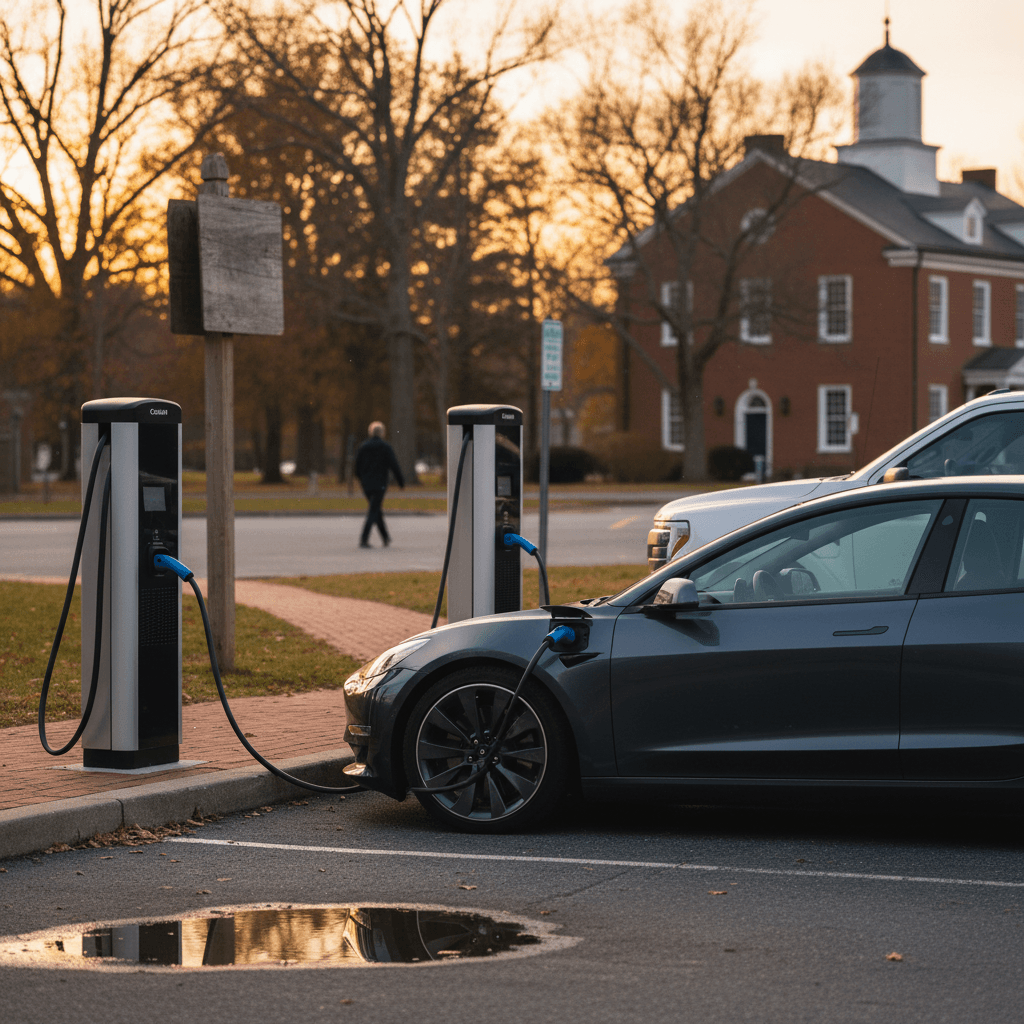
If you drive or are considering a used electric vehicle in Northern Virginia, you’re in one of the better‑served EV regions in the country. The state now ranks in the top 10 nationwide for public EV chargers, and a big share of those stations sit in the busy Northern Virginia corridor around I‑66, I‑95, Route 7, and the Capital Beltway. Understanding how EV charging stations in Northern Virginia are laid out, and how to use them without stress, can make daily life and road trips much easier.
Virginia is now a top‑10 charging state
Why Northern Virginia Is a Strong EV Charging Market
Northern Virginia sits at the crossroads of federal commuters, long‑haul travelers on I‑95, and tech‑corridor traffic along the Dulles Toll Road and Route 28. That mix has made the region a natural early hotspot for public EV charging. Local utilities and counties are layering on incentives and programs, from Dominion Energy’s Level 2 rebates to Fairfax County’s Charge Up Fairfax grants for condos, HOAs, and community organizations, so apartment dwellers and visitors aren’t left behind.
EV Charging Snapshot: Virginia & Northern Virginia
Think of NoVA as a string of charging hubs
Types of EV Charging Stations You’ll See in Northern Virginia
Before you worry about where chargers are, it helps to know what kind you’re looking at. In Northern Virginia you’ll mainly see three flavors of public charging, plus home and workplace options that fill in the gaps.
Common Charging Levels Around Northern Virginia
Match charging speed to how long you’ll be parked
Level 1 (120V)
Slower, but simple.
- Standard household outlet.
- 2–4 miles of range per hour.
- Best for overnight at home or all‑day workplace parking.
In NoVA, Level 1 is mainly a home backup, not a public solution.
Level 2 (240V)
The workhorse of public charging.
- 20–60 miles of range per hour.
- Found at shopping centers, garages, park‑and‑rides, workplaces, and multi‑family buildings.
- Great for topping up while you shop or work.
Most public stations in Northern Virginia are Level 2.
DC Fast Charging (DCFC)
Road‑trip speed.
- Typically 50–350 kW chargers.
- Roughly 150–200+ miles in 20–40 minutes for many newer EVs.
- Concentrated along I‑95, I‑66, and major arterials.
Best when you’re traveling or in a time crunch, not for everyday use.
Watch your plug type
Major EV Charging Networks in Northern Virginia
You’ll see dozens of logos on charging maps, but a handful of networks dominate EV charging stations in Northern Virginia. Knowing the big players helps you pick which apps and accounts to set up first.
Key Public Charging Networks Serving Northern Virginia
Use this as your cheat sheet for which apps to download and what each network is best for.
| Network | Typical Speed | Where You’ll See It | Best For |
|---|---|---|---|
| ChargePoint | Mostly Level 2, some DCFC | Office parks, garages, shopping centers, universities | Daily driving, workplace and errand charging |
| Electrify America | DC fast + some Level 2 | Along I‑95 & I‑66, big box retailers, travel plazas | Road trips and fast top‑ups |
| EVgo | DC fast + Level 2 | Urban and suburban retail, parking garages | Quick city charging and shared garages |
| Tesla Supercharger | High‑power DC fast (NACS) | Interstates and major corridors; expanding CCS/NACS access for non‑Teslas | Fast, reliable stops if your EV is compatible |
| Smaller/local networks | Level 2 mainly | Municipal lots, hotels, multifamily properties | Opportunistic charging while you’re parked |
Coverage and strengths vary by neighborhood, so always double‑check your route in an app before you head out.
Reston: home base for a major fast‑charge network

Where EV Chargers Are Clustered in Northern Virginia
Instead of hunting for single lonely chargers, think in terms of charging clusters. In Northern Virginia, most public stations are built where you were already going to park anyway, and where utilities and site hosts can justify the investment.
1. Retail & Town Centers
- Big‑box stores, grocery chains, and mixed‑use town centers often host several Level 2 ports and sometimes a small DC fast hub.
- Think Tysons, Reston Town Center, One Loudoun, Potomac Yard, Springfield Town Center, and similar developments.
- Ideal for 1–3 hour visits while you shop, eat, or see a movie.
2. Commuter & Travel Corridors
- Look along I‑66, I‑95, I‑495, and the Dulles Toll Road for fast chargers near exits, especially at newer travel plazas and large gas‑station chains.
- Park‑and‑ride lots and Metro stations increasingly host Level 2 stations, so you can charge while you’re downtown.
- Perfect for topping up on a commute or grabbing a fast charge on long trips.
Good news for condo and HOA drivers
How to Find EV Charging Stations in NoVA
You don’t have to memorize every charger in Fairfax or Loudoun County. A few well‑chosen apps will do the heavy lifting and keep you out of low‑battery panic mode.
Best Ways to Locate EV Charging Stations in Northern Virginia
Use at least two tools so you’re never relying on a single network map
1. Multi‑Network Apps
Start with apps that show every network in one view.
- PlugShare, A Better Routeplanner, and similar tools crowd‑source real‑time status and photos.
- Filter by plug type, power level, and amenities.
- Read recent check‑ins from other drivers before you commit to a stop.
2. Utility & State Maps
Dominion Energy and national tools like the Department of Energy’s Alternative Fuels Data Center maintain maps of public EV charging.
- Great for a high‑level view of station density.
- Helpful when you’re comparing commute options or neighborhoods.
- Use in combination with more detailed apps.
3. Parking & Property Apps
Garages, workplaces, and apartment communities may restrict chargers to residents or patrons.
- Check your office parking app or building portal.
- Hotel listings often note on‑site chargers.
- If you’re apartment‑hunting, ask about EV parking upfront.
Bookmark a couple of "fallback" sites
What It Costs to Charge in Northern Virginia
Public charging prices in Northern Virginia aren’t one‑size‑fits‑all. Some stations charge per kWh, some per minute, and some tack on idle fees if you stay plugged in after your session ends. And home electricity rates, plus utility programs, can make overnight charging dramatically cheaper than relying on DC fast chargers every day.
Typical EV Charging Costs Around Northern Virginia
Exact prices vary by network and time of day, but these ranges will help you budget and compare to gasoline.
| Charging Type | Where | Typical Use Case | Relative Cost |
|---|---|---|---|
| Home Level 1/2 | Driveway, garage, shared condo charger | Overnight, daily commuting | Usually cheapest, especially with off‑peak rates |
| Public Level 2 | Retail, offices, garages, park‑and‑rides | 2–4 hour top‑ups | Often cheaper than DC fast; some are free for customers |
| DC Fast Charging | Highways, large plazas, some town centers | Road trips, quick boosts on busy days | Most expensive per kWh, but pays you back in saved time |
For most NoVA drivers, mixing home Level 2 charging with occasional public top‑ups gives the best balance of cost and convenience.
Watch idle and parking fees
Home & Community Charging Incentives in Northern Virginia
If you live in Northern Virginia and can plug in at home or in your community, incentives can take some of the sting out of installation costs. Utility and federal programs are changing quickly, but several are particularly useful for NoVA drivers.
Key EV Charging Incentives for Northern Virginians
Dominion Energy residential Level 2 incentives
Dominion has offered residential incentives for qualifying Level 2 chargers enrolled in managed charging programs. These have taken the form of rebates or bill credits in exchange for letting the utility shift charging to off‑peak hours. Check Dominion’s current EV page for active offers before you install.
Dominion & NOVEC commercial and fleet programs
For workplaces, fleets, and multi‑family properties, Dominion and regional cooperatives may cover a portion of equipment and installation costs for Level 2 or DC fast chargers. Their goal is to seed charging in high‑use locations like offices and public parking.
Fairfax County Charge Up Fairfax grants
Condo associations, community pools, and similar organizations in Fairfax County can apply for technical help and grants to install Level 2 stations. Grants can cover a significant slice of design and installation costs, especially for higher‑vulnerability communities.
Federal tax credits for chargers & electrical work
Federal incentives have included credits toward residential EV chargers and panel upgrades when the work supports EV charging. For businesses, a separate tax credit can cover a portion of commercial charging equipment costs through mid‑2026. Always confirm current IRS rules or talk with a tax professional.
Virginia commercial installation credits
Virginia has offered tax credits for businesses that install EV charging, covering part of the cost of both Level 2 and DC fast equipment. If you own or influence a workplace or retail property, this can make on‑site charging more realistic, and more attractive to employees and customers.
Bring incentives into price negotiations
Planning Northern Virginia Commutes and Road Trips
Living in Northern Virginia often means heavy traffic and long commutes. The good news is that with the region’s growing charging network, you can turn that reality into an opportunity, charging while you’d be parked anyway, and relying on fast chargers only when they really save you time.
Daily Commutes Around NoVA
- Target home Level 2 if you can, so you leave each morning with 70–90% charge and rarely need public stations.
- If you can’t charge where you live, look for workplace charging or park‑and‑ride lots with Level 2 plugs.
- Use public Level 2 at grocery stores or gyms near home to build a weekly routine, plug in while you’re already running errands.
Weekend Getaways and Long Drives
- For trips south on I‑95, west into the Shenandoah Valley, or north toward Philadelphia and New York, sketch out your primary and backup DC fast stops before you leave.
- Favor larger stations with multiple plugs; in busy corridors they’re less likely to be full or offline.
- Build 20–30 minutes of fast‑charge time into your meal or restroom breaks so charging doesn’t feel like a chore.
Don’t ignore winter range loss
Charging Tips for Used EV Buyers in Northern Virginia
If you’re shopping for a used EV in Northern Virginia, the local charging network is only half the story. The other half is how well the specific car you’re considering will use that network, its connector, charging speed, and battery health all affect your day‑to‑day experience.
How to Match a Used EV to Northern Virginia Charging
Use these checks before you sign anything
1. Check battery health & range
Ask for objective battery health information, not just a dashboard guess. Tools like the Recharged Score Report quantify remaining battery capacity so you can compare one car to another.
This matters in NoVA traffic, where a worn battery can make winter commuting and highway trips more stressful.
2. Confirm DC fast‑charge capability
Some early EVs either can’t fast‑charge or top out at low speeds, which limits how useful DCFC stations are for you.
Know your car’s max DC rate (for example, 50 kW vs. 150 kW) so you can plan realistic stop lengths on I‑95 and I‑66.
3. Understand connector and adapters
Ask whether the car uses CCS, CHAdeMO, or NACS for DC fast charging, and what’s included in the sale.
In a rapidly changing connector landscape, the right adapter can dramatically expand which Northern Virginia stations you can use comfortably.
Every used EV listed on Recharged includes a detailed Recharged Score Report with verified battery health and charging capability. That’s especially useful in a region like Northern Virginia, where strong public infrastructure rewards shoppers who pick EVs that can take full advantage of fast chargers and high‑power Level 2 stations.
FAQ: EV Charging Stations in Northern Virginia
Frequently Asked Questions About EV Charging in Northern Virginia
Bottom Line: EV Charging in Northern Virginia
Northern Virginia is no longer an early‑adopter frontier; it’s a mature, fast‑expanding EV region. Between thousands of public chargers statewide, a dense mix of Level 2 and DC fast stations around key corridors, and utility and county incentives, the infrastructure is already strong and getting better. The key is to match the right EV to your daily routes, build a simple charging routine, and keep a couple of reliable fast‑charge backups in your favorite apps.
If you’re still deciding which EV fits your life in Northern Virginia, Recharged can help. Every used EV we list comes with a Recharged Score Report, transparent pricing, and EV‑savvy guidance so you understand exactly how the car will perform on your commute, in winter traffic, and at the charging stations you’ll use most. That way, the next time you plug in, whether in Tysons, Reston, or along I‑95, you’re not crossing your fingers. You’re just topping up and getting on with your day.