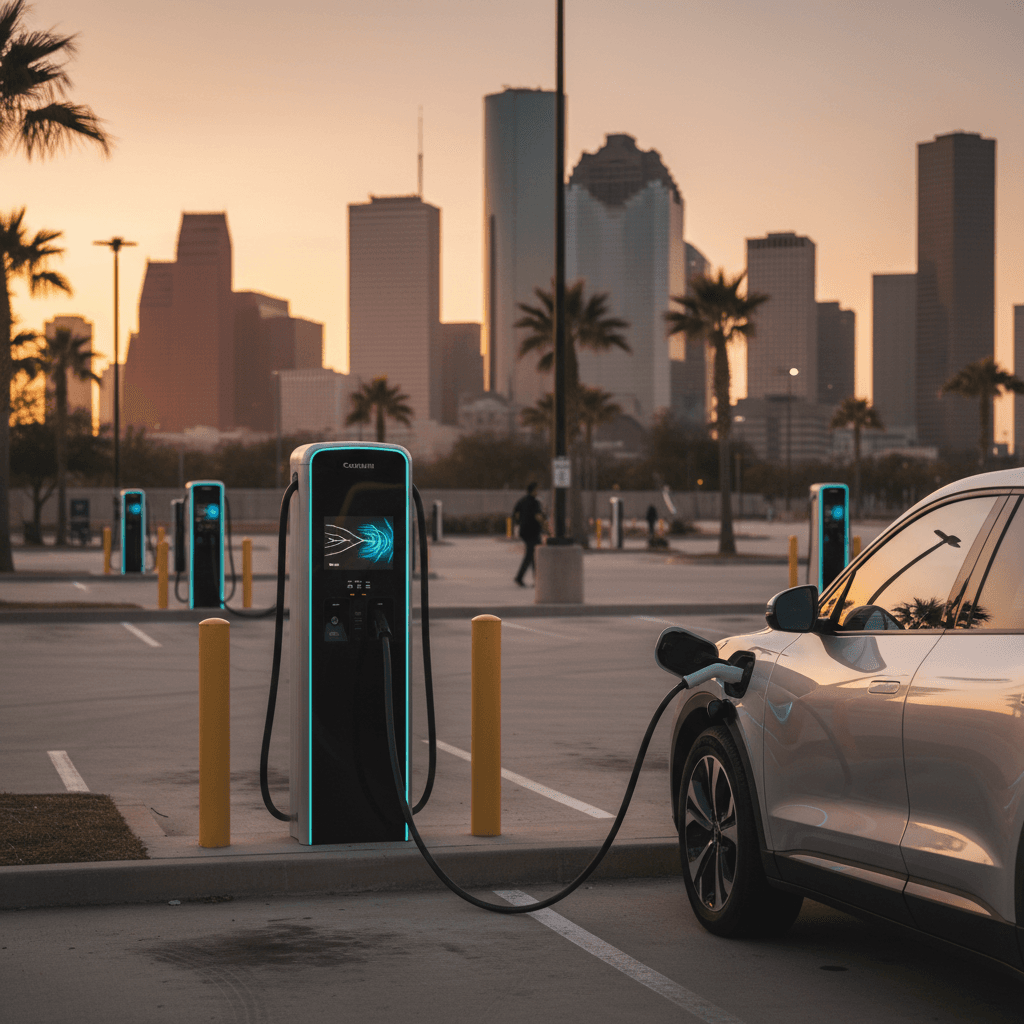
If you drive an electric vehicle in the Houston area, your life revolves around two questions: **where can I charge, and how long will it take?** The good news is that public EV charging stations in Houston, TX have grown quickly over the last few years, especially fast chargers along major freeways, while home charging remains the backbone of day‑to‑day driving. This guide walks you through what’s actually available today, what it costs, and how to plan your charging around Houston’s size, traffic, and heat.
Houston is catching up fast
Why Houston’s EV charging scene matters
Houston isn’t just any city, it’s a sprawling, car‑centric metro with extreme heat, heavy traffic, and long commutes. Those conditions magnify both the strengths and weaknesses of EV charging. If you have reliable home charging, Houston can be a very EV‑friendly place. If you don’t, you’ll lean heavily on public stations at apartments, workplaces, grocery stores, and along I‑10, I‑45, and Beltway 8.
At the same time, Houston is central to Texas’ broader energy transition. The city’s Resilient Houston and EVolve Houston initiatives aim to make 30% of new car sales electric by 2030, which is pushing utilities, property owners, and charging networks to build more infrastructure. For you, that means more plugs in more places, but also more complexity to sort through.
Houston & Texas EV charging by the numbers
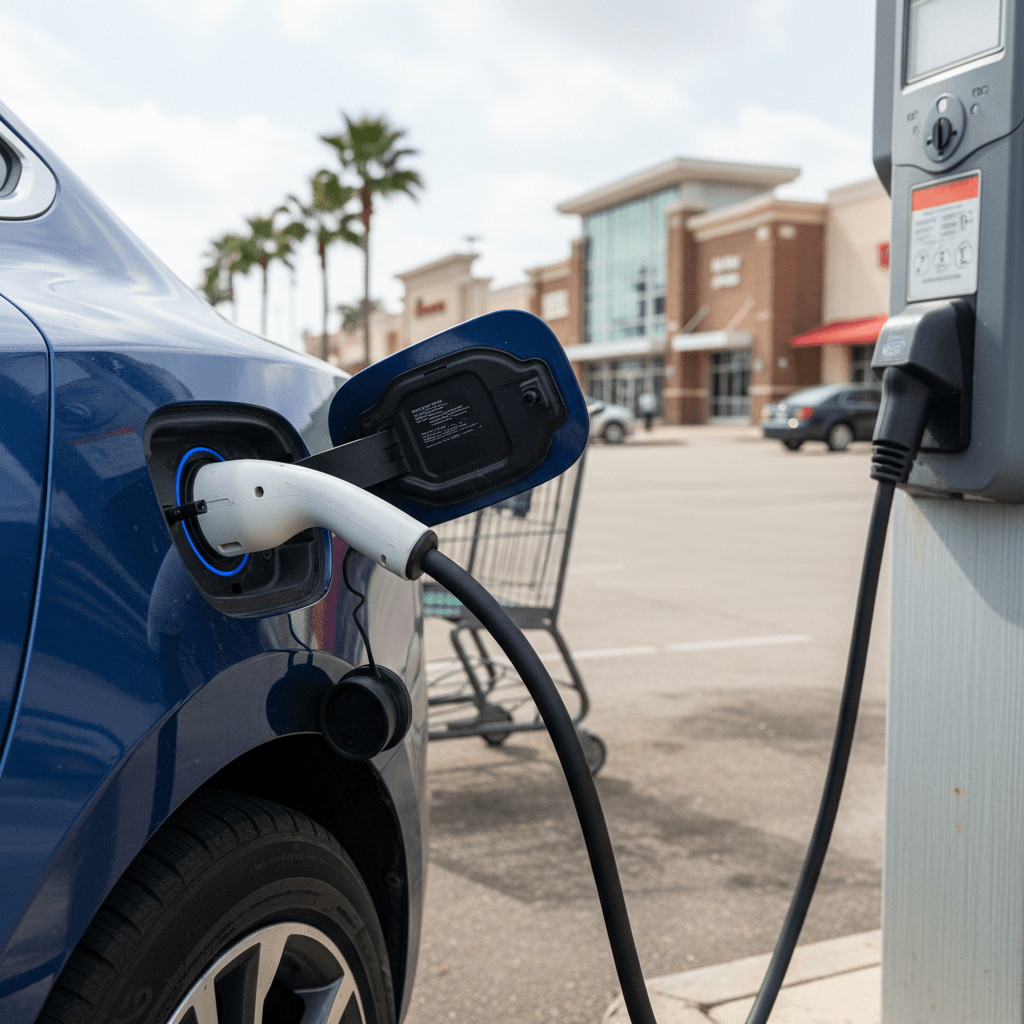
How many EV charging stations does Houston have?
Exact counts change every month, but public data from EVolve Houston and federal station maps show that the **Greater Houston region has on the order of 700–850 public charging locations**, depending on which suburbs you include. That splits roughly into:
- Around 600–700 public Level 2 sites (J1772 or Tesla destination chargers) at workplaces, retail centers, garages, and multifamily housing.
- Roughly 120–180 DC fast charging locations once you add up Tesla Superchargers, Electrify America, EVgo, bp pulse, Blink, and other networks.
- Thousands of individual ports across those sites, since many locations offer 4, 8, or even dozens of plugs.
City vs. metro numbers
Types of EV charging stations in Houston, TX
Before you worry about which app to download, it helps to understand the three main types of chargers you’ll actually encounter in Houston. The names refer to the **power level and voltage**, which directly affect how fast you gain miles of range.
Common charger types you’ll find in Houston
How Level 1, Level 2, and DC fast charging compare for real‑world Houston driving.
| Charger type | Voltage | Typical location | Speed (approx.) | Best use cases |
|---|---|---|---|---|
| Level 1 | 120V | Older homes, workplaces with regular outlets | 2–4 miles of range per hour | Overnight charging for low‑mileage drivers, workplace top‑ups |
| Level 2 | 240V | Apartments, offices, parking garages, retail, most public stations | 20–40 miles of range per hour | Daily charging, 1–4 hour errands, supplement when you lack home charging |
| DC fast | 400–800V DC | Freeways, highway travel plazas, large shopping centers | 150–300+ miles of range per hour | Road trips, quick top‑ups, drivers without home charging |
Approximate charging speeds assume a modern EV with 60–80 kWh battery; your exact rates may vary by model and conditions.
Match the charger to your schedule
Major public charging networks in Houston
Who actually runs Houston’s charging stations?
You’ll see different brand names, but a handful of networks dominate.
Tesla Supercharger & Destination
Tesla operates multiple Supercharger sites around Houston along I‑10, I‑45, and key suburban hubs, plus slower "destination" chargers at hotels and shopping centers. Many newer Tesla sites now support non‑Tesla EVs via built‑in adapters and NACS ports. You’ll activate these through the Tesla app.
Electrify America & EVgo
These two are the main CCS DC fast networks in Houston, with high‑power chargers (150 kW+ in many cases) at Walmarts, grocery stores, and malls. Both also run some Level 2 stations. You pay through their respective apps, RFID cards, or credit card readers.
bp pulse, Blink & others
Houston’s first large bp pulse Gigahub opened at bp’s U.S. headquarters with dozens of fast chargers, and Blink, ChargePoint, and smaller operators fill in Level 2 coverage at offices, universities, and municipal sites. Apartment and workplace chargers often use these networks behind access gates.
Think in corridors, not just dots
How to find EV charging stations in Houston
Because the network is fragmented across utilities, city programs, and private operators, there’s no single “Houston EV app.” In practice, you’ll want at least one **planner app** plus the apps for whatever fast‑charging networks you expect to use most.
Best tools to locate Houston EV charging
Use a mix of planning apps and network apps for the most accurate picture.
All‑network map apps
PlugShare, A Better Routeplanner (ABRP), Chargeway, and similar apps crowd‑source EV charger locations across all networks. Use these to:
- See every known charger on a single map
- Filter by plug type (CCS, NACS, CHAdeMO, J1772)
- Read user check‑ins about reliability and parking fees
Network‑specific apps
Download apps for the networks you’ll actually use, typically Tesla, Electrify America, EVgo, bp pulse, Blink, and possibly ChargePoint. Their apps are best for:
- Real‑time stall availability
- Starting and stopping sessions
- Viewing per‑kWh or per‑minute pricing
Built‑in car navigation
Most modern EVs can route you through Houston traffic directly to compatible chargers. Use your car’s nav when:
- You’re low on charge and need a **guaranteed compatible** station
- You want automatic pre‑conditioning of the battery for faster DC charging
Quick setup checklist: apps to install before you need a charge
Create accounts with 2–3 major networks
At a minimum, set up accounts with <strong>Tesla</strong> (for NACS access and Magic Dock sites), <strong>Electrify America</strong>, and <strong>EVgo</strong>. Add bp pulse, Blink, or ChargePoint if you see them on your usual routes.
Add a universal planning app
Install PlugShare or another all‑network map. Mark your home and work locations so you can quickly see nearby chargers and user reliability ratings.
Save your payment methods
Add a credit card to each app and, where possible, order RFID cards or key fobs. Houston downpours and spotty cell service make tap‑to‑pay and RFID nice backups.
Verify plug compatibility
Double‑check whether your EV uses **CCS**, **NACS**, or both. If it’s an older CCS‑only model, confirm whether you’ll receive a NACS adapter or need to buy one to access newer stations.
What does EV charging cost in Houston?
EV charging pricing isn’t standardized in Texas, and the rules differ between home and public stations. Think of cost in two layers: electricity price per kWh and **how efficiently your car converts that into miles**.
Public DC fast charging
Texas averages around $0.50 per kWh at public DC fast chargers, though Houston locations frequently range from about $0.35 to $0.60 per kWh depending on network, time of day, and any membership discounts.
For a typical EV getting 3 mi/kWh, that’s roughly $0.12–$0.20 per mile. A 200‑mile top‑up might cost $24–$40, still often less than gasoline, but not by a huge margin.
Some networks layer on session fees or idle fees if you stay plugged in after charging completes, so always check the rate card in the app before you start a session.
Public Level 2 vs. home charging
Level 2 public charging in Houston often falls between **free and $0.30 per kWh**. Many employers and retail sites offer it as a low‑cost or complimentary perk, especially in garages and office parks.
At home, your per‑kWh cost simply mirrors your electric rate, commonly in the mid‑teens cents per kWh for residential customers. That puts your cost per mile closer to $0.04–$0.07, and you can schedule charging overnight to avoid afternoon grid stress.
When you can charge at home, DC fast charging becomes an occasional convenience, not a weekly bill.
Watch for idle and parking fees
Home vs. public charging in Houston
In a city the size of Houston, relying purely on public charging can work, but it requires planning, and you’ll pay more per mile. Home charging, even from a simple 240V outlet, turns EV ownership into something you barely think about.
When home charging works best
- You have a driveway or garage where you can safely install a Level 2 charger or 240V outlet.
- Your daily round‑trip commute is under ~80 miles.
- You’re willing to schedule charging for off‑peak hours (late night and early morning).
In this scenario, public chargers are mainly for road trips or the occasional long day, and you can ignore a lot of the noise about public reliability.
When you’ll lean on public charging
- You live in an apartment or condo without a dedicated parking space or outlet.
- You regularly drive 100+ miles in a day for work across the metro.
- You’re doing rideshare or delivery driving and need multiple top‑ups per shift.
Here, a **dense Level 2 network** near your home and workplace, plus fast chargers along your routes, becomes crucial. You may want to choose your EV specifically for its compatibility with the networks that dominate your side of town.
How Recharged can help with home charging
Ready to find your next EV?
Browse VehiclesRoad-tripping from Houston: I‑10, I‑45 and beyond
Houston sits at the intersection of several major Texas corridors, and state and federal programs have targeted these routes for fast‑charging build‑out. By 2026, you can reliably road‑trip from Houston to San Antonio, Austin, Dallas, or the Gulf Coast in almost any modern EV with a bit of planning.
Key EV road-trip routes from Houston
Approximate conditions for EV fast‑charging along major corridors out of Houston as of 2026.
| Route | Distance (one way) | Fast‑charging coverage | Planning notes |
|---|---|---|---|
| Houston ⇄ Austin (US‑290 / I‑10) | ~165–180 miles | Multiple DC fast hubs in Katy, Brenham, Columbus, and Austin area | Most EVs can make this on one charge, but fast chargers at midway towns provide insurance against headwinds, heat, and high speeds. |
| Houston ⇄ San Antonio (I‑10) | ~195 miles | Fast‑charging every ~50–70 miles per NEVI‑aligned build‑out | Plan a brief stop in Columbus, Schulenburg, or Seguin; network mix includes Tesla, Electrify America, and others. |
| Houston ⇄ Dallas (I‑45) | ~240 miles | Several DC fast sites in Huntsville, Corsicana, and the DFW area | Longer gap than Austin/San Antonio, so pre‑condition your battery and leave with a high state of charge. |
| Houston ⇄ Gulf Coast (Galveston, Lake Charles) | ~50–150 miles | Growing mix of fast and Level 2 in bay and coastal towns | Shorter trips but more weather risk, watch for surge‑related outages and plan a backup charger in case coastal stations are busy. |
Always check a live map before you depart, since new stations open regularly and temporary outages are common.
Build redundancy into every route
Practical tips for reliable EV charging in Houston
- Use recent check‑ins, not just map pins. In PlugShare or network apps, prioritize locations with check‑ins from the last few days. A station with dozens of check‑ins from last year and none recently is a red flag.
- Favor sites with multiple plugs. In a busy city, single‑stall DC fast chargers are often blocked or broken. Aim for sites with at least 4–6 fast chargers to reduce wait risk.
- Bring your own cable and adapters. For Level 2, know whether you need a J1772 adapter (Tesla owners) or a NACS adapter (legacy CCS cars beginning to use NACS sites). Keep them organized so you’re not fumbling in a rainstorm.
- Leverage Houston’s retail dwell time. Choose chargers where you can reasonably spend 30–60 minutes, Target, H‑E‑B, malls, rather than sitting in the car at an isolated lot.
- Plan for heat. Gulf Coast summers can slow fast‑charging if your battery or charger is heat‑soaked. Start highway legs early in the day when possible, and don’t obsess over squeezing out the last 5% charge, charging slows dramatically near full.
Storms and grid events matter
FAQ: EV charging stations in Houston, TX
Frequently asked questions about charging in Houston
The bottom line on EV charging in Houston
Houston’s EV charging story is no longer about scarcity. The metro now has a **broad, if uneven, mix of Level 2 and DC fast chargers**, and state and local programs are filling in gaps along key corridors. The real question is how you’ll plug that network into your life: whether that means a simple Level 2 in your garage, a rotation of trusted public sites near your apartment, or fast‑charge hubs on the way to Austin or San Antonio.
If you’re considering a used EV in Houston, don’t treat charging as an afterthought. Look at where you park, the routes you drive, and how local networks line up with your car’s hardware. That’s exactly the kind of analysis Recharged builds into our Recharged Score and buying support, so when you take delivery, you already know where and how you’ll keep your EV charged in H‑Town.