If you drive an electric car in Western North Carolina, your experience will rise or fall on one thing: how easily you can find EV charging stations in Asheville. Between the Blue Ridge Parkway, I‑26, local breweries, and trailheads, you need a plan that works just as well for a Tuesday commute as it does for a Saturday in Pisgah.
Asheville’s EV moment
Why Asheville is Becoming an EV-Friendly City
On paper, Asheville looks like a tough EV town: steep grades, cold winter nights, and long distances between mountain communities. In practice, the region has leaned into charging early. The city streamlined EV charger permitting years ago, and today it’s layering on broader electrification programs, zoning that bakes chargers into new construction, and access to state and federal highway funding for fast‑charging along I‑26 and I‑40.
EV Charging Context for Asheville Drivers
Think regional, not just local
EV Charging Basics for Asheville Drivers
Level 1 & Level 2 (AC)
Level 1 is a regular household outlet (120V). In Asheville, that’s fine for plug‑in hybrids or very short daily mileage, but it’s too slow for most full EVs.
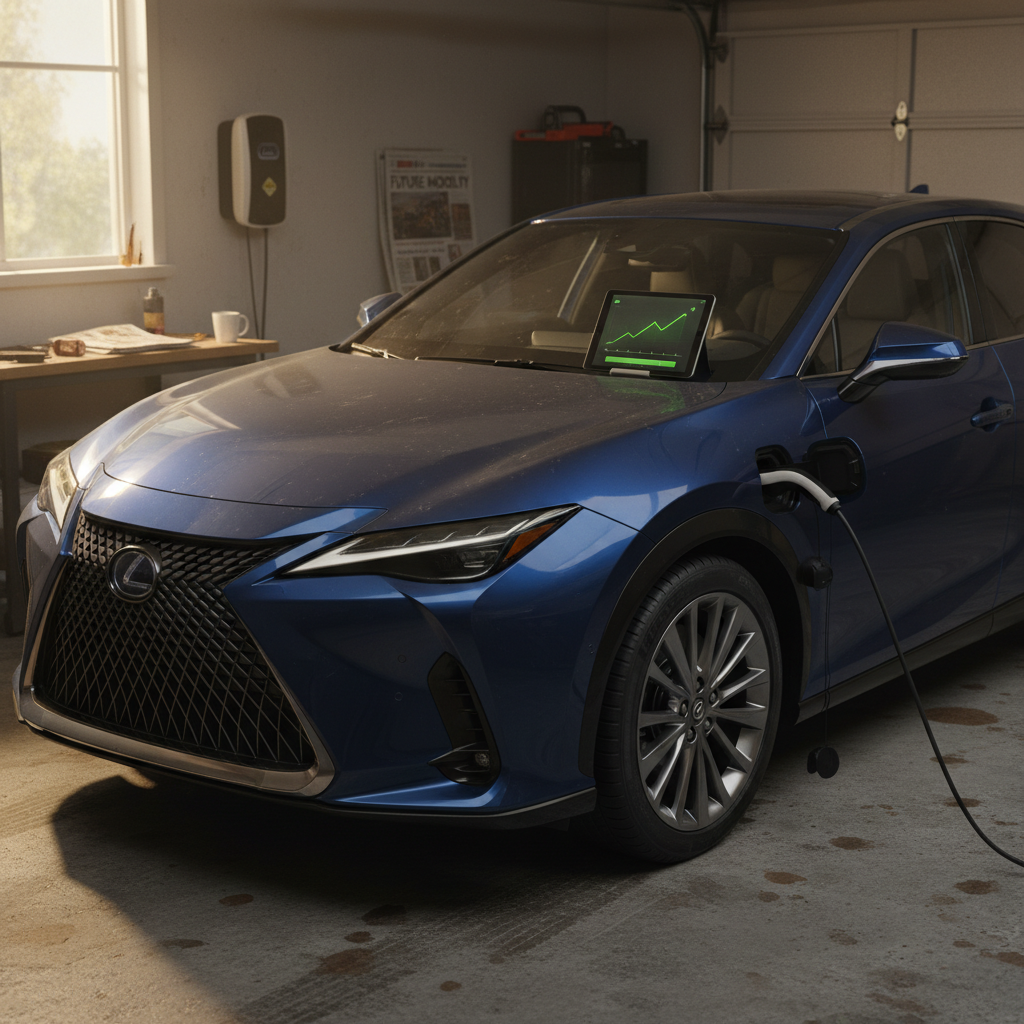
Level 2 uses 240V power, similar to an electric dryer. At 6–11 kW, you’ll typically add 20–35 miles of range per hour, which is perfect for overnight at home or a few hours at a hotel or workplace.
DC Fast Charging
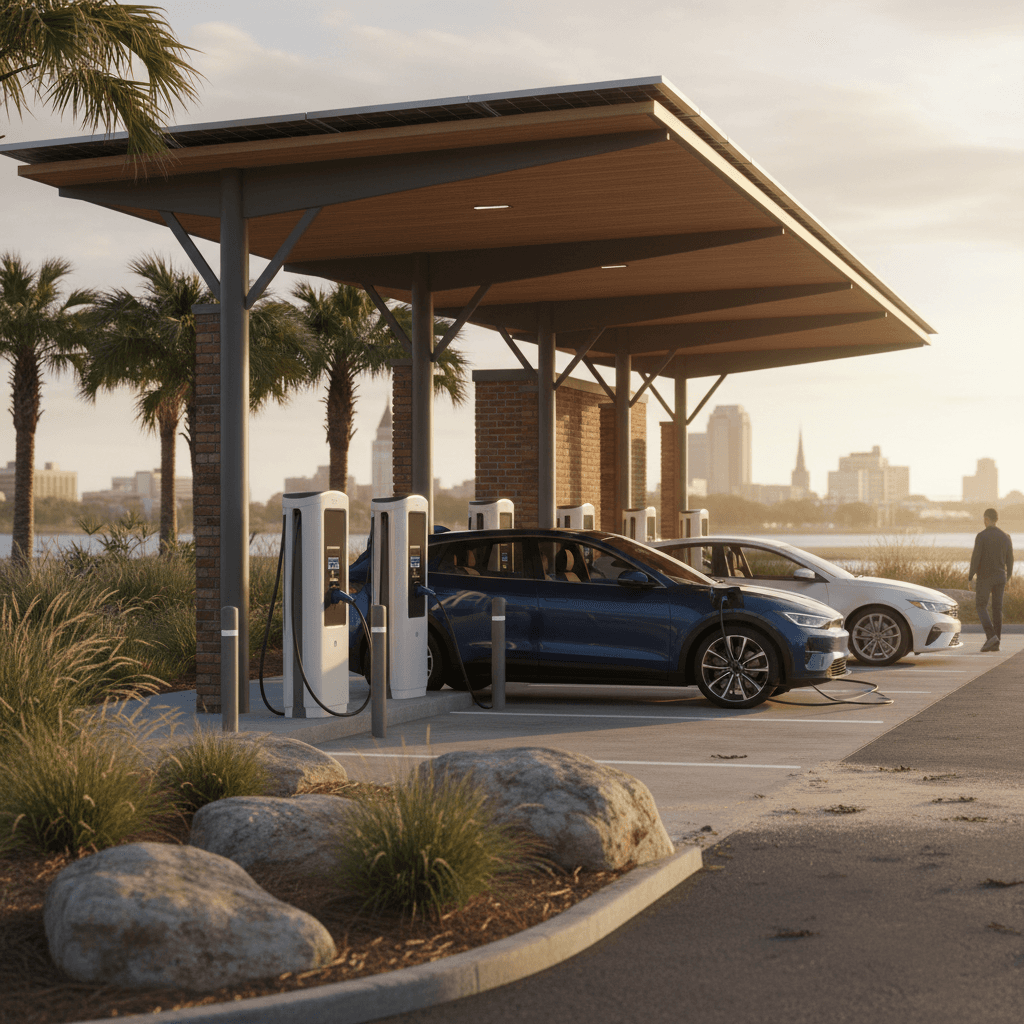
DC fast chargers (often 50–350 kW) are what you’ll use along I‑26, I‑40, or on your way to the Parkway. They can add 150–200+ miles of range in 20–40 minutes, depending on your car.
Because Asheville sits at higher elevation and grades are steep, plan a buffer, especially in winter. Fast‑charge closer to your final destination if you’re heading deep into the mountains.
- Most public Level 2 stations in Asheville use the J1772 connector (or NACS with an adapter, depending on your car).
- Most non‑Tesla DC fast chargers in the region use CCS. Many newer EVs adopt the Tesla‑based NACS standard with adapters in transition years.
- Charging speeds are limited by both the station and your vehicle’s onboard hardware, your car may not pull the station’s full advertised kW.
Watch your winter range
Where to Find EV Charging Stations in Asheville

Key Areas With EV Charging in and Around Asheville
Use your charging apps to confirm availability and pricing before you drive
Downtown & River Arts District
Look for Level 2 chargers in city garages, surface lots, and near breweries and galleries. These are ideal if you’re parking for a meal or spending a few hours exploring.
Biltmore & South Asheville
Shopping centers and mixed‑use developments in south Asheville often host Level 2 and some fast‑charging. This is a convenient area to top up before heading farther south on I‑26.
I‑26 & I‑40 Corridor Stops
DC fast‑charging sites along the interstates support through‑travel between Knoxville, Asheville, and the Triangle. These are your best bet for fast top‑ups on longer trips.
Beyond the city core, you’ll find clustered chargers in places like outlet centers, grocery‑anchored shopping plazas, and newer multifamily developments, especially as Asheville has started conditioning some zoning approvals on installing EV chargers and wiring for future expansion. When in doubt, check your favorite charging app for the latest station status rather than trusting decade‑old maps or blog posts.
Apps locals actually use
Major Charging Networks Serving Asheville
Charging Networks You’ll See Around Asheville
Always confirm exact locations and live status in the network’s app before you rely on a station, especially in the mountains where redundancy matters.
| Network | Typical Locations Near Asheville | Primary Connectors | Best Use Case |
|---|---|---|---|
| Electrify America | Highway‑oriented sites along I‑26 / I‑40, larger retail centers | CCS, limited CHAdeMO | Fast long‑distance travel, 20–40 minute stops |
| EVgo | Urban retail and grocery parking, some downtown sites | CCS, CHAdeMO, some NACS adapters where available | Shorter top‑ups while you shop or grab a meal |
| ChargePoint | Workplaces, hotels, parking garages, some DC fast | Mostly J1772 Level 2, some CCS DC fast | Daily Level 2 charging at lower power |
| Tesla Supercharger | Highway sites and travel centers; gradually adding support for non‑Tesla EVs via NACS | NACS (with Magic Dock or adapters where deployed) | Tesla road trips; some non‑Tesla fast‑charging where allowed |
| Municipal & Co‑op Sites | City garages, parks, and utility‑owned locations | Mostly J1772, some DC fast | Low‑cost or free Level 2 while you’re parked for hours |
Summary of how major public charging networks typically show up in Western North Carolina.
Don’t assume 100% uptime
Typical Costs to Charge an EV in Asheville
Home & Workplace Charging
Residential electricity rates in Western North Carolina are generally competitive with the national average. If you can plug in at home on a 240V Level 2 charger, you’re usually paying the energy equivalent of $1–$1.50 per gallon of gasoline, depending on your EV’s efficiency and your specific rate plan.
Some employers and multifamily buildings in the Asheville area offer free or low‑cost Level 2 charging as an amenity. In those cases, your per‑mile cost can drop close to zero for commuting.
Public Level 2 & DC Fast
Public Level 2 prices vary, ranging from free (especially at municipal or customer‑attracting sites) to hourly or kWh‑based fees that often equate to $0.15–$0.35 per kWh.
DC fast‑charging is more expensive but time‑saving. Expect effective prices that can be similar to or slightly lower than gas on a cost‑per‑mile basis, especially if you’re using membership discounts or off‑peak pricing in network apps.
Mix home and public charging
Incentives and Programs That Affect Charging in Asheville
Programs Asheville EV Owners Should Know About
Some directly fund chargers; others signal how quickly infrastructure will grow around you.
Utility EV Charger Programs
Duke Energy has rolled out EV charger rental options and managed‑charging pilots in North Carolina. Depending on availability and program phase, that can mean:
- Low monthly payments instead of upfront hardware costs
- Maintenance and warranty bundled into the fee
- Time‑of‑use or subscription charging pilots that reward off‑peak use
Check Duke’s current EV programs page for eligibility and Asheville‑area participation.
Electrify Asheville‑Buncombe (Electrify ABC)
The Electrify Asheville‑Buncombe initiative offers a Home Energy Navigator and online marketplace to help residents plan electrification upgrades, from heat pumps to EV charging.
You can get:
- Personalized consultations on panel capacity and wiring
- Guidance on stacking rebates, financing, and tax credits
- Connections to vetted local contractors
Local policy is quietly shaping charging
Checklist: Getting Help Paying for Home Charging
1. Confirm your electrical capacity
Before you think about rebates, verify with a licensed electrician whether your panel can support a 40–60A Level 2 charger, or whether you’ll need a panel upgrade.
2. Ask Duke Energy about current EV programs
Utility offerings change. Check for active charger rental options, off‑peak rate plans, or rebates tied to specific equipment or enrollment requirements.
3. Explore the Electrify ABC marketplace
Use the online marketplace to compare equipment, see estimated costs, and identify contractors familiar with local permitting and incentive paperwork.
4. Stack federal incentives where possible
Even if North Carolina’s statewide EV rebates evolve over time, federal tax credits for charging equipment and installation can often offset a large share of your costs.
Planning an EV Road Trip To or Through Asheville
Asheville sits at the crossroads of several major regional trips: Atlanta–Asheville–Knoxville, Charlotte–Asheville–Nashville, and Raleigh–Asheville–Gatlinburg. If you’re coming in from lower elevations, your last leg into the mountains is where your planning needs to be tightest.
Route Planning Strategies by Trip Type
Weekend Warriors (100–200 miles each way)
Fast‑charge near your origin city to arrive in Asheville with 40–70% battery left.
Use a Level 2 at your hotel, vacation rental, or a downtown garage while you explore.
Avoid small, single‑unit fast‑charging sites as your only backup, have an interstate‑adjacent site in mind too.
Long‑Haul Travelers (200–500+ miles)
Use A Better Routeplanner or your car’s native planner to string together highway fast‑chargers that meet NEVI‑style standards (150 kW, four ports, near services).
Plan slightly shorter legs heading into Asheville than leaving it, climbing burns more energy than descending.
If your schedule allows, build in one long meal stop at a reliable site instead of several rushed, marginal stops.
Beware of ‘charger deserts’ in the high country
Charging Strategies for Apartment and Condo Drivers
When Your Building Has Chargers
Newer multifamily projects in Asheville are increasingly required, or strongly encouraged, to install some EV chargers and run conduit for future expansion.
If your building already has stations:
- Ask management whether pricing is per kWh, per hour, or flat monthly.
- Confirm whether spots are reserved or first‑come, first‑served.
- Try to charge during lower‑demand hours (overnight or mid‑day) to avoid congestion.
When Your Building Doesn’t (Yet)
If your apartment or condo lacks EV charging, you still have options:
- Use nearby public Level 2 as a “virtual home charger,” topping up once or twice a week.
- Organize with neighbors to request that management tap into local programs and incentives.
- Consider a plug‑in hybrid if your driving pattern or building politics make full‑EV ownership too stressful today.
Bring data when you approach your landlord
How EV Charging Ties Into Buying a Used EV in Asheville
If you live in or near Asheville and you’re shopping for a used EV, charging isn’t a side note, it’s one of the main reasons to buy confidently or walk away. Mountain driving and winter temps put more stress on batteries than flat, temperate routes, so you want both healthy battery capacity and realistic access to charging at home and around town.
Questions to Ask Before You Buy a Used EV in Asheville
Tie your charging reality to the specific car you’re considering.
Battery Health & Range
How much usable range does this EV still have, and how does that translate into a winter round‑trip from Asheville to your most common destinations?
Home & Workplace Options
Can you install Level 2 at home, rent a charger through a utility program, or reliably charge at work? If not, what’s your weekly public‑charging plan?
Road‑Trip Comfort Zone
Are there reliable fast‑chargers along the routes you actually drive, say, to Atlanta, Charlotte, or the outer Blue Ridge? Check this before signing paperwork.
Every used EV listed on Recharged comes with a Recharged Score Report, which includes verified battery health data and range estimates. That’s especially valuable in regions like Asheville, where 10–20% less usable capacity can be the difference between an easy ski trip and a stressful search for a charger at the bottom of every mountain.
How Recharged can help Asheville buyers
Frequently Asked Questions: EV Charging Stations in Asheville
Common Questions About EV Charging in Asheville
Key Takeaways for Charging Your EV in Asheville
Asheville isn’t just a scenic EV backdrop, it’s a case study in how a small mountain city can use policy, utility programs, and smart siting to make electric driving practical. If you can secure reliable Level 2 charging at home or work, the growing network of public stations in town and along I‑26 and I‑40 will comfortably cover your road‑trip ambitions.
Before you commit to an EV, especially a used one, take an honest look at where you’ll park, how far you drive, and which routes you care about most. Then match those needs to a car with verified battery health and a charging plan that leans on home or workplace charging, with public stations as your safety net. That’s exactly the kind of decision Recharged is built to support, with transparent Recharged Score Reports, EV‑savvy advisors, and nationwide delivery that makes it easy to put the right EV in your Asheville driveway.