When you shop for an electric car, you’ll see the same promise over and over: “8‑year/100,000‑mile battery warranty.” But what does that EV battery warranty actually cover, and just as important, what does it leave out, especially if you’re considering a used EV?
At a glance
EV battery warranty basics: time, miles, and capacity
An EV battery warranty is separate from the standard bumper‑to‑bumper or powertrain warranty. It’s designed to cover the most expensive component on the car: the high‑voltage traction battery pack. Most manufacturers follow a similar pattern, but the details matter.
Typical EV battery warranty structure (2026)
Common terms you’ll see across most electric vehicles sold in the U.S.
| Warranty element | What it usually looks like | What it means for you |
|---|---|---|
| Time limit | 8 years is most common; some brands offer 10 years on the battery | Coverage ends once the vehicle hits that age, regardless of mileage. |
| Mileage limit | 100,000–150,000 miles, sometimes higher on certain trims | Whichever comes first, time or miles, ends the battery warranty. |
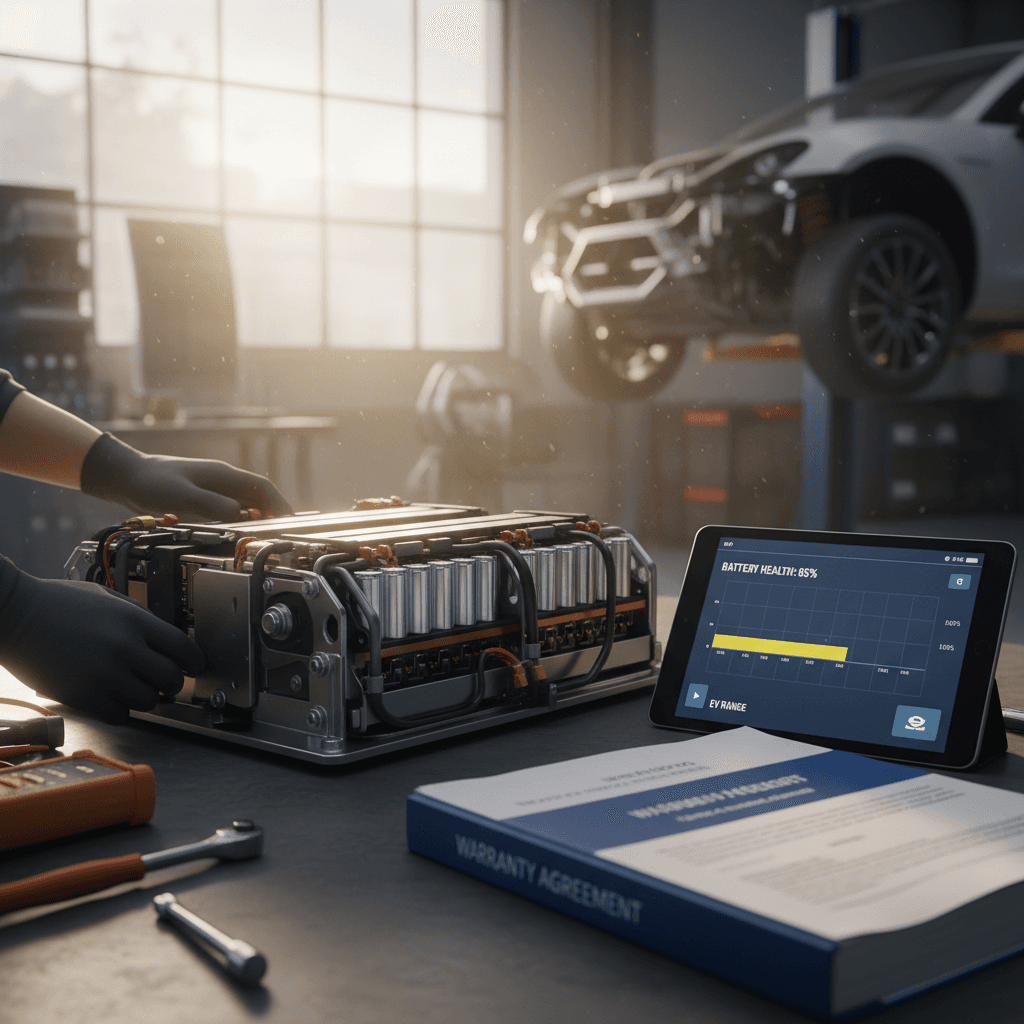
| Capacity guarantee | Battery must retain around 70% (sometimes 75–80%) of original usable capacity | If your battery falls below this threshold within time/mileage limits, you may qualify for repair or replacement. |
| Scope of coverage | Defects in materials/workmanship and abnormal or excessive degradation | The automaker is on the hook for manufacturing problems, not for all loss of range over time. |
| Who’s covered | Original and subsequent owners in most cases | EV battery warranties usually transfer automatically when the car is sold. |
Always read your specific vehicle’s warranty booklet, these are typical examples, not guarantees.
Don’t confuse battery warranty with bumper‑to‑bumper
What EV battery warranties actually cover
While every automaker writes its own legal language, most EV battery warranties cover three core areas: manufacturing defects, excessive capacity loss, and related components in the high‑voltage system. Understanding each bucket will help you know when you realistically have a claim.
Three main things EV battery warranties usually cover
Think in terms of defects, abnormal degradation, and supporting hardware.
1. Manufacturing defects
These are flaws in how the pack, modules, cells, or battery management system (BMS) were designed or built.
- Examples: faulty welds, bad seals, mis‑calibrated BMS, defective cells.
- Symptoms: warning lights, won’t charge, sudden range drops, or the car won’t start.
2. Excessive capacity loss
Most warranties promise your battery will retain at least about 70% of its original capacity over the warranty period.
- If usable capacity drops below that threshold within time/mileage limits, the automaker may repair or replace pack components.
- This is different from normal, gradual range loss.
3. High‑voltage components
Many brands include coverage for hardware directly tied to the battery’s operation:
- High‑voltage contactors and relays
- Battery wiring harnesses and junction boxes
- Sometimes the on‑board charger or DC‑DC converter, if listed in the warranty
Good news for everyday charging
If a covered problem occurs, the manufacturer will usually choose one of three options: repair the affected modules, replace part of the pack, or replace the entire pack with a new or remanufactured unit. You typically don’t get to choose which, they decide what’s “commercially reasonable” to meet the warranty terms.
What EV battery warranties do NOT cover
An EV battery warranty is not a blank check. It’s written to protect you against problems the automaker can control, not everything that could possibly happen to a battery over 8–10 years of use. Knowing the common exclusions will keep you from surprises later.
- Normal degradation: All lithium‑ion batteries gradually lose capacity. A slow drop in range that still stays above the capacity threshold (around 70%) is considered normal wear, not a defect.
- Driver behavior outside guidelines: If the automaker can show abuse, like repeatedly ignoring severe warnings, tampering with the cooling system, or using unapproved modifications, that can void coverage.
- Accident or external damage: Collisions, floods, fires from outside sources, or road debris that punctures the pack are usually handled by insurance, not the battery warranty.
- Lack of basic maintenance or software updates: Skipping required inspections, ignoring recall work, or refusing critical software updates can be used as grounds to deny a claim.
- Third‑party tinkering: Aftermarket tuning, unapproved repairs, or opening the battery pack can easily void battery coverage.
Pack damage is usually an insurance claim
Real-world brand examples of battery warranty coverage
Most brands cluster around the same general structure, roughly 8 years and 100,000 miles with a 70% capacity guarantee, but there are some useful differences. Here are a few illustrative examples to give you a feel for the market as of 2025–2026. Always confirm current terms on the manufacturer’s site before you buy.
Sample EV battery warranties from major brands
Representative coverage terms for popular EVs currently on sale in the U.S.
| Brand / example model | Time & mileage | Capacity guarantee | Notable details |
|---|---|---|---|
| Tesla Model 3 / Model Y Long Range | 8 years / 120,000 miles | 70% of original capacity | Unlimited DC fast charging within published specs; separate terms for Standard Range cars. |
| Hyundai IONIQ 5 / IONIQ 6 | 10 years / 100,000 miles | Around 70% of original capacity | Longer time coverage than many rivals on the high‑voltage battery. |
| Kia EV6 | 10 years / 100,000 miles | Around 70% of original capacity | In some markets marketed as lifetime for the original owner; U.S. buyers should read the fine print. |
| Rivian R1T / R1S | 8 years / 100,000–175,000 miles (depending on pack and drivetrain) | 70% of original capacity | Higher mileage cap on certain Quad‑Motor, Large pack configurations, helpful for high‑mileage drivers. |
| Volkswagen ID.4 | 8 years / 100,000 miles | 70% of original capacity | Typical coverage aligned with industry norms. |
| GM Ultium platform (e.g., Blazer EV, Lyriq) | 8 years / 100,000 miles | 70% of original capacity | Module‑based pack design makes partial replacements more feasible. |
These examples are simplified; individual trims and future model years may differ.
State rules can improve your coverage
How EV battery warranties work for used vehicles
If you’re looking at a used EV, the high‑voltage battery warranty can be one of your biggest safety nets, if you understand what’s left on the clock. Most EV battery warranties are transferable, but they don’t reset with a new owner or a certified pre‑owned program; the original in‑service date still rules.
1. Warranty is based on first sale date
Coverage starts when the car is first sold or leased new. If a brand advertises an 8‑year/100,000‑mile battery warranty and you buy the car at year 4 with 45,000 miles, you’re getting the remaining time and miles, about 4 years and 55,000 miles in that example.
2. Transfer rules vary slightly by brand
Most mainstream EVs allow full transfer of battery coverage to subsequent owners automatically, but there are exceptions, especially for “lifetime” or extended warranties that apply only to the first owner. Always skim the warranty section labeled “Subsequent owners” or “Transferability.”
This is where a verified battery health report becomes particularly valuable. With Recharged, every used EV includes a Recharged Score with diagnostic insights into battery condition and fair‑market pricing that reflects remaining life and warranty coverage. That gives you more than just the seller’s word about how the pack has aged.

Warranty coverage vs. real battery life and replacement cost
A common fear is, “What happens when my battery dies right after the warranty ends?” The good news: modern EV packs are generally lasting longer than their warranty periods. Government and industry data show typical lifespans of roughly 12–15 years in moderate climates, often well past 150,000 miles, especially with newer chemistries.
EV battery life, range loss, and cost, big picture numbers
Think in “usable range,” not just years
How to protect both your coverage and your battery
The same habits that keep your battery healthy also make it easier to get help if something goes wrong under warranty. Automakers can and do look at data logs when evaluating claims. If your use clearly stayed within their guidelines, you’ll have a much stronger position.
Battery‑friendly habits that also protect your warranty
Simple practices that reduce stress on the pack and keep the paperwork clean.
Charge within sensible limits
- Use Level 2 home charging for most day‑to‑day needs.
- Reserve DC fast charging for trips or when you truly need it.
- If your car lets you set a daily limit (say 70–80%), use it.
Respect temperature warnings
- Don’t ignore high‑temperature or battery‑cooling alerts.
- Avoid leaving the car parked fully charged in extreme heat.
- Park in shade or a garage when you can.
Keep records & updates current
- Complete required inspections and software updates.
- Keep service receipts; they can help support a claim.
- Address recalls promptly, especially battery‑related ones.
Be cautious with aftermarket modifications
Checklist: how to read an EV battery warranty before you buy
Battery warranty review checklist
1. Confirm time and mileage limits
Write down the exact years and miles for the high‑voltage battery warranty, and compare them to your expected annual driving. If you drive 20,000+ miles a year, the mileage cap may matter more than the calendar.
2. Look for a specific capacity guarantee
Is there a stated threshold, like 70%, for usable battery capacity? If not, the automaker has more discretion to decide what counts as “excessive” degradation.
3. Check transferability for used buyers
Make sure coverage clearly extends to subsequent owners and note any reduced terms for later buyers or for vehicles moved across borders.
4. Read the exclusions carefully
Find the sections that spell out what is not covered: abuse, accidents, unapproved modifications, or using the vehicle outside rated conditions.
5. Understand the automaker’s remedies
Does the warranty give them the option to repair, replace modules, or swap the entire pack? You usually can’t insist on a brand‑new battery if a repair brings capacity back above the guarantee.
6. For used EVs, match warranty to real battery health
Combine the remaining warranty term with an objective health check, such as a Recharged Score report, to decide whether the price fairly reflects remaining battery life and coverage.
FAQ: Common questions about EV battery warranty coverage
Frequently asked questions about EV battery warranties
Key takeaways when you’re shopping for a new or used EV
An EV battery warranty is one of the strongest protections you get with an electric car, but only if you understand what’s covered and what isn’t. In broad strokes, you’re protected against defects and unusually rapid capacity loss for 8–10 years and roughly 100,000 miles or more, but you’re not shielded from normal aging, accident damage, or aggressive modifications.
As you compare models, pay close attention to the time and mileage limits, the stated capacity guarantee, and the fine print around exclusions and transferability. If you’re shopping used, pair those terms with an objective view of the pack’s health so you’re not buying blind.
Recharged was built to make that process simpler. Every used EV we list includes a Recharged Score report with verified battery diagnostics, fair‑market pricing, and expert guidance from configuration all the way through delivery. That way, your decision isn’t based on guesswork, it’s grounded in real battery data and clear warranty coverage.