When you stack up an electric car vs hybrid vs gas, which one really saves you more money? Sticker prices, fuel bills, maintenance, incentives, and resale value all pull in different directions, and the “cheapest” choice on paper isn’t always the lowest‑cost car in real life. This guide walks through the numbers in plain English so you can see what makes the most sense for your budget and your driving.
Quick answer
How to think about EV vs hybrid vs gas costs
The biggest mistake shoppers make is focusing only on the monthly payment or the sticker price. The real question is: What does this car cost me per year to own and drive? That’s your total cost of ownership (TCO), and it includes more than you might think.
- Purchase price (or lease payment) and interest
- Fuel or electricity costs
- Maintenance and repairs
- Insurance, taxes, and registration fees
- Depreciation (how fast the car loses value)
Electric, hybrid, and gas cars each shuffle those buckets around. EVs tend to cost more up front but save heavily on fuel and maintenance. Hybrids split the difference: moderate fuel savings, familiar gas‑car maintenance, and usually a smaller price premium. Conventional gas cars look cheapest on day one, but higher fuel and service costs often catch up over time.
Rule of thumb
Upfront price vs long‑term savings
Typical purchase prices by powertrain (new, 2026 market)
Actual prices vary by model and brand, but these ranges show how the three types usually stack up.
Gasoline car
Typical starting price: Lowest of the three for comparable size and trim.
- Compact sedans often start in the low–mid $20,000s.
- Compact SUVs frequently in the high $20,000s.
Looks affordable up front, but higher running costs add up.
Hybrid (HEV)
Typical price: About $1,500–$3,500 more than a similar gas model.
- Compact hybrids often land in the high $20,000s to low $30,000s.
- Hybrids can qualify for some local perks (HOV lanes, reduced tolls).
Battery-electric (EV)
Typical price: Often $3,000–$8,000 more than comparable gas, but:
- Many models qualify for federal or state incentives.
- Used EV prices have become very competitive.
Higher up front, but lowest day‑to‑day operating cost.
Don’t forget incentives
Fuel cost comparison: electric vs hybrid vs gas
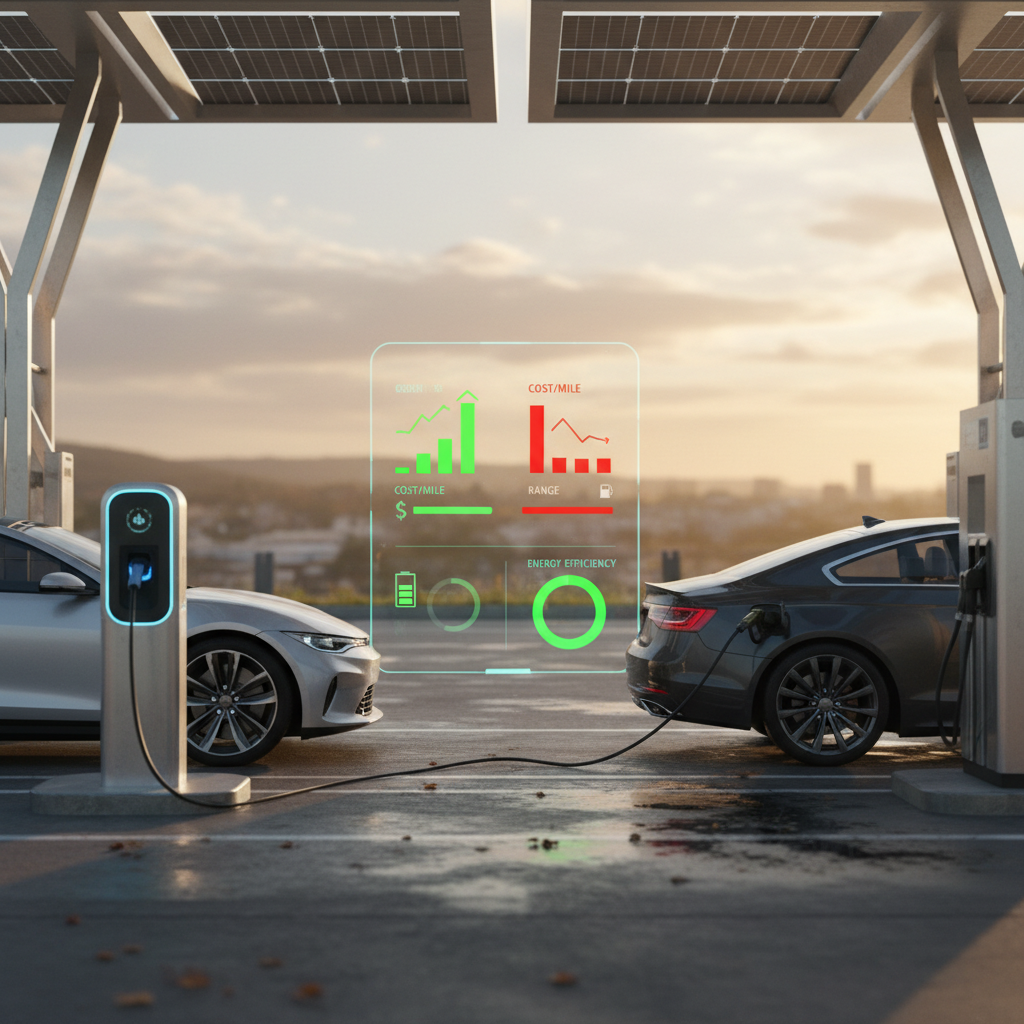
Fuel is where EVs and hybrids do their best work. To keep the math simple, let’s assume U.S. averages around 2026: regular gas at $3.50 per gallon and residential electricity at $0.15 per kWh. We’ll look at three roughly comparable compact SUVs.
Estimated annual fuel/energy cost at 12,000 miles per year
Illustrative averages for a compact SUV. Your actual numbers will vary based on energy prices and driving style, but the relationships between powertrains are consistent.
| Powertrain | Real‑world efficiency assumption | Energy price assumption | Approx. annual energy use | Approx. annual fuel/energy cost |
|---|---|---|---|---|
| Gasoline | 30 mpg | $3.50/gal | 400 gallons | ≈ $1,400 |
| Hybrid (HEV) | 45 mpg | $3.50/gal | 267 gallons | ≈ $935 |
| Battery‑electric (EV) | 30 kWh/100 miles | $0.15/kWh | 3,600 kWh | ≈ $540 |
Electric cars usually cut annual “fuel” costs in half or better compared with gas cars.
In this simple example, the EV saves about $860 per year vs a gas car and around $395 vs a hybrid. If gas prices spike or your local electricity is cheaper at night, the EV’s advantage grows. If gas gets unusually cheap or your utility rates are high, the gap narrows but rarely disappears.
What about road trips?
Maintenance and repairs: where EVs shine
Gas and hybrid cars share the same basic mechanical DNA: engines, transmissions, exhaust systems, and lots of moving parts. EVs skip most of that. Fewer moving pieces typically mean lower routine maintenance and fewer major repair risks once the car has some age on it.
Typical annual maintenance and repair cost ranges (out of warranty)
EVs still need tires, brake fluid, cabin filters, and alignment like any other car, but they avoid many big‑ticket repairs, no timing belts, spark plugs, catalytic converters, or complex transmissions. Hybrids gain some brake life thanks to regenerative braking, but they still carry the cost of traditional engine service.
The big question: battery replacement
Incentives, taxes, and fees that shift the math
Policy can quietly tilt total cost of ownership toward EVs or hybrids in your state. Three buckets matter most: purchase incentives, recurring fees, and perks that save time or money.
How policy affects EV vs hybrid vs gas costs
These programs change over time, but the patterns are consistent across many U.S. states.
Purchase incentives
- Federal EV tax credits (for qualifying new and used EVs).
- State rebates or tax credits for EVs and sometimes plug‑in hybrids.
- Utility rebates for home chargers.
These can significantly narrow or erase the price gap vs gas and hybrids.
Taxes and registration
- Some states add extra registration fees for EVs.
- Others reduce registration fees or offer tax breaks.
- Some localities tax gasoline more heavily than electricity.
Non‑cash perks
- HOV lane access for EVs or plug‑in hybrids.
- Discounted or free parking in some cities.
- Reduced tolls or preferential access in congestion zones.
These won’t show up on a spreadsheet but matter in daily life.
Check current incentives before you decide
Real‑world 5‑year cost example
Let’s run an illustrative 5‑year scenario for a compact SUV you buy in 2026 and drive 12,000 miles per year. We’ll assume moderate resale values and that you keep the car past its basic warranty.
Assumptions (simplified)
- Gas model: $30,000 purchase price
- Hybrid: $32,500 purchase price
- EV: $36,000 purchase price, $3,750 effective incentive → $32,250 net
- Financing costs roughly similar; we’ll focus on price + running costs.
Energy and maintenance estimates are based on the earlier examples.
Illustrative 5‑year totals
| Powertrain | Purchase (net) | Fuel/energy | Maintenance | Approx. 5‑yr total |
|---|---|---|---|---|
| Gas | $30,000 | ≈ $7,000 | ≈ $5,000 | ≈ $42,000 |
| Hybrid | $32,500 | ≈ $4,675 | ≈ $4,250 | ≈ $41,425 |
| EV | $32,250 | ≈ $2,700 | ≈ $3,000 | ≈ $37,950 |
Depreciation and insurance are baked indirectly into these simplified totals; they can vary widely by model.
In this scenario, the EV costs roughly $4,000–$5,000 less than the hybrid and around $4,000+ less than the gas car over five years, even though its sticker price started out higher. Drive more than 12,000 miles a year, and the EV advantage grows. Drive far less, and the gap shrinks.

Range, charging, and your driving patterns
On a pure dollars‑and‑cents basis, EVs usually win. But cost is only part of the story. Your daily driving pattern and access to charging can tilt the choice toward hybrid or even gas in specific situations.
Which powertrain fits which driving pattern?
Think about your real life, not just a perfect‑world scenario.
Mostly local commuting
If you typically drive 20–60 miles a day and can plug in at home:
- An EV is usually ideal and cheapest.
- Most charging happens overnight at low electricity rates.
- Range anxiety fades quickly once you build a routine.
Frequent long road trips
If you routinely drive 300–600 miles in a day:
- A hybrid may be simplest, fast refueling anywhere.
- An EV can still work, but plan on fast‑charging stops.
- Consider DC fast‑charging availability along your routes.
Apartment or street parking
If you can’t install home charging:
- Hybrids shine because you avoid charging hassles.
- EVs can still make sense in cities with strong public charging.
- Run the numbers on public‑charging costs before you decide.
Charging convenience matters as much as cost
Used EVs vs used hybrids vs used gas cars
The used market adds one more twist. Used EV prices have dropped sharply in recent years, partly because new EV incentives and fast‑moving technology put pressure on older models. That can make a used EV a bargain, if you’re confident about battery health.
Used gas and hybrid cars
- Well‑understood depreciation patterns.
- Service history matters a lot, especially for high‑mileage engines and transmissions.
- Fuel and maintenance costs stay higher than an equivalent EV.
They feel familiar, which many buyers like, but long‑term running costs remain higher.
Used EVs
- Often priced lower than comparable used hybrids of the same age.
- Very low fuel and maintenance costs if the battery is healthy.
- Battery condition is the big question mark.
That’s exactly why every car on Recharged comes with a Recharged Score Report that includes independently verified battery health and fair market pricing, so you know what you’re getting before you buy.
Why a verified battery report matters
Ready to find your next EV?
Browse VehiclesWhen each powertrain actually saves you the most
Best‑case scenarios for electric, hybrid, and gas cars
Different winners for different lives.
When an EV saves you the most
- You drive 12,000–20,000 miles/year.
- You can charge at home or at work most days.
- You don’t take constant long‑distance trips beyond your EV’s range.
- Your area has reasonable electricity rates and, ideally, off‑peak discounts.
In this lane, an EV is usually the clear cost winner.
When a hybrid is the sweet spot
- You drive a mix of city and highway miles.
- You can’t easily install home charging.
- You still want significantly better fuel economy than a standard gas car.
- You want long‑trip flexibility without planning charging stops.
Here, a hybrid often comes close to EV total cost with fewer lifestyle changes.
When a gas car still makes sense
- You drive relatively low annual miles (under ~8,000/year).
- You can buy an inexpensive used gas car with cash.
- You live where gas is cheap and electricity is expensive, or charging access is poor.
- You plan to keep the car only a short time.
In narrow cases like these, the simplicity of a cheap gas car can still win.
Checklist: choosing the cheapest option for you
Run through this before you sign anything
1. Estimate your annual miles
Look at your current odometer and last year’s inspection or service records. Are you a 7,000‑mile‑per‑year driver or a 17,000‑mile road warrior? The more you drive, the more EV and hybrid savings matter.
2. Map your charging options
Can you plug in overnight in a garage or driveway? Is workplace charging available? If not, how robust is public charging near you? Honest answers here will steer you toward, or away from, an EV.
3. Price out fuel and electricity
Use recent gas prices in your area and your utility’s current per‑kWh rates (and off‑peak plans if available). Rough‑calculate annual costs for a likely gas, hybrid, and EV candidate.
4. Compare maintenance expectations
Research typical maintenance needs for the models you’re considering. Hybrids and gas cars may need transmission service, timing chains, and exhaust repairs that EVs simply don’t have.
5. Factor in incentives and fees
Check for federal and state EV credits, local rebates, extra EV registration fees, and perks like HOV access or free parking. These are easy to overlook but can tip the scales.
6. Look at used options with data
If you’re shopping used, prioritize listings with transparent history and, for EVs, <strong>verified battery health</strong>. Platforms like Recharged provide a Recharged Score Report so you can make an apples‑to‑apples cost comparison across EVs, hybrids, and gas cars.
FAQ: electric car vs hybrid vs gas costs
Frequently asked questions about EV vs hybrid vs gas savings
Bottom line: which saves more?
If you’re trying to decide between an electric car vs hybrid vs gas, the cheapest choice over time depends on how you drive and where you plug in. For most drivers who can charge at home and drive at least average annual miles, a battery‑electric car will deliver the lowest total cost of ownership over 5–10 years. Hybrids are a strong second place, especially for drivers without easy access to charging or who take frequent long trips. Conventional gas cars still have a place, but mainly for low‑mileage drivers and very low purchase‑price situations.
The smartest move is to run your own numbers and, if you’re considering a used vehicle, insist on transparency, especially around battery health for EVs. That’s exactly what Recharged was built for: a simple, digital way to shop used EVs with verified battery diagnostics, fair pricing, and expert guidance from start to finish. Once you can compare real total ownership costs side by side, the right choice for your driveway usually becomes obvious.