If you’re driving a Tesla, you already know the battery is the single most expensive component in the car. So it’s natural to ask: does Tesla Insurance cover the battery if something goes wrong? The short answer is that insurance can pay for battery damage in specific situations, but it will not bail you out from normal battery wear, range loss, or a worn-out pack. To understand your real risk, you have to look at how Tesla Insurance, traditional auto insurance, Tesla’s battery warranty, and new extended battery plans all fit together.
Key takeaway
Does Tesla Insurance Cover the Battery?
Tesla Insurance is built on the same foundation as any modern auto policy. It includes liability, plus optional collision and comprehensive coverage. The policy doesn’t treat the high‑voltage battery as some exotic extra, it’s simply part of the insured vehicle.
How Tesla Insurance Typically Treats the Battery
Think of it like the engine in a gas car, valuable, but not special in the policy language.
Covered as part of the car
Event-based coverage
No coverage for wear
So when people ask whether Tesla Insurance covers the battery, they’re usually really asking: “If my battery fails or loses range, will my insurance buy me a new pack?” In almost all cases, the answer is no, unless the failure is caused by a covered event. Normal battery aging is not an insurance problem; it’s a warranty and ownership‑cost problem.
Don’t rely on insurance for degradation
How Tesla’s Battery Warranty Works (and What It Covers)
Before you think about insurance, you need to understand what Tesla already promises through its Battery and Drive Unit Limited Warranty. This is separate from Tesla Insurance and applies whether you insure with Tesla, Geico, or anyone else.
Tesla Battery & Drive Unit Warranty Overview (Factory Coverage)
Factory battery coverage by model as of 2025–2026. Always confirm exact terms for your VIN in the Tesla app or owner documents.
| Model | Warranty term | Mileage limit | Capacity guarantee |
|---|---|---|---|
| Model 3 / Model Y (standard-range variants) | 8 years | 100,000 miles | At least 70% battery capacity retained over warranty period |
| Model 3 / Model Y (long-range & performance variants) | 8 years | 120,000 miles | At least 70% battery capacity retained over warranty period |
| Model S / Model X / Cybertruck | 8 years | 150,000 miles | At least 70% battery capacity retained over warranty period |
Mileage and term limits are whichever comes first.
Within that period, Tesla will repair or replace the battery and drive unit if there’s a manufacturing defect or if capacity falls below the guaranteed threshold. The warranty also explicitly covers damage caused by a battery fire in many cases, even if the fire is due to driver error, as long as it isn’t tied to a prior total loss.
Warranty vs. insurance in one sentence
When Insurance Pays for Tesla Battery Damage or Replacement
Auto insurance, including Tesla’s own, steps in when your battery is damaged by a covered event. In that situation, the battery is just a very expensive part of the total repair bill. If the pack is damaged badly enough, it can push the car into total‑loss territory, because a replacement pack often costs well into five figures before labor.
- Collision coverage – Pays for battery damage from crashes you cause (hitting another vehicle, pole, curb, barrier, etc.), after your deductible.
- Uninsured/underinsured motorist property damage – Can step in for battery damage if someone else is at fault and doesn’t have enough coverage, depending on your state and policy.
- Comprehensive coverage – Pays when battery damage comes from non‑collision events like fire, theft, vandalism, falling objects, and many weather‑related incidents (hail, some flooding, storm debris), subject to the usual exclusions in your policy.
- Gap coverage – Tesla offers optional loan/lease gap coverage in some states; this doesn’t directly pay for a battery but can cover the difference between your loan balance and the insurer’s payout if the car is totaled.
Examples where insurance likely pays
- You rear-end another car and the impact crushes the battery pack.
- A garage fire damages the car and pack; comprehensive responds.
- A tornado drops debris that punctures the battery case.
- Thieves damage the underbody while attempting to remove components.
In all of these, the battery damage is part of a broader insurable loss.
Examples where it almost certainly won’t
- Your battery capacity drops from 300 miles to 230 miles over eight years.
- The car still drives, but range loss makes it inconvenient to own.
- Charging habits or extreme heat accelerate degradation.
- The pack fails after the factory warranty ends with no specific incident.
These are seen as wear, not sudden accidents.
Good news for catastrophic failures
What Insurance Won’t Cover: Battery Degradation and Other Exclusions
Where most Tesla owners get tripped up is assuming that because the battery is expensive, insurance must somehow backstop its long‑term health. That’s not how property and casualty insurance works. Policies are built around fortuitous events, not predictable wear.
Common Situations Where Insurance Won’t Buy You a New Pack
These are either warranty issues or simply part of EV ownership costs.
Normal degradation
Post‑warranty failures without an incident
Negligent use
Policy gaps or low coverage limits
No coverage for “my range isn’t what it used to be”
Tesla Insurance vs. Other Insurers for Battery Coverage
From a battery perspective, Tesla Insurance is more similar to other insurers than different. The company has built EV‑specific tools, like tying premiums to your Safety Score in most states where it operates, and it has experimented with EV‑oriented add‑ons. But when you read the fine print, collision and comprehensive coverage still define what happens to your pack after a loss.
Where Tesla Insurance is similar
- Battery is covered under collision/comprehensive when damaged by a covered event.
- No coverage for normal degradation or wear.
- Deductibles and limits apply the same way they would to any major component.
- Adjusters still decide whether to repair, replace components, or declare a total loss.
Where Tesla Insurance can differ
- Access to Tesla’s own repair network and parts, which can streamline decisions about pack replacement vs. vehicle total loss.
- EV‑specific add‑ons in some states, like packages that protect Tesla wall chargers or keys.
- Pricing tied to driving behavior in many states, using Tesla’s Safety Score, which can lower premiums for careful drivers.
Other insurers are quickly catching up. Many now have internal EV guidelines and are comfortable writing large checks for battery‑related total losses. What they still don’t offer, just like Tesla, is a policy that treats long‑term battery health like a covered peril. That gap is filled by warranties and extended service contracts, not by auto insurance.
Extended Battery Coverage Beyond the Factory Warranty
The biggest evolution in Tesla battery risk management over the last couple years hasn’t come from insurance at all. It’s come from extended battery coverage. Tesla now offers a dedicated High Voltage Battery and Drive Unit Extended Service Agreement (Battery ESA) for many Model 3 and Model Y vehicles in the U.S. and Canada, which can be purchased as the factory battery warranty nears its end.
Tesla High Voltage Battery & Drive Unit Extended Service Agreement (Example Terms)
Representative details for the Battery ESA as of late 2025 for eligible Model 3 and Model Y vehicles. Exact eligibility, price, and terms vary by model, market, and VIN.
| Plan feature | Typical value (US) | What it means |
|---|---|---|
| Coverage focus | High‑voltage battery & drive unit only | Separates battery/drivetrain risk from the rest of the car. |
| Term | ~24 months / 30,000 miles beyond factory battery warranty | Extends protection past the original 8‑year limit. |
| Price | Around $2,000 one‑time | Up‑front cost to keep coverage in place for two more years. |
| Deductible | About $500 per covered repair visit | You pay this each time Tesla performs a covered repair under the plan. |
Always confirm current pricing and eligibility in the Tesla app under Upgrades → Service Plans.
Extended warranty is not insurance
For owners who plan to keep a Tesla well past the eight‑year mark, the combination of a healthy pack, an extended battery ESA (where available), and solid collision/comprehensive insurance is the closest you can currently get to full‑spectrum coverage on the heart of the car.
Real-World Costs: How Much a Tesla Battery Replacement Can Run
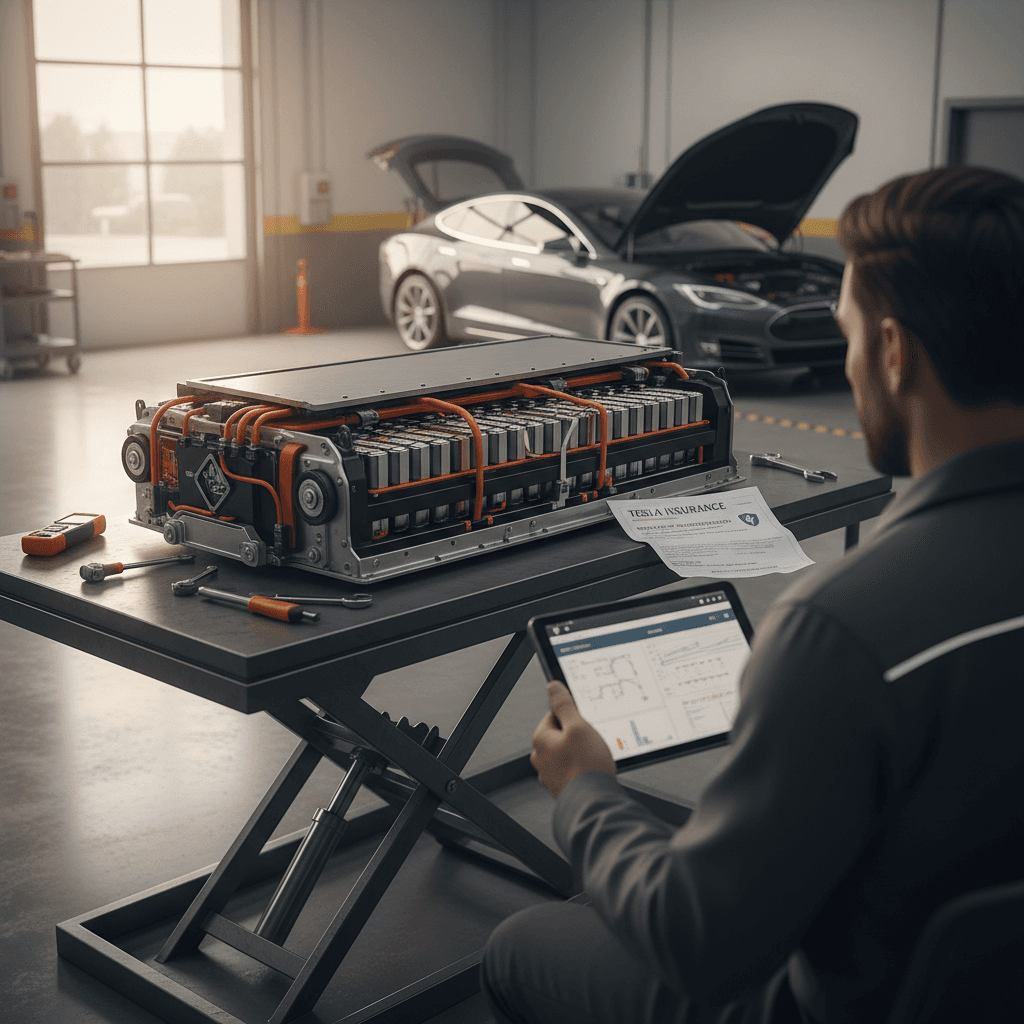
Understanding why all of this matters means looking at real numbers. Tesla doesn’t publish retail battery prices in a neat menu, but reported service invoices and insurer data put full pack replacements in roughly the $10,000–$22,000 range in the U.S., depending on model, pack size, and labor. Partial repairs or module replacements can be cheaper, but they’re still multi‑thousand‑dollar jobs.
Why Battery Coverage Decisions Matter
Those economics explain why a badly damaged battery often leads to a total loss and why under‑insuring a Tesla is so risky. If you carry only liability on a car whose pack gets crushed in a crash, you could be staring at a vehicle that’s economically dead long before you finish paying it off.
Used Teslas, Battery Coverage, and How Recharged Helps
If you’re shopping for a used Tesla, or already own one you didn’t buy new, the battery questions multiply. You’re thinking about what’s left of the factory warranty, how much the pack has degraded, whether it’s been abused, and how insurable the car is now that it’s a few owners removed from the showroom.
Where insurance falls short on used Teslas
- Insurers rarely know the real battery health; they just see a VIN, value, and risk factors.
- Policies don’t guarantee that your used Tesla still hits its original range numbers.
- If the pack fails outside of warranty and without a covered event, you’re on the hook, even if you just bought the car.
How Recharged closes that information gap
- Every used EV sold through Recharged includes a Recharged Score Report with verified battery health.
- You see how the specific car’s pack has held up, not just what the EPA sticker said when it was new.
- We price vehicles with remaining battery warranty and real‑world degradation baked in, so your insurance and ownership costs line up with reality.
That clarity makes it easier to choose the right combination of insurance, warranty, and budget.
Buying used? Get the data first.
Checklist: Protecting Yourself from Big Battery Bills
Smart Steps for Tesla Owners and Shoppers
1. Confirm your battery warranty dates and mileage
Open the Tesla app or your owner documents and note the exact battery warranty expiration, both <strong>year</strong> and <strong>mileage</strong>. Set a reminder 6–12 months before it ends.
2. Carry collision and comprehensive coverage if you can
If your budget allows, full coverage is critical on an EV whose battery can cost tens of thousands of dollars. Without it, a single incident can total your car with no payout.
3. Check policy limits and deductibles
Make sure your property‑damage and comprehensive/collision limits reflect the car’s actual value. A $50,000 Tesla with a rock‑bottom property‑damage limit is asking for trouble if things go wrong.
4. Ask your insurer specific battery questions
Don’t just ask, “Is my battery covered?” Instead ask, “If a crash/flood/fire damages my battery, will you replace it? Under which coverage? With what deductible?” Get answers in writing if possible.
5. Evaluate Tesla’s Battery ESA before your warranty ends
If you’re eligible and plan to keep the car, compare the cost of the Battery ESA to your risk tolerance and how much value the car still has. It may be cheaper than self‑insuring a full pack failure.
6. For used Teslas, insist on a battery health report
Whether you buy through Recharged or elsewhere, push for objective data about battery condition and any warranty claims. It’s the only way to price the risk correctly.
7. Drive and charge for longevity
Insurance won’t cover degradation, but you can slow it down: avoid frequent 0–100% swings, limit high‑power DC fast charging when you can, and don’t leave the car sitting fully charged for long periods.
FAQ: Tesla Insurance and Battery Coverage
Frequently Asked Questions
Bottom Line: How to Think About Tesla Battery Risk
Tesla Insurance does cover your battery, but only in the narrow sense that it covers the car when a crash, fire, theft, or other insurable event damages it. It does not function as a safety net for battery aging, range loss, or end‑of‑life replacement. That job belongs to Tesla’s battery warranty, optional extended coverage, and smart buying and charging decisions.
If you’re buying or already own a Tesla, the smartest move is to treat battery risk as a three‑part system: warranty for defects, insurance for accidents, and data for everything else. That last piece is where Recharged adds real value in the used market. By combining verified battery health data, transparent pricing, financing options, and expert guidance, Recharged helps you choose a Tesla whose battery story actually matches your budget and expectations, so you’re not relying on an insurance policy to solve a problem it was never designed to fix.