If you’re planning a summer road trip in your EV, you’ve probably wondered: does AC affect EV range in summer enough that I should be worried? The short answer is yes, air conditioning does use noticeable energy, but probably less than you fear, and it’s only one piece of the summer range puzzle.
Key Takeaway
How Much Does AC Really Cut EV Range in Summer?
When people ask whether AC affects EV range in summer, what they really want to know is: how many miles am I losing? Several large studies and fleet analyses give us a solid ballpark, especially around the 90–100°F range that many U.S. drivers see in July and August.
Summer AC Impact on EV Range: Typical Numbers
Put numbers on that: if your EV is rated for 250 miles, a realistic summer AC penalty might be 10–20 miles in typical 80–90°F weather, and perhaps 30–40 miles in extreme heat with the cabin set very cold. That’s noticeable, but it doesn’t turn a practical EV into a driveway ornament.
Watch for small packs in big heat
Why AC Uses More Energy in an EV Than You’d Expect
Gas cars “hide” the energy cost of AC. The engine already wastes heat; the compressor just taps into that spinning hardware. In an EV, every watt for cooling comes straight from the high‑voltage battery, competing directly with the motor for range.
- HVAC is electric only. The compressor, fans, and electronics are all powered by the traction battery, there’s no free waste heat like in a gas car.
- Big temperature swings cost more. Dropping cabin temperature 25–30°F below outside air on a 100°F day takes longer and uses more energy than shaving off 10–15°F.
- Cabin + battery cooling. Today’s EVs manage not just the cabin but also battery temperature. In high heat, coolant loops and fans may run frequently to protect the pack, adding to total draw.
- Low‑speed penalty. At 20–30 mph, the motor isn’t working very hard, so HVAC can be a surprisingly large slice of the energy pie. At 70 mph, aerodynamics dominate and AC is a smaller share of the total load.
Cooling hurts less than heating
AC vs. Other Summer Range Killers: What Matters Most
AC use does affect EV range in summer, but it’s not working alone. If your real‑world range suddenly looks nothing like the window sticker, there are usually several culprits stacking together.
What Eats EV Range Most in Summer?
Air conditioning matters, but it’s rarely the only issue.
1. Highway Speed
Jumping from 50 mph to 80 mph can slash range by 20–30%, even in perfect temperatures. Aerodynamic drag grows quickly with speed, so a high‑speed road trip will always use dramatically more energy than a 55‑mph cruise, AC or not.
2. Extreme Heat
Above the mid‑90s, the battery and cabin both need active cooling. Studies show hot conditions alone can trim 10–20% of usable range, even before you factor in your exact AC setting.
3. AC & HVAC Settings
Blasting the AC at 65–68°F on max fan will use far more power than setting 72–74°F with ECO or eco‑climate modes. Expect roughly single‑digit to low‑teens percent range impact for normal use on hot days.
4. Elevation, Cargo & Passengers
Steep climbs, heavy loads, and roof boxes all boost energy use. A mountain pass in August with four people and luggage will show much higher consumption than a solo flat‑land commute at the same temperature.
Where to focus first
City vs. Highway: How Driving Patterns Change AC Impact
Low‑Speed / City Driving
In stop‑and‑go traffic, the motor often draws very little power, especially in efficient EVs with strong regenerative braking. That means the AC can become one of the largest energy consumers while you inch along.
- If you’re crawling in 95°F heat with the AC blasting, HVAC might explain a big share of the range you’re losing.
- Short trips can be especially tough: the system has to cool a hot cabin from scratch each time.
Highway Driving
At 65–75 mph, aerodynamic drag dominates energy use. Here, speed, headwinds, and elevation usually matter more than AC. You’ll still see some penalty from cooling the cabin and battery, but it’s a smaller slice of a bigger energy pie.
- Dropping from 75 mph to 65 mph can save more range than turning the AC down a couple of degrees.
- Pre‑cooling before you hit the highway keeps early cabin loads lower.
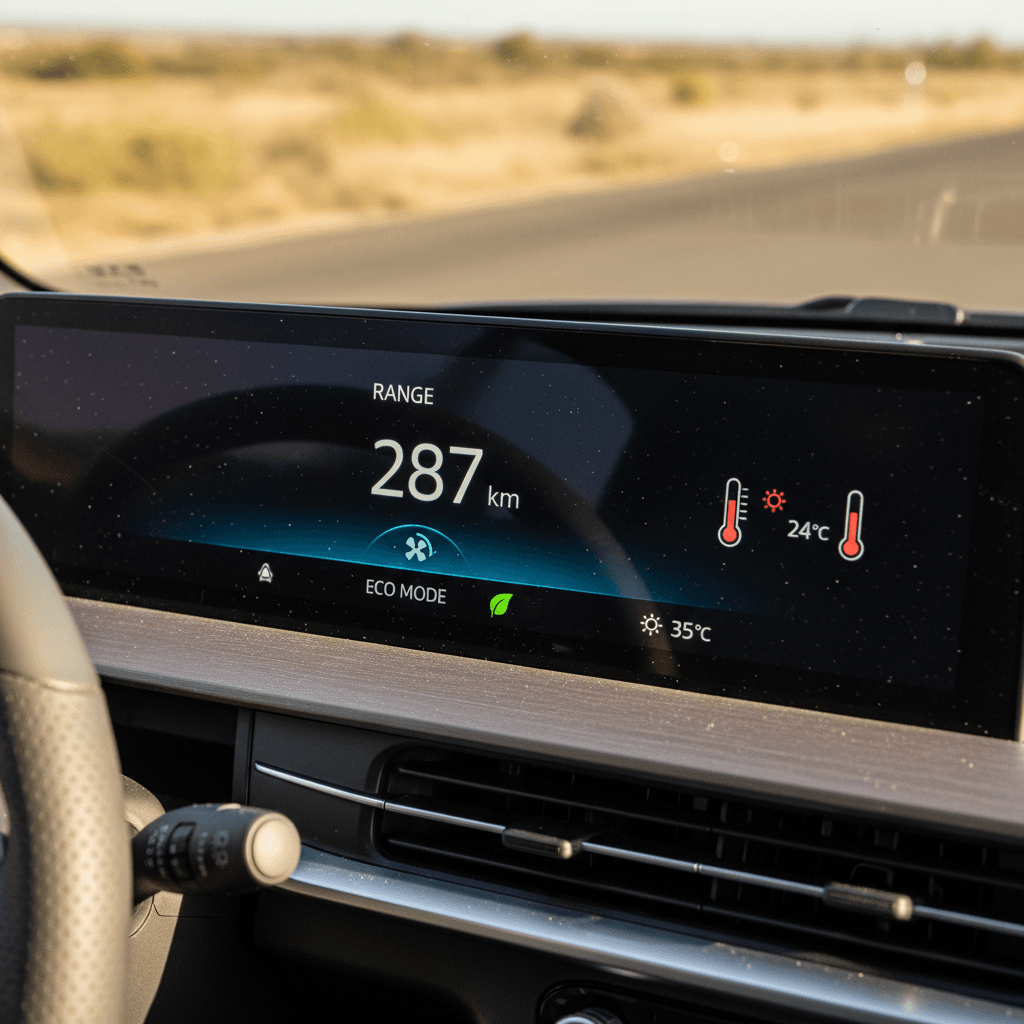
10 Ways to Stay Cool and Protect EV Range
You shouldn’t have to suffer through a 95°F drive just to eke out a few more miles. These strategies let you keep the AC on while keeping range anxiety in check, especially helpful if you’re driving an older or used EV with a smaller battery.
Practical AC & Summer Range Tips
1. Pre‑cool while plugged in
Use your app or in‑car scheduler to <strong>cool the cabin before you unplug</strong>. That way, the grid, not your battery, does the hardest work bringing the interior down from oven‑hot to comfortable.
2. Aim for 72–76°F, not 65°F
Every degree matters. Setting the climate control a bit warmer (while using fan speed and ventilation smartly) can cut HVAC draw significantly with barely any comfort trade‑off.
3. Use ECO or eco‑climate modes
Most EVs offer an <strong>eco climate</strong> mode that softens fan speeds and compressor output to save energy. It’s an easy on/off switch when you want to extend range on the fly.
4. Ventilate the cabin at start
If the car has baked in the sun, open doors or windows briefly before you crank the AC. Dumping out super‑hot air first reduces how long the AC has to run at full blast.
5. Park smart
Whenever possible, choose shaded parking or use a sunshade. Keeping interior temps lower while parked means less cooling needed once you get back in.
6. Rely on seat and wheel coolers
If your EV has <strong>ventilated seats</strong> or a cooled steering wheel, use them. They consume far less power than dropping cabin temperature another 5–10°F.
7. Moderate highway speeds
On long summer trips, shaving just 5–10 mph off your cruise speed can add more range than turning the AC down does, without sacrificing comfort for you or your passengers.
8. Use scheduled departure daily
For commuters, set a daily departure time so the car finishes charging and pre‑conditions just before you leave, keeping the battery and cabin in the sweet spot for efficiency.
9. Watch the energy screen
Many EVs show a breakdown of energy use by driving, climate control, and accessories. Keep an eye on that display during heat waves so you can quickly see when AC is becoming a major load.
10. Plan charging with a buffer
In extreme heat, add a <strong>10–15% state‑of‑charge buffer</strong> above what your route planner says you’ll need. That covers AC use, traffic, and unexpected detours without stress.
Good news for daily drivers
Summer Range and Used EVs: What to Watch For
If you’re shopping the used market, you’re not just asking whether AC affects EV range in summer in general, you’re asking what it will do in this specific car, with this specific battery. Battery health, pack size, and thermal management all change the picture.
How Used EV Factors Change Summer AC Impact
Questions to ask and what they mean for real‑world range when it’s hot.
| Factor | Why it Matters in Summer | What to Look For |
|---|---|---|
| Battery health / SOH | Lower state‑of‑health means less usable capacity, so the same AC draw eats a bigger share of range. | Ask for a recent battery‑health report, like a Recharged Score, rather than guessing from the odometer. |
| Pack size | Smaller packs have less buffer; AC and thermal management are a larger percentage of total energy use. | If you live in a hot region, favor EVs with ~230+ miles original EPA range when budget allows. |
| Thermal management design | Liquid‑cooled packs handle high heat better and avoid extreme efficiency losses. | Confirm whether the model uses active liquid cooling or passive/air cooling, especially on older models. |
| Charging behavior | Regular DC fast charging in hot climates can accelerate degradation over the years. | Look for vehicles with service records and normal fast‑charging patterns, not constant DCFC at high states of charge. |
| Software & eco modes | Newer software can optimize HVAC, compressor speed, and preconditioning logic. | Check that the used EV is up to date on software and supports features like scheduled preconditioning. |
Combine these checks with a trusted battery‑health report before you buy a used EV.
Where Recharged fits in
Quick Comparison: Winter vs. Summer Climate Control
It’s natural to worry about AC ruining your range, but in practice winter is still the tougher season for EVs. Understanding the difference helps you calibrate your expectations and plan charging around the right worst‑case scenario.
Climate Control Penalties: Winter vs. Summer
Numbers are typical ranges from major studies and fleet data; exact results vary by model and driving style.
Winter (Heat On)
- Battery chemistry is less efficient in the cold.
- Cabin heating often uses resistive elements or a heat pump working very hard.
- Combined effect can slash range by 25–40% or more on very cold days, especially with short trips.
Summer (AC On)
- Battery operates near its preferred temperature band.
- AC cooling is comparatively efficient vs. resistive heating.
- Range losses with AC typically sit in the 5–17% band in hot conditions, often less in the 80s.
Don’t ignore long‑term heat
FAQ: AC and Summer EV Range
Frequently Asked Questions About AC and EV Range in Summer
Bottom Line: Should You Ever Turn the AC Off?
If you’ve been wondering, “Does AC affect EV range in summer enough that I should sweat it out?” the answer is no. For most drivers and most modern EVs, air conditioning trims range by single‑digit to low‑teens percentages, significant enough to plan for, but not a reason to avoid road trips or daily drives.
Where you’ll see the biggest gains isn’t turning the AC off; it’s slowing down a bit, pre‑conditioning when plugged in, parking smart, and understanding your specific car’s battery health. That’s especially true if you’re driving or shopping for a used EV, where pack condition and thermal management make a real difference in hot‑weather range.
If you’re evaluating a used electric vehicle, Recharged makes those trade‑offs easier to see. Every car includes a Recharged Score Report with verified battery health and real‑world range context, plus EV‑specialist support to help you understand how it will perform on the hottest days of the year. Stay cool, protect your range, and choose the EV that fits your summer driving, without giving up the AC.