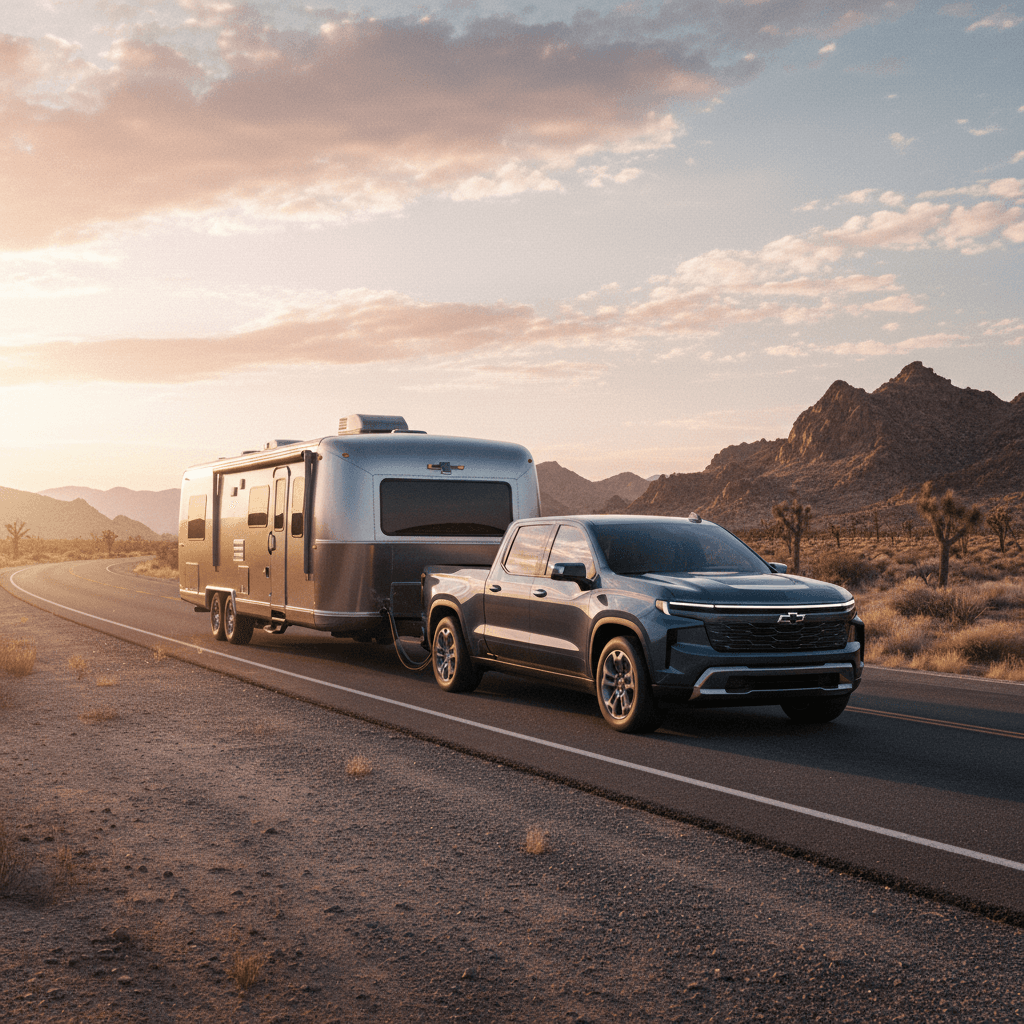
If you’re looking at an electric truck to haul campers, boats, or job‑site trailers, the Chevy Silverado EV towing capacity and range numbers are probably at the top of your list. On paper, this truck can pull as much as many gas half‑tons, and in some trims, even more, but towing with an EV changes how you plan trips, stops, and payload.
Key takeaway up front
Chevy Silverado EV overview: trims, batteries, and range
Before you drill into towing capacity, it helps to understand how the Silverado EV lineup is structured. Chevy sells the truck in several trims, Work Truck (WT), LT, RST, and (by 2026) Trail Boss, built on GM’s Ultium platform with big battery packs and dual‑motor all‑wheel drive. Different packs and wheel/tire combinations change range, but towing ratings remain competitive across the board.
Silverado EV trims at a glance
All are dual‑motor e4WD; range depends on battery and wheels
Work Truck (WT)
Primarily for fleets and work users.
- Standard, Extended, and Max Range battery options
- Focus on payload, efficiency, and durability
- Highest published range in the lineup on Max pack
LT
Blends comfort with capability.
- Extended Range battery only
- More comfort and tech than WT
- Strong highway range, solid towing
RST & Trail Boss
Performance and lifestyle trims.
- Extended or Max Range batteries
- Big wheels, more features, higher curb weight
- Four‑wheel steering on many versions for easier trailer maneuvers
Core Silverado EV capability numbers
Think in packs, not just trims
Chevy Silverado EV towing capacity by trim
Published tow ratings for the Silverado EV put it at or near the top of the light‑duty truck class. Here’s how capacity breaks down by major trim based on current information. Exact figures can vary slightly by model year and configuration, so always verify the door‑jamb label and owner’s manual for a specific truck.
Chevy Silverado EV towing capacity by configuration
Approximate maximum conventional (bumper‑pull) trailer ratings for key Silverado EV trims.
| Trim / Variant | Battery pack | Max tow rating | Typical payload |
|---|---|---|---|
| WT 3WT (fleet) | Extended or larger pack | 12,500 lb | ~1,400 lb |
| WT 4WT | Larger fleet pack | 10,000 lb | ~1,400 lb |
| General WT retail | Extended / Max Range | 10,000–12,500 lb (check build) | ~1,400 lb |
| LT Extended Range | Extended Range | ~10,000 lb (expected) | Similar to WT |
| RST Extended Range | Extended Range | 10,000 lb | Up to ~1,300–1,400 lb |
| RST Max Range | Max Range | 10,000 lb | Slightly lower due to weight |
| Trail Boss (Max tow) | Extended or Max Range | Up to 12,500 lb (GM‑estimated) | Up to ~2,100 lb on some specs |
Always consult the specific truck’s door‑jamb sticker and owner’s manual before towing.
Don’t forget tongue weight
Silverado EV range by battery pack and trim
On the range side, the Silverado EV has some of the strongest numbers of any electric pickup. Work Truck models with the Max Range battery are EPA‑rated around the high‑400‑mile mark, while RST and LT trims trade a bit of range for larger wheels and more equipment. Newer model years add Standard Range packs on WT for lower entry pricing but shorter legs.
Approximate Silverado EV range by battery and trim
Representative EPA or GM‑estimated ranges on a full charge in ideal conditions, not towing.
| Trim | Battery pack | Approx. range (no trailer) |
|---|---|---|
| WT Standard Range | 119 kWh usable | ~280–300 miles |
| WT Extended Range | 170 kWh usable | ~420–450 miles |
| WT Max Range | 205 kWh usable | ~490+ miles |
| LT Extended Range | 170 kWh usable | ~400+ miles |
| RST Extended Range | 170 kWh usable | ~390–440 miles |
| RST Max Range | 205 kWh usable | ~450–460 miles |
| Trail Boss Extended | 170 kWh usable | ~410 miles (GM‑estimated) |
| Trail Boss Max Range | 205 kWh usable | ~470+ miles (GM‑estimated) |
Real‑world range will vary based on speed, temperature, load, tires, and driving style.
Weather and speed still matter
How towing affects Silverado EV range in the real world
Here’s the part that separates gas and electric trucks: with an EV, towing doesn’t just burn more fuel, it directly reduces how far you can go between charging stops. Silverado EV owners and early tests consistently show that towing a sizable, non‑aero‑friendly trailer can cut effective range roughly in half.
- Chevy’s own guidance for the Silverado EV Work Truck assumes about a 50% range reduction when you connect a ~5,000‑pound trailer and engage Tow/Haul mode.
- Independent tests pulling 6,000–9,000‑pound trailers report similar 40–55% drops compared with solo driving, depending on terrain and speed.
- Boxy cargo, like tall enclosed trailers or big travel campers, hurts range more than low, streamlined boats or flatbeds, even at the same weight.
Factors that reduce towing range
- Weight: Heavier trailers demand more energy to accelerate and climb.
- Aerodynamics: Square campers act like sails, increasing drag dramatically at highway speeds.
- Speed: Going from 60 to 75 mph can have a bigger impact than adding several hundred pounds.
- Hills and headwinds: Mountain passes or steady headwinds can chew through your buffer quickly.
Factors that help preserve range
- Moderate speeds: Cruising at 60–65 mph instead of 75+ mph.
- Efficient trailer setup: Tonneau covers, properly inflated tires, and aligned axles.
- Smart load distribution: Avoiding unnecessary cargo in the bed and cab.
- Effective regen: Leaving room in the pack (not charging to 100%) before long downhill grades.
Important safety note on charging to 100%
Real-world Silverado EV towing range: example scenarios
To make planning easier, let’s walk through some rough‑cut scenarios. These aren’t promises; they’re conservative ballparks to help you decide which Silverado EV configuration fits your needs and how frequently you’ll be stopping to charge.
Sample Silverado EV towing scenarios
Assumes mild weather, 60–65 mph, mixed highway terrain
WT Max Range + 7,000‑lb camper
Baseline range (no trailer): ~490 mi
Assume 50% hit: ~245 mi usable towing range.
Practical target: Plan your DC fast‑charge stops every 160–190 miles to keep a safe buffer for detours and hills.
RST Extended + 5,000‑lb boat
Baseline range: ~400 mi
Assume 40–45% hit: ~220–240 mi towing.
Practical target: Stops every 150–180 miles, especially if you’re running bigger 22–24" wheels.
WT Extended + 9,000‑lb equipment trailer
Baseline range: ~420 mi
Assume 50–55% hit: ~190–210 mi towing.
Practical target: Plan around 130–160‑mile legs and know your heavy‑duty DC sites along freight routes.
Use your first trip as a benchmark
Charging a Silverado EV while towing: what to expect
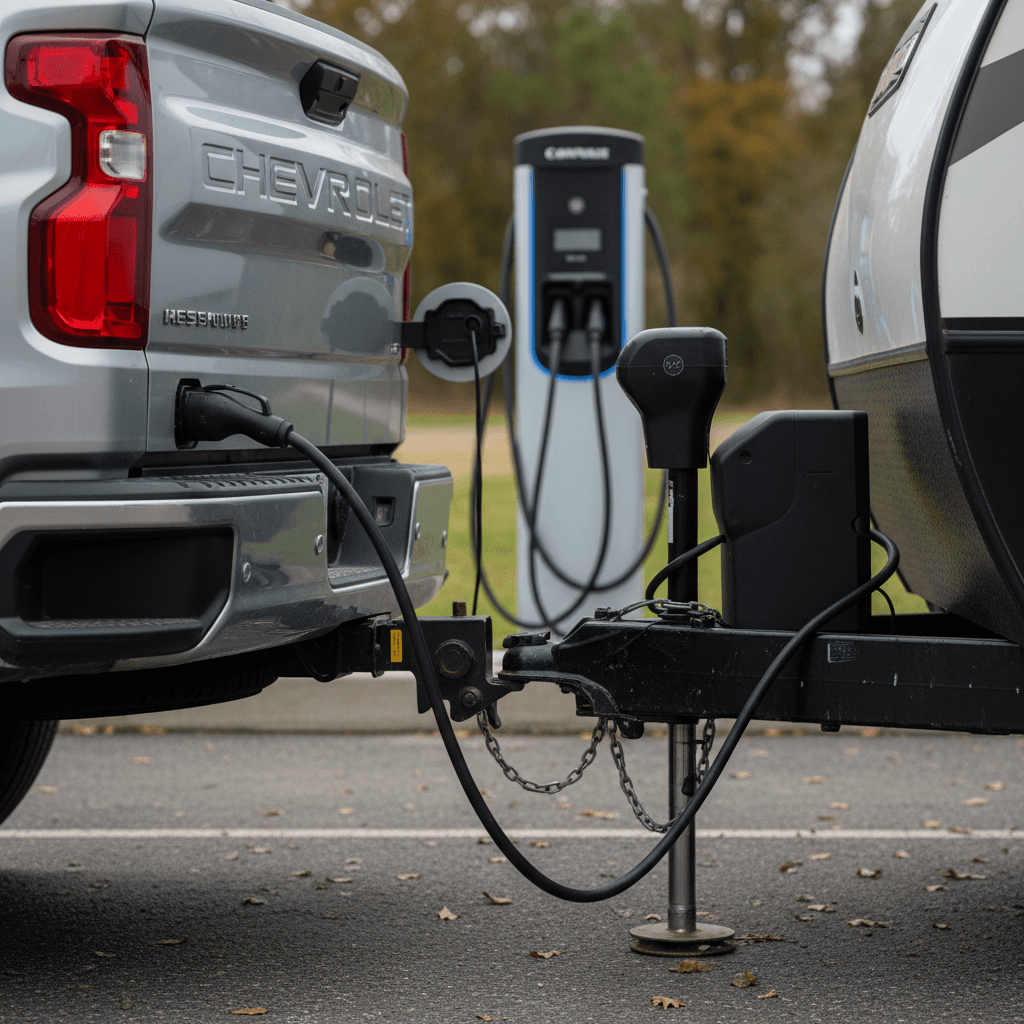
Even with strong range, you’ll be planning more frequent stops when towing with a Silverado EV than you would running empty. The good news: the truck’s 350‑kW DC fast‑charge capability means those extra stops don’t have to be long if you find the right stations.
Towing‑friendly charging tips for Silverado EV owners
1. Look for pull‑through or end‑spot chargers
Most public DC fast chargers still aren’t designed for vehicles with trailers. When you can, target <strong>pull‑through spots or end units</strong> where you can nose in while staying connected to your trailer. Otherwise, be prepared to briefly unhitch.
2. Plan around 10–80% state of charge
Charging from 10% to ~80% is where DC fast charging is quickest. Above ~80%, charge rates taper. On road trips, it’s often faster overall to <strong>do more short sessions</strong> between 10–70% than one long charge to 100%.
3. Use built‑in route planning
Later Silverado EVs can route you through charging stops based on load and terrain. Engage Tow/Haul mode and input your destination so the nav can suggest more realistic stops and arrival state of charge.
4. Watch weather and elevation
Climbing into the mountains with a big trailer may require an extra stop compared with flatland towing. Use apps that show elevation profiles, and add an extra 10–15% buffer for mountain passes or strong headwinds.
5. Know alternate networks
Chevy owners are gaining access to high‑power third‑party and Tesla Supercharger stations over time. Have accounts set up with at least <strong>two major networks</strong> so you can reroute easily if a site is down or full.
Charging adapters and Superchargers
Silverado EV towing vs gas trucks and rival EV pickups
If you’re cross‑shopping a Silverado EV with a gas Silverado 1500, Ford F‑150 Lightning, or Rivian R1T, towing is probably the biggest open question. On raw numbers and driving feel, the EV holds its own, and often wins.
Compared with a gas Silverado 1500
- Tow ratings: Top gas 1500s can tow a bit more, up to ~13,300 lb, while Silverado EV trims top out around 12,500 lb.
- Range hit: Both gas and EV trucks see big efficiency drops when towing. With gas, you just stop more often for fuel. With EV, you must plan more carefully to match DC fast chargers and trailer‑friendly sites.
- Driving feel: Instant torque and low‑speed control make the EV feel confident when backing or climbing with a heavy load.
Compared with other EV pickups
- Ford F‑150 Lightning: Max tow rating also around 10,000 lb, but with smaller battery options and lower range when empty compared with Silverado EV’s largest packs.
- Rivian R1T: Strong tow ratings and good manners, but with a shorter wheelbase and smaller pack than Silverado EV Max.
- GM’s own GMC Sierra EV: Shares Ultium underpinnings and similar ratings, your choice may come down to styling and pricing.
Where Silverado EV shines
Buying considerations: is the Silverado EV right for your towing needs?
Whether a Silverado EV fits your towing life depends less on headline tow rating and more on your patterns: how far you go, how often you tow, and where you can charge. Here are the questions to answer before you sign anything, especially if you’re considering a used truck.
Key questions before buying a Silverado EV for towing
1. How heavy, and how tall, is your trailer?
A 7,000‑lb low boat or car hauler will be easier on range than a 7,000‑lb travel trailer with a flat front. If you want to tow a tall camper, lean toward <strong>Max Range</strong> packs wherever possible.
2. What’s your longest typical towing day?
If your longest day under load is 150–200 miles, nearly any Extended Range Silverado EV can work comfortably. If you need 300+ mile days, especially with heavier trailers, focus on <strong>Max Range WT, RST, or Trail Boss</strong> and verify DC fast‑charge coverage.
3. How strong is public charging where you live and travel?
Check major corridors you actually use, family trips, race weekends, job sites. Strong coverage of 150–350‑kW chargers near highways makes EV towing much easier; sparse coverage means more planning and time.
4. Can you charge at home or at your yard?
Being able to start every towing day at or near a full charge from a <strong>Level 2 charger</strong> at home or at your yard dramatically improves the EV ownership experience and lowers operating costs.
5. Are you open to adjusting your pace?
If you’re used to hammering out 600‑mile towing days with quick gas stops, an EV truck will feel different. If you’re comfortable with <strong>more frequent, shorter breaks</strong> and slightly lower cruising speeds, the Silverado EV can be a strong fit.
Watch curb weight on payload‑sensitive jobs
How Recharged can help you shop Silverado EV and other used electric trucks
If you’re looking at a used Chevy Silverado EV or another electric truck, the big missing piece in most listings is clear information about battery health and how that affects range, especially under load. That’s where Recharged is built to help.
Shopping an electric tow rig with Recharged
What you get beyond a standard used‑truck listing
Recharged Score battery report
Every vehicle on Recharged includes a Recharged Score with verified battery health. That gives you more confidence that the range you’re counting on for towing will still be there years into ownership.
Financing and trade‑in support
Need to move out of a gas half‑ton into an EV truck? Recharged offers financing options and online trade‑in or instant offer tools to simplify the switch.
Nationwide delivery & EV specialists
Shop digitally, lean on EV‑specialist support for questions about towing and charging, and have your truck delivered nationwide or visit the Recharged Experience Center in Richmond, VA.
Ready to find your next EV?
Browse VehiclesIf you’re comparing multiple EV trucks, say a Silverado EV WT against a Ford F‑150 Lightning or Rivian R1T, Recharged’s team can walk you through real‑world towing range expectations, charging options, and ownership costs so you can pick the setup that matches your work or play, not just the spec sheet.
Chevy Silverado EV towing capacity and range: FAQ
Frequently asked questions about Silverado EV towing and range
Bottom line: planning Silverado EV towing without surprises
The Chevy Silverado EV combines serious tow ratings with some of the best range numbers in the electric‑truck class, but you still have to respect the physics: hitch a big, square trailer behind any EV and you’ll see a big drop in miles per charge. If you size the battery pack to your longest towing day, build in a 40–50% safety margin for range, and map out trailer‑friendly DC fast chargers, the Silverado EV can confidently shoulder everything from job‑site gear to family campers.
If you’re exploring a used Silverado EV, or cross‑shopping other electric pickups, Recharged can help you line up battery health, real‑world range, and financing with how you actually use a truck. Do that homework up front, and the move from gas to electric towing doesn’t have to be a gamble; it can be a predictable upgrade in power, comfort, and long‑term operating costs.