If you’re looking at a Chevrolet Silverado EV, especially as a long‑term workhorse or family hauler, it’s natural to ask how much the battery will degrade per year. With a battery pack in the roughly 170–205 kWh range depending on trim, even small percentage changes can mean big swings in usable range and towing confidence.
Why degradation matters more on big trucks
Silverado EV battery degradation basics
Start with one crucial point: there is no official, published “X% per year” degradation rate for the Silverado EV’s Ultium battery. The truck is still relatively new, and GM hasn’t released fleet‑wide degradation curves the way some early EV players eventually did. What we do have are three pieces of evidence you can lean on:
- GM’s 8‑year / 100,000‑mile EV battery warranty language, which sets a performance floor.
- Early real‑world data from other Ultium‑based vehicles like the Cadillac Lyriq, Blazer EV, and BrightDrop vans, which use the same core battery tech.
- A decade of industry experience with modern, liquid‑cooled lithium‑ion packs, which generally lose most of their capacity in the first few years and then level off.
Put those together and a reasonable expectation for a well‑cared‑for Silverado EV is something like 1–2% capacity loss per year on average over the first 8 years, with more noticeable loss front‑loaded into the first 2–3 years. That’s a generalized EV industry pattern; we’ll talk shortly about why the Silverado EV might actually be on the more conservative, “slow degradation” end of that spectrum.
No precise annual number, on purpose
How GM’s Ultium battery in the Silverado EV is built
To understand Silverado EV battery degradation, you need a basic picture of the Ultium pack under the floor. In max‑range trims, the Silverado EV uses one of the biggest Ultium packs GM has put on the road, around 200+ kWh usable, depending on configuration. The Work Truck (WT), LT, and RST trims layer different module counts to hit approximate capacities from about 120 kWh up to roughly 205 kWh, all on the same Ultium architecture.
Ultium pack design choices that influence degradation
Why the Silverado EV’s battery is built to age slowly, not chase spec‑sheet bragging rights
Modular cell layout
Ultium uses standardized large pouch cells arranged in modules, then combined into packs. In the Silverado EV, GM can vary module count to hit different capacities while keeping the chemistry and thermal design consistent.
Active liquid cooling
The pack uses liquid thermal management with a heat pump and chiller loop to keep cells in their ideal temperature window, reducing heat‑driven degradation during high‑load towing and DC fast charging.
Conservative power density
Compared with some sporty EVs, GM’s big trucks use their huge packs to spread current across many cells. Lower C‑rates (current per unit capacity) generally translate to less stress on each cell over time.
The important takeaway for you: the Silverado EV’s battery isn’t some fragile, one‑off science project. It’s a scaled‑up version of the same Ultium building blocks now deployed across GM’s lineup, which gives us a growing pool of real‑world experience to draw from when we talk about degradation.
What we know (and don’t know) about Silverado EV degradation per year
Silverado EV battery degradation: realistic ballpark numbers
So where does “Chevrolet Silverado EV battery degradation per year” likely shake out? Based on Ultium chemistry, cooling, and early experiences from related models, a sensible expectation for a private‑use truck would be:
- First 2–3 years: Slightly faster aging as the pack settles in, maybe on the order of 3–5% total over that period if usage is moderate.
- Years 3–8: Slower, steadier decline, roughly 1–2% per year for most drivers, assuming no abusive heat or charging patterns.
- Beyond 8 years: Behavior depends a lot on mileage and how the truck was used, but a well‑treated pack still delivering ~70–80% of original capacity would be a solid outcome.
How this compares to other EV trucks
The big caveat is duty cycle. A Silverado EV running hot, heavy, and fast in a commercial fleet, fast‑charging multiple times per day, may age somewhat more aggressively than a lightly‑loaded personal truck that lives on a Level 2 charger at home. That’s why GM frames its promises through the lens of warranty rather than publishing a neat per‑year number.
GM’s Ultium battery warranty and what it implies
GM’s U.S. warranty guides for recent model years specify 8 years or 100,000 miles of coverage for EV propulsion batteries. For other GM EVs, that coverage explicitly includes a capacity guarantee, typically that the pack won’t fall below about 70% of its original capacity within that period, or GM will repair or replace it. The Silverado EV follows the same playbook.
How GM’s warranty frames Silverado EV battery life
Use the warranty as a floor, not a prediction of typical degradation.
| Item | Coverage (U.S., typical) | What it means for you |
|---|---|---|
| Battery time limit | 8 years | GM expects the pack to remain serviceable and above its minimum capacity threshold for at least eight years from in‑service date. |
| Battery mileage limit | 100,000 miles | Heavier‑use trucks may hit the mileage limit before the time limit; degradation expectations are tied to both. |
| Capacity floor | ~70% of original | If your pack falls significantly below this within the warranty window, you may qualify for repair or replacement. |
| Transferability | Usually to subsequent owners | If you buy a used Silverado EV within the 8‑year/100k‑mile window, remaining coverage typically follows the truck. |
Always read the specific warranty booklet for your model year and trim, but this table reflects GM’s general approach to EV battery coverage in the Silverado EV era.
Use the warranty to set your expectations
Factors that speed up or slow down Silverado EV battery degradation
No matter how capable Ultium is, the way you use a Silverado EV profoundly affects how many percentage points of capacity you lose per year. For most owners, the question isn’t “What’s the average?” but “Am I going to be on the good side or the bad side of that average?”
Habits that accelerate degradation
- Frequent DC fast charging from very low state of charge (e.g., 5–10% up to 100%), especially on hot days.
- Regularly parking at 100% charge for hours or days, particularly in warm climates.
- Sustained high‑load towing at highway speeds in extreme heat, which pushes pack temperature and current draw up.
- Letting the truck sit for weeks at very low charge, which can stress cells and supporting systems.
Habits that slow degradation
- Daily charging to 70–80% instead of 100% when you don’t need the full pack.
- Relying on Level 2 charging at home or work most of the time, reserving DC fast charging for trips.
- Letting the truck manage pack temperature (preconditioning before fast charging, avoiding extreme storage temps when possible).
- Keeping average speed and acceleration moderate when you’re not towing or hauling.
Heat is the real enemy
Realistic Silverado EV range loss over 5–10 years
Because the Silverado EV’s pack is so large, it helps to translate degradation into actual miles of range rather than abstract percentages. Let’s assume a Max‑Range truck with an EPA rating in the 440–480‑mile ballpark when new, and a more work‑focused trim around 300 miles.
Example range loss on different Silverado EV trims
These are illustrative scenarios, not promises, real results vary with climate and usage.
| Scenario | Original EPA range | Capacity after 8 years | Estimated range after 8 years |
|---|---|---|---|
| Max‑range RST / WT | 450 mi | 85% | ~380 mi |
| Standard‑range WT | 300 mi | 85% | ~255 mi |
| Hard‑use fleet truck | 300 mi | 75% | ~225 mi |
| Gently‑used personal truck | 450 mi | 90% | ~405 mi |
Assuming moderate use with mostly Level 2 charging and no extreme heat abuse.
In other words, for a typical private owner, it’s reasonable to expect that your Silverado EV will still deliver roughly 80–90% of its original range after 8 years, maybe more if you treat the battery kindly. That’s not nothing, but on a 450‑mile truck you’re still comfortably above the 300‑mile mark that many early EVs started with when new.
Oversized pack, undersized worry
How to drive and charge to protect your Silverado EV battery
You don’t have to baby your truck, but if you’re deliberate about a few choices you can plausibly shave several percentage points off lifetime degradation. Think of this as nudging your Silverado EV into the “gently‑used personal truck” scenario instead of the “hard‑use fleet” one.
Practical habits to slow Silverado EV battery degradation
1. Set a sensible daily charge limit
For commuting and errands, use the truck’s charging settings to cap daily charging around <strong>70–80%</strong>. Bump it to 90–100% only on days when you actually need maximum range, and start driving soon after it hits full.
2. Prefer Level 2 charging at home
Install a reliable Level 2 charger in your garage or driveway rather than relying on DC fast charging for everyday use. Slower, cooler charging is simply easier on the pack over the long haul.
3. Use DC fast charging strategically
On road trips, try to arrive at fast chargers with <strong>10–30% state of charge</strong> and unplug around 70–80% when possible; the last 20% is slower, hotter, and tougher on cells. Let the truck precondition the battery before high‑power sessions.
4. Watch temperature on heavy tow days
When towing at or near the Silverado EV’s rating in hot weather, consider slightly lower cruising speeds, take breaks if you see repeated fast‑charging sessions, and avoid immediately parking at 100% afterward if the pack is still hot.
5. Avoid long storage at extreme states of charge
If the truck will sit for weeks, aim to store it somewhere around <strong>40–60% state of charge</strong>, not full and not nearly empty, and ideally in a shaded or climate‑controlled spot.
6. Keep software up to date
GM can and does tune charging behavior, cooling strategies, and range estimates over the air. Staying current helps ensure your truck uses the latest thermal and charging logic GM has developed from broader fleet data.
Home charging is your friend
Battery health when buying a used Silverado EV
For many shoppers, the real question behind “Chevrolet Silverado EV battery degradation per year” is: How worried should I be about the battery on a used truck? That’s where objective diagnostics become far more important than generic industry averages.
What you can check yourself
- Compare range at a known state of charge: If a truck originally rated for 450 miles now shows ~360–380 miles at 100% in mild weather, that’s broadly in line with expected aging, not a red flag.
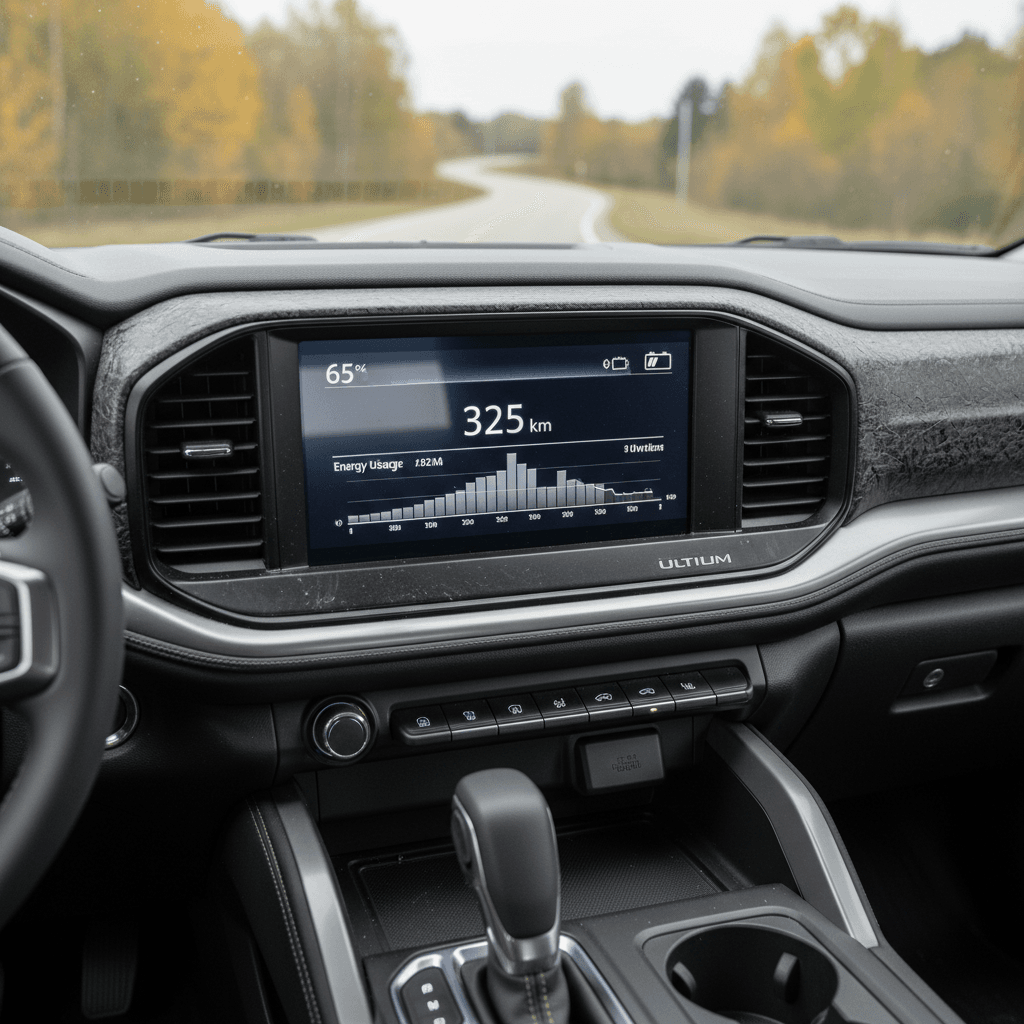
- Scan trip energy history: Look at recent trips in the infotainment energy screens. Wildly inconsistent consumption can indicate tire, alignment, or driving‑style issues that mask the battery’s real health.
- Review charging history if disclosed: A truck used mainly for home Level 2 charging will usually be a better bet than one living on public DC fast chargers.
Where professional tools matter
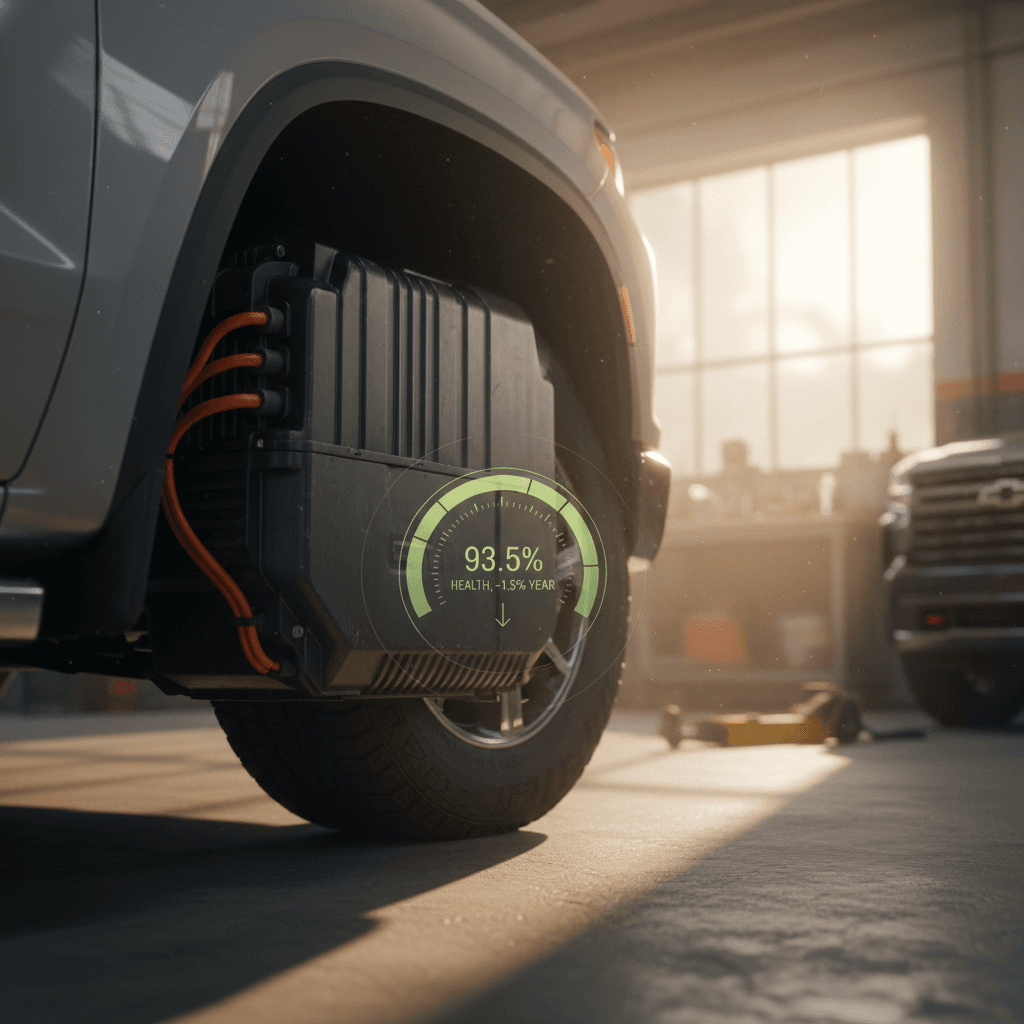
- Independent battery health scans can surface pack‑level state of health (SoH) that the dash won’t expose.
- Warranty status checks confirm how much of GM’s 8‑year/100k‑mile coverage remains and whether any prior pack work has been done.
- Structured test drives that log detailed energy usage, like the range testing we do at Recharged, reveal whether a truck behaves like others of the same trim and age.
How Recharged evaluates Silverado EV battery health
FAQ: Common questions about Silverado EV battery life
Frequently asked questions about Chevrolet Silverado EV battery degradation
Key takeaways on Silverado EV battery degradation
When you strip away the speculation, the story around Chevrolet Silverado EV battery degradation per year is actually pretty straightforward. Ultium packs are liquid‑cooled, conservatively powered, and backed by an 8‑year / 100,000‑mile warranty that strongly hints GM expects most owners to stay well north of 70% capacity over that window.
- For a typical private owner, a Silverado EV that still delivers 80–90% of its original range after 8 years is a realistic expectation.
- Daily charging to 70–80%, favoring Level 2 at home, and being thoughtful about fast charging and high‑heat towing can easily keep you on the “good” side of average degradation.
- On a truck that starts around 300–450 miles of range, even 10–15% loss leaves a lot of real‑world usability on the table.
- If you’re shopping used, battery‑specific diagnostics, like the Recharged Score Report that comes with every truck we sell, matter far more than armchair estimates about percentage loss per year.
In other words, the Silverado EV’s battery is unlikely to be the weak link in your ownership experience if you treat it with basic care. Whether you’re speccing a new truck or considering a pre‑owned one, focus on getting clear, transparent information about actual battery health and range in your use case. The rest is just noise.