If you’re driving, or thinking about buying, an electric car in California, the rules around electric car inspection requirements can feel murky. Do you still need a smog check? What happens with a salvage-title EV? And what should you inspect on a used electric car before you sign the papers? This guide walks you through how California actually treats EV inspections, in plain language.
Quick answer
Overview: How California Treats Electric Car Inspections
California’s inspection system was built around tailpipe pollution, so the state draws a sharp line between vehicles that burn fuel and those that don’t. A battery-electric vehicle (Tesla, Nissan LEAF, Chevy Bolt, Hyundai IONIQ 5, etc.) has no tailpipe and no combustion engine, which is why it’s treated differently from a gas, diesel, or even a hybrid vehicle.
Where EVs fit into California’s inspection landscape
Think of it this way: California doesn’t obsess over what’s coming out of an EV’s tailpipe, because there isn’t one. Instead, the state is mostly interested in identity (VIN), safety, and fraud prevention, especially when a vehicle has a complex history like a salvage title.
Do electric cars need smog checks in California?
This is the big one. According to the California DMV, electric vehicles do not need a smog inspection when you register or renew registration. EVs sit alongside older classics and heavy-duty diesels on the exempt list, but the reason is different: there’s simply nothing to test in the usual way.
- Fully electric vehicles (EVs): permanently exempt from California’s Smog Check program.
- Plug-in hybrids (PHEVs): treated like gasoline vehicles and do require smog checks on the usual schedule.
- Conventional hybrids: also require smog checks; they still burn fuel.
- Hydrogen fuel cell vehicles: currently treated as zero-emission vehicles and are not subject to traditional tailpipe smog checks.
Don’t mix up EVs and hybrids
You’ll still see smog-related language on some generic DMV forms, but when the system recognizes the car as a battery-electric vehicle, it won’t ask you for a Smog Check certificate. Instead, you’ll simply renew registration and pay the usual fees.
Other inspections California EV owners might run into
No smog check doesn’t mean no inspections ever. Depending on how your EV is registered and its history, you may see one or more of these checks:
Common inspection touchpoints for California EVs
Not every EV will hit all of these, but you should know what they are.
VIN verification
Needed when you bring an out-of-state EV into California, or if there’s any question about identity.
Usually handled by DMV, CHP, or a licensed verifier.
Safety systems inspection
Required for revived salvage, junk, or specially constructed vehicles before they can be registered.
Covers brakes, lights, airbags, seatbelts, tires, and structural repairs.
Paperwork review
Title transfers, lien releases, odometer disclosures, and any brand (like “Salvage” or “Lemon Law Buyback”) are reviewed when ownership changes.
What about routine safety inspections?
Special rules for salvage and revived-salvage electric cars
Where things get serious is when an electric car has been declared a salvage or junk vehicle, often after a crash, flood, or major insurance claim. If someone repairs that car and wants to put it back on the road, California treats it as a revived salvage vehicle, and that triggers inspection requirements.
1. Salvage inspection (identity & theft prevention)
Under the Salvage Vehicle Inspection Program, many revived-salvage vehicles are referred to the California Highway Patrol (CHP) or DMV for inspection. The focus is:
- Confirming the vehicle identification number (VIN).
- Checking for stolen parts or tampered VIN plates.
- Verifying the car matches its paperwork.
2. Vehicle safety systems inspection
California has moved from old-style “brake & light” certificates to a broader safety systems inspection managed through the Bureau of Automotive Repair (BAR).
- Brakes, steering, and suspension.
- Headlights, brake lights, and turn signals.
- Seatbelts, airbags, and basic structural integrity.
- Tires and TPMS warnings.
Revived salvage EVs need extra scrutiny
How California treats salvage vs. revived-salvage EVs
Use this as a quick reference if you’re considering a bargain-priced electric car with a branded title.
| Status | What it means | Can it be registered? | Inspections involved |
|---|---|---|---|
| Salvage EV (not yet repaired) | Insurer or owner has declared the vehicle a total loss. | Not until repairs are completed and inspections passed. | Future revived-salvage inspection plus safety systems check. |
| Revived salvage EV | Previously totaled but now repaired and cleared for use. | Yes, once it passes required inspections and DMV paperwork review. | Salvage/VIN inspection plus vehicle safety systems inspection. |
| Clean-title used EV | Never branded as salvage or junk. | Yes, standard registration and title transfer. | No special state inspection, but a private pre-purchase inspection is smart. |
Always read the title brand before you fall in love with the price.
Buying a used EV in California: inspection checklist
Here’s where “inspection” really matters for you personally, even if the state isn’t forcing you into a lane at a testing station. A used EV can look gorgeous and still have an unhealthy battery or sketchy repair history. Before you commit, walk through a structured inspection process.
California used EV inspection checklist
1. Pull the vehicle history report
Look for title brands like <strong>Salvage</strong>, <strong>Junk</strong>, <strong>Flood</strong>, or <strong>Lemon Law Buyback</strong>. Multiple accidents or rapid-fire ownership changes are also red flags.
2. Confirm California title status
Make sure the title matches what you were told (clean vs. salvage). The paperwork should list any brands clearly. If the seller is vague about the title, walk away.
3. Get battery health data
Ask for a recent <strong>battery health report</strong>. At Recharged, every car comes with a Recharged Score that includes verified pack condition, so you’re not guessing about the most expensive component on the car.
4. Inspect tires, brakes, and suspension
EVs are heavy and can chew through tires and suspension parts faster than a comparable gas car. Uneven tire wear can hint at alignment or suspension issues from past damage.
5. Test all safety systems
Check headlights, brake lights, turn signals, seatbelts, airbags (no warning lights), and the horn. On a revived-salvage EV, this is doubly important.
6. Verify charging performance
Plug into Level 2 and, if possible, DC fast charging. Watch that the car charges at an expected rate and doesn’t throw charging or battery temperature warnings.
Use EV-savvy inspectors
Battery health: the inspection that matters most
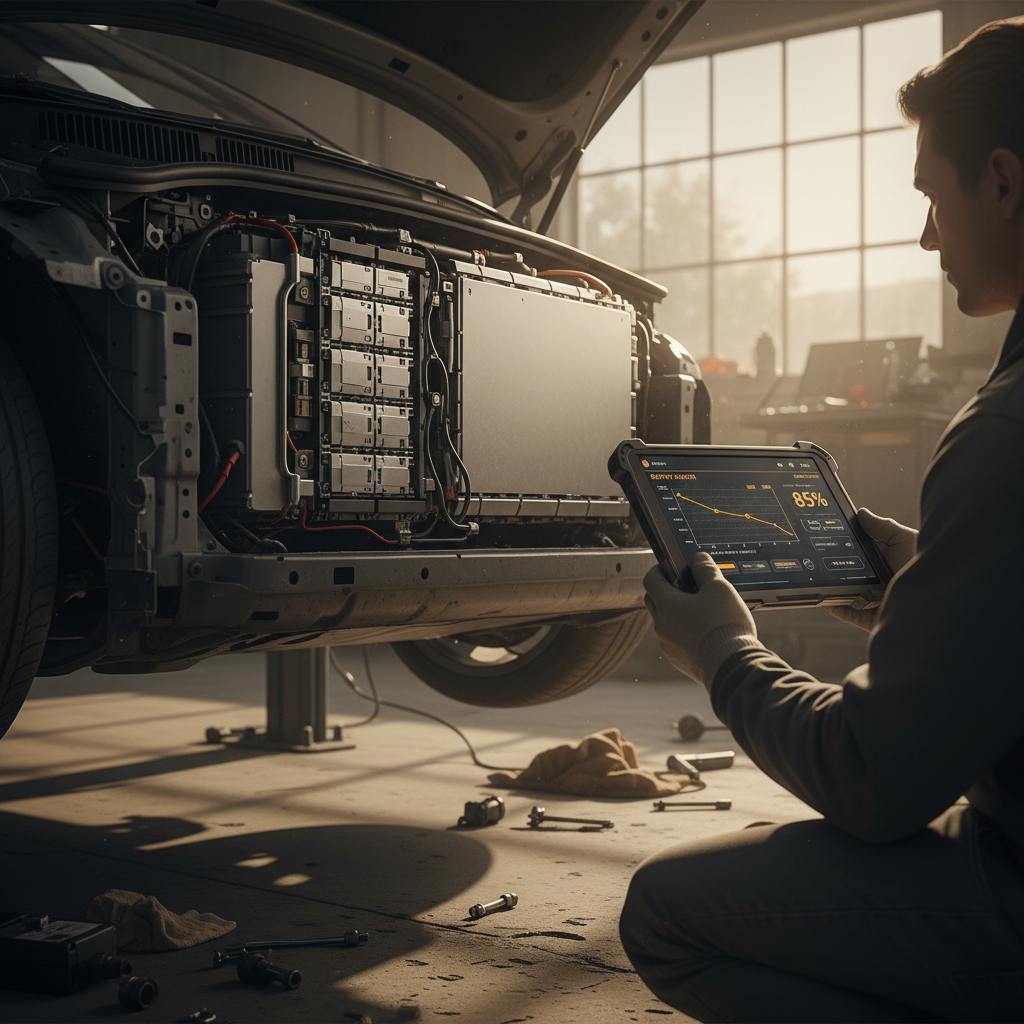
California doesn’t yet require a formal state battery inspection, but for your wallet, that high-voltage pack is the main event. On many EVs, a replacement battery can rival the value of the car itself. That’s why serious used-EV buyers treat battery health like the new version of a compression test on an old V8.
Key ways to evaluate EV battery health
You want data, not just a range estimate on the dash.
Capacity vs. original
Look for a report that shows estimated remaining capacity compared with the original (for example, 88% of original).
That’s a clearer picture than dash bars alone.
Fast-charging behavior
Healthy batteries accept DC fast charge without throttling too early.
If charging speed falls off sharply, the pack may be tired or heat-stressed.
Thermal management history
Frequent DC fast charging, hot-climate use, or cooling-system faults can age a pack prematurely.
Service records and diagnostic scans help fill in the picture.
How Recharged tackles battery health
Registration, title, and paperwork checks for EVs
When you register or transfer an electric car in California, the paperwork side looks a lot like it does for a gas car, minus the Smog Check line. The DMV is interested in ownership, taxes, and title brands more than the fact that the car runs on electrons.
Common California paperwork scenarios for electric cars
Use this table to understand what the DMV is likely to ask from you when there’s an EV involved.
| Scenario | What you’re doing | Typical state requirements for an EV | Inspection angle |
|---|---|---|---|
| Renewing registration on a California EV | You already own the car and it’s registered in-state. | Pay registration fees; no smog certificate needed for a fully electric vehicle. | No emissions inspection; DMV may still flag recalls or unpaid fees. |
| Buying a used EV from a private seller in CA | Title transfer between residents. | Signed title, odometer disclosure, transfer fees. Smog certificate is not required for a fully electric car. | No state inspection, but you should do a private pre-purchase inspection. |
| Bringing an EV into CA from another state | Registering an out-of-state EV in California. | Out-of-state title, VIN verification, proof of insurance, payment of fees and any use tax. | VIN check is common; no smog check required for a fully electric EV. |
| Registering a revived-salvage EV | Putting a repaired, previously totaled EV back on the road. | Proof of repairs, salvage paperwork, inspection appointments, and standard registration forms. | CHP or DMV salvage/VIN inspection plus BAR safety systems inspection. |
Always read your renewal or transfer notice carefully, DMV will flag what’s required for your specific car.
Watch the title brand
How Recharged handles inspections on used EVs
If you’d rather not become your own DMV clerk and field inspector, one option is to start with a car that’s already been through a rigorous EV-focused review. That’s exactly what Recharged was built for.
- Recharged Score battery diagnostics that verify pack health and estimated usable range, far beyond what a basic test drive can tell you.
- Full safety and systems inspection covering brakes, tires, suspension, lights, and high-voltage components for issues or past damage.
- Title and history review so you know if a car has ever been branded salvage, flood, or lemon, and what that means for you.
- Transparent pricing and financing designed around used EVs, plus trade-in options if you’re coming out of a gas car.
- Digital buying experience with nationwide delivery, backed by EV-specialist support instead of generic dealership scripts.
For California buyers specifically
FAQ: California electric car inspection requirements
Frequently asked questions about California EV inspections
Bottom line for California EV inspection rules
In California, the phrase “electric car inspection requirements” can be misleading. The state largely leaves fully electric cars out of its smog program, and it doesn’t require annual safety inspections for everyday EV drivers. Where inspections do show up is around identity, safety, and salvage history, and that’s where you need to be sharp when you’re buying used.
If you’re shopping for a used EV, treat a deep battery and safety inspection as non‑negotiable, especially on any car with a complicated past. You can piece that together yourself with specialists and paperwork, or you can start with vehicles that already have transparent battery health data and safety checks baked in, like the used EVs listed on Recharged. Either way, understanding California’s rules, and where they stop, is your best tool for getting an electric car you’ll trust for years.