You don’t buy a luxury electric SUV just for the light show and the leather. If you’re looking at a Cadillac Lyriq, you also want to know exactly how it performs in **crash tests** and how its **safety ratings** stack up against rival EVs from Tesla, BMW, Mercedes, and Hyundai. The good news: the Lyriq’s core safety story is strong, 5‑star crash scores and top-tier IIHS crashworthiness, though there are a couple of important footnotes you should know about.
Quick safety snapshot
Cadillac Lyriq safety overview
The Lyriq arrived as Cadillac’s first ground‑up EV for the 2023 model year. Structurally, it benefits from a low, heavy battery pack sandwiched in the floor, stout crash structures at both ends, and a wide footprint, all friends of physics when crashes happen. By the **2024–2026 model years**, both U.S. safety agencies agree that the Lyriq is fundamentally a very safe midsize luxury SUV.
Cadillac Lyriq safety by the numbers
The catch: headlights & AEB nuance
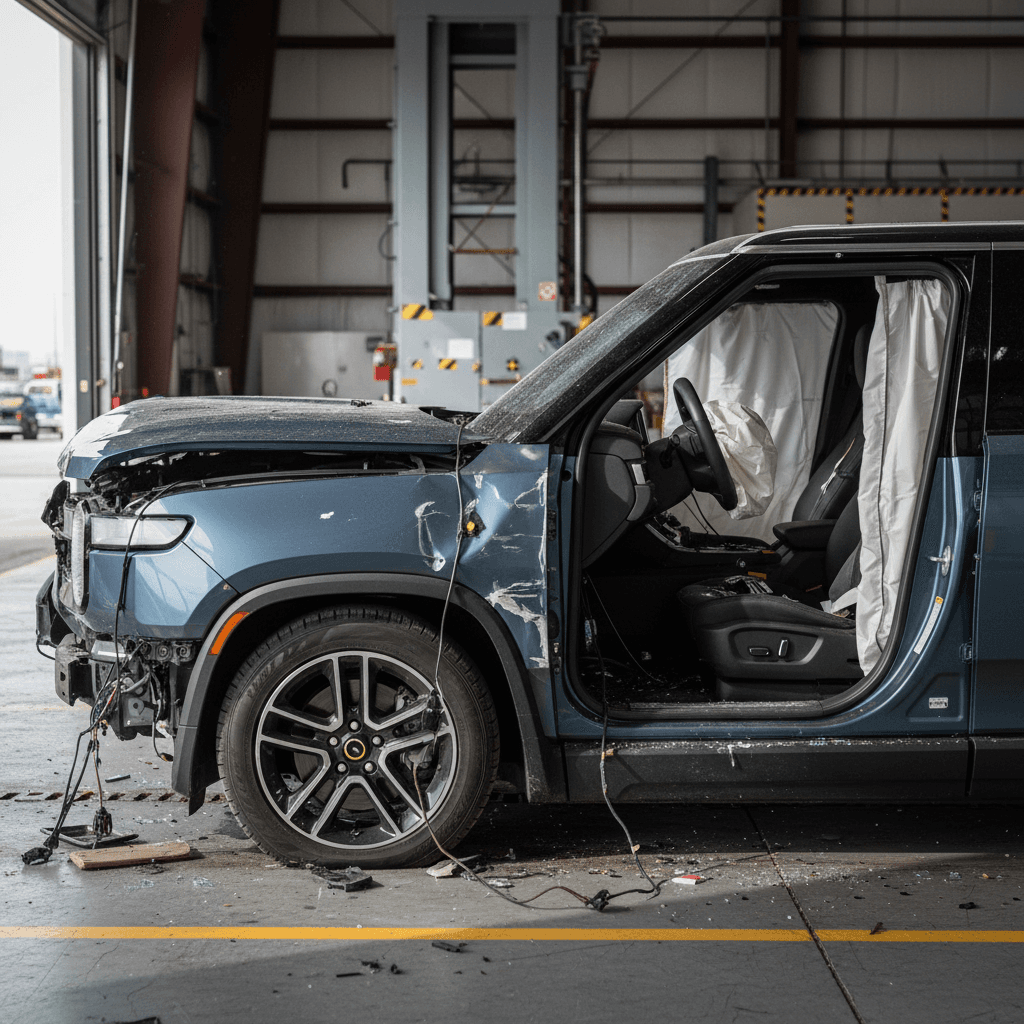
NHTSA crash tests: 5-star safety ratings explained
Let’s start with the blunt instrument of safety metrics: the **NHTSA 5‑Star Safety Ratings**. For many shoppers, this is the number on the window sticker that makes or breaks a deal. The Cadillac Lyriq clears that bar easily.
NHTSA safety ratings for Cadillac Lyriq
Summary of published NHTSA results for 2024–2025 Cadillac Lyriq models.
| Model year | Drivetrain | Overall rating | Frontal crash (overall) | Side crash (overall) | Rollover rating | Rollover risk |
|---|---|---|---|---|---|---|
| 2024 Lyriq | RWD | 5 stars | 5 stars | 5 stars | 5 stars | 0.09 |
| 2024 Lyriq | AWD | 5 stars | 5 stars | 5 stars | 5 stars | 0.09 |
| 2025 Lyriq | RWD | 5 stars | 5 stars | 5 stars | 5 stars | 0.09 |
Ratings are out of 5 stars; higher is better.
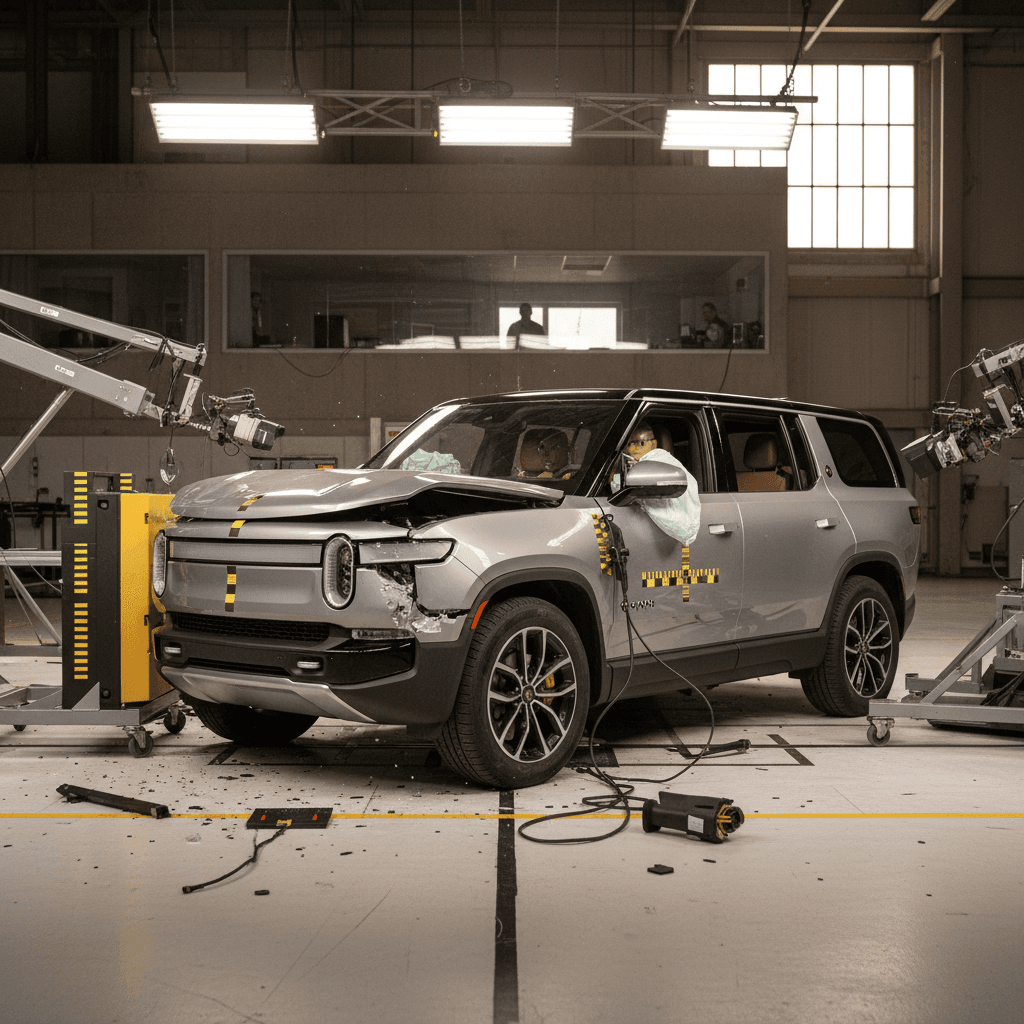
The government’s frontal crash test is a 35‑mph full‑width barrier impact; NHTSA then looks at head, chest, and leg loads for both driver and front passenger. In the Lyriq, those numbers translate to **5‑star frontal scores** for the driver and 4–5 stars for the passenger depending on configuration, still squarely in the top tier for this class.
Side impact is where tall, heavy SUVs often struggle, but the Lyriq again delivers **5‑star driver and rear‑seat occupant ratings**, plus a 5‑star result in the more severe pole test, where the car is hurled sideways into a narrow pole to simulate hitting a tree or utility pole. The curtain and torso airbags do the heavy lifting here, and they appear to do it well.
Rollover risk is unusually low for an SUV, **0.09 according to NHTSA’s calculations**. That’s the Tesla‑like benefit of a battery‑in‑the‑floor skateboard chassis: the center of gravity is so low it takes real violence to get the thing on its roof.
How to interpret 5-star ratings when cross‑shopping
IIHS crash tests and the headlight asterisk
The **Insurance Institute for Highway Safety (IIHS)** tends to be tougher than NHTSA, and its awards, Top Safety Pick and Top Safety Pick+, have become shorthand for best‑in‑class safety. Here, the Lyriq is a bit of a straight‑A student with bad handwriting: the crash scores are stellar, but the lighting lets the car down.
IIHS ratings for 2024–2026 Cadillac Lyriq
Crashworthiness and safety system performance as evaluated by IIHS.
| Category | Test / Feature | Rating |
|---|---|---|
| Crashworthiness | Small overlap front (driver) | G |
| Crashworthiness | Small overlap front (passenger) | G |
| Crashworthiness | Moderate overlap front (updated) | G |
| Crashworthiness | Side impact (updated) | G |
| Crashworthiness | Seat/head restraints | G |
| Crash avoidance | Front crash prevention: vehicle‑to‑vehicle 2.0 | G |
| Crash avoidance | Front crash prevention: pedestrian (daytime) | A |
| Crash avoidance | Front crash prevention: pedestrian (night) | A |
| Lights | Headlights (all trims) | P (Poor) or P/A depending on year/trim |
| Child safety | LATCH ease of use | G |
| Other | Seat belt reminders | G |
“G” = Good, “A” = Acceptable, “M” = Marginal, “P” = Poor.
IIHS tested a **2024 Lyriq** and applied its crashworthiness ratings through the **2026 model year**, since there were no structural changes. In the hardware‑meets‑concrete tests, small overlap, moderate overlap, and the newer, more brutal side impact, the Lyriq earns straight **“Good”** scores. The safety cage holds up, intrusion into the cabin is limited, and the dummies walk away metaphorically intact.
Where IIHS dings the Lyriq is its **headlights**, initially rated **“Poor” on 2024 models** due to glare and inadequate illumination on curves, even though the units are LED projectors with automatic high‑beams. Cadillac has been iterating, and some trims move closer to **“Acceptable”**, but the result is the same: the Lyriq **misses out on a Top Safety Pick award primarily because of its lighting, not its crash structure.**
Night driving caution
Cadillac Lyriq safety features and driver aids
On paper, the Lyriq looks like a safety‑tech demo car. Cadillac bundles a **Cadillac Smart System–style suite of standard driver aids**, plus optional hands‑free **Super Cruise** on many trims. Most used Lyriqs you’ll see on the market have a rich set of active safety features baked in.
Core Cadillac Lyriq safety and driver-assistance tech
Most features are standard across trims; verify options like Super Cruise when you shop used.
Crash protection basics
- Strong passenger safety cage and multiple load paths
- Front, side, curtain, and knee airbags
- Seat-belt pretensioners and load limiters front and rear
Situational awareness
- Blind spot monitoring and lane change alert
- Rear cross-traffic alert and rear automatic braking
- HD rear vision camera; many have 360° surround view
Lane-keeping & cruising
- Lane keep assist with lane departure warning
- Available adaptive cruise control
- Available Super Cruise hands-free highway driving on mapped roads
Automatic braking & pedestrians
- Automatic emergency braking with forward collision alert
- Front pedestrian braking and bicyclist detection on newer models
- Enhanced AEB in many 2024+ trims
Family-focused features
- Rear seat reminder
- Teen Driver mode with report cards and configurable limits
- Well-rated LATCH anchors for child seats
Connected safety
- OnStar automatic crash notification subscription-dependent
- Over-the-air software updates for some safety systems
- Vehicle diagnostics to flag issues early
Super Cruise & safety
Safety tech to verify on a Cadillac Lyriq
1. Confirm standard AEB and lane keeping
Every Lyriq should have automatic emergency braking and lane keep assist, but double‑check that these are active in the settings menu and that no dashboard warning lights are on during your test drive.
2. Look for Super Cruise
If you want hands‑free highway driving, verify the car actually has Super Cruise hardware and an active or renewable subscription. Some cars are pre‑wired but not fully enabled.
3. Inspect cameras and sensors
Walk around the vehicle and confirm front/rear cameras and radar sensors are intact, with no cracked lenses or missing sensor covers, especially important on used vehicles that may have had minor collisions.
4. Test parking and reverse braking
In a safe, open area, slowly back toward an obstacle (like a traffic cone) to see if rear parking assist and reverse automatic braking intervene as expected.
5. Ask about software updates
Dealers and previous owners don’t always apply over‑the‑air or service‑department updates that improve performance of AEB, Super Cruise maps, or camera behavior. Ask for service records and update history.
Does the Lyriq-V change the safety picture?
For 2026, Cadillac adds the **Lyriq‑V**, a performance‑tuned version with well over 600 hp available in its most aggressive drive modes. The question is obvious: does bolting a rocket pack onto the Lyriq compromise safety?
What stays the same
- The underlying crash structure and battery skateboard are shared with mainstream Lyriq trims.
- Airbag coverage, seat design, and basic driver-assistance suites carry over.
- IIHS applies its existing crashworthiness ratings through at least the 2026 model year.
What changes with Lyriq‑V
- Higher power output and quicker acceleration, around 3.3 seconds 0–60 mph in testing.
- Retuned suspension, larger brakes, and performance tires for better control.
- Potentially shorter stopping distances, but also more speed to manage in the real world.
In other words, the **passive safety**, what happens when things go wrong, is still strong. But the envelope of what’s possible in this 5,000‑plus‑pound SUV gets much wilder. The Lyriq‑V is the sort of car that can quietly arrive at triple‑digit speeds; it demands a driver who understands that just because the systems will *help* you, they will not save you from bad judgment.
Performance amplifies your choices
Real‑world safety: what the ratings don’t tell you
Crash tests are snapshots: controlled impacts, instrumented dummies, lab‑bright lighting. Real life is messier. When you’re deciding whether a Lyriq feels safe enough for your family, it’s worth thinking beyond the scorecards.
Real-world safety factors for Cadillac Lyriq owners
Crash-test ratings are the foundation; the rest is how and where you drive.
Weight and crash partners
Weather & tires
Battery and fire safety
Repair quality after crashes
Night-driving upgrade strategies
Buying a used Cadillac Lyriq: safety checks that matter
The Lyriq is already moving into the **used EV** market in meaningful numbers, which is where Recharged lives. A used luxury EV can be a screaming deal, if you know what you’re getting. Beyond the usual cosmetic and range checks, you should give safety a front‑row seat in your inspection.
Used Cadillac Lyriq safety checklist
1. Pull a full history report
Look for **structural damage, airbag deployments, or flood history**. A Lyriq that’s taken a serious hit may not protect you the way GM and the crash labs intended.
2. Verify airbag and seat-belt systems
Confirm no airbag or seat‑belt warning lights are illuminated. Buckle and unbuckle every seating position; look for proper tensioning and latch operation.
3. Inspect ADAS sensors and cameras
Check the front grille, rear bumper, side mirrors, and windshield for replaced or misaligned components. If a seller has photos from a small collision, assume at least an alignment and sensor calibration are needed.
4. Test all driver-assistance features
Safely test lane keep assist, adaptive cruise (if equipped), blind spot warning, parking sensors, and automatic emergency braking. These systems should intervene smoothly, not jerkily or inconsistently.
5. Review software and recall status
Ask for documentation of completed recalls and software campaigns. Some Lyriq updates address behavior of safety features, not just infotainment quirks.
6. Evaluate tires and brakes
Oversized wheels with cheap tires are a safety tax. Make sure tread depth and tire load/speed ratings meet factory spec, and that brake feel is firm and consistent.
Where Recharged fits in
How Recharged evaluates Lyriq safety and battery health
For used EVs, crash‑test data is just the opening argument. What really matters is **how your specific vehicle has lived**. That’s the gap the Recharged Score Report is designed to close.
Inside a Recharged Cadillac Lyriq evaluation
Beyond a basic Carfax and a quick walk‑around.
Battery & high-voltage health
- Capacity and degradation estimate vs. original spec
- DC fast‑charging history where available
- HV system fault codes and thermal events
Structural & safety integrity
- Underbody and crash structure inspection
- Signs of poorly repaired collision damage
- Verification of airbag modules and seat belts
ADAS & software validation
- Camera, radar, and ultrasonic sensor checks
- Calibration status where accessible
- Confirmation of major safety-related software updates
Ready to find your next EV?
Browse VehiclesBecause Recharged operates fully digitally, with optional delivery and an **Experience Center in Richmond, VA**, you can shop used Lyriqs nationwide while still getting **specialist EV guidance**. If you’re torn between two Lyriqs with similar mileage but different accident histories or option packages, an expert can walk you through which one is the better long‑term safety bet.
Cadillac Lyriq safety FAQ
Frequently asked questions about Cadillac Lyriq safety
Bottom line: is the Cadillac Lyriq a safe EV?
Viewed purely through the crash‑test lens, the **Cadillac Lyriq is absolutely a safe electric SUV**. It posts 5‑star NHTSA ratings, aces the IIHS crashworthiness gauntlet, and layers on a thick spread of modern driver‑assistance tech. The fine print is mostly about **headlights and nighttime pedestrian detection**, not about the integrity of the shell or the behavior of the battery in a crash.
If you’re shopping new, that means you can choose a Lyriq with confidence, as long as you’re realistic about its lighting and don’t treat the electronics as a get‑out‑of‑physics‑free card. If you’re shopping **used**, the homework shifts to **how that specific vehicle has been driven, maintained, and (if necessary) repaired**. That’s where tools like the **Recharged Score Report, expert EV inspections, and transparent accident histories** turn an opaque gamble into an informed decision.
In a market crowded with flashy electric crossovers, the Lyriq’s safety story is refreshingly straightforward: strong bones, smart tech, and a couple of quirks. Understand those quirks, and buy from a seller who takes EV safety as seriously as you do, and the Lyriq can be a calm, confident choice for your driveway.