If you’re eyeing a Cadillac Lyriq, or you already have one, the big money question is simple: what does it cost per mile to charge? With electricity prices climbing and range numbers all over the place, you want a clear answer, not marketing fluff. In this guide, we’ll break down Cadillac Lyriq charging cost per mile using current U.S. electricity prices, EPA efficiency numbers, and realistic driving examples so you can budget with confidence.
Short answer
Cadillac Lyriq charging cost per mile: quick overview
Typical Cadillac Lyriq charging costs (2026)
The Cadillac Lyriq uses GM’s Ultium battery platform with about 100–102 kWh of usable capacity and combined EPA energy consumption around 36–40 kWh per 100 miles, depending on model and wheels. That efficiency number is what you’ll use to work out your actual cost per mile.
On the electricity side, U.S. residential prices have climbed in recent years. Depending on whose data you use, the nationwide average is roughly $0.17–$0.19 per kWh as of late 2025 and early 2026. Some states are still down near $0.12 per kWh; others are well over $0.25. That spread is why your neighbor in another state may pay a very different rate per mile than you do.
Remember this range
How efficient is the Cadillac Lyriq?
To estimate cost per mile, you need to know how many kilowatt‑hours (kWh) of electricity the Lyriq uses per 100 miles. The EPA and Cadillac publish efficiency figures; they vary slightly by model year, drivetrain, and wheels, but you can use these ballpark numbers:
Cadillac Lyriq efficiency estimates
Approximate combined energy use for recent Lyriq models. Your real‑world results will vary with speed, weather, and driving style.
| Model / configuration | Drivetrain | EPA-style energy use (kWh/100 mi) | Miles per kWh (approx.) |
|---|---|---|---|
| Lyriq single‑motor (RWD), smaller wheels | RWD | ~36 | 2.8 mi/kWh |
| Lyriq dual‑motor (AWD), standard wheels | AWD | ~38 | 2.6 mi/kWh |
| Lyriq performance / larger wheels | AWD | ~40 | 2.5 mi/kWh |
Use these figures as a starting point for your own cost‑per‑mile math.
Owner reports line up roughly with these figures. Many Lyriq drivers see about 2.6–3.2 miles per kWh in mixed driving, more in ideal mild‑weather conditions and less in winter or at high interstate speeds. For our examples, we’ll use a middle‑of‑the‑road efficiency of 2.7–2.8 mi/kWh (about 36–38 kWh/100 mi).
Check your own efficiency
Step-by-step: how to calculate your cost per mile
You don’t need a spreadsheet, just a couple of simple steps. Once you understand the math, you can plug in your own numbers in under a minute.
How to calculate Cadillac Lyriq charging cost per mile
1. Find your electricity price per kWh
Look at your latest electric bill or your utility’s online portal. You want the <strong>total cost per kWh</strong>, including delivery and fees, not just the energy line. If the bill is confusing, divide your total bill (minus fixed fees if you know them) by total kWh used for the month.
2. Get your Lyriq’s efficiency
Use the Lyriq’s <strong>mi/kWh readout</strong> or an EPA‑style number like 36–38 kWh/100 mi. If you have mi/kWh, convert it: 100 ÷ (mi/kWh) = kWh/100 mi.
3. Convert to kWh per mile
Take your kWh/100 mi figure and <strong>divide by 100</strong>. Example: 38 kWh/100 mi ÷ 100 = 0.38 kWh per mile.
4. Multiply by your electricity rate
Multiply kWh per mile by your cost per kWh. Example: 0.38 kWh/mi × $0.17/kWh = <strong>$0.0646 per mile</strong> (~6.5 cents per mile).
5. Estimate monthly or annual cost
Multiply cost per mile by your miles driven. Example: $0.065/mi × 1,000 miles/month ≈ <strong>$65/month</strong> in electricity, or about $780 per year.
Back‑of‑the‑napkin shortcut
Example: what a Lyriq owner pays in different states
Let’s say your Lyriq averages 38 kWh/100 miles (0.38 kWh per mile). We’ll run the same car through three different electricity‑price scenarios using 2025–2026‑style rates: a relatively cheap state, a near‑average state, and a high‑cost state.
Cadillac Lyriq cost per mile at different electricity prices
All examples assume 38 kWh/100 mi (0.38 kWh/mi) and 1,000 miles/month of driving.
Lower‑cost power (~$0.13/kWh)
Example: parts of the Midwest or Pacific Northwest.
- Cost per mile: 0.38 × $0.13 ≈ $0.049/mi
- 1,000 mi/month: about $49
- 12,000 mi/year: about $588
Near‑average power (~$0.17/kWh)
Example: close to recent U.S. residential averages.
- Cost per mile: 0.38 × $0.17 ≈ $0.065/mi
- 1,000 mi/month: about $65
- 12,000 mi/year: about $780
Higher‑cost power (~$0.25/kWh)
Example: expensive coastal or island markets.
- Cost per mile: 0.38 × $0.25 ≈ $0.095/mi
- 1,000 mi/month: about $95
- 12,000 mi/year: about $1,140
Watch your off‑peak discounts
Home charging vs. public fast charging cost per mile
So far we’ve assumed you’re charging the Lyriq at home. Public DC fast charging, especially along interstates, is priced very differently. Think of it as paying a convenience premium for speed and location.
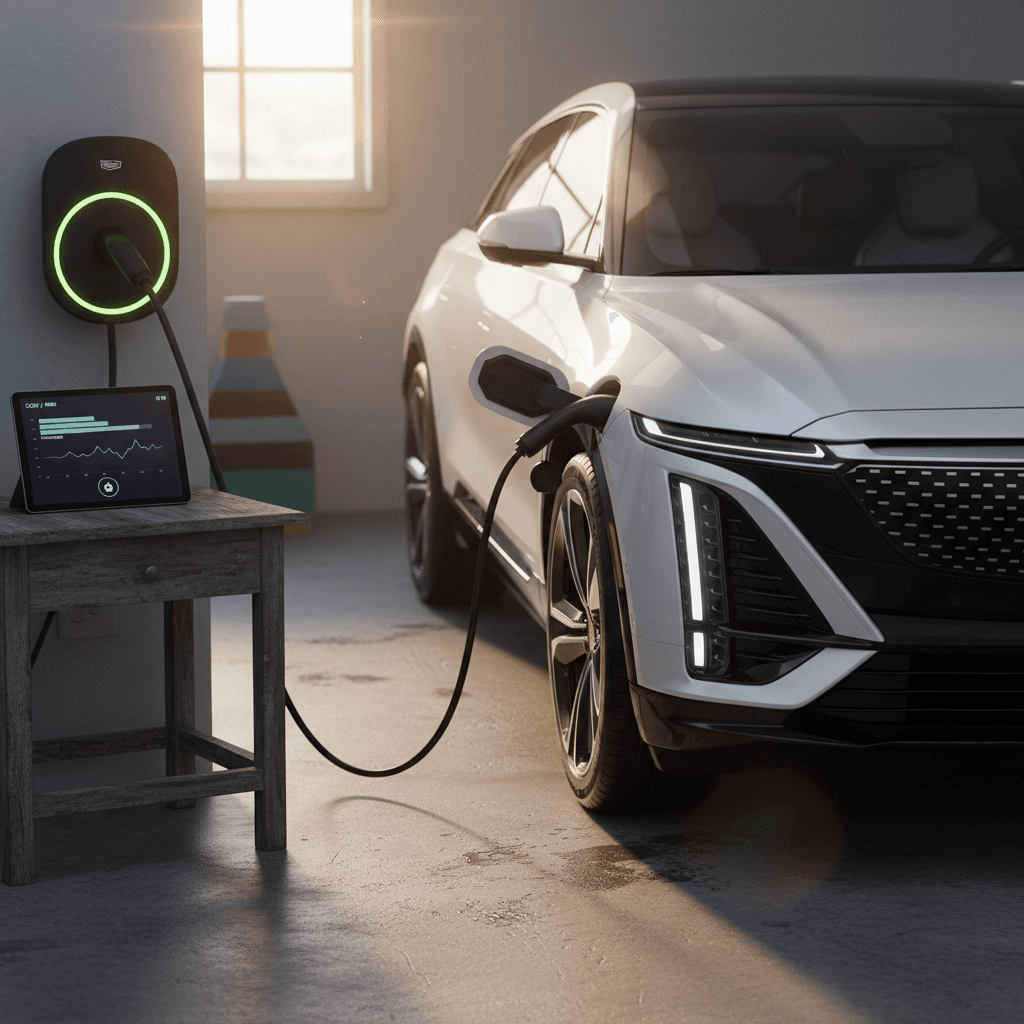
Level 2 home charging
- Uses 240‑volt AC power in your garage or driveway.
- Price is based on your residential kWh rate, which might average $0.13–$0.20/kWh in many areas.
- Using 38 kWh/100 mi, that’s roughly $0.05–$0.08 per mile.
- Best for daily driving and regular commuting.
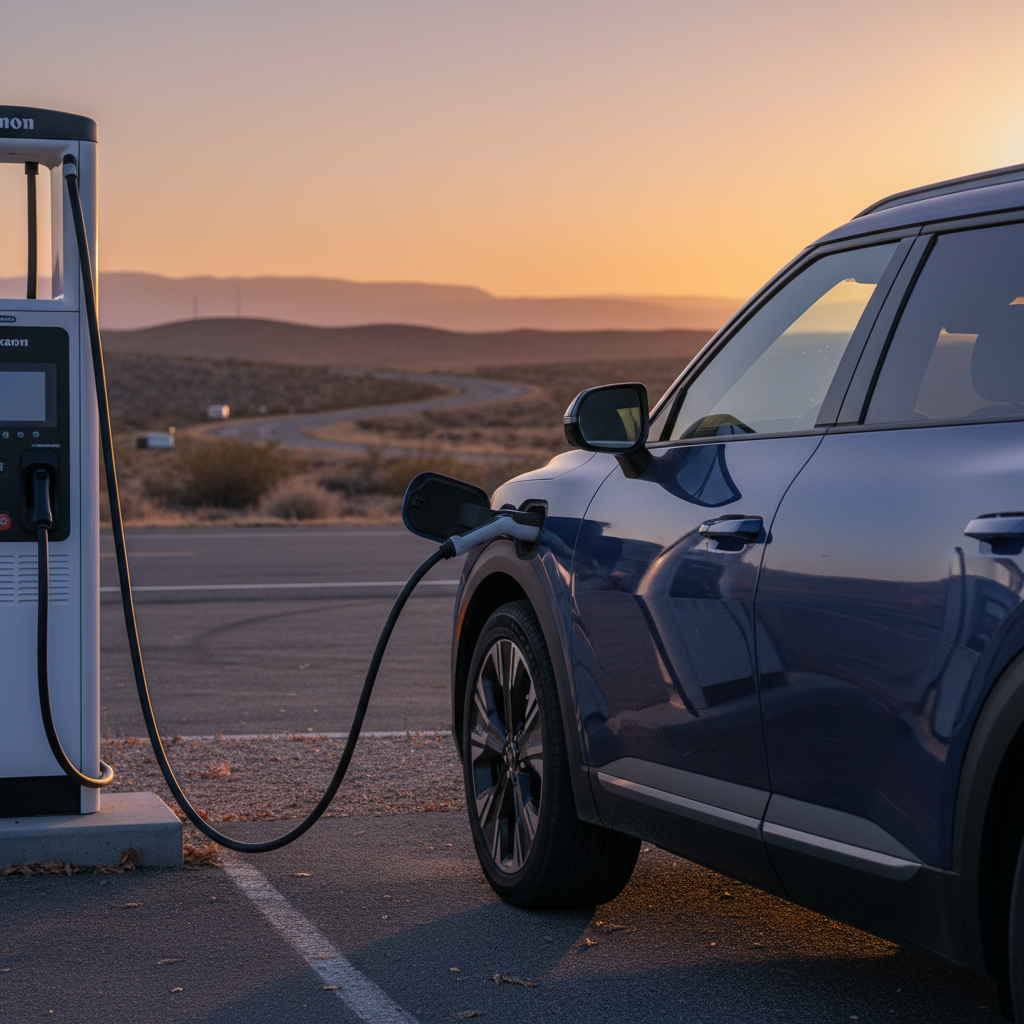
DC fast charging (public)
- High‑power chargers along highways and in busy metro areas.
- Often priced per kWh (for example, $0.35–$0.50/kWh) or per minute.
- At $0.40/kWh and 38 kWh/100 mi, you’re at about $0.15 per mile.
- Great for road trips, not ideal as your everyday fueling plan.
Don’t plan to live on fast chargers
What changes your Lyriq charging cost per mile?
- Electricity price: The biggest lever. A Lyriq in a 12¢/kWh state has dramatically lower running costs than one in a 28¢/kWh state.
- Driving speed: The Lyriq is far more efficient at 45–65 mph than at 80 mph. High sustained speed can push you from ~2.9 mi/kWh down toward 2.3–2.5 mi/kWh.
- Temperature and climate: Cold weather hurts EV efficiency by increasing battery heating demands and cabin heating. You’ll see your cost per mile climb in winter.
- Wheel size and tires: Big, flashy wheels and stickier tires can trim range and raise kWh/100 mi. If you care about cost per mile, base wheels and efficiency‑oriented tires help.
- Load and terrain: Extra passengers, cargo, and hilly routes all demand more energy, raising your cost per mile.
- Charging losses: A little energy is always lost as heat while charging, especially at very high or very low states of charge. That’s why your wall‑metered kWh for a session is slightly higher than what the battery actually stores.
Expect a seasonal swing
Practical ways to lower your Lyriq charging costs
Simple tactics that actually move the needle
Schedule charging for off‑peak hours
If your utility offers a time‑of‑use plan, set your Lyriq to start charging overnight when rates are lowest. Getting power at $0.12 instead of $0.22 per kWh can shrink your cost per mile by nearly half.
Use Level 2 at home as your default
Make home charging the norm and <strong>save DC fast charging for road trips</strong> and rare situations. Even a modestly priced 40‑amp Level 2 charger can pay for itself quickly if it keeps you away from expensive public stations.
Drive a little slower on the highway
You don’t have to hypermile, but knocking your cruising speed from 80 mph down to 70 mph can improve efficiency by a surprising margin and shave a couple of cents off each mile at higher electricity prices.
Precondition while plugged in
Use the Lyriq’s cabin preconditioning while the car is still on the charger. Warming or cooling the cabin on grid power instead of battery power preserves range and effectively lowers your cost per mile on that drive.
Keep tires properly inflated
Underinflated tires increase rolling resistance and energy use. Check your pressures regularly, especially when seasons change, and follow the placard in the driver’s door jamb.
Shop your electric plan
In deregulated markets you may be able to switch suppliers or plans. Even in regulated markets, utilities sometimes offer EV‑specific rates or off‑peak discounts if you enroll and provide proof of EV ownership.
Real‑world owner benchmark
Cadillac Lyriq cost per mile vs. gas luxury SUVs
To put all this in context, let’s stack the Lyriq against a typical gas luxury crossover. Picture a V6 or turbo‑4 midsize SUV that averages about 22 mpg on regular gas and maybe 20 mpg on premium in real life.
Cadillac Lyriq vs. gas SUV: fuel cost per mile
Illustrative comparison using round numbers. Your actual results will depend on local fuel and electricity prices.
| Vehicle | Assumptions | Energy cost | Fuel/energy cost per mile |
|---|---|---|---|
| Cadillac Lyriq (home charging) | 38 kWh/100 mi; electricity $0.17/kWh | 0.38 × $0.17 ≈ $0.065/mi | ≈ $0.07/mi |
| Gas luxury SUV on premium | 22 mpg; premium gasoline $4.00/gal | $4.00 ÷ 22 ≈ $0.18/mi | ≈ $0.18/mi |
| Gas luxury SUV on regular | 24 mpg; regular $3.50/gal | $3.50 ÷ 24 ≈ $0.145/mi | ≈ $0.15/mi |
Assumes Lyriq using 38 kWh/100 mi at $0.17/kWh; gas SUV assumes 22 mpg and $4.00/gal premium.
Even if you live in a high‑cost electricity state and your Lyriq comes in around $0.09–$0.10 per mile, you’re still typically spending meaningfully less per mile than a comparable gas SUV that drinks premium. The savings compound quickly once you’re driving 10,000–15,000 miles a year.
Buying a used Lyriq: look beyond cost per mile
If you’re shopping for a used Cadillac Lyriq, cost per mile is only one piece of the ownership puzzle. Electricity is cheap compared with gasoline, but you still want to know that the battery is healthy, the car is priced fairly, and you have a clear picture of real‑world range.
Used Lyriq checklist: what smart shoppers verify
Especially important if you’re counting on low running costs over many years.
Battery health
Ask for verified battery diagnostics, not just the dash range estimate. A healthy Ultium pack is key to keeping your cost per mile low over the long haul.
Fair market price
Compare asking price against similar Lyriqs by model year, mileage, and trim. EV values can swing more quickly than gas cars as incentives and interest rates change.
Realistic range
Consider your typical routes and weather. If you regularly do 200‑mile winter drives, you’ll want a margin above the EPA range to stay comfortable.
How Recharged can help
Cadillac Lyriq charging cost per mile: FAQ
Frequently asked questions about Lyriq charging costs
Bottom line: what you should budget
When you strip away the marketing and do the math, a Cadillac Lyriq is genuinely efficient to run. For most U.S. drivers in 2026, a realistic Cadillac Lyriq charging cost per mile is around $0.05–$0.08 at home and roughly $0.12–$0.18 on public DC fast chargers. Where you land in that range depends on your electricity rate, how you drive, and how often you fast charge.
If you’re cross‑shopping the Lyriq against a gas luxury SUV, those pennies per mile add up to hundreds or even thousands of dollars a year in fuel savings, especially if you drive a lot or live where gasoline is expensive. And if you’re considering a used Lyriq, pairing that low per‑mile energy cost with a verified battery‑health report, like the Recharged Score you get when you buy through Recharged, is one of the smartest ways to make sure the numbers keep working in your favor for years to come.