You can find a used electric vehicle on a dealer lot, in a neighbor’s driveway, or on a marketplace app at 11 p.m. in your pajamas. The hard part is deciding whether buying a used EV from a dealer vs private seller is actually safer, smarter, and worth the money, especially when a single bad battery can turn a bargain into a five‑figure regret.
Context: used EVs in 2026
Why this decision matters more with EVs
With a gas car, the list of things that can hurt you is long but familiar: transmissions, head gaskets, timing chains. With an EV, the list of moving parts is shorter, but the stakes are higher. The high‑voltage battery pack is the beating heart of the car and often the single most expensive component. Depending on size, a replacement pack can easily run into the five figures once you add labor, which is why the choice of where you buy, a dealer or a private seller, matters more for EVs than for comparable gas cars.
Used EV reality check
Quick take: dealer vs private for used EVs
Dealer vs private seller at a glance
How the two paths stack up when you’re shopping for a used EV.
| Factor | Dealer | Private seller |
|---|---|---|
| Upfront price | Higher asking price, plus fees | Often lower price, fewer fees |
| Battery transparency | Sometimes; varies widely by dealer | Rare unless owner has reports |
| Warranty | Factory + dealer or CPO coverage more common | Usually "as‑is" once factory warranty ends |
| Financing | On‑site or partner lenders, lower friction | You arrange your own loan or pay cash |
| Paperwork | Dealer handles title, tax, registration | You handle DMV and tax yourself |
| Selection | More late‑model mainstream EVs | More hit‑or‑miss; niche or older models |
| Consumer protections | State & federal dealer rules apply | Minimal protections; you’re on your own |
Summary comparison of the main differences when buying a used EV from a dealer vs a private seller.
30‑second rule of thumb
How buying a used EV differs from a gas car
What matters more with an EV
- Battery health & history – Fast‑charging habits, climate, and mileage all influence remaining capacity.
- Software & updates – Range estimates, charging speeds, and even safety features can change with software.
- Charging compatibility – What plug type does it use? Can it access networks you care about?
- Warranty status – Many EVs carry 8‑year/100,000‑mile battery warranties that may still be in play.
What matters less (but not zero)
- Oil changes & tune‑ups – They don’t exist, so service history looks different.
- Exhaust or transmission trouble – No tailpipe, no multi‑gear transmission.
- Warm‑up wear – Electric drivetrains aren’t cold‑start sensitive in the same way.
- Minor idle noises – EVs are quiet, so small rattles are easier to notice but often cheap to fix.
The trap: treating EVs like any other used car
Pros and cons of buying a used EV from a dealer
Dealer advantages and drawbacks for used EVs
The safety net is real, but you pay for the net.
Pros of buying from a dealer
- More protections – Dealers must follow disclosure rules and are subject to state and federal consumer laws.
- Warranty options – You’re more likely to find EVs still under factory warranty, plus certified pre‑owned programs and third‑party EV warranties.
- Financing & trade‑in – On‑site financing, trade‑in appraisals, and one‑stop paperwork can make the process smoother.
- Selection of mainstream EVs – Dealers cluster around popular models: Tesla Model 3/Y, Chevy Bolt, Nissan Leaf, Hyundai/Kia crossovers, etc.
- Some level of inspection – Most franchised dealers at least do a basic safety and functionality check.
Cons of buying from a dealer
- Higher prices – You’re paying for overhead, a warranty, and a margin; EVs on dealer lots often list higher than similar private‑party cars.
- Fees and add‑ons – Doc fees, processing fees, mandatory add‑ons, and marked‑up service contracts are common.
- Battery opacity – Many dealers still don’t run or share meaningful battery health diagnostics; you may get little more than "seems fine".
- Sales pressure – Cross‑selling of paint protection, GAP insurance, and accessories hasn’t gone out of style.
Focus on EV‑literate dealers
Pros and cons of buying a used EV from a private seller
Private seller advantages and drawbacks for used EVs
More price flexibility, much less safety net.
Pros of buying from a private seller
- Lower prices – Without dealer overhead and fees, private sellers often undercut dealer pricing by hundreds or thousands of dollars.
- Flexible negotiations – You’re dealing with one person, not a sales desk; if they need the driveway space or the cash, you have leverage.
- Unfiltered history – A conscientious one‑owner seller can give you detail that never shows up in a Carfax: charging habits, daily routes, quirks.
- Access to niche cars – Off‑beat specs (like unusual colors or high‑spec trims) and older EVs show up more often in private listings.
Cons of buying from a private seller
- Usually sold “as‑is” – Once you hand over the money and sign the title, any problem is your problem unless you can prove outright fraud.
- No built‑in financing – You’ll need cash or a pre‑arranged loan; there’s no F&I office to smooth things over.
- DIY due diligence – You’re responsible for arranging inspections, pulling history reports, and verifying there are no liens or open recalls.
- Paperwork burden – Title, bill of sale, registration, and sales tax all run through you and your DMV.
- Higher risk of “hidden” EV issues – It’s rare for private sellers to invest in proper EV battery diagnostics before listing.
Red flags in private EV sales
Battery health and warranty: where the real risk lives
Most used EVs aren’t falling apart. In fact, compared with similar‑age gas cars, they often show less mechanical wear. The wild card is the battery: not whether it works today, but how much usable capacity it still has and how quickly it might degrade from here.
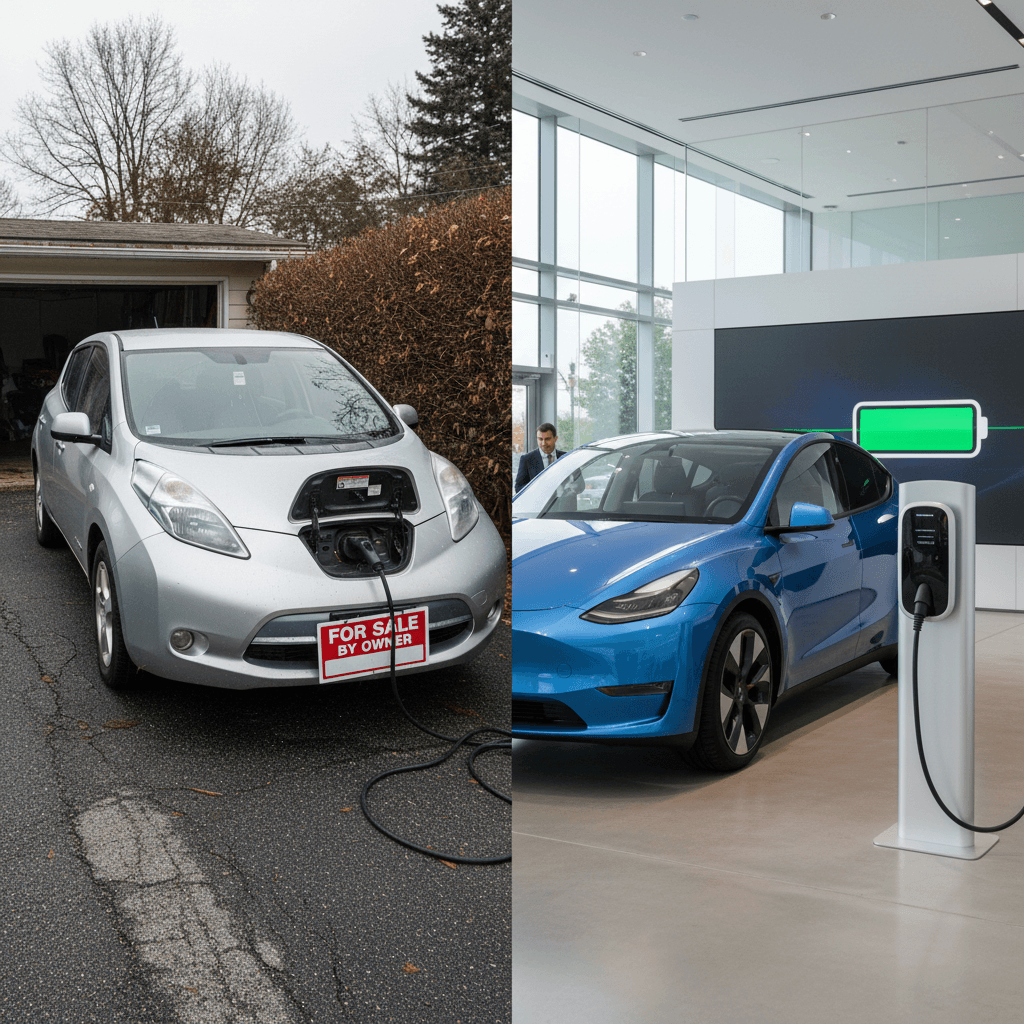
Why battery transparency matters
Battery health isn’t something you can feel in a 10‑minute test drive. A car can drive "normally" yet have lost 20–30% of its original capacity, quietly shrinking your real‑world range and resale value.
- State of Health (SoH) – A quantitative estimate (often shown as a percentage) of remaining battery capacity.
- Charging behavior – A car that spent its life on DC fast chargers in Phoenix has a different future than one trickle‑charged in Seattle.
- Thermal management – Early EVs without proper cooling (notably some older Leafs) are more vulnerable to heat‑related degradation.
How dealers vs private sellers handle it
- Typical dealers – May run a generic OBD scan and a test drive but often don’t provide a clear SoH report.
- Specialist dealers – Increasingly partner with battery‑diagnostic firms to produce formal health reports and offer dedicated EV warranties.
- Private sellers – Rarely provide formal battery reports unless they’re enthusiasts; you may need to bring your own tools or inspection service.
Given that large pack replacements can easily cost five figures, a proper battery report and meaningful warranty often matter more than squeezing out the last $1,000 in price.
Where Recharged fits in
Paperwork, financing, and trade-ins
Romantics love the idea of handing over an envelope of cash and driving off into the sunset. The DMV is less romantic. The more complex your financial life is, loan, trade‑in, taxes across state lines, the more a dealer starts to look like a necessary evil rather than an optional middleman.
What you’re really choosing between
Dealer: friction handled for you
A dealer will typically manage sales tax, title transfer, registration, and lien payoff. You sign a stack of papers, and a few weeks later a plate shows up. They can also roll negative equity into a new loan, dangerous if you’re not careful, but sometimes necessary.
Private: DIY everything
You’re responsible for drafting a bill of sale, verifying the title is clean, settling any existing loan, filing paperwork with the DMV, and paying taxes directly. None of this is rocket science, but it’s time‑consuming and varies by state.
Dealer: integrated financing
At a dealer, you can often compare multiple lenders quickly, including credit‑union partners and manufacturer‑subvented rates for certain models. That can mean lower rates or longer terms than you’d secure solo.
Private: arrange your own loan
You may need a personal loan or a used auto loan that allows private‑party purchases. Those can have higher rates and stricter conditions. Many buyers end up paying cash for private deals, which concentrates risk if something goes wrong.
Trade‑ins vs. selling your car yourself
Dealers and platforms like Recharged can give you an <strong>instant offer</strong> or help with consignment, rolling the value into your next EV. With a private seller, you’ll almost always need to sell your old car separately.
Which option fits your situation?
Buyer profiles: who should buy where?
Risk‑averse, first‑time EV buyer
Prioritize vehicles with documented battery health and at least some remaining battery warranty.
Favour <strong>EV‑savvy dealers</strong>, certified pre‑owned programs, or Recharged over random private listings.
Accept that you’ll pay more than rock‑bottom private‑party prices in exchange for fewer unknowns.
Experienced EV driver, technically confident
Comfortable interpreting battery reports, reading forums, and using OBD tools or paid inspections.
Can safely pursue private‑party deals and niche models, as long as inspections and paperwork are done properly.
Still wise to compare against specialist dealers or Recharged to sanity‑check pricing and risk.
Payment‑sensitive buyer chasing lowest price
Private sellers and auction‑style platforms may offer the biggest sticker savings.
Budget for a <strong>professional EV inspection</strong> and potential repairs; don’t spend every last dollar on the purchase price.
Be extra picky about charging history and climate exposure, heat is hard on batteries.
Busy professional, no time for hassle
Lean toward dealers or digital retailers like Recharged that can bundle financing, trade‑in, inspection, and delivery.
Look for transparent, fixed‑price offers instead of haggling every last fee.
Value your time honestly: two Saturdays at the DMV and on test drives are worth real money.
How Recharged combines the best of dealer and private
Traditional dealers give you convenience and paperwork help but are often flying blind on EV specifics. Private sellers may treat their EVs well but rarely invest in proper diagnostics. Recharged was built to close that gap for used EV buyers.
What you get with Recharged on your side
Dealer‑level support, EV‑specialist data, and the flexibility of a modern marketplace.
Recharged Score Report
EV‑specialist guidance
Modern buying experience
Not local to Richmond? No problem.
Checklist before you commit to any used EV
Pre‑purchase checklist for any used EV (dealer or private)
1. Get a real battery health readout
Ask for a manufacturer battery report, third‑party diagnostic, or Recharged Score. If nobody can show you a number, or they refuse, assume risk and price accordingly, or walk.
2. Confirm remaining battery and drivetrain warranty
Battery warranties often run 8 years/100,000 miles or more. Confirm in writing what’s left and whether it’s transferable to you.
3. Study the charging history and climate
Ask how often the car DC‑fast‑charged, where it lived, and whether it sat at 100% for long periods. Hot climates and fast‑charging abuse speed up degradation.
4. Pull a vehicle history report
Look for accidents, salvage titles, odometer issues, and whether the car came from a region known for extreme heat or flood risk.
5. Do a proper test drive
Drive at highway and city speeds, check range estimates against trip distance, test AC/heat, infotainment, and all driver‑assist and charging functions.
6. Arrange an independent EV inspection
For private sales, and even many dealer cars, paying an EV‑savvy mechanic or service to inspect the car can reveal issues that casual eyes and short test drives miss.
7. Compare total cost, not just sticker price
Include taxes, fees, expected repairs, home‑charging setup, insurance, and financing into your math. A “cheaper” private sale can become more expensive quickly if the battery is marginal.
Used EV dealer vs private: FAQ
Frequently asked questions about buying a used EV from a dealer vs private seller
Bottom line: choose the risk, not just the price
Buying a used EV from a dealer vs a private seller isn’t a moral question, it’s a risk‑allocation question. Dealers usually charge more but carry some of the risk for you through warranties, financing support, and paperwork. Private sellers let you pay less up front but hand you the full risk of what’s lurking inside that battery pack and title history.
If you understand that trade and go in with your eyes open, battery report in hand, inspection booked, financing lined up, you can win either way. If you’d rather not moonlight as your own EV forensic accountant, leaning on an EV‑focused platform like Recharged can give you the price transparency of a marketplace with the safety net of a specialist dealer. However you shop, make the battery health, warranty, and total risk, not just the sticker, do the talking.