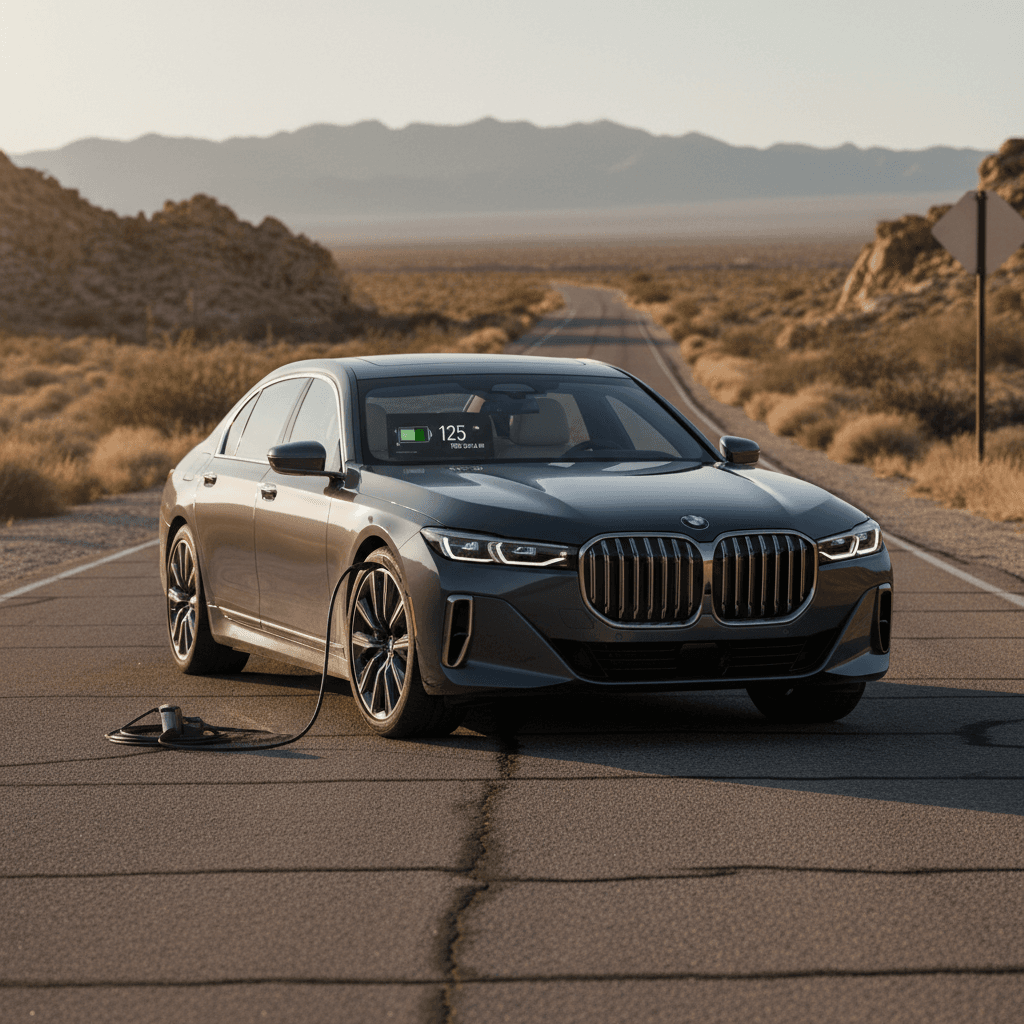
If you’re eyeing a BMW i7, you’re not just thinking about the weekday commute. You want to know whether this all‑electric 7 Series can swallow states, smooth out bad pavement, and still have enough juice left when you pull into the hotel. This BMW i7 road trip review focuses squarely on real-world range, charging, and comfort so you know what it’s like to live with as a long‑distance cruiser.
Quick take
Is the BMW i7 a good road trip car?
Think of the i7 as a modern S‑Class–style limousine that happens to run on electrons. Every trim (eDrive50, xDrive60, M70) uses a roughly 101.7 kWh usable battery and delivers an EPA‑rated range of about 270–320 miles, depending on spec and wheels. That’s solid for such a huge, heavy sedan. More important on a road trip, the i7 rides quietly, steers with uncanny calm, and gives rear passengers business‑class space if you spec the Executive Lounge package.
BMW i7 on a road trip: highlights and tradeoffs
What stands out when you spend a full day in the saddle
What the i7 nails
- Comfort first: Air‑suspension smoothness and superb seat comfort keep fatigue low.
- Quiet cabin: Excellent isolation from wind and tire noise, even on coarse highway surfaces.
- Real‑world range: The xDrive60 can realistically stretch close to 300 miles between stops when driven sensibly.
- Rear‑seat luxury: With the 31‑inch Theater Screen and reclining seats, passengers may not want to get out at stops.
Where you compromise
- Charging curve: Peak DC fast‑charge power around 190–200 kW, but average closer to ~100 kW over a long session.
- Weight: This is a very heavy car; you’ll feel that on tight mountain switchbacks.
- Trunk space: At about 11 cubic feet, luggage space is fine for two, tight for four adults on a week‑long trip.
- Big‑car footprint: In old city centers and narrow hotel garages, the i7 feels every inch of its size.
Model choice for road trips
Real-world BMW i7 range on the highway
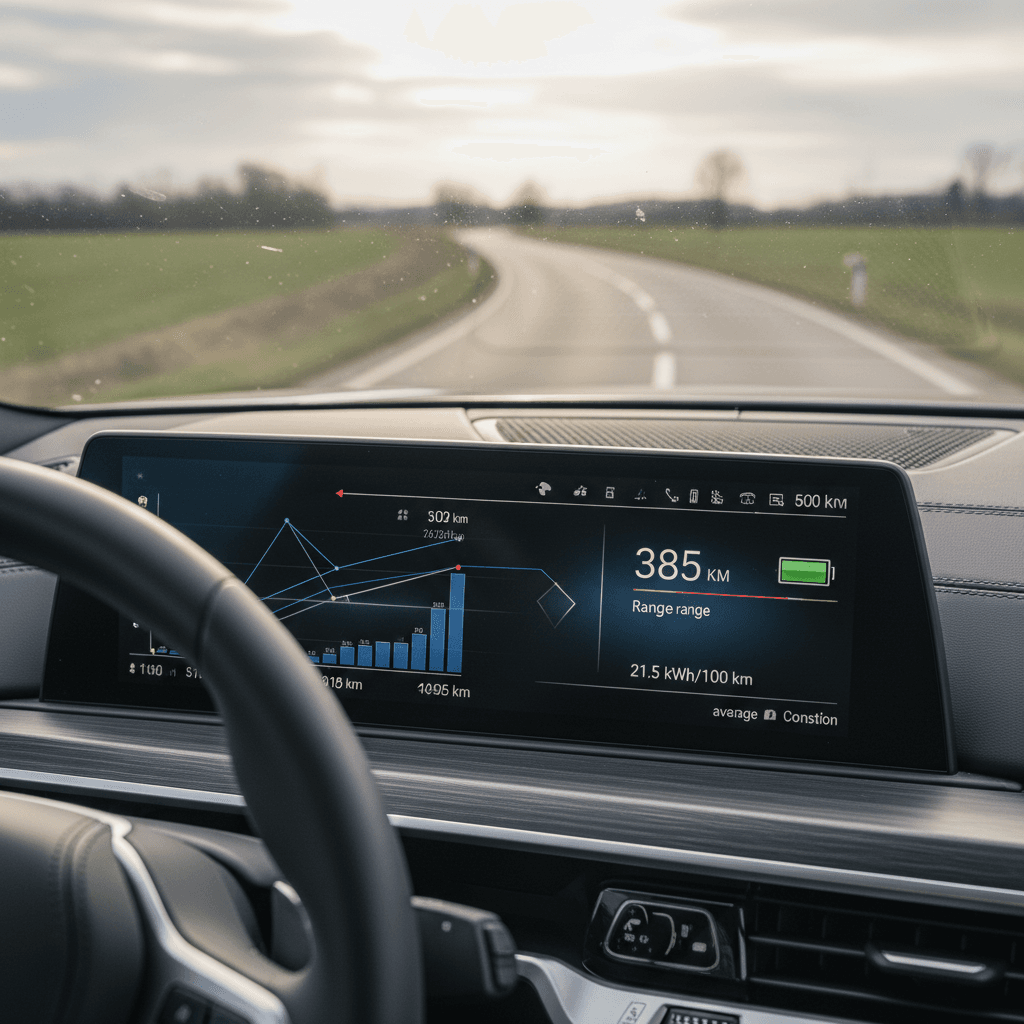
On paper, recent BMW i7 models offer an EPA‑estimated range of roughly 301–321 miles for the eDrive50, about 298–317 miles for the xDrive60, and around 268–291 miles for the M70, depending on options and wheels. Independent tests on 2024–2025 cars have shown an xDrive60 on 21‑inch wheels managing roughly 310 miles on a steady 70‑mph highway loop when started at 100% and run down close to empty, impressively beating its official number in the right conditions.
BMW i7 range snapshots for road‑trippers
On an actual road trip, you won’t run from 100% down to zero every time. Most drivers hover between 10% and 80–90% to keep charging quick and predictable. In that band, you can comfortably plan on 230–260 miles between fast‑charge stops in good weather, less if you cruise above 75 mph or load the car with people and luggage.
Range reality check
Charging the BMW i7 on a road trip
Every i7 sold in the U.S. includes access to public fast charging, and recent model years come with complimentary energy, BMW has partnered with Electrify America, typically offering several years or a set kWh allowance of DC fast charging with a new purchase. That matters when you’re knocking down states on I‑95 or I‑5 and don’t want to think about per‑kWh prices.
BMW i7 charging options and road‑trip usefulness
How different charging levels fit into a long‑distance plan
| Charging type | Power (approx.) | Best use on a trip | Typical i7 experience |
|---|---|---|---|
| Level 1 (120V outlet) | 1–2 kW | Emergency top‑off at a relative’s house | 70+ hours from empty to full. Fine for a weekend parked, not for active road‑tripping. |
| Level 2 (240V, home or hotel) | 7–11 kW | Overnight charging at destination | Roughly 8–11 hours from low to full on a wallbox. Great for starting each morning at or near 100%. |
| DC fast charging (public) | Up to 200 kW peak | Quick highway top‑ups | Around 30–45 minutes from 10–80% on a good 150–350 kW station, adding roughly 180–220 miles. |
Use DC fast charging for quick hops between cities; rely on Level 2 overnight.
On a healthy 150–350 kW DC fast charger, the i7 can briefly spike toward 190–200 kW, but over a full 10–90% session you’ll average closer to 100–120 kW. In practice, that means about 30–40 minutes to go from 10% to 80–90%, or roughly a coffee, restroom, and email‑check stop. You can typically add about 100 miles in 10 minutes when arriving on the lower end of the battery.
Use preconditioning for faster charges
- Aim to arrive at fast chargers between 5–20% state of charge, below 50% is where DC fast charging is quickest.
- Unplug around 80–90% unless you truly need the extra range; the last 10–20% is slower on any EV, including the i7.
- Whenever possible, book hotels with Level 2 chargers so you wake up full and skip a morning DC fast‑charge stop.
Comfort, noise, and ride quality over long miles
Where the BMW i7 really earns its keep is comfort. Adaptive air suspension, rear‑axle steering, and a long wheelbase give it that gliding, almost old‑school luxury‑sedan feel. At 70–80 mph, wind and tire roar are impressively muted; you find yourself turning the audio down, not up, as the miles roll on.
What the i7 feels like at the end of a long day
Less white‑knuckle, more first‑class cabin
Seats built for hours
Whisper‑quiet cabin
Rear‑seat theater
Ride character
Front row
The driver’s environment is classic modern BMW: a wide curved screen, solid switchgear, and just enough physical controls that you’re not lost in sub‑menus. The driving position is natural, with plenty of adjustment for tall and short drivers alike.
After several hundred miles, what stands out isn’t the tech; it’s how fresh your shoulders and lower back feel. The seats do their job quietly in the background.
Rear row and luggage
The back seat is enormous by EV standards, with limo‑like legroom. However, because there’s no wagon body and no front trunk, cargo space sits at around 11 cubic feet. Two large checked bags plus a couple of carry‑ons fit, but a full family may need to pack with intention.
If you road‑trip frequently with lots of gear, consider a low‑profile roof box and be aware of the efficiency hit at speed.
Tech and driver assistance on long drives
Long‑distance driving is where BMW’s driver‑assist stack really proves its worth. Adaptive cruise control, lane‑centering, automatic lane changes (where equipped), and blind‑spot monitoring take the strain out of dense interstate traffic. The i7 won’t fully replace a human driver, but it will gladly handle the monotony.
Key tech features that matter most on a road trip
1. Adaptive cruise & lane‑keeping
Set your speed, set following distance, and let the car smooth out traffic waves. It eases mental fatigue but still keeps you in the loop.
2. Excellent head‑up display
Speed, navigation prompts, and key alerts appear on the windshield so you can keep your eyes up and read signs and traffic more naturally.
3. Navigation with EV routing
The native nav system can suggest charging stops based on state of charge and route. It’s not perfect, EV trip apps are still handy, but it’s good enough to keep range anxiety tamped down.
4. Multi‑screen entertainment
Front passengers get BMW’s curved display; rear occupants, if equipped, get the Theater Screen. Everyone can occupy themselves when you’re stuck at a 35‑minute fast‑charge stop.
5. BMW app connectivity
Use the app to pre‑condition the cabin at your hotel, check state of charge from the breakfast buffet, and even locate the car in a sprawling resort lot.
Don’t over‑trust driver assistance
BMW i7 vs Tesla Model S vs Mercedes EQS on a road trip
If you’re cross‑shopping flagship EVs, you’re probably wondering whether the i7 is the right long‑haul pick versus a Tesla Model S or Mercedes‑Benz EQS. Each plays a slightly different role on the highway.
How the BMW i7 stacks up against key luxury EV rivals
A road‑trip‑focused comparison, not a drag‑strip shootout
| Model | Road‑trip strength | Range & charging feel | Comfort & cabin character |
|---|---|---|---|
| BMW i7 | Supreme comfort and quiet; traditional luxury feel | Real‑world ~230–260‑mile legs; 30–40 min fast‑charge stops; strong Electrify America access | Warm, opulent, and tech‑heavy with standout rear‑seat experience. |
| Tesla Model S | Charging network simplicity and efficiency | Generally quicker DC fast‑charge sessions and denser Supercharger network, especially off main interstates | More minimalist interior; less rear‑seat theater, more Silicon Valley vibe. |
| Mercedes EQS | S‑Class–style cocoon; slick aero efficiency | Good real‑world range thanks to low drag; charging speeds competitive but network depends on third parties | Ultra‑quiet, flowing interior with massive screens and softer ride tuning. |
Model details vary by year and spec; think of this as a directional guide for road‑trip behavior.
Where the i7 shines
Planning a road trip in a BMW i7: step-by-step
A successful i7 road trip isn’t about obsessing over every kilowatt‑hour; it’s about folding charging naturally into your meal and rest stops. Here’s a simple planning framework you can reuse for any big drive.
BMW i7 road trip planning checklist
1. Start full and warm
Charge to 100% overnight on Level 2 and pre‑condition the cabin while plugged in so you don’t waste early‑morning energy heating or cooling the car.
2. Plan 200–230‑mile first legs
Use an EV‑aware routing app or the car’s nav to pick DC fast chargers around the 200–230‑mile mark for your first stop. That keeps you in the quick‑charging band and leaves margin for traffic or detours.
3. Prioritize 150–350 kW stations
The i7 can take advantage of higher‑power units to hit its near‑200 kW peaks, especially when arriving below 30% and with a preconditioned battery.
4. Bundle stops with meals
Aim to charge when you’d naturally stop anyway: coffee in the morning, lunch around mid‑day, a snack stretch in the afternoon. A 30–40 minute charge disappears when everyone’s busy.
5. Book charging‑friendly hotels
Search for hotels with on‑site Level 2 chargers so the car refills while you sleep. Waking up near 100% makes the second day of the trip feel just as easy as the first.
6. Have a Plan B charger
For each critical stop, note a backup DC fast charger 10–20 miles further along the route. If one station is down or busy, you’re not stuck improvising with a nearly empty pack.
Watch rural coverage
Who the BMW i7 road trip experience suits best
The i7 isn’t trying to be all things to all drivers. It’s a particular flavor of road‑trip car, and for the right person it’s spot‑on.
- Perfect for: Drivers who value serenity and space more than shaving 10 minutes off each stop; families or executives who want a genuine back‑seat lounge for passengers; EV owners stepping up from smaller crossovers who want a true long‑distance luxury upgrade.
- Good fit for: Couples who road‑trip regularly between major metros where fast‑charging coverage is strong; anyone who likes a classic BMW driving feel with a modern electric twist.
- Less ideal for: People who frequently tow, need huge cargo capacity, or drive far off the beaten path where fast chargers are few and far between. A large electric SUV or plug‑in hybrid may make more sense there.
Thinking used?
BMW i7 road trip FAQ
Common BMW i7 road trip questions
Final thoughts: BMW i7 as an electric grand tourer
Taken as a whole, the BMW i7 is one of the best electric grand tourers you can buy today. It doesn’t chase the wildest numbers or the quickest charge sessions; instead, it leans hard into the qualities that matter after hours behind the wheel, quiet, calm, and an interior that feels like a rolling lounge.
If you’re comfortable planning around 230–260‑mile legs and 30–40 minute fast‑charge stops, the i7 turns long‑distance travel into something closer to rail‑car comfort than airline coach. And if you’re considering a used BMW i7, working with an EV‑focused retailer like Recharged, where every car comes with verified battery health data, transparent pricing, and expert guidance, can make sure your first big road trip is memorable for the scenery, not for charging surprises.