The BMW i7 is one of the most comfortable EVs on sale, but long‑distance driving is where it really earns its keep. With a usable battery of around 101.7 kWh and EPA‑rated ranges in the high‑200s to low‑300s depending on trim and wheels, it’s built for serious miles rather than short hops. Still, how far you actually go on a charge – and how relaxing the trip feels – depends heavily on how you drive and charge it. These BMW i7 long distance driving tips focus on real‑world range, smart charging strategies, and comfort so you can treat every road trip like business‑class travel on wheels.
Quick context on i7 range and charging
Why the BMW i7 Excels at Long‑Distance Driving
Core strengths that matter on the highway
Range is only part of the story – the i7 is designed as a long‑haul luxury car first, EV second.
Big battery, solid efficiency
The i7’s roughly 101.7 kWh usable pack gives it the energy budget of a long‑range SUV in a slippery sedan body. On the highway, that translates to genuinely useful 230–300+ mile legs depending on trim, wheels, and conditions.
True luxury‑class comfort
Multi‑contour seats, quiet cabin, adaptive air suspension, and rear‑seat amenities make 4–8 hour stints feel surprisingly easy. Unlike many EVs, the i7 doesn’t punish you for staying behind the wheel all day.
Sophisticated driver assistance
With the right options and software, the i7’s Driver Assistance Professional and Highway Assistant can handle a lot of the tedium of lane‑keeping and speed control – as long as you stay fully engaged.
Think of the i7 as an electric S‑Class or 7 Series first. If you treat it like a traditional luxury road‑trip sedan and layer on EV‑specific habits – smart speeds, planned charging, climate management – you unlock the best of both worlds.
BMW i7 range & charging at a glance (typical figures)
Know Your i7’s Real‑World Range
Before you plan aggressive legs, you need a realistic baseline for your specific i7 trim, wheel size, and driving environment. EPA numbers are a useful reference, but they’re not a guarantee – especially at U.S. interstate speeds.
BMW i7 EPA range vs realistic highway targets
Approximate targets assuming mostly highway driving, mild weather, and speeds around 70 mph. Your results will vary with temperature, terrain, traffic, and wheel/tire choice.
| Trim (illustrative) | EPA rated range | Conservative highway target | Optimistic but achievable |
|---|---|---|---|
| eDrive50 (19" wheels) | ~300–314 mi | 230–250 mi | 260–290 mi |
| xDrive60 (19" wheels) | ~290–310 mi | 220–240 mi | 250–280 mi |
| M70 / big wheels (20–21") | High‑200s | 210–230 mi | 240–260 mi |
Use these as conservative planning numbers, not as promises.
Don’t chase the EPA number at 80 mph
- In mild weather at 65–70 mph, many owners see 3.0–3.3 mi/kWh, or 280–320 miles from full if you run the pack deep.
- At 75–80 mph, consumption often climbs into the 2.3–2.7 mi/kWh range – now you’re looking at 230–270 miles from a full charge.
- A headwind, heavy rain, or cold weather can easily knock another 10–20% off. Build that into your mental model.
The most honest way to calibrate your own i7 is to take a familiar 100–150 mile route, set the cruise at your typical road‑trip speed, reset the trip computer, and see what consumption you get over the full drive. Multiply that efficiency by ~101 kWh and you have a personalized range estimate for your style and environment.
Best Speed and Driving Modes for Long‑Distance Range
You don’t need to hypermile a BMW i7, but small choices in speed and settings add up over 400–800 miles. Think of it as giving the car an easier physics problem.
Optimize i7 settings for highway efficiency
1. Favor Efficient or Personal mode
For long highway stints, use <strong>Efficient</strong> or a personal mode with calmer throttle, normal suspension, and a modest climate target. Sportier modes reduce range with no benefit at a steady 70 mph.
2. Keep cruising speeds reasonable
The i7 feels rock‑solid at 80+, but range doesn’t. If you care about minimizing stops, aim for <strong>65–72 mph</strong>. The difference between 70 and 80 mph can be an extra 45–60 minutes of charging over a full day.
3. Use adaptive cruise whenever practical
Adaptive cruise smooths out speed variations, which helps efficiency and reduces fatigue. Just remember that following aggressive traffic too closely may trigger more braking and re‑acceleration than ideal.
4. Set regen to a balanced level
BMW’s adaptive regen logic works well on the highway. Let the car coast when it makes sense, and capture energy only when you actually need to slow down instead of constantly driving in heavy one‑pedal mode at high speeds.
5. Precondition before high‑speed legs
If you’ve been fast‑charging, the battery will already be warm – efficiency is better in that state. In cold weather, preconditioning the cabin and pack while plugged in before departure avoids wasting energy for the first 30–60 minutes of driving.
A simple speed rule of thumb
BMW i7 Charging Strategy for Road Trips
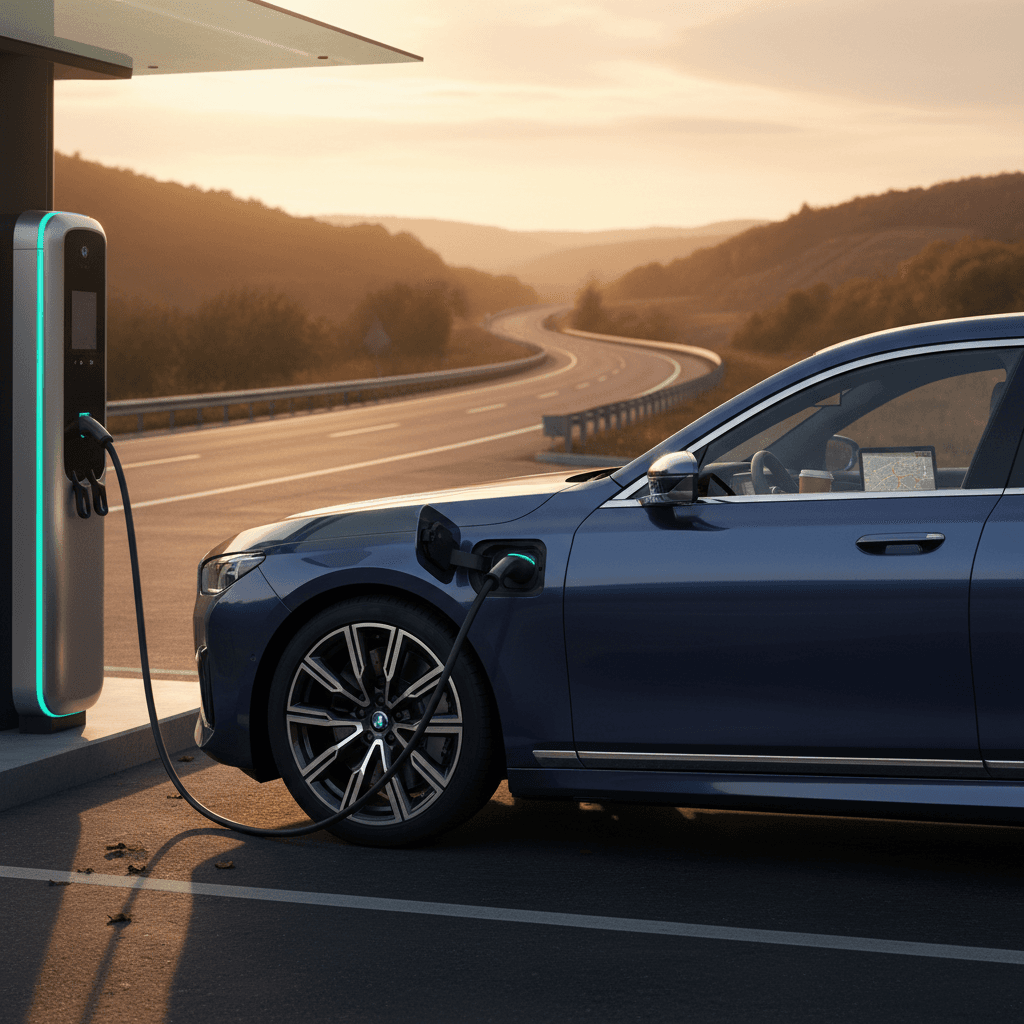
On paper, the i7 can accept up to about 195 kW on a DC fast charger and typically delivers a strong 10–80% window in the ~30–35 minute range when the battery is warm. The way you structure stops matters just as much as max power, though.
Target the 10–70% sweet spot
Like most large‑battery EVs, the i7 charges fastest when the battery is between roughly 10% and 60–70%. Above that, the charging curve tapers to protect the pack.
- Arrive with 5–20% when you can do so comfortably.
- Plan to unplug in the 70–80% range unless the next leg is truly sparse on chargers.
- Several shorter, faster sessions usually beat one long 15–95% slog in total time.
Use preconditioning for DC fast charging
If your i7 has battery preconditioning tied to navigation, always set the charger as your destination. The car will warm (or cool) the pack on the way, so you see higher initial power and a flatter charging curve.
This can easily shave 10–15 minutes off a 10–80% session, especially in cold weather or if the car has been sitting.
Don’t chase the biggest kW number on the map
- String chargers 120–170 miles apart whenever possible. That gives you flexibility if one site is down or congested.
- Avoid arriving with 0–3% unless you know the site well and have a backup a few miles away.
- On a big travel day, think in terms of 3–5 stops of 20–35 minutes rather than 1–2 giant charges. Your body will thank you.
- Treat 90–100% as a special‑case range extender for truly sparse stretches, mountains, or bad weather – not your default target.
Using Driver Assistance on the Highway Safely
One of the i7’s underrated long‑distance advantages is its advanced driver‑assistance stack. Features like Driver Assistance Professional and Highway Assistant (availability varies by model year, options, and market) can handle most of the steering and speed control on well‑marked highways, but they are not autonomous driving.
Best practices for BMW i7 driver assistance on long trips
1. Learn the system at home first
Before a big trip, spend time using adaptive cruise, lane‑keeping, and (if equipped) Highway Assistant on familiar roads. Understand the icons, chimes, and when it will disengage.
2. Treat it as an assistant, not a pilot
BMW’s hands‑free or “assist plus” modes still require your <strong>eyes on the road</strong> and ability to take over instantly. Use them to reduce workload, not to multitask.
3. Watch for lane quality and weather limits
Heavy rain, poor lane markings, construction zones, and severe glare can all make the system bail out abruptly. Keep a mental “hand on the wheel” at all times, even when the system isn’t asking for it.
4. Combine with sensible spacing
Set following distance generously. Aggressive cut‑ins and accordion traffic can trigger harder braking and acceleration than you’d use manually, which is tiring for passengers and wastes energy.
5. Don’t rely on assistance for navigation choices
The i7 can help with lane changes and route guidance on some highways, but you’re still responsible for choosing exits, understanding detours, and sanity‑checking what the nav suggests.
Over‑reliance is the real risk
Comfort Settings So You Arrive Fresh, Not Fried
The energy cost of comfort in a 100+ kWh luxury EV is surprisingly small compared with the comfort benefits. On a hot or cold day, using climate and seat features intelligently matters more for your body than for your range graph.
Comfort tweaks that pay off over 400+ miles
Spend watt‑hours on what helps you drive better, not on waste.
Use seat & steering wheel heaters
In cold weather, seat and wheel heaters give direct warmth for relatively little power. You can keep cabin temperature a few degrees lower while staying comfortable, saving energy compared with blasting hot air.
Precondition while plugged in
Set your departure time in the BMW app so the i7 heats or cools the cabin while it’s still on shore power. You start the trip comfy and with a warm battery, and you avoid that initial spike in consumption.
Use massage and posture adjustments
On multi‑hour drives, cycle seat massage and tweak lumbar and bolster settings occasionally. It sounds indulgent, but reducing fatigue keeps you more alert – which is a genuine safety benefit on long days.
- If you’re chasing maximum range, aim for a cabin setpoint in the 68–72°F range and dress for the season.
- Fan speed has little impact on energy use; it’s the temperature delta vs. outside that really matters.
- The panoramic roof shade can help in strong sun – less solar load means less A/C cycling.
- Don’t be afraid to use the rear seat climate if you have passengers. A tired, uncomfortable passenger is often more dangerous (via distraction) than a 2–3% hit to efficiency.
Cold‑Weather and Hot‑Weather Driving Tips
Temperature affects every EV, including the i7. The good news is that a big battery gives you margin. The bad news is that physics still wins. Plan for reduced range and slower charging when it’s truly cold or blazing hot.
Cold‑weather strategies
- Expect 20–35% less range in sustained sub‑freezing conditions, especially on short hops.
- Precondition the cabin and battery before departure whenever possible.
- On the highway, try to charge more often from 15–65% instead of stretching to 5% in a blizzard.
- Use seat and wheel heaters so you can run a slightly lower cabin setpoint.
- Watch for snow, slush, and wet roads – rolling resistance jumps, and so does the risk of losing traction.
Hot‑weather strategies
- Air conditioning is much less punishing than winter heat, but at 100°F+ you can still see a 5–15% range hit.
- Pre‑cool the cabin while plugged in so you aren’t dragging interior temps down from oven levels while driving.
- Shade the cabin at stops and close the panoramic roof shade to reduce solar load.
- If you’re DC fast‑charging multiple times, keep in mind that back‑to‑back high‑power sessions in extreme heat can trigger more aggressive battery protection and slower charge rates.
Planning Routes and Stops with Apps
The hardware in the BMW i7 is only half the equation. The other half is how you plan your route and choose where to stop. A little up‑front work here can turn a stressful day of hunting for plugs into a smooth, predictable itinerary.
Smart route‑planning habits for BMW i7 owners
1. Start with BMW’s built‑in nav
The factory navigation can route you via compatible DC fast chargers and, in many markets, precondition the battery before arrival. Use it as your baseline so the car knows when to warm the pack.
2. Cross‑check with a dedicated EV planner
Apps and tools like A Better Routeplanner, PlugShare, or your preferred charging network app let you sanity‑check charger density, reviews, and backup sites. That’s especially useful in rural areas or on unfamiliar routes.
3. Build in redundancy
For each planned DC stop, know at least one backup charger within 10–20 miles. If you roll up to a broken, full, or poorly performing station, you want a plan B that doesn’t involve white‑knuckle driving at 50 mph.
4. Align stops with your natural rhythm
Most people want a bathroom or snack break every 2–3 hours anyway. If you time your legs to <strong>120–170 miles</strong>, your charging schedule and your body’s schedule naturally line up.
5. Don’t obsess over “optimal”
Perfectly optimized charging plans are fragile – one closed charger or surprise traffic jam and everything breaks. Aim for <strong>robust, not perfect</strong>. The i7’s big buffer gives you room to improvise.
Long‑Distance Ownership Considerations (Including Used i7s)
If you’re thinking about an i7 specifically for frequent road trips, or you’re cross‑shopping new vs. used, it’s worth zooming out from a single journey and looking at the bigger ownership picture – especially battery health and charging access.
What to weigh if you road‑trip often
New or used, the right i7 spec and inspection matter.
Battery health and degradation
BMW designed the i7’s pack to withstand years of DC charging and high‑mileage use, but no battery is immune to time and use. If you’re considering a used i7, pay close attention to real‑world range vs. original expectations and how the previous owner charged it.
At Recharged, every used i7 comes with a Recharged Score Report that includes a battery health and fast‑charging history snapshot, so you aren’t guessing about the most expensive component in the car.
Access to reliable DC networks
For frequent interstate travel, map your typical corridors against major fast‑charging networks to make sure you’ll have multiple options. Where you live and drive matters as much as which EV you buy.
If you know you’ll be running the odometer up quickly, strong charging coverage plus a clean bill of health on a used i7 can deliver flagship comfort at a substantial discount to new.
Why a used i7 can be a long‑distance bargain
Ready to find your next EV?
Browse VehiclesIf you already own an i7 and are considering trading or selling, Recharged can provide an instant offer, or consign your car to reach a wider audience of EV‑savvy buyers who specifically value its long‑distance strengths.
BMW i7 Long‑Distance Driving Checklist
Day‑of‑departure checklist for BMW i7 road trips
1. Pre‑trip planning
Confirm your route in the BMW nav, identify 3–5 primary DC fast‑charging stops plus backup sites, and save key chargers in your preferred apps. Check weather along the route for major temperature or storm swings.
2. Vehicle prep
Charge at home to 80–90% (or slightly higher if the first leg is sparse), set tire pressures to spec, clear any warning lights, and make sure your charging cards/apps are logged in and funded.
3. Climate and comfort
Set cabin temperature around 68–72°F, enable preconditioning for your departure time, and adjust seat/posture presets for all drivers. Pack layers so you can dial climate back slightly without discomfort.
4. On‑road habits
Cruise near 65–72 mph where conditions allow, use adaptive cruise and driver assistance thoughtfully, and avoid jack‑rabbit starts or hard braking. Keep an eye on real‑time consumption instead of fixating on the remaining‑range number alone.
5. Charging rhythm
Aim to arrive at DC fast chargers with 5–20% remaining, unplug around 70–80% unless you truly need more, and combine charging stops with meals and rest breaks. If a station looks problematic, move on while you still have plenty of buffer.
6. End‑of‑day wrap‑up
At your destination, plug into Level 2 if available, set a lower charge limit (60–80%) for overnight if you don’t need full range the next day, and review your trip consumption to refine your expectations for future drives.
BMW i7 Long‑Distance Driving FAQ
Frequently asked questions about BMW i7 road trips
Key Takeaways for BMW i7 Road Trips
If you treat your BMW i7 like the long‑legged luxury sedan it is – and then layer in a few EV‑specific habits – long‑distance driving becomes one of its greatest strengths. Keep speeds reasonable, plan conservative legs around the fast‑charging sweet spot, give the battery time and temperature to work at its best, and use driver assistance and comfort features to reduce fatigue rather than to push harder. Do that, and 400‑ to 800‑mile days become surprisingly relaxed.
Whether you’re exploring the idea of a BMW i7 for cross‑country work trips, or you already own one and want to use it more confidently, Recharged can help you take the guesswork out of EV ownership. From Recharged Score battery‑health diagnostics on used examples to trade‑in, financing, and nationwide delivery, the goal is the same as your road‑trip goal: fewer unpleasant surprises, more smooth miles.